opening evening
Fabian Reads the Headlines
In a Berlin cafe, [Jakob Fabian](entity:character-recall-character-jakob-fabian-1ecd2761d6c6) reads a crowded list of disasters, political failures, scandals, and oddities as the ordinary daily load. He asks the waiter whether he should go somewhere; when the waiter advises against it, Fabian decides to go, and admits he does not know why he asked.
The exchange introduces Fabian’s detached, contradictory posture toward a city and a society he watches more readily than he acts upon. His heart condition and uncertain livelihood already shadow that amused distance.
later that evening
The Club’s Rules
Following an address supplied by his office chief, Fabian reaches the [Institut für geistige Annäherung](entity:organization-recall-organization-institut-f-r-gei-f757c5969e51), a discreet paid club for sexual encounters. The proprietress records his personal details and explains the rules: members may approach one another, discretion is required, expenses are paid immediately, and the club exists to arrange encounters rather than sustain relationships.
The club’s bureaucratic formality turns intimacy into a managed service. Fabian pays the fee out of curiosity, even though he has no clear desire to pursue what the institution offers.
later that evening
The Blondine’s Invitation
At the club, a talkative woman makes astrological guesses about Fabian and presses him about his intentions. A tall blonde arrives, dances with him, and leaves with him after describing the club’s gossip and sexual rivalries.
In a taxi, she abruptly attacks him with kisses while he protests that he has little money and wants to write a letter. Fabian’s discomfort and comic resistance establish his reluctance to turn every encounter into an obligation, despite his willingness to drift into them.
late that night
The Moll Household
The blonde takes Fabian to her home, where he learns that she is Irene [Moll](entity:character-recall-character-moll-f367c4e0599e) and that the gaunt Felix Moll is her husband. Felix calmly explains that their marriage contract requires Irene to show him any prospective lover; if he disapproves, she must abandon the encounter, with a financial penalty for disobedience.
Felix says he devised the arrangement because Irene’s sexual fantasies had become difficult for him to manage. He even begs Fabian to stay, explaining that he wants Irene to enjoy herself and offering the possibility of financial support. Fabian refuses the role and slips out with a set of house keys.
after midnight
The Blind Cafe Patron
Back at his regular cafe, Fabian hears the proprietor recount an episode in which a woman flirted simultaneously with her blind companion and another man at a nearby table. The supposedly foolish companion, the proprietor reveals, could not see what was happening.
The story makes Fabian remark that human progress is unmistakable, but its joke rests on the same compromised social world he has been observing: people’s apparent innocence may conceal arrangements others cannot or will not see.
after midnight
The Vanishing Beggar
When cafe staff manhandle a shabby unemployed beggar, Fabian intervenes, welcomes him to his table, and urges him to order food without shame. The man says he has been out of work for two years, lives on relief, has been imprisoned, and has contemplated suicide; his bitter joke about a stomach ruined by caviar exposes the gulf between official assistance and actual hunger.
Fabian goes to fetch the head waiter so the beggar can be treated properly, but the man disappears before he returns. Fabian’s impulse to help is real, yet the episode also reveals how quickly suffering can slip beyond the reach of a would-be rescuer.
the same night
The Night Newsroom
The journalist [Münzer](entity:character-recall-character-m-nzer-dcaa6ead7dfa) takes Fabian to the newspaper office, where the staff rushes to revise the paper around a speech by the chancellor. When a column needs filling, Münzer invents a report of Hindu-Muslim street fighting in Calcutta, complete with fourteen dead and twenty-two wounded, though no unrest has occurred.
Münzer defends the fabrication by claiming that reports difficult to disprove are effectively true. He also explains how omissions and government-friendly silence shape public opinion, while the paper has been instructed not to attack the government. The scene exposes a press whose practical loyalties have displaced truth.
deep into the night
Malmy’s Confession
In the newsroom, [Münzer](entity:character-recall-character-m-nzer-dcaa6ead7dfa) accepts a headline declaring that optimism is a duty, while [Malmy](entity:character-recall-character-malmy-65559711f83c) pays him a small wager to reclaim the money as a rebuke. Malmy admits that he knowingly serves an economic system he believes to be false, calling himself a coward whose character cannot match his understanding.
Later, over wine, Malmy describes unemployment, falling mass purchasing power, capital flight, and policies that protect powerful interests while worsening the crisis. He argues that no economic remedy will work without a renewal of spirit, but the listeners drift into drunkenness, self-pity, and arguments for more money. Fabian leaves with the image of snails crawling in circles: motion without progress.
the next morning
The Cigarette Campaign
Fabian arrives at the advertising office hungover and works on slogans for a cigarette poster showing a cigarette as large as Cologne Cathedral. His colleague Fischer worries about impending dismissals, while Fabian recounts his shifting past jobs, including managing securities during inflation and briefly running a greengrocer’s shop.
The work feels purposeless, but Fabian continues to perform it. His education and literary ability have led him not to a stable vocation but to commercial copywriting, a small emblem of the mismatch between talent and the labor market.
that afternoon
The Letter from Home
In his rented room, Fabian reads a letter from his mother. She describes ordinary family matters, worries about her health and her husband’s, asks whether he still enjoys advertising cigarettes, and recalls their childhood walks together.
The letter makes Fabian question why he remains in Berlin writing propaganda for a product he does not respect. He imagines Europe as a classroom abandoned by its teachers, with no plan or direction, and feels the distance between his own uncertain life and the tenderness of home.
that evening
Hohlfeld’s Advances
[Frau Hohlfeld](entity:character-recall-character-frau-hohlfeld-9e470a5b20ab) complains about a lodger’s sexual visitors, then hints that she too is not too old for romance. Fabian recognizes her lonely advances and deflects them with a joke about her having no children.
After she leaves, he tries to read Descartes on beginning again by overturning accepted beliefs. The philosophical prospect of a solitary revolution seems remote from his own drift, and he leaves to meet [Stephan Labude](entity:character-recall-character-stephan-labude-7268d1dc5dc8) instead.
that evening
Labude’s Research
At his private apartment, Labude tells Fabian that his five-year study of Lessing’s thought is awaiting a response from an overburdened academic mentor. He fears that his psychological reading of the canonical writer will anger scholars who prefer a more reverential account.
He also recounts seeing a professor arrested for stealing rare library books. Fabian jokes that philologists have joined the thieves, a remark that links intellectual respectability to the general breakdown of ethical norms.
the following evening
The Debate at Haupt’s
Fabian and Labude sit above the dance floor at Haupt’s, a venue where streetwalkers perform and customers crowd around them. Their conversation turns to Fabian’s refusal to pursue money or power, and to his claim that he can neither find a system worth serving nor imagine power being used selflessly.
Labude argues that power could be used for others and that imperfect reform is better than passive spectatorship. Fabian doubts that a just society can overcome human selfishness, and says he watches to see whether people are capable of decency. Their disagreement sharpens the novel’s central tension between action and moral disillusionment.
later that night
Moll’s Outburst
At Haupt’s, Fabian recognizes Irene [Moll](entity:character-recall-character-moll-f367c4e0599e) in a neighboring alcove, where she is trying to undress a resisting soldier. Drunk and furious, she throws a glass into the room, denounces the men, and calls for men’s brothels; when she sees Fabian, she recognizes him and tries to reach him.
Labude has taken the house keys from Fabian and returned them to her. The episode brings Fabian’s previous brush with the Molls back into view and shows Irene’s aggression as part of the same transactional and unstable sexual world surrounding the club.
later that night
The Political Shootout
Walking with Labude near the Märkisches Museum, Fabian speaks about the sense that Europe is again a waiting room before an unknown catastrophe. Their argument over whether the reasonable and just should nevertheless seize power is interrupted by gunshots.
They find a wounded Communist and then a wounded National Socialist, each injured in a political quarrel that began over a swastika. Fabian and Labude take both men to hospital and urge them to stop treating political labels as justification for shooting one another. The doctor calls the violence a feverish symptom of a continent suffering hunger.
after the shootout
The Anonymes’ Cabaret
Labude takes Fabian to the Kabarett der Anonymen, where affluent spectators ridicule performers presented as mentally unstable. A young dancer is heckled through her act, and the proprietor Caligula introduces Paul Müller as a supposedly insane reciter.
Müller struggles to deliver his melodramatic ballad while the audience pelts him with sugar and jokes. When he finally attacks a woman in the crowd, the proprietor drags him away. Fabian and Labude leave disgusted by a public that pays to turn vulnerability into entertainment.
late that night
The Bathtub Acquaintance
At the cabaret’s exit, a scarred man greets Fabian as an old school friend, though Fabian does not recognize him and soon learns that the man has mistaken him for someone else. The stranger boasts of a secure life in the bathtub business, a wife, a child, and a house with a garden.
After the man leaves, Labude envies the apparent stability of the household. Fabian argues that economic insecurity makes marriage and children an irresponsible burden for many people, exposing how social crisis reaches even private hopes for family life.
after Labude’s return from Hamburg
The Hamburg Initiative
At his parents’ villa, Labude explains that he and other students have formed a radical-bourgeois initiative in Hamburg. Their plan is to organize groups at universities, build links with socialist students, and persuade their generation to restrain private profit and reform capitalism before collapse.
Fabian congratulates him but remains skeptical that reason and power can be reconciled. Labude’s political organizing offers a direct challenge to Fabian’s waiting posture, even as Fabian doubts that youthful idealism can overcome entrenched interests.
after Labude’s Hamburg visit
Labude’s Night Watch
Labude confesses that he secretly went to Hamburg because he suspected [Leda](entity:character-recall-character-leda-ed9a2c156084) had become distant and performative. He waited outside her home through the night and saw her arrive with another man, let him inside, and later wave to him from her balcony.
The next day, Leda denied the affair and described the strain of their long-distance relationship, but Labude confronted her about both the man and a pregnancy she had ended without telling him. He slapped her and left, concluding that she had never truly loved him. The discovery destroys the orderly future he had imagined for himself.
after Labude’s breakup
The Atelier Gathering
Labude takes Fabian to the studio of sculptor [Ruth Reiter](entity:character-recall-character-ruth-reiter-ba15dcd3ddd4), where models and acquaintances gather amid casual sexual propositions. Fabian speaks privately with Fräulein Battenberg, who says that men have twice abandoned her after she offered them love and a shared life.
She accuses men of wanting women to be available without obligation while still expecting them to love and grieve on command. Fabian answers that poverty and insecurity make commitment a moral trap: either a man takes responsibility and risks ruining both lives, or refuses responsibility and causes suffering anyway.
later that evening
The Todeskandidat
A dying man named Wilhelmy arrives at the studio and pays for time with Kulp, who treats his approaching death with bitter familiarity. The group leaves for the women’s club known as the Cousine, where Labude begins flirting with the model [Selow](entity:character-recall-character-selow-dbd5e6da96aa) and Reiter grows jealous.
Kulp returns after Wilhelmy has beaten her and collapses in the club. In the resulting commotion, Selow suddenly rejects the women around her, declares that she wants a man, and pulls Labude away. The scene intensifies the novel’s tangled connections between sex, money, loneliness, and violence.
that night
The City as Madhouse
Walking home with Fräulein Battenberg, Fabian describes the city’s hidden circuits of exploitation, prostitution, fraud, and sexual commerce. He tells her to assume that nearly every adult is mad until proven otherwise, a practical rule born of his view that the city resembles an asylum.
They discover that she lives in the same building as Fabian. In her room, she admits that she had asked him upstairs because she feared the loneliness of a new city and a strange room. They kiss, and she says she feels she may love him, while insisting that her love is her own affair and not a claim on him.
that night
A First Night Together
After they make love, Cornelia says that intimacy has left her hungry, and she has no food in her room. Fabian playfully takes her to his own room for bread, sausage, and biscuits, turning an ordinary meal into a private adventure.
They agree to meet again and to conceal their arrangement from [Frau Hohlfeld](entity:character-recall-character-frau-hohlfeld-9e470a5b20ab). Their easy intimacy begins to give Fabian a personal stake in a life he had previously treated as something to observe from a distance.
the following morning
Fabian’s Dismissal
Fabian arrives early at the cigarette company and calculates a promotional contest designed to sell large numbers of cigarette packs. Before he can present the plan, a letter informs him that the company has fired him because the board has cut the advertising budget.
Fischer is relieved that his own lower salary has spared him, while Fabian leaves with his final pay and no immediate work. The dismissal turns his abstract unease about the city into a practical crisis and removes the routine that had sustained his detached life.
the first day after his dismissal
The Inventor on Kreuzberg
After wandering through the city, Fabian climbs Kreuzberg and meets an elderly inventor who explains that his textile machines multiplied production but displaced workers. Having witnessed police attack the unemployed in Manchester, he now regrets inventing what he sees as weapons against workers and has abandoned his wealth and family.
The inventor carries secret designs for an even more powerful loom, yet refuses to sell or use them. Fabian gives him his address and offers him a place to sleep, making a small act of care toward a man whose technological achievements helped produce the very unemployment that now afflicts Fabian.
that evening
The Inventor’s Hidden Lodging
The inventor arrives at Fabian’s room and stays on the sofa, while Fabian and Cornelia prepare an evening meal. Fabian tells Cornelia he has lost his job; she responds with concern, and the inventor works over his concealed calculations nearby.
Labude visits to apologize for leaving the previous evening and discusses [Selow](entity:character-recall-character-selow-dbd5e6da96aa), then leaves for [Frankfurt](entity:location-recall-location-frankfurt-a153b9e4cc4d) to continue political organizing. [Ruth Reiter](entity:character-recall-character-ruth-reiter-ba15dcd3ddd4) arrives seeking Labude’s address, but Fabian refuses to disclose it. The intersecting visits show how his room has become a fragile refuge for friends and strangers alike.
the next morning
The Inventor in the Wardrobe
To keep [Frau Hohlfeld](entity:character-recall-character-frau-hohlfeld-9e470a5b20ab) from discovering the inventor, Fabian hides him in a wardrobe while she brings breakfast. The inventor endures the cramped concealment, then emerges after Fabian stages a comic arrival and introduces him as an uncle.
Over coffee, the old man says he loves life more intensely because he thinks about death every day. Fabian questions how anyone can love life while despising humanity, a tension that echoes the inventor’s remorse and Fabian’s own mixture of compassion and contempt.
the next day
The Labor Office Circuit
Fabian spends hours visiting employment offices, repeatedly sent to the wrong branch and forced to travel across Berlin. He encounters unemployed clerks, nurses, teachers, and professionals, along with desperate men debating theft, hunger, and political action.
The bureaucratic maze offers rules, stamps, prohibitions, and bad directions instead of work. Fabian learns that he cannot even register properly until his paid notice period expires, while others live on sums too small to feed their families. The day makes mass unemployment visible as both material misery and institutional absurdity.
that evening
His Mother’s Visit
Fabian returns to find his mother waiting with food, clothing, and the familiar practical care of home. He introduces the inventor as an old friend and an improvised uncle; soon afterward, officials arrive with authority to take [Professor Kollrepp](entity:character-recall-character-professor-kollrepp-7c73c5e1930e) back to a sanatorium.
Kollrepp calmly accepts the removal, asks Fabian to write to him, and leaves his machine papers in Fabian’s care. Fabian’s mother worries about her son’s imprudence, while the episode leaves Fabian responsible for the inventor’s designs and for a secret he cannot explain easily.
that evening
Mother and Son at the Cinema
Fabian takes his mother to a lavish but foolish sound film, pleased that she laughs. They walk home together, remembering his childhood and the hardships his mother endured while raising him.
Because Cornelia has already gone to bed, Fabian sleeps on the sofa beside his mother. He quietly returns to wish her good night, a childhood gesture that reveals how much the visit has restored his connection to home even as he conceals the loss of his job.
that evening
Cornelia’s Film Opportunity
Cornelia tells Fabian that [Edwin Makart](entity:character-recall-character-edwin-makart-edb45dcb1b88) has noticed her at the film company and wants her to audition for a role. She asks Fabian for money to buy a new sweater and hat so she can pursue the opportunity.
Fabian gives her his last hundred-mark note and wishes her luck, correcting himself to say that he hopes it will bring them luck. His generosity makes their relationship more consequential just as his unemployment leaves him with almost nothing.
that night
The Dream of the Mirror Factory
Fabian dreams of an endless street without doors, then follows [Professor Kollrepp](entity:character-recall-character-professor-kollrepp-7c73c5e1930e) through a hidden entrance into a gigantic machine. The machine consumes children and produces people who stare at unreachable reflections of themselves, while Kollrepp explains its enormous output and shortened workweek.
The dream’s grotesque factory turns technological progress into a system that manufactures alienation and reproduces human beings as trapped images. Fabian watches the inventor disappear into his own machine before confronting scenes of sexual exploitation and political violence.
continuing that night
The Dream of the Stolen Staircase
In the dream, wealthy spectators devour and assault young performers beneath a glass floor. Fabian sees Cornelia resisting Makart, while Wilhelmy and the sculptor struggle over [Selow](entity:character-recall-character-selow-dbd5e6da96aa)’s tongue as if it were a rope in a tug-of-war.
The vision then shifts to a staircase where everyone steals from the person ahead while agreeing with Labude’s call for decency. Gunfire kills the crowd, but the survivors keep reaching into one another’s pockets. Fabian carries a little girl away from the bodies and wakes when Cornelia calls his name, leaving the dream’s images of complicity and helplessness unresolved.
the following morning
Cornelia Leaves
After Cornelia leaves for work, Fabian sits in the window and recognizes that she has a career and he has none. [Frau Hohlfeld](entity:character-recall-character-frau-hohlfeld-9e470a5b20ab) learns that he is jobless, and Fabian pays his rent with the last of his money.
He visits [Zacharias](entity:character-recall-character-zacharias-0a4cabc5190f) at a newspaper publisher, hoping for work. Zacharias admires his ability and offers to pay him privately, but immediately retreats from the idea because colleagues might resent him. Fabian leaves without a position and feels the isolation of his situation deepen.
that evening
Cornelia’s Farewell Letter
Fabian falls asleep after wandering through Berlin and wakes to find Cornelia’s room empty. Her farewell letter says that Makart has offered her a film role and a place to live; she believes she must accept, even though she fears what the arrangement will do to her and to their relationship.
She writes that she is leaving in order to remain with Fabian, hoping he will still be willing to see her. She asks him to meet her at [Café Schottenhaml](entity:location-recall-location-caf-schottenhaml-08dec0995598) the next afternoon. Fabian reads the letter in the dark and realizes that he wanted to change, but has not yet acted.
that evening
Wedding Street Clashes
Unable to stay in his room, Fabian rides north and watches police and workers collide around [Wedding](entity:location-recall-location-wedding-46a5bb3596fe). Police lines advance against the approaching workers; horses charge, shots are fired, stones fly, and officers use batons as reinforcements arrive.
Fabian passes through the crowd and hears a woman calling for her husband, who has gone back into the fighting. The disturbance is already being framed as a question of policing and public order, while the underlying social anger remains unresolved.
later that night
The North Park Fair
Fabian enters [Onkel Pelles Nordpark](entity:location-recall-location-onkel-pelles-nordpar-0abf1cc61952), a shabby fair where working people gamble small coins for food: sugar, coffee, butter, flour, or sausage. The prizes and callers’ patter make hunger itself part of the entertainment.
Inside a tent, an aging horse carries a woman around a sand ring while a melodramatic show plays to a crowd that weeps over theatrical hardship. Fabian leaves with a stranger, but the spectacle only intensifies his thoughts of Cornelia and the life she has entered.
that night into the next morning
A Night with Mucki
Fabian follows the stranger, a married woman called Mucki, to her apartment and spends the night with her. In the morning she admits that her husband is away on business and begs Fabian to stay for the ten days before his return, offering food and a comfortable home.
Fabian asks to use a telephone, then buys the requested calf’s liver and calls [Zacharias](entity:character-recall-character-zacharias-0a4cabc5190f), who still has no job to offer. He returns to Mucki’s flat, eats with her, and leaves later that afternoon, emotionally absent even as she tries to make him a temporary partner.
the following afternoon
Reunion at the Cafe
Fabian finally enters [Café Schottenhaml](entity:location-recall-location-caf-schottenhaml-08dec0995598) and finds Cornelia waiting. She weeps and asks why he will not look at her, while he sits in silence and eats before telling her that she has entered Berlin’s market of exchange and has traded intimacy for a career opportunity.
He argues that Makart’s money and influence will likely demand further compromises, and that Cornelia has already established the precedent. She says everything was wrong and leaves. Fabian catches up with her, apologizes for the cruelty of his words, and agrees that she may visit the next day; she embraces him and runs away crying.
that evening
The Husband Returns
After leaving Cornelia, Fabian returns to Mucki’s apartment because he cannot bear the thought of going back alone to his room. She welcomes him with dinner and declares that she wants a child with him.
Her traveling husband arrives unexpectedly. Mucki bolts into the bedroom, while the husband calmly shares the wine before suddenly grabbing Fabian by the throat. Fabian punches him in the mouth, apologizes, and leaves, once again displaced from any place that might have offered refuge.
that night
Labude’s Death
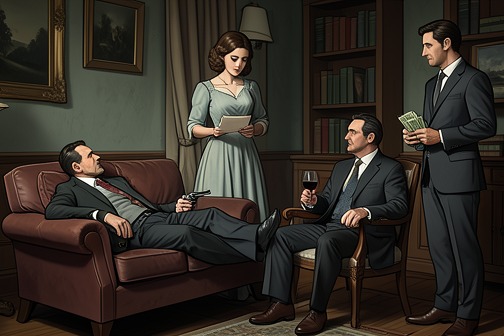
[Frau Hohlfeld](entity:character-recall-character-frau-hohlfeld-9e470a5b20ab) tells Fabian that the [Kriminalpolizei](entity:organization-recall-organization-kriminalpolizei-849a99271255) has come looking for him twice, then sends him to an address where he finds Labude dead on a sofa with a gunshot wound to the temple. The room next door is wrecked, and five women, including [Selow](entity:character-recall-character-selow-dbd5e6da96aa) and [Ruth Reiter](entity:character-recall-character-ruth-reiter-ba15dcd3ddd4), are being questioned.
A letter and a bundle of money lie with Labude’s body. In his Abschiedsbrief, Labude says that [Weckherlin](entity:character-recall-character-weckherlin-a3f61fa6fd98) told him his Habilitationsschrift had been rejected, after the failure of his relationship with [Leda](entity:character-recall-character-leda-ed9a2c156084) and his political disappointment. Believing himself defeated in love, scholarship, and public life, he says he is ending his life with the revolver he once took from the wounded Nazi.
later that night
Labude’s Last Journey
Fabian reads the letter beside Labude’s body and cannot make sense of his friend’s death. The women enter, and one binds Labude’s jaw shut with a serviette; their bleak jokes deepen the absurdity of the scene.
With Labude’s parents away, Fabian rides with the body in an ambulance to the family villa. He sits beside his friend through the familiar streets of Berlin, adjusting his head on the pillow as the city passes outside. The journey turns their earlier shared walks into a final passage through the world they had argued about.
before dawn
The Father’s Reckoning
At the Labude villa, Fabian stays beside the body until [Justizrat Labude](entity:character-recall-character-justizrat-labude-a89f286981f1) arrives. The grieving father admits that he was not a father who lived for his son, but insists that life does not lose its meaning because of death.
Fabian conceals the full contents of Labude’s letter and says only that the academic Geheimrat had rejected the thesis. He gives the father a copy of the work, which the older man begins to read, and leaves him alone with his son.
early that morning
The Lessing Portrait Shattered
[Justizrat Labude](entity:character-recall-character-justizrat-labude-a89f286981f1) telephones the Geheimrat and learns that the scholar had praised the thesis, not rejected it. He breaks a portrait of Lessing against the desk, calling the image a symbol of the false academic judgment that helped destroy his son.
Fabian leaves the villa exhausted, emotionally numb, and unable to grieve in a steady way. The revelation plants a doubt that will soon force him to return to the university and test whether Labude’s stated reason for suicide was true.
the next morning
The Secret Rejection
Fabian wakes with the previous day’s events returning to him and resolves to confront the university. On the way, Cornelia appears in a private car and offers to take him there; she has come because she could not wait until their planned meeting.
She describes the strange film role Makart has offered, in which her character is forced into successive transformations. Fabian warns her that Makart may be testing whether the role will change her in real life, and gives her half of Labude’s remaining money to quiet his own unease.
that morning
The Geheimrat’s Praise
At the university, Fabian meets Labude’s parents and hears that the father has read the thesis and found its conclusions intelligent and sharp. When the Geheimrat arrives, the family tells him that Labude died because his work was rejected.
The Geheimrat is stunned and insists that he had praised the thesis as an outstanding contribution and circulated it for approval. Fabian realizes that [Weckherlin](entity:character-recall-character-weckherlin-a3f61fa6fd98), the assistant, gave Labude a false account of the decision. The truth threatens to turn the suicide from an academic defeat into the consequence of a cruel lie.
immediately afterward
Fabian Beats Weckherlin
Fabian finds [Weckherlin](entity:character-recall-character-weckherlin-a3f61fa6fd98) cataloging books and drags him before the Geheimrat and Labude’s parents. He asks whether Weckherlin told Labude that the thesis had been rejected and that the Geheimrat had wanted to spare him public humiliation.
Weckherlin admits that it was only a joke. Fabian erupts and beats him with both fists until students restrain him and Weckherlin falls down the stairs. The Geheimrat dismisses the assistant, but the violence cannot undo Labude’s death or restore the future that the lie cut short.
later that day
The Joke’s Aftermath
As Fabian walks through Berlin, he wonders whether exposing [Weckherlin](entity:character-recall-character-weckherlin-a3f61fa6fd98)’s lie has served anyone. The truth makes Labude’s death seem even more senseless: his friend’s actual work had been praised, and a spiteful falsehood had redirected his despair toward suicide.
Fabian imagines the funeral and recoils from the city. He no longer wants to remain in Berlin after losing his job, his friend, and his relationship with Cornelia. The exposure brings justice in a narrow sense, but no repair.
that afternoon
Cornelia’s Public Debut
At [Anhalter Bahnhof](entity:location-recall-location-anhalter-bahnhof-c82652e8ea62), Fabian reads newspaper accounts of economic reform and wonders whether Labude’s faith in practical change might have been justified. Yet he still doubts that material prosperity alone could make people decent.
A feature announces that Cornelia, a former law trainee, has become a film star under Makart. Another photograph shows her in a car beside him. Fabian carefully cuts out the images, regards them like a grave marker, and decides that no remaining tie can keep him in Berlin.
during the train journey home
Moll’s Flight Offer
On the train out of Berlin, Fabian sees Irene [Moll](entity:character-recall-character-moll-f367c4e0599e) in the corridor. She says that police have discovered her brothel and that she has paid off a police officer to escape; she is carrying a hundred thousand marks and offers Fabian a new life abroad.
She proposes Budapest, Prague, Paris, or Italy, promises luxury, and tries to tempt him with money and the possibility of a partnership. Fabian refuses each offer and says he is going to his mother. Irene asks whether he prefers an ordinary woman, but he returns to his compartment without taking her cash.
early evening that day
Homecoming to the Soap Shop
Fabian arrives in his hometown and walks past the familiar streets without luggage. At the family soap shop, he sees his mother weighing soap and serving customers, then enters and tells her that Labude has shot himself.
The news breaks through Fabian’s numbness. He retreats to the back room, lays his head on the windowsill, and weeps, bringing his Berlin losses into the intimate, ordinary setting of the home he had longed to return to.
the next day
The Barracks of Childhood
Fabian walks past the old military barracks and visits the boarding school where he had spent his youth. The routines remain familiar: boys hurry from dormitory to lessons and meals, while the institution’s order and obedience continue to shape each new generation.
He remembers the fear, discipline, and loneliness of school, but also admits that some moments had been good despite the coercion. Much of his class has since died, and the school’s unchanged rhythms make it seem like a barracks designed to manufacture compliant citizens.
later that day
The Past Turns the Corner
In the school park, Fabian rolls a bowling ball down the old lane and is recognized by the director, who urges him to cultivate his character and asks what he has achieved. Fabian answers that he would still be without a profession even if he had passed his state examination.
Outside, he encounters [Eva Kendler](entity:character-recall-character-eva-kendler-89523cfdff96), a former schoolmate now married to a doctor and caring for two daughters. She says that her own life seemed to begin before responsibility for children took over. When she leaves, Fabian feels that the past has come around the corner and become unrecognizable.
that evening
The Homecoming Debate
Fabian tells his mother about the school and Eva, then says he wants to work and find a goal, inventing one if necessary. His mother suggests he seek a job locally, settle down, and perhaps find a wife.
She understands a life organized around earning money and raising a family, while Fabian remains uncertain whether those inherited goals can give his life meaning. Her plain conclusion, that people are creatures of habit, closes their conversation without settling his future.
the following evening
Wenzkat’s Patriotism
Fabian meets his former classmate [Wenzkat](entity:character-recall-character-wenzkat-b3ad10ab2fbb), who identifies with the [Stahlhelm](entity:organization-recall-organization-stahlhelm-cace0e49810c) and talks about a desperate national struggle. Fabian warns that such a fight would lead directly to despair and challenges the presumption that a faction may risk the fate of an entire nation for its wounded pride.
Wenzkat calls Fabian unpatriotic; Fabian calls him a fool. They abandon politics and go drinking, but the exchange shows how casually militarized thinking persists in private conversation.
later that night
The Brothel’s Quiet Gift
[Wenzkat](entity:character-recall-character-wenzkat-b3ad10ab2fbb) takes Fabian to a clandestine brothel, where he drinks and disappears with one of the women. Fabian cannot afford the other woman’s offer, but she invites him to her room without charge and treats him gently.
When he gives her his last four marks, she secretly slips them back into his pocket before he leaves. The small act of kindness contrasts with the surrounding exchange of money and bodies, offering Fabian a brief experience of generosity without calculation.
the following day
A Job at the Tagespost
On [Wenzkat](entity:character-recall-character-wenzkat-b3ad10ab2fbb)'s advice, Fabian visits [Holzapfel](entity:character-recall-character-holzapfel-97d93969d32e) at the conservative newspaper Rìbǎn. Holzapfel directs him to the editor, who offers a trial period writing for the feuilleton and listens as Fabian proposes a more ambitious advertising and circulation strategy. The editor is
later that day
The Mountain Retreat Plan
After considering the offer, Fabian decides not to work for the right-leaning newspaper. He imagines spending several months in the [Erzgebirge](entity:location-recall-location-erzgebirge-295f3409c97e), using part of Labude’s money to walk, recover, and listen for a moment when meaningful action becomes possible.
He asks himself whether retreat is merely another form of flight, since a person who wants to act may find a place for action anywhere. The uncertainty between spectator and actor remains, but he feels relief at refusing a job that would require him to silence his conscience.
near the ending
The River Rescue
While crossing a bridge, Fabian sees a small boy balancing on the stone railing. He runs toward the child, but the boy slips, cries out, and falls into the river.
Fabian throws off his jacket and jumps after him, though he cannot swim. The child reaches the bank alive; Fabian drowns. His final act breaks decisively with the passivity that has defined him, but the rescue costs him his life.