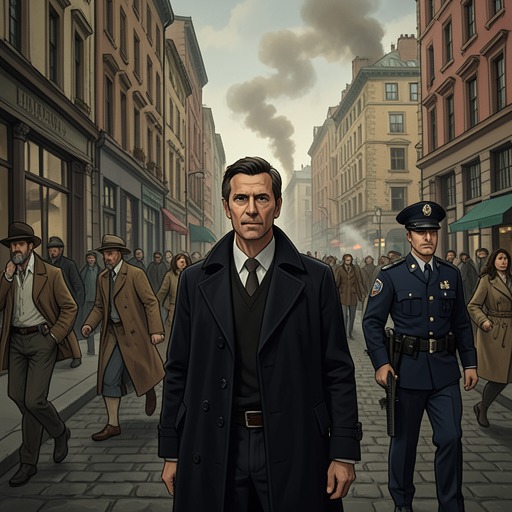
Wedding clashes between workers and police
FabianThe Wedding clashes between workers and police turn Berlin’s political and economic antagonisms into a street confrontation at Weddingplatz and Reinickendorfer Straße. Jakob Fabian follows police vehicles north, witnesses the clash and its dispersal, and later encounters an official account that reports a death while defending the police presence. The episode’s sharpest contrast is between the disorder he sees and the language through which the newspaper makes that disorder an argument for more policing.
Causes and Background
The clash occurs against a landscape of unemployment and political hostility. Earlier, Fabian has found jobless office workers queuing at an employment office and professionals seeking crisis relief; one man calculates that his family receives only 2.72 marks per person per week, or 38 pfennigs per person per day. This surrounding deprivation gives the march and the police response a material context, without reducing the confrontation to a single cause.
The episode also belongs to a novelistic pattern in which political antagonism readily becomes physical violence. In a separate confrontation, Labude and Fabian hear gunshots and find a wounded man who says that an argument began in a tavern when another man drew a swastika on a tablecloth. Fabian takes a broader view of such fighting: opposing parties may know what they fight against imperfectly, and shooting one another will not remedy the country’s conditions. That earlier exchange frames the Wedding clash as part of a wider crisis of political division rather than an isolated disturbance.
The Confrontation
After losing his work and being separated from Cornelia, Fabian follows police vehicles north through a crowded street. At Weddingplatz, the police block Reinickendorfer Straße as workers approach in large numbers. Mounted police wait behind the barrier; uniformed working-class policemen face working-class civilians. The workers’ songs grow louder, and then give way to angry shouting as the police line advances, leaving a meter between each man.
The first cries from the crowd confirm that the groups have met. Police begin striking, mounted officers move into the opening, and a shot rings out. Windows shatter as the horses gallop. People at the edge of Weddingplatz press forward, but another police line seals the approach to Reinickendorfer Straße and advances to clear the square. Stones fly; a police sergeant is stabbed. Officers raise their batons and break into a run, while reinforcements arrive on three lorries and jump down from the moving vehicles. Workers retreat, then regroup at the square’s outer edges and in the adjoining streets.
Fabian pushes through the crowd and goes on his way rather than joining either side. Three streets later, the sound of the clash has receded enough that the surroundings seem peaceful. A woman calls after him to ask whether there is a fight at Wedding; he answers that the opposing groups are taking each other’s measure. Her next words bring the political scene back to ordinary domestic life: she fears that Franz is again caught up in the fighting and calls for him to come home.
Report and Aftermath
Later, while at a woman’s home, Fabian reads the newspaper’s account of the previous day’s disorder in Reinickendorfer Straße. The police sergeant who was stabbed has died in hospital; three demonstrators are reported seriously injured, and others have been arrested. The report describes the demonstrators as irresponsible elements who repeatedly incite the unemployed and presents the police as entrusted with an important task. It adds that events such as this demonstrate the need for preventive action and argues against reducing the protective-police budget.
The report does not erase the physical consequences: it names a dead policeman, serious injuries, and arrests. But it also turns the clash into a case for policing, assigning the role of agitator to unnamed actors and elevating prevention as the lesson of the day. The text’s juxtaposition of Fabian’s direct experience with the newspaper’s institutional explanation makes the aftermath an information conflict as well as a public-order dispute.
Narrative Significance
The scene’s force lies partly in its abrupt change of scale. At the barrier, bodies, horses, stones, a knife, batons, and gunfire make the political conflict immediate; a few streets away, a bystander asks about the disturbance as though it were news from elsewhere. The episode then shifts again, from street noise to a printed report whose measured language converts injuries and death into a defense of the police budget.
Fabian’s conduct holds observation and involvement in tension. He follows the vehicles and passes through a living wall of people, but does not remain to take a side or intervene. The episode therefore connects the novel’s recurring portrait of the unemployed and politically divided city with Fabian’s position as a witness who sees violence firsthand, then encounters it again in a public account that organizes its meaning. Its ending offers no settlement: the police have dispersed the crowd, while the social antagonisms and competing explanations remain.