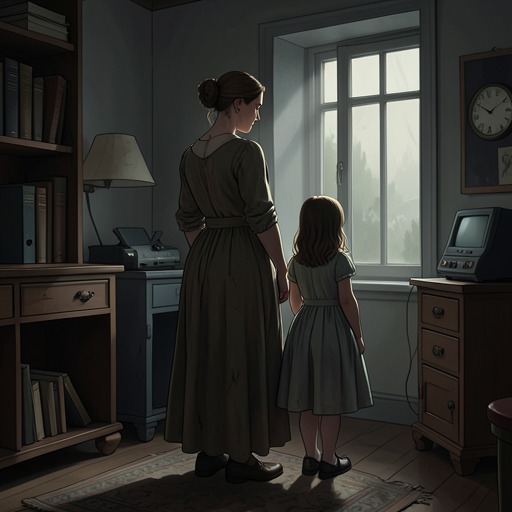
Bathsheba Confesses Her Love for Troy to Liddy
Far from the Madding CrowdBathsheba Confesses Her Love for Troy to Liddy is the private turning point at which Bathsheba’s efforts to deny her attachment to Sergeant Troy give way to an explicit confession. After hearing the household servants speculate about their relationship, she first insists that she hates Troy, then admits to Liddy that she loves him with a force she describes as misery and agony. The exchange makes the contradiction between her self-command and her emotional dependence unmistakable, while establishing Liddy as the trusted witness to a secret Bathsheba is not ready to acknowledge publicly.
Context and the Attempt at Denial
The confession takes place after Troy has accompanied Bathsheba to her door, said he will be away for two days visiting friends in Bath, and kissed her again. Still unsettled by the encounter, Bathsheba writes to Boldwood that she cannot marry him. She had told Gabriel Oak that she would wait until Boldwood returned before giving her final answer, but finds the decision impossible to defer. Wanting the letter sent, she carries it toward the kitchen, where she overhears the servants imagining that she may marry Troy and give up farming.
The servants’ conversation turns her private attachment into a matter of household speculation. Bathsheba bursts in and demands to know whom they were discussing. When Liddy admits it was Bathsheba herself, she immediately denies the servants’ interpretation, claiming that she does not care for Troy and hates him. Her emphatic repetition does not convince the reader: the scene has already shown her preoccupation with Troy, and the stronger her denial becomes, the more exposed her feelings are.
The Confession to Liddy
Bathsheba’s denial becomes more difficult to sustain when Maryann observes that Bathsheba had admired Troy earlier that day. Bathsheba defends him against the description of him as a wild scamp, while insisting that she has no reason to hate him and does not care about his reputation. She threatens to dismiss anyone who speaks against him. Her rapid reversals reveal that the supposed indifference is a protective posture: she is already taking his side, even as she insists that his character is no concern of hers.
In the parlour, Liddy tries to soothe her by treating the denial as proof that Bathsheba cannot love Troy. Bathsheba asks whether Liddy cannot read the riddle, then abandons the performance and confesses that she loves him intensely and is suffering for it. She embraces Liddy and says she needs to tell somebody because keeping the feeling inside is wearing her down. The confession is not a declaration to Troy or a decision about what to do; it is the first candid acknowledgment of the attachment to a trusted companion.
Secrecy, Loyalty, and Emotional Dependence
Once Bathsheba has admitted her love, she immediately asks Liddy to believe that Troy is not as disreputable as people say. When Liddy cannot simply affirm this, Bathsheba presses her to disbelieve the reports, then becomes distressed by Liddy’s uncertainty. Her response shows how her attachment is narrowing the space for independent judgment: she needs not only to love Troy, but also to have the person closest to her confirm the version of him she wants to believe.
Bathsheba also demands that Liddy keep the confession secret, warning that she will never again trust or love her if she repeats it. Yet when Liddy takes offence at being stormed at and says she may leave, Bathsheba quickly drops from command to entreaty. She insists that Liddy is not merely a servant but a companion, asks her to stay, and speaks of feeling friendless and worn down by her troubles. Liddy promises not to leave and responds with a kiss; Bathsheba kisses her in return. Their reconciliation makes the scene an exchange of confidences and comfort, but the intimacy is unequal as well: Bathsheba needs Liddy’s loyalty while struggling to accept Liddy’s independent assessment of Troy.
Significance in Bathsheba’s Arc
The confession follows the earlier uncertainty surrounding Boldwood’s offer. Bathsheba recognizes that marriage to him would be reasonable and desirable in many practical respects, and she esteems him, yet does not want him. She also feels that, having begun the emotional game with him, honesty may require accepting its consequences. Her reflections expose the division between deliberation and action that the narrative associates with her character: she can reason through the case, but impulse repeatedly determines what she does. The immediate letter rejecting Boldwood and the private confession of love for Troy show that the conflict has moved from abstract calculation into decisive feeling.
That feeling develops within a life Bathsheba has tried to govern for herself. On taking charge of the farm, she dismisses the bailiff for theft and announces that she will manage the work herself, promising the men that she will serve them fairly if they serve her well. She presents female authority as a practical responsibility, not simply a claim to independence. The confession complicates that position without erasing it: she remains the farm’s mistress, but in love she is increasingly dependent on Troy’s attention and on Liddy’s reassurance.
The later harvest revel sharpens the contrast between Bathsheba’s earlier confidence and her changed circumstances as a married woman. Gabriel notices the threatening weather and warns that the ricks need protection, but Troy dismisses the warning and turns the gathering into a wedding feast, announcing that he has married Bathsheba. When she objects to his plan to serve the workers brandy and water, he sends the women and children away and threatens the men’s winter work if they refuse to stay. This later scene shows the stakes of the attraction confessed to Liddy: Troy’s influence reaches beyond private feeling into the management of the farm and the treatment of its workers.
During Troy’s later absence, Bathsheba’s sense of her future grows bleak. She believes he will return, but also fears that their tenancy of the Upper Farm may end; the estate agent had initially distrusted her position because she was young, a woman, and beautiful, even though her uncle’s will and her capable management had won confidence. She worries about the legal effects of her marriage on her standing and sees poverty approaching if she and Troy cannot meet the rent. In retrospect, the confession marks an early point in a larger conflict between Bathsheba’s hard-won authority and the consequences of an attachment that she first admitted only behind a closed door to Liddy.