Weatherbury Church gargoyle
Far from the Madding CrowdThe Weatherbury Church gargoyle is one of eight medieval stone projections on the church tower, but the south-eastern one becomes an active force in the narrative: during a night of heavy rain, its outflow damages Fanny Robin’s grave, prompting Bathsheba and Gabriel Oak to tend the site and allowing Bathsheba to read the inscription that names Francis Troy as the tombstone’s donor. An ordinary architectural fixture becomes consequential through the interaction of weather, neglected maintenance, and a grave whose significance has not been fully understood.
Design and Setting
Weatherbury Church has a square, fourteenth-century tower with two stone gargoyles on each of its four faces. Of the eight, only two still perform their original work of carrying water away from the lead roof: one on each of the tower’s active fronts. The others have been closed by churchwardens or have broken away and become blocked. The functioning openings are large enough to manage the flow under ordinary conditions, but the distinction between a fixture that still works and one that has been forgotten becomes important when the weather exceeds expectation.
All eight carvings differ. The south-eastern gargoyle, the one relevant to the story, is presented as an ambiguous, grotesque figure: neither quite dragon, man, animal, fiend, nor bird. Its wrinkled surface, upright ears, staring eyes, and hands pulling open its mouth make the stone appear to strain in the act of releasing water. Its lower teeth have been worn away, while its upper teeth remain. Set a couple of feet out from the wall, it has faced the landscape for centuries, silent in dry weather and making a gurgling sound when it rains. Its very age and familiar function make it easy to regard as part of the church rather than as a mechanism capable of affecting what lies below.
The Outflow and the Grave
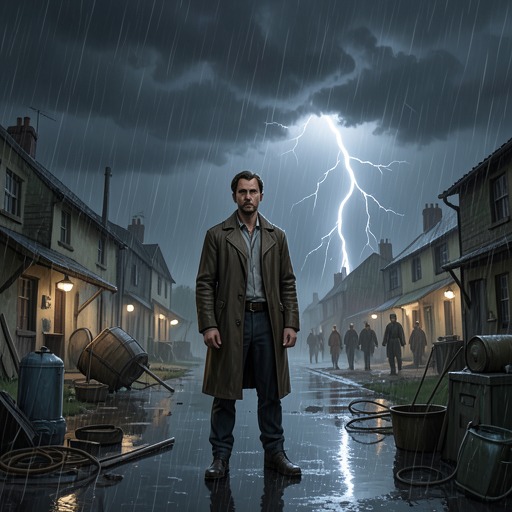
During a sustained downpour, the gargoyle’s stream strengthens and travels farther from the tower than it has in several years. Its water falls from a height of about seventy feet, crosses the tower’s projecting base and nearby stones, and reaches the area around Fanny Robin’s grave. Loose stones that had previously shielded the soil were cleared during the summer, leaving bare earth exposed. The combination of unusually forceful flow and the missing protective layer sends the water into the grave rather than away from it.
The resulting disturbance ruins the flowers planted there by Fanny’s repentant lover. The water loosens the soil and turns the grave into a muddy hollow; flowers and bulbs are uprooted and cast across the surrounding grass and path. The tombstone is stained as well. Nothing in the account suggests that the gargoyle has changed its designed purpose: it still carries roof water. The harm arises because its outlet, the weather, and the unprotected ground align in a way that has not recently occurred and was overlooked.
Discovery and Response
In the morning, Troy returns to the grave with a spade. He finds mud on the path and sees the uprooted plants before reaching the damaged site. The stream’s effects have made the hidden course of the water visible, turning a routine part of the church tower into the immediate explanation for the ruined grave.
Bathsheba arrives later and sees the hollow, the stained tomb, and Gabriel Oak standing nearby. At first, she does not recognize the grand tomb as Fanny’s and looks for a humbler grave. She then follows Oak’s gaze to the inscription, which begins by identifying the memorial as erected by Francis Troy in beloved memory of Fanny Robin. The gargoyle’s accidental damage therefore becomes part of a scene of recognition: the exposed grave and visible inscription disclose Troy’s connection to Fanny in a place where Bathsheba had come already troubled by the thought that Fanny was connected to her own history.
Bathsheba asks Oak to fill in the hole with the spade. While he does so, she gathers the displaced flowers and replants them, handling their roots and leaves with care. She also asks him to have the churchwardens redirect the gargoyle’s leadwork so that its stream will flow sideways and the same accident will not recur. Her response addresses both immediate damage and its preventable cause: the grave is repaired, the flowers restored, and the watercourse identified for correction.
Narrative Significance
The gargoyle links a long-lived structure to fragile, local consequences. For centuries its grotesque face has directed rain from the tower; on this occasion, its familiar function becomes newly conspicuous because the outflow reaches Fanny’s grave. The event is not presented as a deliberate act by any character. It follows from an exceptional flow, the removal of stones during the summer, and the failure to anticipate how the discharge would travel under such conditions.
That material accident also advances the human story. The damaged memorial draws Bathsheba’s attention to the inscription and confirms that Troy erected the tombstone. Rather than treating the disclosure as an occasion for confrontation, she attends to the grave and its flowers, while Oak helps with the repair. The gargoyle’s significance rests in this double consequence: its water physically disrupts a place of mourning, and the disruption brings concealed relational knowledge into view. Repairing the outlet and the grave cannot undo the past, but it converts an unforeseen failure into practical care.