
Faust’s Journey from Study to World
FaustFaust’s movement from solitary scholarship into public life, magic, romance, and catastrophe tests whether experience can answer his spiritual hunger.
increasing Bearing strength in each event
 decreasing
Bearing strength in each eventdecreasingThe Closed Chamber
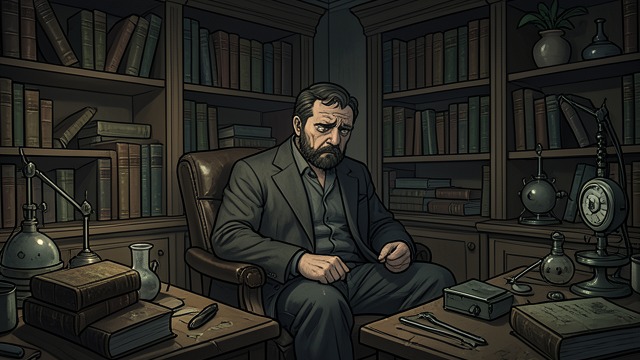
A Life in Confinement
The study as a prison
Surrounded by old books and scientific instruments, Faust sees his room as an environment of dust, dead matter, and intellectual repetition.
His learning has not given him either happiness or a convincing way to help other people.
A desire to break out
Moonlight and the imagined freedom of nature sharpen his sense of confinement.
The wish to escape becomes the first movement in a larger passage from abstract knowledge toward risky action.
The Springtime Crowd

Reentry into Public Life
The city awakens
Faust and Wagner encounter people streaming into the spring landscape after the Easter service.
Faust feels among the crowd a temporary return to ordinary human fellowship, a contrast to his isolation among books.
Two responses
Wagner recoils from popular noise, while Faust welcomes it as a reminder that life is lived among others.
The difference anticipates their opposed ideas of knowledge, embodiment, and experience.
A Pact for Experience

The Turn to Action
Beyond scholarship
After failing to command the Spirit, Faust remains dissatisfied with the limits of his own understanding.
Mephistopheles offers practical access to the world and invites Faust to exchange reflection for experience.
A self-imposed test
Faust accepts the bargain and sets the moment of perfect satisfaction as its decisive condition.
He expects action to enlarge his life without ever bringing him to a final stopping point.
The World of Appetite

Pleasure as Experiment
Public spectacle
The cellar’s enchanted wine and the Witch’s Kitchen’s grotesque magic introduce Faust to forms of pleasure and transformation.
Neither setting offers intellectual certainty; both show the Devil converting desire into theatrical experience.
A narrowed pursuit
The rejuvenating potion redirects Faust toward physical appetite, and he soon fixes upon Margaret.
His broad ambition contracts into a particular desire that will involve another person in the bargain’s consequences.
The Ruined Return

The Failure of Escape
A world transformed by harm
Faust returns to Margaret not as an explorer seeking new sensations but as a man confronted with the damage of his conduct.
His urgency cannot restore her mother, brother, or child, and Margaret’s confinement makes the cost unmistakable.
An incomplete rescue
Margaret rejects flight and turns toward divine judgment, while Faust departs with Mephistopheles.
The journey out of the study has brought action, but not the mastery or uncomplicated fulfillment Faust sought.
At the opening of Part One
Easter Day outside the city gate
That night, after the Earth-Spirit encounter
After the pact, from Leipzig to the Witch’s Kitchen
Near the end, when Faust reaches Margaret’s prison
