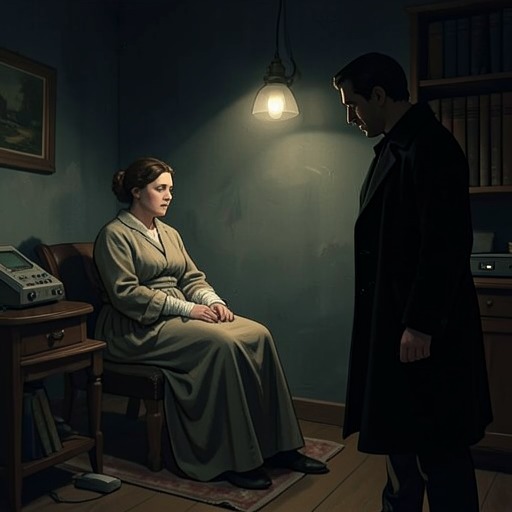
Margaret's salvation
FaustMargaret’s salvation is the final spiritual reversal of the tragedy’s dungeon scene: refusing to place her fate in Mephistopheles’ hands, she gives herself to God, calls on the angels, and receives a declaration of salvation from above. The verdict sets a transcendent judgment against Mephistopheles’ claim that she is condemned, while leaving the human consequences of her crimes intact.
The Judgment Behind the Ending
The scene’s religious stakes have been prepared in the Cathedral, where Margaret stands among the congregation during the service, with the Evil Spirit behind her. The spirit recalls her earlier innocence at the altar and her childhood prayers, then confronts her with the death of her mother, blood at her threshold, and the presence of a life stirring beneath her heart. Its questions turn worship into accusation: Margaret is made to confront guilt and consequences that she cannot simply pray away.
At the dungeon, the setting makes the contrast between earthly confinement and spiritual judgment concrete. Faust arrives at the iron door with keys and a lamp, seeking Margaret inside the prison. Her fate appears to be in human hands, but the ending ultimately transfers judgment beyond the prison and beyond Mephistopheles’ authority.
Margaret’s Response
When Margaret recognizes the gravity of the moment, she does not accept escape as the measure of rescue. She gives herself to God and asks the angels to guard and protect her from evil. Her prayer marks a decisive change in allegiance: the rescue she invokes is spiritual, not merely release from the dungeon.
She also addresses Faust as Henry and says that the thought of him makes her shudder. The line places their relationship within her final crisis without undoing the preceding appeal to God. Her response is therefore not a simple return to the lover who has come to free her; it is a separation from the course of action he represents and a turn toward a judgment she accepts.
The Conflicting Verdicts
Mephistopheles declares that Margaret is judged and presses Faust to come with him, threatening to leave both her and Faust behind. His words make the immediate cost of her refusal explicit: Faust is urged to abandon her, and the Devil presents condemnation as the settled outcome.
A voice from above answers with the opposite verdict: Margaret is saved. The brief exchange places two claims of authority side by side. Mephistopheles can name judgment and demand departure, but the final pronouncement comes from beyond the characters onstage and overturns his declaration.
Significance and Limits of the Resolution
The salvation is not presented as an erasure of what Margaret has done. The Cathedral accusation remains part of the context: her mother has died, blood has been shed, and she is confronted with the consequences of her actions. Rather, the ending distinguishes human guilt from the final spiritual verdict. Margaret gives herself to God, and the voice from above supplies an outcome that Mephistopheles cannot control.
The close is sharply compressed: Margaret’s prayer, Mephistopheles’ opposing declaration, and the answering voice resolve the spiritual question at the instant Faust is urged to leave. The result is a reversal of the Devil’s announced judgment, not a reconciliation between Margaret and Faust or a narrated account of her life after the scene.