before the dramatic action
The Translator’s Dedication
The translator opens by explaining his long effort to render Goethe’s poem in English while preserving its original metres. He argues that poetic form is not decoration: rhythm and sound carry meaning, and a prose version necessarily loses part of the work’s life.
He presents the translation as an attempt to combine close fidelity with English poetic music. The dedication that follows addresses Goethe as a transforming poet and asks that his spirit speak through the translator’s voice.
before the heavenly prologue
The Playhouse Debate
A Manager asks a Poet and a Merry-andrew how to make a successful theatrical production. The Manager wants spectacle, abundant incident, and a full house; the Merry-andrew insists that popular entertainment needs comic variety and recognizable human feeling.
The Poet resists turning art into a commercial hash, defending the inward force that makes a work endure beyond its first audience. Their argument frames the tragedy with a question about artistic integrity, public taste, and the difference between genuine creation and mere effect.
before Faust’s story begins
The Heavenly Praise
The [Three Archangels](entity:character-recall-character-three-archangels-ad6f454d864c) praise the ordered grandeur of the universe: the sun’s course, the rushing tides, and the storms all participate in a vast creation whose workings exceed human understanding. Their hymn presents the world as active, harmonious, and continually renewed.
[Mephistopheles](entity:character-recall-character-mephistopheles-80a65eea768a) answers with contempt for humanity, describing people as irrational creatures made worse by the glimmer of reason. [The Lord](entity:character-recall-character-the-lord-43e401aa4704) asks whether he knows [Faust](entity:character-recall-character-faust-8c7662977a93), and Mephistopheles describes a scholar who cannot be satisfied by ordinary life and strains after the highest experience.
before Faust’s story begins
The Wager on Faust
[Mephistopheles](entity:character-recall-character-mephistopheles-80a65eea768a) asks permission to lead [Faust](entity:character-recall-character-faust-8c7662977a93) astray. [The Lord](entity:character-recall-character-the-lord-43e401aa4704) allows him to try while Faust remains alive, holding that a striving person may err but can still be guided toward the right way.
The wager establishes the spiritual contest underlying the tragedy. Mephistopheles expects to win Faust through appetite and disillusionment; the Lord trusts that Faust’s persistent striving will keep him from final ruin.
Easter eve
Faust’s Learned Despair
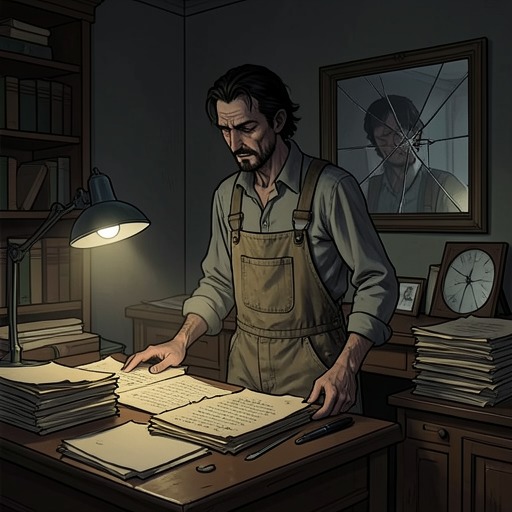
In his narrow Gothic study, [Faust](entity:character-recall-character-faust-8c7662977a93) reviews his years of study in philosophy, law, medicine, and theology and concludes that he is no wiser than before. He has learned enough to doubt accepted knowledge, but not enough to discover the hidden force governing the world.
Feeling his life wasted among books and instruments, he longs to escape his cramped room and reach living nature directly. His dissatisfaction is not simple boredom: he wants a kind of knowledge that can unite thought with experience and disclose the world’s inner life.
Easter eve
The Book of Symbols
[Faust](entity:character-recall-character-faust-8c7662977a93) opens [Nostradamus’s Book](entity:object-recall-object-nostradamus-s-book-8713f5d2f591) and sees the sign of the Macrocosm. For a moment, the image fills him with the sense that natural forces rise and descend in a reciprocal order, all things working and living within a greater whole.
The vision proves insufficient: Faust can contemplate the harmony but cannot make it his own. He turns impatiently through the book and finds the sign of the [Earth Spirit](entity:character-recall-character-earth-spirit-53d37b3309c4), whose power appears to promise direct contact with the life he has only observed from afar.
Easter eve
Faust Summons the Earth Spirit
The sign of the [Earth Spirit](entity:character-recall-character-earth-spirit-53d37b3309c4) floods [Faust](entity:character-recall-character-faust-8c7662977a93) with confidence and an intense desire to meet the power behind nature. He calls the spirit, and a ruddy flame appears; but when the Earth Spirit confronts him, Faust is seized by fear despite his claim to be its equal.
The spirit dismisses him as unlike the power he sought to comprehend and vanishes. Faust is left humiliated by the gap between his ambition and his actual capacity, a failure that makes his hunger for experience more desperate.
Easter eve, immediately afterward
Wagner Interrupts the Vision
A knock interrupts [Faust](entity:character-recall-character-faust-8c7662977a93)’s collapse, and [Wagner](entity:character-recall-character-wagner-0f9cfda2c53a) enters, having heard him speaking. Wagner wants to learn the art of persuasive public speech, but Faust argues that eloquence cannot be assembled from borrowed phrases: it must rise from genuine feeling.
Their disagreement broadens into an argument about scholarship. Wagner trusts the accumulation of learning; Faust mocks secondhand accounts of history and warns that those who speak honestly about the human heart have often been punished. Wagner leaves still eager to learn everything, while Faust sees in him the safety of a mind content with shallow certainty.
Easter eve, after Wagner leaves
The Easter Chants
Alone again, [Faust](entity:character-recall-character-faust-8c7662977a93) hears the voices of women and angels singing of Christ’s death and resurrection. The music recalls the faith and tenderness of his childhood, when church bells and sacred hymns drew him away from despair and into the spring world.
The chants turn him from the brink of self-destruction. He cannot assent to the religious miracle as doctrine, but the remembered sounds renew his attachment to life, and he leaves the study to join the [Easter](entity:time-recall-time-8441fe9013cc) crowds outside.
Easter morning
The Easter Crowd
Outside the city gate, townspeople, apprentices, servants, students, and soldiers set out to enjoy the holiday. Their chatter and plans make visible the ordinary social life that [Faust](entity:character-recall-character-faust-8c7662977a93)’s scholarly isolation has kept at a distance.
Walking with [Wagner](entity:character-recall-character-wagner-0f9cfda2c53a), Faust watches the people pour into the countryside and feels, for a moment, that he belongs among them. He exclaims that here he is a human being and dares to be one, though Wagner regards the crowd’s noise and rough pleasures with distaste.
Easter morning, outside the city
The People Honor Faust
Peasants recognize [Faust](entity:character-recall-character-faust-8c7662977a93) and thank him for the care he and his father gave during a plague. They recall that Faust entered infected homes as a young man and survived, and they offer him a drink in gratitude for the family’s service.
Their praise deepens Faust’s shame rather than consoling him. He believes his father’s medicines may have poisoned patients, and he doubts that either of them deserved the honor. The scene brings his intellectual uncertainty into contact with the consequences of his medical inheritance.
Easter morning, on the way back to the city
Two Souls Within Faust
As evening approaches, [Faust](entity:character-recall-character-faust-8c7662977a93) longs to follow the sun beyond the horizon, carried from the earth into a wider existence. He recognizes that part of him clings to bodily life and its pleasures, while another part strains upward toward the spiritual and infinite.
[Wagner](entity:character-recall-character-wagner-0f9cfda2c53a) answers with the pleasures of reading and study, but Faust imagines airy spirits that might bear him into new experience. Their exchange gives voice to his divided nature and prepares him to recognize the black poodle following them from a distance.
Easter evening, returning home
The Black Poodle
[Faust](entity:character-recall-character-faust-8c7662977a93) notices a black poodle circling near him and sees what looks like a fiery trail in its wake. [Wagner](entity:character-recall-character-wagner-0f9cfda2c53a) dismisses the animal as an ordinary dog that has lost its master, while Faust suspects a supernatural presence.
The poodle follows them through the city gate into Faust’s study. Its arrival carries the unsettled world of spirits into the room where Faust’s studies and failed invocation have left him most vulnerable.
that night in Faust’s study
The Word and the Act
Back in his study, [Faust](entity:character-recall-character-faust-8c7662977a93) tries to translate the opening of the Gospel of John. He rejects “the Word” as an unsatisfactory beginning, considers “Thought” and “Power,” and finally writes that in the beginning was the Act.
The effort reveals Faust’s instinct to privilege force and action over inherited language. While he works, the poodle grows monstrous, and the apparent pet becomes a manifestation of the supernatural threat he has been circling.
that night in Faust’s study
Mephistopheles Appears
[Faust](entity:character-recall-character-faust-8c7662977a93) invokes elemental powers and then challenges the creature with sacred names. The poodle expands into an enormous beast before [Mephistopheles](entity:character-recall-character-mephistopheles-80a65eea768a) emerges from the vapor in the guise of a traveling scholar.
Asked to identify himself, Mephistopheles calls himself part of a power that wills evil but works good, and then the spirit that denies. He explains that he seeks destruction because created things seem worthy of being unmade, yet admits that his attacks have not stopped life’s recurring renewal.
that night in Faust’s study
The Pentagram’s Snare
[Mephistopheles](entity:character-recall-character-mephistopheles-80a65eea768a) discovers that the [Pentagram](entity:object-recall-object-pentagram-7b8786fc2b6f) at the threshold prevents his departure, though one angle was left open and allowed him to enter. [Faust](entity:character-recall-character-faust-8c7662977a93) realizes that the Devil has become trapped in his room and takes satisfaction in having caught him.
Mephistopheles cannot leave until he gets help from spirits who sing Faust to sleep. He then summons a rat to gnaw through the marked threshold, escapes, and leaves Faust waking with the impression that the encounter may have been only a dream.
the following night
Mephistopheles Returns
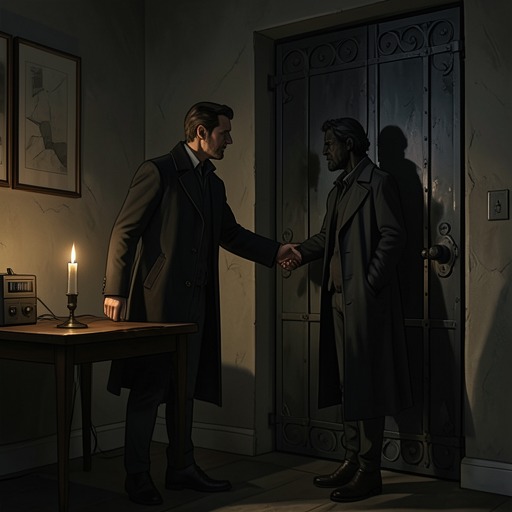
[Mephistopheles](entity:character-recall-character-mephistopheles-80a65eea768a) returns to [Faust](entity:character-recall-character-faust-8c7662977a93)’s study and insists that Faust invite him in three times. He appears in bright, fashionable clothes and urges Faust to abandon his secluded life for a wider experience of the world.
Faust replies that neither ordinary pleasures nor ordinary disappointments can satisfy him. He curses the hopes, possessions, and comforts that have failed to relieve his life, and Mephistopheles offers to act as his guide and servant.
the following night
The Blood Pact
[Faust](entity:character-recall-character-faust-8c7662977a93) demands that [Mephistopheles](entity:character-recall-character-mephistopheles-80a65eea768a) state his terms plainly. Mephistopheles offers to serve him on earth if Faust will serve him in the world beyond, and Faust accepts the prospect without concern for what may follow death.
Faust proposes a wager of his own: if Mephistopheles can make him content enough to ask a moment to remain, Faust will belong to him. He signs the agreement in blood, declaring that he wants to experience the full range of human life, including its highest joy and deepest pain.
soon after the pact
The Student’s Consultation
A student arrives hoping to begin his education, and [Mephistopheles](entity:character-recall-character-mephistopheles-80a65eea768a) puts on [Faust](entity:character-recall-character-faust-8c7662977a93)’s academic clothes to receive him. He satirizes formal logic, metaphysics, theology, and the legal profession, showing how systems and technical language can substitute for understanding.
When the student asks about medicine, Mephistopheles recommends confidence and opportunism, especially in dealing with women. He writes in the student’s album a warning drawn from the ancient temptation to become like God through knowledge, then resumes preparations for the journey with Faust.
soon after the pact
The Leipzig Wine Trick
[Mephistopheles](entity:character-recall-character-mephistopheles-80a65eea768a) takes [Faust](entity:character-recall-character-faust-8c7662977a93) to [Leipzig](entity:location-recall-location-leipzig-e5c1d0af4fa7) and introduces him to a cellar full of drinking companions. He entertains the men with a song about a king’s favored flea and offers them wine that he appears to draw from holes bored into the table.
When the drinkers spill wine and it catches fire, they turn on him with knives. Mephistopheles alters their perception so that they mistake one another for grapes and seize each other’s noses; he then vanishes with Faust, leaving the men confused about what they experienced.
after the Leipzig visit
The Witch’s Kitchen
[Faust](entity:character-recall-character-faust-8c7662977a93) objects to the absurd surroundings of the Witch’s Kitchen and asks whether a potion made by an old woman can truly restore his youth. [Mephistopheles](entity:character-recall-character-mephistopheles-80a65eea768a) says that there is a more natural route, but Faust refuses the labor and limits of an agricultural life.
While Faust studies a vision in a mirror, apes play at poetry and nonsense around a cauldron. [The Witch](entity:character-recall-character-the-witch-a6cda7f2f2c2) returns in a burst of flame, recognizes Mephistopheles, and is persuaded to prepare a rejuvenating drink for Faust.
immediately after the Witch prepares it
Faust Drinks the Potion
[The Witch](entity:character-recall-character-the-witch-a6cda7f2f2c2) chants a deliberately nonsensical spell and gives [Faust](entity:character-recall-character-faust-8c7662977a93) the potion. [Mephistopheles](entity:character-recall-character-mephistopheles-80a65eea768a) urges him to drink it, and Faust does so, despite his contempt for the theatrical rituals around the cauldron.
The drink makes Faust feel renewed and intensifies his sexual desire. Before leaving, he asks again about the beautiful woman he saw in the mirror; Mephistopheles promises that he will soon see a real woman who will seem beautiful to him.
soon after Faust’s rejuvenation
Faust Meets Margaret
On a street, [Faust](entity:character-recall-character-faust-8c7662977a93) offers his arm to a young woman, [Margaret](entity:character-recall-character-margaret-6a6d3c475969), who declines his help and briskly goes on her way. Her modest refusal only increases his fascination with her, and he tells [Mephistopheles](entity:character-recall-character-mephistopheles-80a65eea768a) that he wants her.
Mephistopheles says that Margaret is too innocent for him to seize directly and that winning her will require time and strategy. Faust insists on immediate possession, while Mephistopheles promises to find her room and create an opportunity for a later visit.
soon after Faust meets Margaret
The First Jewelry Casket
[Mephistopheles](entity:character-recall-character-mephistopheles-80a65eea768a) takes [Faust](entity:character-recall-character-faust-8c7662977a93) into [Margaret](entity:character-recall-character-margaret-6a6d3c475969)’s neat, poor room while she is away. The quiet household and traces of her family stir tenderness in Faust, briefly softening the lust that brought him there.
Mephistopheles hides a casket of jewelry in her press. When Margaret returns, she discovers the ornaments and is astonished by their beauty, trying them on before a mirror and imagining how they might change the way others see her.
the next day
The Church Takes the Jewels
[Margaret](entity:character-recall-character-margaret-6a6d3c475969)’s mother discovers the first jewelry casket and turns it over to a priest, believing that suspicious wealth should be given to the [Church](entity:organization-recall-organization-church-c786755b8de3). The priest accepts the gift and assures her that the Church can properly absorb riches of any origin.
Margaret is disappointed when the ornaments disappear, though she does not know how they came to her. [Faust](entity:character-recall-character-faust-8c7662977a93) hears what happened and tells [Mephistopheles](entity:character-recall-character-mephistopheles-80a65eea768a) to obtain another set, pressing him to use Margaret’s neighbor as an accomplice.
soon after the first set is confiscated
The Second Jewelry Casket
[Mephistopheles](entity:character-recall-character-mephistopheles-80a65eea768a) arranges a second and more splendid jewelry casket for [Margaret](entity:character-recall-character-margaret-6a6d3c475969). Her neighbor [Martha](entity:character-recall-character-martha-d013454074d5) encourages her to keep it from her mother and to wear the ornaments privately before a mirror.
The gifts deepen the bond of secrecy and temptation around Margaret. Mephistopheles also uses his visit to introduce a fabricated story about Martha’s absent husband, creating an excuse to bring [Faust](entity:character-recall-character-faust-8c7662977a93) and Margaret together under the appearance of a legal confirmation.
soon after the second jewelry gift
The False Death Report
[Mephistopheles](entity:character-recall-character-mephistopheles-80a65eea768a) tells [Martha](entity:character-recall-character-martha-d013454074d5) that her husband has died in Padua and that he brought a message asking her to arrange masses for his soul. His account is a sham, but Martha wants formal proof of the death before she considers herself free to remarry.
Mephistopheles promises to return with [Faust](entity:character-recall-character-faust-8c7662977a93) as a second witness. When Faust objects to swearing to something he does not know, Mephistopheles reminds him that he has spent his life making confident claims about matters he could not truly prove, and that he plans to declare endless devotion to [Margaret](entity:character-recall-character-margaret-6a6d3c475969) as well.
that evening
The Garden Courtship
[Faust](entity:character-recall-character-faust-8c7662977a93) meets [Margaret](entity:character-recall-character-margaret-6a6d3c475969) in [Martha](entity:character-recall-character-martha-d013454074d5)’s garden while Martha and [Mephistopheles](entity:character-recall-character-mephistopheles-80a65eea768a) walk separately nearby. Margaret worries that she cannot entertain so experienced a traveler, but Faust tells her that a single look or word from her matters more to him than scholarship.
Margaret describes her household duties, her mother’s strictness, and the sister she once nursed. She admits that Faust’s boldness first confused and angered her, but a flower game leads her to discover that she believes he loves her; he answers by declaring his love and holding her hands.
after the garden meeting
Margaret’s Love Song
[Margaret](entity:character-recall-character-margaret-6a6d3c475969) sits alone at her spinning wheel and sings that her peace is gone. She recalls [Faust](entity:character-recall-character-faust-8c7662977a93)’s bearing, voice, hand, and kiss, and admits that she longs to hold him and die in his embrace.
The song gives private form to the passion that has overtaken her. It marks the contrast between the intensity of her attachment and the constrained domestic life to which she must return when Faust is absent.
after Margaret falls in love
The Forest Confession
Alone in the forest, [Faust](entity:character-recall-character-faust-8c7662977a93) thanks the spirit that opened nature to him and made him feel its living force. Yet he also admits that [Mephistopheles](entity:character-recall-character-mephistopheles-80a65eea768a) has become a companion he cannot do without, even as the Devil’s cold mockery diminishes the value of those experiences.
Mephistopheles needles Faust about his desire for [Margaret](entity:character-recall-character-margaret-6a6d3c475969) and says that she waits for him sadly. Faust reacts with anger, then confesses that his passion has made her peace impossible and that he sees no way to avoid bringing ruin upon them both.
soon after the forest encounter
Margaret Questions Faust’s Faith
In [Martha](entity:character-recall-character-martha-d013454074d5)’s garden, [Margaret](entity:character-recall-character-margaret-6a6d3c475969) asks [Faust](entity:character-recall-character-faust-8c7662977a93) to tell her honestly about his religion. Faust avoids a simple confession of belief and describes the divine as the encompassing force felt in nature and in human love, saying that names can obscure the reality they attempt to express.
Margaret finds his words moving but remains uneasy that he has no Christianity. She also says she instinctively recoils from [Mephistopheles](entity:character-recall-character-mephistopheles-80a65eea768a), sensing something evil in him; Faust dismisses her fear and turns the conversation back toward their intimacy.
that evening
The Sleeping Potion
[Margaret](entity:character-recall-character-margaret-6a6d3c475969) says that her mother’s light sleep makes it impossible for [Faust](entity:character-recall-character-faust-8c7662977a93) to visit her privately. Faust gives her a phial and tells her to put three drops into her mother’s drink so that she will sleep deeply.
Margaret asks whether the potion could hurt her mother, but Faust reassures her that he would not give it if it were harmful. Trusting him and wanting to please him, she accepts the potion; [Mephistopheles](entity:character-recall-character-mephistopheles-80a65eea768a) has overheard their exchange and mocks Faust for leading her into danger.
after the secret visits begin
Margaret’s Pregnancy
[Margaret](entity:character-recall-character-margaret-6a6d3c475969)’s relationship with [Faust](entity:character-recall-character-faust-8c7662977a93) carries her beyond the bounds of her sheltered life, and she becomes pregnant. In the period that follows, she is increasingly isolated and burdened by the consequences of their affair.
Her later songs and the accusations around her show how the intimacy Faust pursued becomes a public and private catastrophe for her. The pregnancy is the turning point that makes her vulnerability, rather than his desire, the central cost of their relationship.
after Margaret gives her mother the potion
The Potion’s Fatal Consequence
[Margaret](entity:character-recall-character-margaret-6a6d3c475969) gives her mother the sleeping draught [Faust](entity:character-recall-character-faust-8c7662977a93) supplied, intending only to secure a private night with him. The potion proves too strong, and her mother dies.
The death leaves Margaret exposed to grief, guilt, and social danger. Faust’s reassurance has turned her trust into an act with irreversible consequences, although [Mephistopheles](entity:character-recall-character-mephistopheles-80a65eea768a) and Faust continue their pursuit rather than stopping to protect her.
after her pregnancy becomes known
Margaret Hears the Scorn
At a fountain, [Margaret](entity:character-recall-character-margaret-6a6d3c475969) hears Lisbeth condemn another young woman who has been seduced and abandoned. Lisbeth recounts the girl’s visits with her lover and predicts public disgrace, treating the pregnancy as proof of shame rather than a shared responsibility.
Margaret pities the girl, then recognizes herself in the story. She remembers how readily she once judged others and realizes that she has become the very person she condemned, even though her love for [Faust](entity:character-recall-character-faust-8c7662977a93) still seems to her good and true.
after the fountain encounter
Margaret’s Prayer
Alone before an image of the sorrowful Virgin, [Margaret](entity:character-recall-character-margaret-6a6d3c475969) asks for compassion and sings of the anguish consuming her. She describes a life of sleepless sorrow and remembers arranging flowers with tears already wetting them.
Her prayer reveals the depth of her remorse and fear as the consequences of her affair gather around her. The religious language that [Faust](entity:character-recall-character-faust-8c7662977a93) rejected remains, for Margaret, a last appeal for help and forgiveness.
night before the Walpurgis Night gathering
Valentine Confronts the Shame
[Valentine](entity:character-recall-character-valentine-79252b27fd2a), [Margaret](entity:character-recall-character-margaret-6a6d3c475969)’s soldier brother, remembers once boasting that his sister was the best and most honorable woman in the land. Now he hears people mock her reputation and cannot defend her without admitting that the accusations are true.
When [Faust](entity:character-recall-character-faust-8c7662977a93) and [Mephistopheles](entity:character-recall-character-mephistopheles-80a65eea768a) approach Margaret’s house, Valentine challenges them. Mephistopheles’s song provokes the confrontation, and he helps Faust defeat Valentine in the fight; the wounded brother falls, leaving Margaret’s family honor and safety in ruins.
the same night
Valentine’s Dying Condemnation
As neighbors gather around the dying [Valentine](entity:character-recall-character-valentine-79252b27fd2a), he condemns [Margaret](entity:character-recall-character-margaret-6a6d3c475969) in front of the crowd. He tells her that her reputation will follow her openly and that society will shun her, turning his last moments into a public curse rather than an act of protection.
[Martha](entity:character-recall-character-martha-d013454074d5) asks Valentine to commend his soul to God, but he also insults her before he dies. His death leaves Margaret exposed to disgrace, and his words anticipate the isolation and punishment that will overtake her.
after Valentine’s death
The Cathedral Torment
During a church service, an evil spirit stands behind [Margaret](entity:character-recall-character-margaret-6a6d3c475969) and recalls her former innocence. It accuses her of her mother’s death, the bloodshed at her threshold, and the life stirring within her, while the funeral chant sounds around her.
Margaret feels the pillars and vaulted roof closing in and cannot breathe. She asks for a cordial and collapses in a swoon, overwhelmed by guilt and fear as the religious setting becomes a place of accusation rather than comfort.
Walpurgis Night
The Walpurgis Night Ascent
[Faust](entity:character-recall-character-faust-8c7662977a93) and [Mephistopheles](entity:character-recall-character-mephistopheles-80a65eea768a) climb through the Hartz Mountains toward the [Brocken](entity:location-recall-location-brocken-afeacb9e8689), accompanied for a time by a will-o’-the-wisp. Faust enjoys the spring air and the difficult path, while Mephistopheles complains of the cold and guides him toward the mountain’s strange lights.
A storm and the glow of Mammon’s underground fire surround them as the witches’ procession sweeps toward the summit. The ascent carries Faust away from the suffering left behind in the city and into a carnival of spirits, appetite, and disorientation.
Walpurgis Night, on the Brocken
The Brocken Revels
The mountain fills with witches, wizards, and other revelers, who sing and jostle through the night. [Mephistopheles](entity:character-recall-character-mephistopheles-80a65eea768a) moves easily among them, introducing [Faust](entity:character-recall-character-faust-8c7662977a93) to figures who make the gathering a grotesque version of ordinary society and its vanities.
Faust dances with a young witch but breaks away after seeing a red mouse emerge from her mouth. He then notices a pale girl who resembles [Margaret](entity:character-recall-character-margaret-6a6d3c475969), with a narrow red mark around her neck; Mephistopheles calls the apparition a dangerous magical image, but Faust is shaken by the reminder of the woman he left behind.
later on Walpurgis Night
The Golden Wedding Masque
The revel continues as an intermezzo celebrating the golden wedding of [Oberon](entity:character-recall-character-oberon-2b45568599ee) and [Titania](entity:character-recall-character-titania-0de20ede4fb6). [Puck](entity:character-recall-character-puck-218506ed4131), [Ariel](entity:character-recall-character-ariel-58a268ed7cd5), and a parade of allegorical figures, artists, critics, and social types contribute brief songs that mock fashionable opinion and theatrical pretension.
The masque turns the gathering into a satirical spectacle rather than a simple witches’ dance. Its shifting voices and absurd imagery reinforce the disordered world through which [Mephistopheles](entity:character-recall-character-mephistopheles-80a65eea768a) is leading [Faust](entity:character-recall-character-faust-8c7662977a93), while offering no resolution to Faust’s growing unease about [Margaret](entity:character-recall-character-margaret-6a6d3c475969).
after Walpurgis Night
Margaret’s Imprisonment
[Margaret](entity:character-recall-character-margaret-6a6d3c475969)’s child dies, and she is arrested and confined in a dungeon. By the time [Faust](entity:character-recall-character-faust-8c7662977a93) learns what has happened, she is accused of killing the baby and faces execution; her mind has been shattered by grief, guilt, and confinement.
Faust realizes that his pursuit of pleasure has helped produce the catastrophe. He turns on [Mephistopheles](entity:character-recall-character-mephistopheles-80a65eea768a) for concealing Margaret’s fate, while Mephistopheles answers that Faust himself brought her into danger and cannot blame the consequences entirely on the Devil.
the night before Margaret’s execution
Faust Demands a Rescue
[Faust](entity:character-recall-character-faust-8c7662977a93) orders [Mephistopheles](entity:character-recall-character-mephistopheles-80a65eea768a) to take him to [Margaret](entity:character-recall-character-margaret-6a6d3c475969) and free her. Mephistopheles warns him that spirits await the murderer of [Valentine](entity:character-recall-character-valentine-79252b27fd2a), whose death still weighs against Faust, and asks whether Faust is willing to face the danger.
Faust refuses to retreat. Mephistopheles agrees to cloud the jailer’s senses and provide horses, but makes clear that he cannot erase the guilt or command every power that governs Margaret’s fate.
late that night
The Ride to the Dungeon
[Faust](entity:character-recall-character-faust-8c7662977a93) and [Mephistopheles](entity:character-recall-character-mephistopheles-80a65eea768a) race through the night on black horses. Faust notices figures at a raven-stone performing strange rites, but Mephistopheles does not explain what they are doing, and the journey continues toward the prison.
The ride brings Faust to the threshold of the consequences he has tried to ignore. The witches’ activity and the darkness around the road sustain the sense that no straightforward escape from guilt or judgment is possible.
before dawn
The Prison Song
At the dungeon door, [Faust](entity:character-recall-character-faust-8c7662977a93) hears [Margaret](entity:character-recall-character-margaret-6a6d3c475969) singing a broken song about a mother who killed her child and a little sister buried in the woods. Her words turn her own history into a distorted nursery tale, showing how thoroughly grief and madness have overtaken her.
Faust unlocks the door and enters, hoping to release her. Margaret, hiding on her pallet, mistakes him for the executioner and begs for mercy, unaware at first that the visitor is the lover she once welcomed.
before dawn, inside the dungeon
Margaret Recognizes Faust
[Faust](entity:character-recall-character-faust-8c7662977a93) tells [Margaret](entity:character-recall-character-margaret-6a6d3c475969) that he has come to free her and reaches for her chains. She speaks of the baby taken from her and says that people accuse her of killing it; when Faust calls her name, she recognizes his voice and the fetters fall away.
For a brief moment, she relives their earlier meetings and feels that her suffering has ended because he has returned. But Faust urges her to leave at once, while she alternates between joy, fear, and a confused awareness of what has happened.
before dawn, immediately before execution
Margaret Refuses to Flee
[Margaret](entity:character-recall-character-margaret-6a6d3c475969) remembers that she killed her mother and drowned the child she bore to [Faust](entity:character-recall-character-faust-8c7662977a93). She asks him to arrange the family’s graves and grieves that their former intimacy cannot be restored; then, as Faust presses her to escape, she imagines the dead mother still waiting on the mountain.
She refuses to flee, believing that flight would leave her hunted, destitute, and burdened by a guilty conscience. When [Mephistopheles](entity:character-recall-character-mephistopheles-80a65eea768a) appears and urges Faust away, Margaret turns to God and asks for rescue rather than continuing with the man who brought her to the prison.
dawn, at the end of the tragedy
Margaret Is Saved
[Mephistopheles](entity:character-recall-character-mephistopheles-80a65eea768a) declares that [Margaret](entity:character-recall-character-margaret-6a6d3c475969) is judged and demands that [Faust](entity:character-recall-character-faust-8c7662977a93) follow him. A voice from above answers that she is saved, affirming a divine judgment different from the earthly sentence awaiting her.
Mephistopheles disappears with Faust, while Margaret’s voice calls after Henry from within the dungeon. Her refusal to escape with Faust and her appeal to God complete the tragedy’s moral turn: she is condemned by the world but granted salvation beyond it.