
The Woman in Stone
Felix AustriaThis flow traces the stone woman as artwork, refuge, hiding place, and finally the force that exposes the villa’s buried history.
increasing Bearing strength in each event
 decreasing
Bearing strength in each eventdecreasingPetro’s Unusual Figure
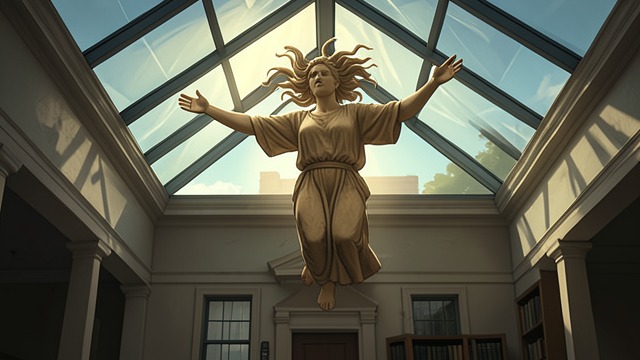
A Woman Above the House
A figure in sandstone
Petro carves a woman with extended hands and unruly hair, placing her above the salon. He calls her the jar-woman and studies her through the glass roof.
Art with an inner life
The sculpture seems to Stefania to wait or pray. It gives physical form to the villa’s mysterious, unstable imagination.
Felix Finds a Nest
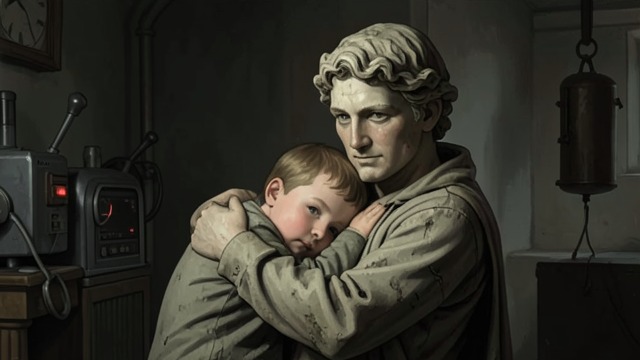
Shelter in the Sculpture
A hidden child
During a search, Stefania finds Felix curled in the statue’s arms. He appears comfortable there, looking out at her without fear.
A chosen refuge
The stone figure provides a place that does not demand conventional behavior. Felix’s use of the sculpture suggests that Petro’s art can become shelter for a living person.
The Attic Above the Salon
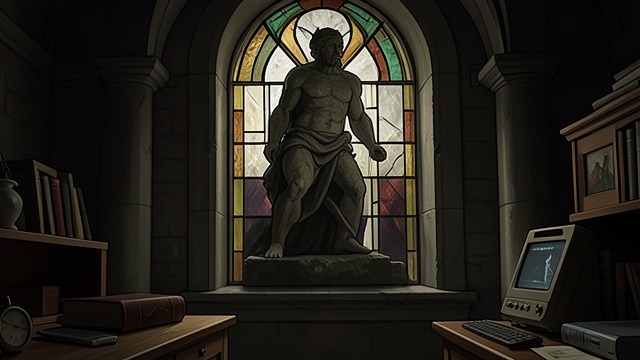
A Figure Seen from Below
An object in the house
From the salon, the sculpture is part of Petro’s strange domestic world, visible through the stained glass. Felix repeatedly returns to its embrace, while the adults do not fully understand the attraction.
Shelter and secret converge
The statue’s interior links the child’s hiding places to the hidden sacred objects. The house’s art is not only decorative; it participates in the plot’s concealed history.
The Statue Falls
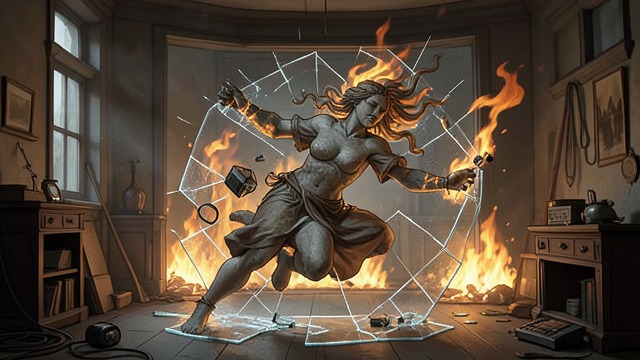
Stone Enters the Burning Room
The roof gives way
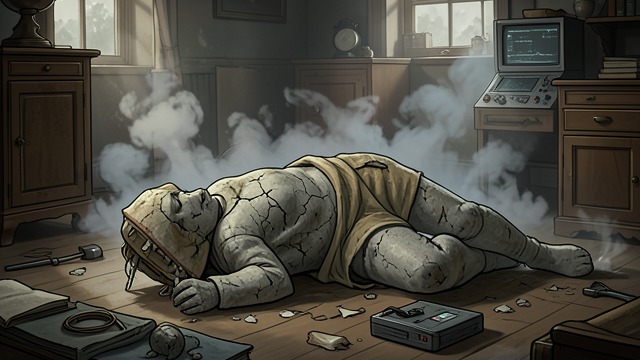
As the fire consumes the house, the glass roof collapses and the stone woman crashes into the room beside Stefania and Adèle.
A secret is uncovered
Relics spill from the vessel she carries. The sculpture’s artistic mystery becomes material evidence, linking the domestic refuge to the thefts that have haunted the city.
Life Cannot Be Preserved in Stone
The Image Remains
Art survives as memory
The falling sculpture does not save the house or settle the characters’ futures. Its significance persists through the forms of care and concealment it held.
A boundary unsettled
Petro can make stone seem alive, and Felix can make a carved angel appear living. Yet neither art nor apparent miracle can secure a stable world.
During the construction of the villa
Late summer 1900
Autumn 1900
During the final fire
At the novel’s close
