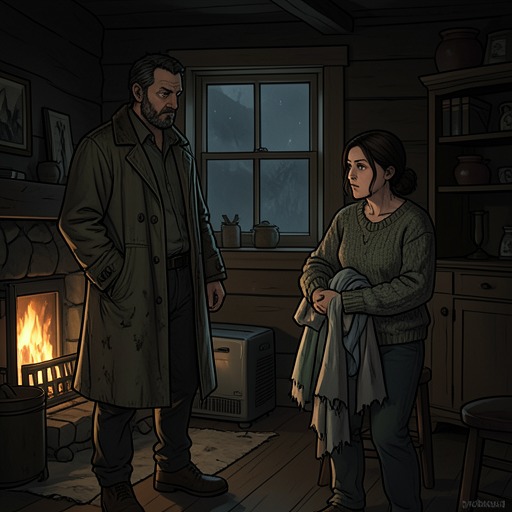
Winter at Tashmore
FirestarterWinter at Tashmore is both a season of precarious refuge and the turning point that pushes Andy McGee from hiding toward disclosure. At Granther McGee’s camp, the isolation protects Andy and Charlie McGee from immediate discovery, but illness, snow, and the memory of the Shop’s violence make clear that shelter is not the same as safety. In the stillness of Tashmore Pond, Andy begins to see that their story must reach the outside world.
A Winter of Confinement
The season follows Andy’s miserable awakening in an Ohio motel. For a while, the prediction he had made to Charlie—that things would somehow be all right—seems to have come true, but their refuge is far from idyllic. Shortly after Christmas, Charlie catches a cold that lasts until early April. She has a fever for a time, and Andy gives her halves of aspirin, privately setting a limit: if it has not gone down within three days, he will take her to a doctor across the lake in Bradford, whatever the consequences. The fever subsides, but the cough and sniffles persist through much of the winter.
Andy, too, is tested by the cold. He suffers a minor case of frostbite in March. On a screaming, subzero night in February, he overloads the woodstove and nearly overheats the cottage; Charlie wakes and discovers how dangerously hot the room has become. The reversal is characteristic of their precarious domestic life: the child he is trying to protect is, in that moment, the one who notices the danger first.
The passage of time is marked by two birthdays. Andy celebrates his on December 14; Charlie turns eight on March 24. She is now taller than his elbow, with long hair she braids away from her eyes. Andy looks at her with renewed wonder, recognizing that she is no longer a little girl and imagining the beauty she is growing into. These ordinary markers of growing up sit uneasily beside the extraordinary conditions in which she is growing up.
Snowbound Survival
They have no usable car. Irv Manders’s Willys Jeep freezes solid in January, and Andy suspects its block is cracked. He starts it every day out of responsibility, though he knows that even four-wheel drive could not get them out of Granther McGee’s camp after New Year. Snow lies nearly two feet deep, disturbed mainly by animal tracks. Three pairs of old cross-country skis are stored in a shed, but none fits Charlie, whom Andy keeps indoors as much as possible because he fears her fever might return.
For trips of necessity, Andy finds Granther McGee’s old ski boots in a cardboard toilet-tissue box beneath the table where Granther McGee once planed shutters and made doors. The boots are dusty and cracked. Andy oils and flexes them, but they are too large, so he stuffs their toes with newspaper. The practical fix carries a more troubling thought: he cannot quite fill Granther McGee’s shoes, and he wonders what the old man would have made of their predicament.
About six times, Andy straps on the difficult old skis—an entanglement of straps, buckles, and rings rather than modern snap bindings—and crosses Tashmore Pond to Bradford Town Landing. From there, a winding road leads two miles east into Bradford, New Hampshire. He leaves before first light with Granther McGee’s knapsack and does not return before three in the afternoon. On one trip he barely beats a howling snowstorm that could have left him lost and blinded on the ice. Charlie cries with relief when he gets back, then breaks into a long, alarming coughing fit.
The journeys bring clothes and supplies. Andy uses Granther McGee’s money, then breaks into three large camps at the far end of Tashmore Pond and takes the money kept in their cookie jars—roughly thirty or forty dollars from camps he estimates could sell for about eighty thousand dollars apiece. He is not proud of the theft, but regards it as necessary to keep them alive. He also takes about forty gallons of range oil from the drum behind a modern cottage named CAMP CONFUSION. The scale of the thefts is small beside the owners’ presumed means, but each is part of the same practical calculation: survival has narrowed his choices.
From Refuge to Decision
The crossings also give Andy time to think. In February, with four feet of snow over the ice, the pond can appear like a long corridor of dazzling white, edged by sugar-dusted pines beneath a hard blue sky or the blank whiteness of approaching snow. The silence and exertion clear his head. Andy remembers the physical satisfaction of sweating as he works, a feeling he had lost while teaching Yeats and Williams and correcting bluebooks.
The clarity does not make their position less dangerous. Andy recognizes that they came to Granther McGee’s place for the winter but are still running. His unease around the old-timers who sit by the stove, smoking pipes and watching them inquisitively, makes their continued exposure harder to ignore. He and Charlie are cornered, and he believes some way out must be found. He remains angry that his family, American citizens in what is supposed to be an open society, have been hunted: his wife was murdered and his daughter kidnapped.
Andy considers telling their story to one person or several, believing that public knowledge might destroy the Shop’s ability to continue. Until now, he has held back partly because the strange hypnotic influence connected to Vicky’s death has not entirely lifted. He fears that Charlie would be treated as a sideshow freak or institutionalized, supposedly for the country’s good or her own. He also recognizes that he has kept lying to himself, even after finding Vicky’s body hidden in the laundry ironing closet, by believing that eventually they would be left alone. The refuge at Tashmore has given them time, but it has not made that hope credible.
At last, Andy makes the painful decision to act. He writes six nearly identical letters: two to Ohio’s United States senators, one to the woman representing Harrison in the U.S. House of Representatives, and one each to The New York Times, the Chicago Tribune, and the Toledo Blade. The letters trace what happened from the experiment at Jason Gearneigh Hall to the enforced isolation on Tashmore Pond. In this way, the winter’s repeated journeys across the ice lead toward a different crossing: Andy stops treating concealment as a permanent answer and prepares to make their account public.