C-space
FirewallC-space is the recurring, unexplained term in Tynnes Falk’s diary for activity, messages, and a presence that may be reached through a computer network. Its significance lies in the contrast it creates: Falk’s notes appear to catalogue ordinary days with clerical precision, yet their references to C-space point toward a concealed electronic world that has real consequences beyond his flat.
The Diary’s Private Vocabulary
Falk’s diary records weather, temperatures, domestic tasks, and walks in unusually exact detail. Against these ordinary observations, C-space appears as a compressed private vocabulary. In the entry for Saturday, October 4, 1997, Falk notes that there has been no activity there, no messages, and no reply from C when prompted; he concludes that all is calm. The entry does not explain what C-space is, who or what C might be, or what kind of communication Falk expects. Its terse statements establish a routine of waiting and checking without disclosing its object.
The dated details make the unexplained notation more striking. Falk records gusty winds of 8–10 metres per second, broken cloud, and temperatures of 7°C at six in the morning and 8°C at two in the afternoon. He then places the uneventful status of C-space beside those measurements as if both belong in the same daily ledger. This flat, orderly form gives the unknown a place among verifiable facts while withholding the key that would make it intelligible.
The diary also shows how completely Falk’s habits organize his account of himself. He records that cleaning his flat took three hours and twenty-five minutes, compares the time with the previous Sunday, and notes meditation at St Maria’s Church and a walk to the marina. In the October 5 entry, the weather, cleaning, and possibility of an evening walk recur alongside the computer-related notation. Falk even hesitates over how to describe the walk, pressing blotting paper over the line he has written. The routine therefore contains both scrupulous record-keeping and small acts of revision, but C-space remains the most consequential item whose meaning is left unrecorded.
Wallander’s Interpretation
When Kurt Wallander examines Falk’s diary, the recurring references do not immediately resolve into a comprehensible system. He sees that some entries report quiet and others mention messages, but he cannot tell what the messages are or whom Falk is addressing. The notation that C does not reply when prompted makes the entries sound like an exchange, yet the diary supplies no names or explanation. Wallander finds the absence of names especially strange in a record that otherwise preserves so much detail.
The term takes on a possible meaning when Wallander returns with Martinsson to Falk’s flat on Runnerströms Torg. Wallander connects C-space with cyberspace because the words resemble one another, and Falk’s computer offers a concrete counterpart to the diary’s obscure reports. The association is suggestive rather than a full explanation: the scene establishes no independent definition of C-space, and Wallander still does not know what message Falk had been waiting for.
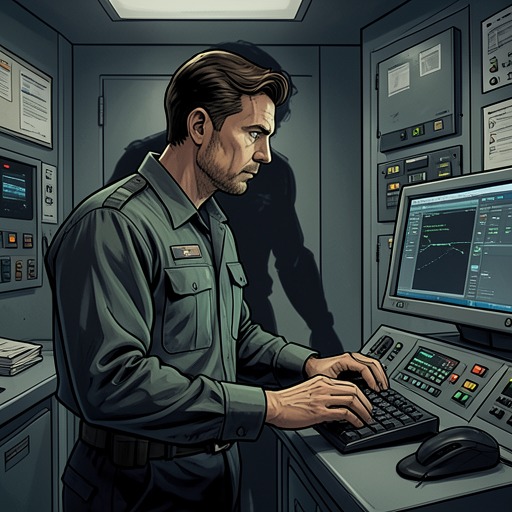
Martinsson finds that the computer automatically connects to a server when switched on. When he tries to open a file, a blinking cursor makes him suspect that someone elsewhere has been notified of the attempt. The system is protected by complicated codes and barriers, and Martinsson cannot initially get in. He later determines that someone used the computer the previous night. That discovery changes the significance of Falk’s apparently private notation: access to the computer and its material is not necessarily confined to Falk or to someone entering his flat.
A Network Beyond the Flat
The computer’s remote connections place Falk’s private routine within a larger, unseen system. Martinsson explains that a person connected to the Internet may be anywhere in the world, or even in another flat in the same building. The distance between Falk’s carefully ordered room and an unknown user elsewhere is therefore not a reliable boundary. C-space, in Wallander’s tentative reading, names something less like a place than a networked condition: activity whose participants and location cannot be inferred from the diary alone.
Carter’s experience in Luanda supplies a further, disturbing connection. He follows daily checks on Falk’s computer system, which Falk created from Carter’s instructions, and receives a flashing icon indicating that someone has broken through its first layer of security in Ystad. Carter consults a manual written by Falk and realizes that the breach is real, though the deeper layers remain protected. His alarm confirms that the computer is watched and connected to interests well beyond the police investigation; it does not, by itself, identify C or establish that every diary reference to C-space describes this particular breach.
Meaning and Uncertainty
C-space gives Falk’s diary a double character. Its weather reports and cleaning times make the pages look like a record of predictable, controlled life, while the references to messages and prompts imply communication with an absent other. The diary never supplies enough information to decide whether C is a person, a system, or a designation for something else. That silence is part of the expression’s force: it converts a technical mystery into a pattern of expectation, response, and nonresponse.
The gap between Falk’s impersonal notes and the computer’s hidden connections also shapes the investigation. Wallander can find the machine and observe its protections, while Martinsson can establish that it has been accessed remotely; neither discovery immediately reveals what the messages mean. C-space thus marks the point where a private record opens onto a network whose participants remain difficult to locate. The calm Falk records is not proof that nothing is happening. In the computer’s world, an apparently quiet interval can coexist with distant access, concealed communication, and a breach that Carter recognizes before Wallander understands its reach.