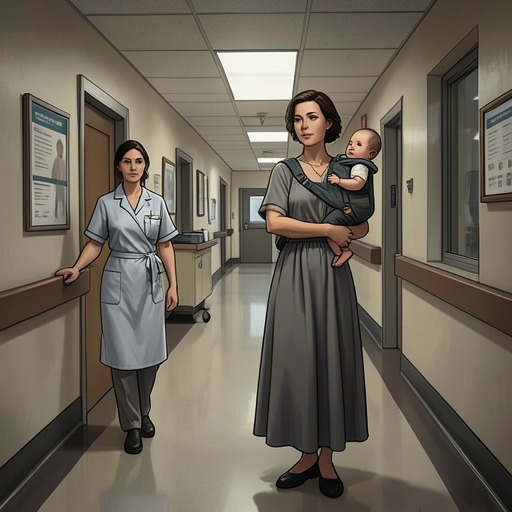
Sybil’s pregnancy is revealed
Forever...Sybil’s pregnancy is revealed to Katherine by Erica in a brief school conversation that opens onto a much larger story of secrecy, reproductive choice, and the limits imposed by family expectations. Erica’s account makes clear that Sybil has continued attending school while concealing the pregnancy, intends to place the baby for adoption, and has kept her decision from her parents because she believes they would insist on an abortion. The later birth and departure of the baby with her adoptive parents give the revelation a concrete, difficult aftermath.
The News and Its Circumstances
Erica first tells Katherine that she has secured a job at Westfield’s weekly newspaper, The Leader. When she is waiting for Katherine again the following morning, she shifts her books from one arm to the other and shares a different piece of news: Sybil is pregnant. The revelation comes through Erica rather than from Sybil herself, and Katherine initially responds with shock. As Erica fills in the circumstances, the scale of what Sybil has kept hidden becomes apparent.
The baby is due in early July. Katherine works backward from that date and concludes that Sybil became pregnant in October; Erica confirms the timing and adds that Sybil has not missed a day of school. The ordinary continuity of school attendance had helped the pregnancy remain undisclosed. Sybil wore loose, tent-like clothes that concealed her changing shape, and she told a doctor that she was married, supplying a false name and address. These details show that the concealment was sustained and deliberate, not simply a matter of her friends failing to notice.
Sybil’s Decision and the Secrecy Around It
Erica explains that Sybil wanted to have the baby. She also says Sybil believed that, if her parents discovered the pregnancy, they would make her have an abortion. Sybil’s silence therefore protects a decision she had already made, while leaving her to manage the pregnancy without her parents knowing. The account does not establish who the father is: Erica specifically reports that Sybil does not know. Nor does it suggest that Sybil intends to raise the child herself. She knows she cannot keep the baby and plans to place it for adoption as soon as it is born.
When Katherine asks why Sybil would continue the pregnancy if she could not keep the baby, Erica reports Sybil’s answer: she wanted the experience. That stated reason sits beside the practical plan for adoption, without resolving the tension between carrying a child and relinquishing it. The account presents Sybil’s intention as her own, but also makes its conditions visible: she anticipates parental opposition, conceals the pregnancy, and expects the baby to leave with adoptive parents after birth.
Katherine and Erica’s Reactions
Katherine and Erica’s conversation turns from the revelation to what each of them would do in a comparable situation. Erica says she would have an abortion. She also tells Katherine that her mother, alarmed by Sybil’s pregnancy, has arranged for her to see a gynecologist and wants her to take the Pill. Erica says that she is still a virgin, but intends to take it because she likes being prepared and hopes it might also help Artie feel more secure. Her response links the public news about Sybil to a private decision about her own sexual and reproductive circumstances.
The conversation does not treat the Pill as evidence that Erica is sexually active: she explicitly tells Katherine she is a virgin. Instead, her mother’s concern and Erica’s willingness to prepare for the future show how the revelation changes the family conversation around contraception. Erica’s response also differs from Sybil’s situation: she imagines preventing a pregnancy, while Sybil has already decided to continue hers and arrange an adoption.
Katherine’s own earlier visit to Planned Parenthood provides a further contrast in the novel’s treatment of preparation and responsibility. At the clinic, she attends a group discussion about birth-control methods and a private session with a social worker, where she explains that she considers preventing pregnancy her responsibility. The visit is not presented as a direct result of Erica’s news; rather, placed alongside it, it shows that questions of contraception and pregnancy are already part of Katherine’s experience before Sybil’s circumstances are disclosed.
Birth, Adoption, and Significance
The pregnancy’s later outcome confirms the plan Erica described. After Sybil gives birth to a girl, Erica and Katherine visit her with daisies. Sybil says the birth was not as difficult as the films she had seen suggested, asks whether they have seen the baby, and talks rapidly about her graduation, which she had hoped to attend. She expects her diploma to be mailed to her. Her talk also turns to future plans, including losing weight and going to Smith, placing the birth within a life that she imagines continuing beyond the immediate crisis.
Sybil says she intends to get an IUD so that she will not become pregnant again, while making clear that she does not intend to give up sex. She also says that, if she has another child, she wants to be in a position to keep it. That distinction gives her adoption plan a future-facing dimension: she is not describing motherhood as permanently impossible, but separating this pregnancy from the circumstances under which she would choose to raise a child.
The baby is due to leave with her adoptive parents on Friday. Sybil hopes the child will have a good life and believes that two people who deeply want a child will care for her. Erica agrees that this is the best arrangement, while Katherine feels a lump in her throat and hopes Sybil will not cry. The revelation therefore leads not to a simple resolution but to an acknowledged separation: Sybil has carried out her decision to give birth, and the baby is about to leave for a different family. Through that sequence, the novel places personal choice alongside secrecy, anticipated parental control, contraception, and the practical reality of adoption.