Cattle
FosterCattle recur in Unnamed girl's account as living animals and as part of the rural economy that surrounds her. A red Shorthorn lost by Dan in a card game, Friesian cows grazing in John Kinsella's fields, a heifer that remains missing, and calves fed milk replacement each enter the narrative differently. Together, these brief appearances join the child's attentive view of animals to the adult systems of betting, selling, milking, and tending that govern farm life.
Identity and Place in Farm Life
On the journey from Clonegal toward the coast in Wexford, cattle are already part of the family history carried along the road. Dan once lost the family's red Shorthorn in a game of forty-five in Shillelagh. The man who won the heifer later sold her at the mart in Carnew. The animal's movement from family possession to a card-game stake and then to sale gives cattle an economic presence before Unnamed girl has even arrived at the Kinsellas' farm. Her summer placement begins within a world where an animal can be remembered both as a particular loss and as something traded.
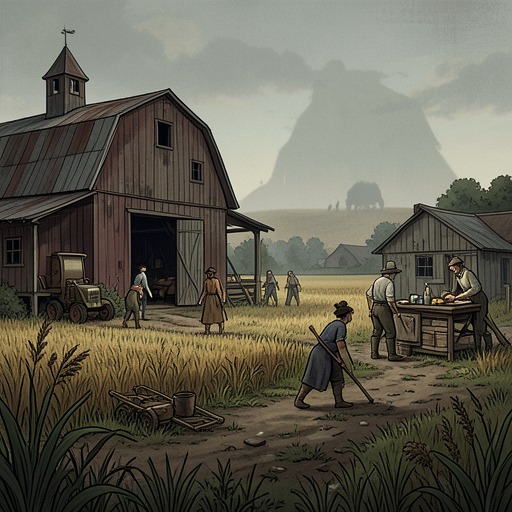
At the Kinsellas' property, cattle are part of the landscape Unnamed girl learns by walking through it. Edna Kinsella takes her down the fields with the zinc bucket, past broad, level strips divided by electric fences. Friesian cows stand grazing together on one strip. They look up as the pair passes but do not move away. The child's attention settles on their large udders and long teats, and on the sound of them pulling grass from its roots. This close observation makes the animals more than distant farm scenery: their bodies, feeding, and stillness become specific features of her new surroundings.
Cattle as Property and Economic Measure
The conversation between Dan and John Kinsella after their first meeting turns from the weather and the need for rain to the price of cattle, alongside the EEC, butter mountains, lime, and sheep-dip. The exchange is one of the subjects through which the men maintain conversation without speaking directly about themselves. Cattle therefore belong both to the practical business of farming and to a familiar language of rural talk: their price sits among concerns about markets, land, and agricultural supplies.
The lost Shorthorn on the journey offers a more personal instance of that economy. Dan's loss in the game is followed by the winner's sale of the animal at Carnew, so the recollection gives the heifer a brief sequence of changing ownership and destination. It also places a concrete animal behind the abstract talk about cattle prices. The account does not dwell on the loss, but its mention in the passing geography of the drive shows how readily a remembered wager can mark a place: Shillelagh is where the animal was lost, and Carnew is where she was sold.
Grazing, Water, and the Child's Attention
The walk through the fields presents the herd at the scale of Unnamed girl's senses. Wind bends sections of longer grass until they turn silver; the cows graze among it, occasionally raising their heads as the child and Edna Kinsella pass. Their lack of alarm contrasts with the narrator's initial unease in unfamiliar clothes, which fades as she walks. The scene keeps human feeling and animal presence together without making the cows simply a symbol: they continue feeding, and she watches what they do.
The walk proceeds past the cattle toward a dry path, a small iron gate, and stone steps leading down to a well. Edna Kinsella leaves the bucket on the grass and points out the water, remarking on the lack of rain since the start of the month. The passage places the well, the drought, and the grazing animals within the same farm landscape. It does not describe the cattle drinking from the well, but its sequence makes water and livestock part of the practical surroundings through which Unnamed girl is being introduced to the farm.
Missing Animals and Repeated Loss
Later, while Unnamed girl walks home from the wake, a woman tells her a story about the Kinsellas' dead son and the family dog. As the account moves along the road, the lost heifer also appears again: she is still lost, now in a different part of the road. The repeated mention turns the animal's disappearance into a small, unresolved thread within a much graver conversation. The heifer has not been found in the intervening telling; the landscape shifts around her absence.
That recurrence also contrasts with the specificity of the earlier sale. The Shorthorn's fate is recounted as a completed transfer, from wager to market, whereas the later heifer remains missing. Cattle in the narrative are thus not only possessions that can be priced or sold. Their presence and absence are registered as changing facts of the countryside, sometimes resolved by human action and sometimes left open as Unnamed girl continues walking.
Calves and the Work of Milk Production
Near the end of the stay, Unnamed girl and John Kinsella go out to look at the feeding calves. He has mixed their milk replacement with warm water, and the calves suck it through long rubber teats until the teats run dry. The practical arrangement strikes her as odd: the calves are taken off their mothers and fed replacement milk so that John Kinsella can milk the cows and sell their milk. Yet the calves appear content as they feed.
This scene makes the farm's production routine visible through a child's combination of observation and judgment. The rubber teats, the prepared feed, and the emptying supply show the work in concrete steps; her sense that the arrangement is strange registers the separation between the calves and their mothers. Their apparent contentment complicates, without erasing, that impression. In the account's broader pattern, cattle are at once individual animals watched closely and participants in a system shaped by sale, milking, and daily care.