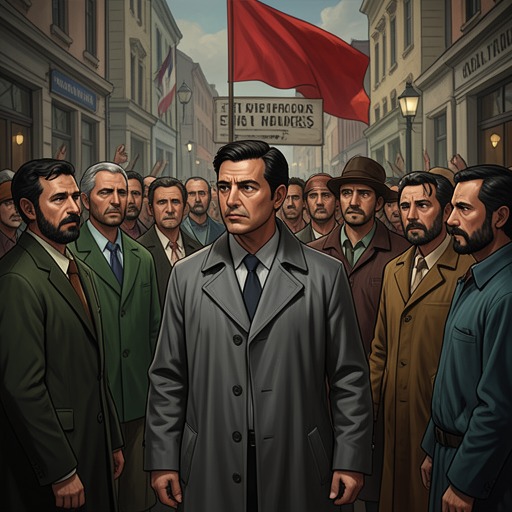
“people of Donbas”
Grey Bees“People of Donbas” is a designation for ordinary residents shaped by the region’s industrial history and rendered newly precarious by war. The novel places Sergey Sergeyich, a disabled pensioner and devoted beekeeper, within this category: a man who seeks to keep his life—and his bees—out of the conflict, yet cannot avoid its political and human consequences.
Meaning and Background
The phrase emerges from a landscape of coal mines and metallurgical plants. In the Soviet period, residents could take pride in playing an inconspicuous part in what the narrator calls the “great industrial whole.” The designation “people of Donbas” extends that anonymity: Russians use it as if the inhabitants were children of mines and slag heaps, without ethnic roots. It identifies a regional population, but also risks reducing its members to the place and labor that define them from outside.
The novel’s foreword sets this identity against the war’s transformation of everyday life. Residents who remain in the grey zone try not to attract attention, while the war becomes a harsh routine rather than a distant military event. Sergey Sergeyich embodies that quiet endurance. He is not introduced as a soldier or political actor, but as a disabled pensioner whose beekeeping gives his days practical purpose and whose wish to remain neutral is tested by events around him.
Sergey Sergeyich as a “Person of Donbas”
The label becomes concrete in Sergey Sergeyich’s movements. As fighting and political control reshape his home region, he carries his apiary away in a green Lada with a flatbed trailer. He plans the journey around the bees’ needs: closing hive entrances, loading the hives one by one, covering them against rain, and securing them for the road. He packs jars of honey as well, treating the product of his work as a dependable form of value. The departure is both a practical relocation and a break from the home that had seemed to protect him.
At a checkpoint, his claim to belong to the grey zone becomes a matter of paperwork and suspicion. When Sergey Sergeyich says he is from Little Starhorodivka, near Karuselino, soldiers check his residence permit and question why he is entering through territory they associate with the separatist authorities. They inspect his mobile phone and passport, briefly separating him from the documents and connections by which he can explain himself. His identity is thus neither simply local nor safely legible: it must be negotiated at a military boundary.
Crossing onward toward Crimea does not restore uncomplicated belonging. At the border post, the route is made visible through barriers, queues, documents, and official scrutiny; a sign identifies the Dzhankoy checkpoint, while a marker he remembers from the approach to Chonhar describes the Russian occupiers as eighteen kilometres away. The ordinary traveler’s passage is shaped by competing political claims made tangible in roads and controls.
Work, Exchange, and Everyday Continuity
Beekeeping gives Sergey Sergeyich a role that exceeds ownership. He understands himself as representing the bees’ legitimate interests: their need is to gather nectar and pollen, while he watches over their health, keeps wasps from their hives, uncaps combs, and collects honey, wax, and pollen. Their lives have their own order, which he does not claim to direct. His work and his sense of meaning are bound together, even though the bees perform most of the labor themselves.
The bees also help him establish a foothold after relocation. He exchanges honey for food at Nadya’s shop, where the shopkeeper Galya gives him credit worth 560 hryvnias when he cannot take enough groceries to match the honey’s price. That credit feels like renewed stability: honey can be converted into food, and a local relationship begins to replace the insecurity of the journey. Later, sales expand to neighboring villages; Galya pays in advance, and Sergey Sergeyich keeps cash in the glove compartment of his Lada. The trade remains warm and friendly rather than becoming merely a business arrangement.
Neutrality Tested
The foreword describes Sergey Sergeyich’s southern stay as an ordeal because he cannot remain entirely neutral while witnessing the oppression of Crimean Tatars by the new authorities. His sympathy draws suspicion from the Russian security service and places the bees he loves at risk. The phrase “people of Donbas,” initially associated with unobtrusiveness and industrial belonging, therefore does not mean political indifference can be maintained without consequence.
The novel’s recurring attention to small necessities sharpens this tension. In a wartime winter, church candles and the absence of electricity make a mention of lard awaken a longing for former comforts; Sergey Sergeyich’s supplies are easier to enumerate as honey, vodka, tinctures, and bee-pollen remedies than as ordinary household goods. Later, the five hundred and sixty hryvnias of shop credit provide a modest measure of security. Such exchanges do not end the war or settle questions of allegiance, but they show how survival depends on goods, local trust, and the ability to keep working.
Significance of the Expression
The expression holds together anonymity and attachment. Sergey Sergeyich wants to stay outside the conflict, yet his home, movements, documents, and sympathy make neutrality increasingly difficult. The bees make that predicament more than a political abstraction: their hives must be transported under suitable conditions, their health requires attention, and their honey becomes food and currency. War disrupts the shared life on which his work depends even when he is not fighting.
By placing a beekeeper rather than a combatant at the center, the novel gives “people of Donbas” a particular human scale. The phrase can erase ethnic distinction and make inhabitants seem like an extension of industry; Sergey Sergeyich’s painstaking care, economic exchanges, and uncertain passage across borders instead reveal a person with attachments and obligations. His story turns a broad regional label into a lived condition: the effort to continue ordinary work and preserve a home while war keeps redefining where he belongs.