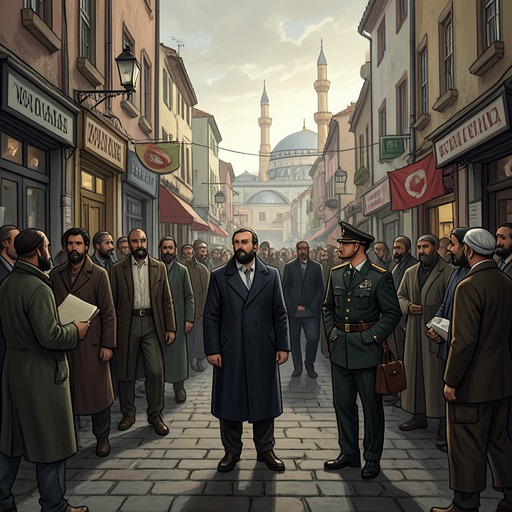
December 31, 1970–late 1980s
A Childhood in Rosso
[Mohamedou Ould Slahi](entity:character-recall-character-mohamedou-ould-slah-6414e78ef21b) was born in Rosso, [Mauritania](entity:location-recall-location-mauritania-9b66e1d0e02e), the son of a nomadic camel trader. After the family moved to [Nouakchott](entity:location-recall-location-e4317bc4d8dc), his father died, and Mohamedou’s promise as a student helped make him feel responsible for a large household.
He memorized the Qur’an, excelled in mathematics, and won a scholarship to study in [Germany](entity:location-recall-location-germany-2e3723c2f347). Leaving home for a university abroad was an extraordinary step for both him and his family.
Late summer 1988
The Journey to Germany
[Mohamedou Ould Slahi](entity:character-recall-character-mohamedou-ould-slah-6414e78ef21b) left [Mauritania](entity:location-recall-location-mauritania-9b66e1d0e02e) for [Germany](entity:location-recall-location-germany-2e3723c2f347), the first member of his family to attend university and the first to travel by airplane. His mother, [Maryem Mint El Wadia](entity:character-recall-character-maryem-mint-el-wadi-5d66f197c84b), was distraught at his departure, while the family hoped he would eventually support them.
In Germany he began studying electrical engineering, setting out on the life his family had imagined for him: education, work, and a future beyond Mauritania.
Early 1991
Training in Afghanistan
During the [Afghan war against communism](entity:time-recall-time-b9685b0f7d5d), [Mohamedou Ould Slahi](entity:character-recall-character-mohamedou-ould-slah-6414e78ef21b) left his studies to attend training at Al Farouq training camp near Khost. He received basic weapons instruction and swore allegiance to [al-Qaeda](entity:organization-recall-organization-al-qaeda-a60f75aa03fa), which operated the camp.
At the time, the Afghan resistance had Western support, and Mohamedou understood his participation as a religious and political cause. That early oath later became a central element in the case used to justify his detention.
Early 1992
The Fall of Kabul
As the communist government in [Afghanistan](entity:location-recall-location-afghanistan-ea09a8d619a6) neared collapse, [Mohamedou Ould Slahi](entity:character-recall-character-mohamedou-ould-slah-6414e78ef21b) returned to the country and joined a unit commanded by [Jalaluddin Haqqani](entity:character-recall-character-jalaluddin-haqqani-6852414c902f) near Gardez. The city fell soon after his arrival.
When rival mujahideen factions began fighting each other after the government’s collapse, he decided he had no reason to remain. He returned to [Germany](entity:location-recall-location-germany-2e3723c2f347), later describing the end of that fighting as the end of his own connection to [al-Qaeda](entity:organization-recall-organization-al-qaeda-a60f75aa03fa).
1990s
A Life in Duisburg
Back in [Germany](entity:location-recall-location-germany-2e3723c2f347), [Mohamedou Ould Slahi](entity:character-recall-character-mohamedou-ould-slah-6414e78ef21b) completed his electrical-engineering degree at the University of [Duisburg](entity:location-recall-location-3e281aa7426e) and built a life there with his Mauritanian wife. He worked and stayed in touch with some former Afghan companions, several of whom retained [al-Qaeda](entity:organization-recall-organization-al-qaeda-a60f75aa03fa) connections.
His cousin and brother-in-law, [Mahfouz Ould al-Walid](entity:character-recall-character-mahfouz-ould-al-wal-616100c05b42), also known as [Abu Hafs](entity:character-recall-character-abu-hafs-ee89e7c4daf1), was a senior al-Qaeda figure. Mohamedou remained in occasional contact with him and twice helped transfer money to his family in [Mauritania](entity:location-recall-location-mauritania-9b66e1d0e02e).
1998–November 1999
Hajj and Canadian Plans
[Mohamedou Ould Slahi](entity:character-recall-character-mohamedou-ould-slah-6414e78ef21b) and his wife performed the hajj in 1998. Unable to secure permanent residency in [Germany](entity:location-recall-location-germany-2e3723c2f347), he later applied to immigrate to [Canada](entity:location-recall-location-canada-a93ef5aae6af) on a friend’s recommendation.
In November 1999 he moved to [Montreal](entity:location-recall-location-646e9d3b6877), stayed with a former classmate and then at al-Sunnah Mosque, where he sometimes led [Ramadan](entity:time-recall-time-ramadan-f9c07c79659e) prayers. His time there would be brief, but it brought him into the orbit of an investigation that followed him home.
Late 1999
The Millennium Plot Investigation
[Ahmed Ressam](entity:character-recall-character-ahmed-ressam-6885aeb78847), an [al-Qaeda](entity:organization-recall-organization-al-qaeda-a60f75aa03fa) member based in [Montreal](entity:location-recall-location-646e9d3b6877), was arrested with explosives intended for an attack on [Los Angeles International Airport](entity:location-recall-location-000fe85e1a0b). He had left Montreal before [Mohamedou Ould Slahi](entity:character-recall-character-mohamedou-ould-slah-6414e78ef21b) arrived, but he had attended the same mosque and knew people connected to its community.
The arrest triggered intense scrutiny of Montreal’s Muslim community. Canadian authorities questioned Mohamedou, who recalled being frightened by the surveillance and interrogation and increasingly uneasy about remaining in [Canada](entity:location-recall-location-canada-a93ef5aae6af).
January 21, 2000
The Flight Home
After his family urged him to return, [Mohamedou Ould Slahi](entity:character-recall-character-mohamedou-ould-slah-6414e78ef21b) left [Montreal](entity:location-recall-location-646e9d3b6877), flying through [Brussels](entity:location-recall-location-e9a4f599452a) toward [Dakar](entity:location-recall-location-a60fc13a10c2). He had lived overseas for twelve years and expected to travel from [Senegal](entity:location-recall-location-b62cc72d4dd1) to [Mauritania](entity:location-recall-location-mauritania-9b66e1d0e02e) for a homecoming.
In Brussels he slept in the airport, prayed in its mosque, and met a Senegalese merchant who was traveling on the same flight. The trip that began as a return to family instead became the start of a long chain of detention.
January 21, 2000
Arrest at Dakar Airport
As [Mohamedou Ould Slahi](entity:character-recall-character-mohamedou-ould-slah-6414e78ef21b) left the airport in [Dakar](entity:location-recall-location-a60fc13a10c2) with his brothers and their companions, Senegalese agents seized him and the others. The arrest was sudden enough that he first thought it was a robbery; his brothers and their companions were detained too.
The group was taken to a police station, where the U.S.-requested investigation focused on the [Millennium Plot](entity:event-recall-event-millennium-plot-477a34676dd6). Mohamedou was frightened and bewildered, while the Senegalese authorities soon recognized that the large volume of allegations supplied by the [United States](entity:location-recall-location-5d55e9152db1) did not establish that he was a terrorist leader.
January 22–February 2000
The Senegalese Interrogation
Senegalese officials questioned [Mohamedou Ould Slahi](entity:character-recall-character-mohamedou-ould-slah-6414e78ef21b) about people and events connected to the [Millennium Plot](entity:event-recall-event-millennium-plot-477a34676dd6). The interrogator told a senior official that Mohamedou did not appear to be the head of a terrorist organization, and his brothers were eventually released.
U.S. representatives continued to influence the case, and Mohamedou remained in custody while Senegalese officials sought direction. In jail he befriended an Ivorian man determined to migrate to Europe, sharing food and listening to his stories amid mosquitoes and poor conditions.
February 2000
Transfer to Mauritania
Senegalese officials eventually released [Mohamedou Ould Slahi](entity:character-recall-character-mohamedou-ould-slah-6414e78ef21b) from their custody but transported him to [Mauritania](entity:location-recall-location-mauritania-9b66e1d0e02e) rather than allowing him to choose his destination. He was returned by a small private plane, accompanied by Senegalese officials and an American representative.
During the flight he asked that his family be told he was in the country. The Senegalese did so and publicly confirmed the handover, a disclosure that angered both the American and Mauritanian authorities.
January–February 2000
Interrogation in Nouakchott
Mauritanian security officials held [Mohamedou Ould Slahi](entity:character-recall-character-mohamedou-ould-slah-6414e78ef21b) in a filthy, mosquito-filled facility and questioned him about his life, his time in [Canada](entity:location-recall-location-canada-a93ef5aae6af), and his contacts. American investigators supplied questions and sought intelligence about [Ahmed Ressam](entity:character-recall-character-ahmed-ressam-6885aeb78847), [Abu Hafs](entity:character-recall-character-abu-hafs-ee89e7c4daf1), and jihadist networks.
At first Mohamedou withheld parts of his [Afghanistan](entity:location-recall-location-afghanistan-ea09a8d619a6) history, believing the [United States](entity:location-recall-location-5d55e9152db1) had no right to demand an account of conduct that was not illegal. Afraid of torture and a televised confession, he eventually chose to tell the Mauritanian interrogator the full story of his Afghan trips.
February 19, 2000
Release and Homecoming
After American agents questioned [Mohamedou Ould Slahi](entity:character-recall-character-mohamedou-ould-slah-6414e78ef21b), Mauritanian officials concluded that they had no evidence against him. He was released, and the authorities publicly affirmed his innocence.
He returned to his family after years abroad, resumed work, and tried to settle into ordinary life. He later compared his struggle to convince the U.S. government of his innocence to a man trying to persuade a rooster that he was not corn.
2000–September 2001
Life Under Suspicion
[Mohamedou Ould Slahi](entity:character-recall-character-mohamedou-ould-slah-6414e78ef21b) worked in [Nouakchott](entity:location-recall-location-e4317bc4d8dc) as an electrical and computer specialist and supported a large family. The U.S. investigation nevertheless continued, and he remained uneasy about being watched and repeatedly questioned.
On September 29, 2001, Mauritanian authorities detained him again at the request of the [United States](entity:location-recall-location-5d55e9152db1). FBI agents questioned him about the [Millennium Plot](entity:event-recall-event-millennium-plot-477a34676dd6), and the government searched his home before releasing him in October.
September 11, 2001
The September Attacks
The attacks on the [United States](entity:location-recall-location-5d55e9152db1) transformed [Mohamedou Ould Slahi](entity:character-recall-character-mohamedou-ould-slah-6414e78ef21b)’s situation. Although Mauritanian officials had previously told his employer that he was cleared, U.S. authorities again pressed [Mauritania](entity:location-recall-location-mauritania-9b66e1d0e02e) to detain and question him.
The attacks also provided the political backdrop for a widening detention campaign. Mohamedou would later argue that governments used fear and broad suspicion to bypass ordinary legal protections and build cases from association rather than proven acts.
September 29, 2001
The Wedding and the Call
On the day of his niece’s wedding, [Mohamedou Ould Slahi](entity:character-recall-character-mohamedou-ould-slah-6414e78ef21b) helped organize transport for guests and later attended a dinner with friends. During the gathering, the head of [Mauritania](entity:location-recall-location-mauritania-9b66e1d0e02e)’s state security service called and asked him to come see him.
Mohamedou went willingly, leaving his car and belongings behind. He had been questioned before and expected another temporary detention, but this time his return home would not follow.
October 2001
A Second Release
Mauritanian authorities held [Mohamedou Ould Slahi](entity:character-recall-character-mohamedou-ould-slah-6414e78ef21b) for about two weeks and questioned him again with U.S. involvement. Investigators searched his home and workplace, seizing a computer and a cellphone, but found no charge to pursue.
The Mauritanian security director publicly declared him innocent, and his employer welcomed him back. Mohamedou returned to work, believing the repeated investigations had finally run their course.
October–November 2001
The Camel Rests Twice
[Mohamedou Ould Slahi](entity:character-recall-character-mohamedou-ould-slah-6414e78ef21b) resumed his job and helped prepare a bid to upgrade the [Presidential Palace of Mauritania](entity:location-recall-location-d8dee4ed2fbe)’s telephone and computer systems. A month after his release, he was again living with his family and planning for the future.
He later used a Mauritanian saying about a camel settling in two stages to describe how premature his relief had been. The [United States](entity:location-recall-location-5d55e9152db1) continued pressing the [Mauritanian government](entity:organization-recall-organization-a6999c5fcfaf), and his freedom was about to vanish again.
November 20, 2001
The Third Arrest
After a long workday during [Ramadan](entity:time-recall-time-ramadan-f9c07c79659e), [Mohamedou Ould Slahi](entity:character-recall-character-mohamedou-ould-slah-6414e78ef21b) returned to his mother’s home. Secret police officers arrived and said a senior official wanted to see him; he showered, changed, reassured his mother, and went with them voluntarily.
His family could have helped him escape through a neighboring house, but he chose to comply, believing that he had done nothing wrong and that the authorities would eventually clear him. He did not know that the arrest was the beginning of a secret transfer beyond [Mauritania](entity:location-recall-location-mauritania-9b66e1d0e02e)’s borders.
November 20–28, 2001
The Secret Custody
Mauritanian authorities held [Mohamedou Ould Slahi](entity:character-recall-character-mohamedou-ould-slah-6414e78ef21b) without allowing his family to visit or learn where he was. He became seriously ill, lost his appetite, and grew weak while officials debated how to respond to U.S. demands.
The Mauritanian security director eventually told him that the [United States](entity:location-recall-location-5d55e9152db1) wanted him sent to [Jordan](entity:location-recall-location-jordan-f8c5142d8daf), despite knowing that Mohamedou was innocent and despite constitutional barriers to extraditing a citizen. Mohamedou asked to see his mother and the president, but was told the decision was final and the operation secret.
November 28, 2001
Independence Day Rendition
On [Mauritania](entity:location-recall-location-mauritania-9b66e1d0e02e)’s Independence Day, officials prepared [Mohamedou Ould Slahi](entity:character-recall-character-mohamedou-ould-slah-6414e78ef21b) for transfer to [Jordan](entity:location-recall-location-jordan-f8c5142d8daf). The security director told him he would be gone only a few days and encouraged him to believe the trip might help establish his innocence.
The secret operation instead delivered him to Jordanian agents aboard a small aircraft. As he left his country without seeing his mother or saying goodbye, the national holiday became an emblem of Mauritania’s compromised sovereignty.
November 29, 2001
Arrival in Jordan
[Mohamedou Ould Slahi](entity:character-recall-character-mohamedou-ould-slah-6414e78ef21b) was blindfolded, handcuffed, and taken from the plane to a Jordanian detention facility. He had been told he was going to [Jordan](entity:location-recall-location-jordan-f8c5142d8daf) for a brief interview, but the guards’ treatment quickly made clear that he was not free to leave.
He was stripped, issued a prison uniform, and placed alone in a cell. Exhausted and frightened, he tried to understand why his country had delivered him to a foreign intelligence service and what accusations he would face.
Late 2001–early 2002
Interrogation in Wadi Sir
Jordanian intelligence questioned [Mohamedou Ould Slahi](entity:character-recall-character-mohamedou-ould-slah-6414e78ef21b) about the [Millennium Plot](entity:event-recall-event-millennium-plot-477a34676dd6), his Afghan training, and people he knew. Interrogators showed him photographs, asked him to write down the names of friends, and repeatedly promised that cooperation would send him home.
He believed the authorities had little substantial evidence, but he was isolated, denied contact with his family, and unsure what might happen next. Guards sometimes offered kindness, yet the prison’s secrecy and the interrogators’ threats left him living in constant fear.
December 2001–July 2002
Hidden from the Red Cross
[Mohamedou Ould Slahi](entity:character-recall-character-mohamedou-ould-slah-6414e78ef21b) discovered prison rules indicating that the [International Committee of the Red Cross](entity:organization-recall-organization-699fc64664b1) visited every two weeks. Guards moved him to a cellar around those visits, concealing him from the organization and denying him a chance to report his detention.
When he challenged the deception, his interrogator said he was being protected and would not be allowed to see the Red Cross. Mohamedou understood that the concealment was deliberate and that his detention depended on cooperation between the [United States](entity:location-recall-location-5d55e9152db1), [Mauritania](entity:location-recall-location-mauritania-9b66e1d0e02e), and [Jordan](entity:location-recall-location-jordan-f8c5142d8daf).
February 20, 2002
The Bombing of the Chief’s Car
A bomb attached to the car of [Jordan](entity:location-recall-location-jordan-f8c5142d8daf)’s counterterrorism chief exploded after the official and his driver had stepped away to buy cigarettes. Neither was injured, and the vehicle was destroyed.
Jordanian investigators pursued a suspect and reportedly tortured his innocent brother until the suspect surrendered. Mohamedou heard the account from guards and saw how readily detention and violence spread through the prison’s population, even to people with no proven connection to a crime.
Spring–summer 2002
The Jordanian Case Closes
After months of questioning, one of [Mohamedou Ould Slahi](entity:character-recall-character-mohamedou-ould-slah-6414e78ef21b)’s Jordanian interrogators concluded that he had not lied and closed his part of the case. The interrogator thanked him for cooperating and even asked whether he would work for the intelligence service.
The apparent resolution did not bring freedom. When Jordanian findings were passed to the [United States](entity:location-recall-location-5d55e9152db1), American authorities rejected the outcome, and questioning resumed. Mohamedou’s hopes of returning home collapsed as he realized that another government controlled his fate.
July 19, 2002
The Flight to Bagram
A U.S. team took [Mohamedou Ould Slahi](entity:character-recall-character-mohamedou-ould-slah-6414e78ef21b) from [Jordan](entity:location-recall-location-jordan-f8c5142d8daf), stripped him, placed him in a diaper, blindfolded and shackled him, and flew him to [Bagram](entity:location-recall-location-e477bb2a9cb7). He feared he was being taken to an American prison for life, though a guard’s reassuring gesture briefly revived his hope.
At Bagram he was processed and interrogated about senior Taliban and [al-Qaeda](entity:organization-recall-organization-al-qaeda-a60f75aa03fa) figures. His captors’ threats and theatrical displays made him suspect torture was possible, while his confusion about where he had landed underscored how completely others controlled his movements.
July 2002
Bagram’s Cells
At [Bagram](entity:location-recall-location-e477bb2a9cb7), [Mohamedou Ould Slahi](entity:character-recall-character-mohamedou-ould-slah-6414e78ef21b) spent time in isolation and saw other prisoners subjected to harsh treatment. He was shackled for long periods, denied ordinary sanitation, and watched guards punish detainees by hanging them from their hands.
He met fellow prisoners through the cells and learned fragments of their stories. The sight of their suffering unsettled him, but companionship and conversation also began to return after months of isolation in [Jordan](entity:location-recall-location-jordan-f8c5142d8daf).
Late July–August 4, 2002
Threats and the Cuba Transfer
Interrogators at [Bagram](entity:location-recall-location-e477bb2a9cb7) questioned [Mohamedou Ould Slahi](entity:character-recall-character-mohamedou-ould-slah-6414e78ef21b) about [al-Qaeda](entity:organization-recall-organization-al-qaeda-a60f75aa03fa) and the [Millennium Plot](entity:event-recall-event-millennium-plot-477a34676dd6). One threatened him with indefinite imprisonment and sexual violence; another tried to persuade him to cooperate by describing Guantánamo as humane and preferable to detention in [Egypt](entity:location-recall-location-egypt-831f7ba4f646).
Mohamedou preferred Guantánamo to remaining at Bagram, where interrogators controlled nearly every part of his life. He spoke with nearby detainees and believed the group might soon be moved, though they did not know what the journey would entail.
August 4–5, 2002
The Long Transport
[Mohamedou Ould Slahi](entity:character-recall-character-mohamedou-ould-slah-6414e78ef21b) was bound with thirty-four other detainees, subjected to searches and degrading processing, and loaded onto military aircraft. The journey involved tight restraints, painful goggles and ear protection, cold, hunger, and difficulty breathing.
After a long flight and transfer between planes, the group arrived at Guantánamo on August 5. Mohamedou was so exhausted he could barely stand, and the trip convinced him that the promised protections of American custody might not mean what he had hoped.
August 5, 2002
Processing at Guantánamo
At Guantánamo, guards took [Mohamedou Ould Slahi](entity:character-recall-character-mohamedou-ould-slah-6414e78ef21b) through medical processing, photographed him, drew blood, and placed him in isolation. He was weak, dehydrated, and unable to eat properly, and soon collapsed and required an IV.
He was held in a segregation block with other newly arrived prisoners. Though he had expected a quick review and a chance to go home, he had no clear information about his legal status or how long his detention would last.
August–September 2002
The First Guantánamo Interrogations
FBI-led interrogators questioned [Mohamedou Ould Slahi](entity:character-recall-character-mohamedou-ould-slah-6414e78ef21b) about his background and his connections. Some treated him politely, gave him food, and spoke with him about his experience in [Jordan](entity:location-recall-location-jordan-f8c5142d8daf); he took their manner as evidence that the [United States](entity:location-recall-location-5d55e9152db1) would respect the law.
He also met guards whose hostility and threats undermined that trust. Although he cooperated at first, the repeated questions and lack of an explanation for his detention gradually convinced him that answering them would not secure his release.
September–October 2002
The Hunger Strike
[Mohamedou Ould Slahi](entity:character-recall-character-mohamedou-ould-slah-6414e78ef21b) joined a hunger strike as detainees protested relentless interrogation, disrespect toward the Qur’an, and the absence of a process to challenge their detention. He could continue for only a few days before his physical condition forced him to stop.
The protest did not end the interrogations or create a path to release. Mohamedou later remembered detainees crying when they were transferred away from new companions, a small measure of how quickly the prison had become a substitute community.
September 2002
A New Detention Block
After a month in an isolation block, [Mohamedou Ould Slahi](entity:character-recall-character-mohamedou-ould-slah-6414e78ef21b) was transferred to a block where he could see other detainees and speak with them. He welcomed the move, hoping to become an ordinary prisoner rather than a special target.
Conditions still worsened: he heard that detainees were being put in cold rooms and subjected to painful interrogations. He began to understand that the camp’s rules and treatment could change without warning.
September 2002
The German Intelligence Visit
Two visitors from [Germany](entity:location-recall-location-germany-2e3723c2f347) questioned [Mohamedou Ould Slahi](entity:character-recall-character-mohamedou-ould-slah-6414e78ef21b) about people they suspected of terrorism. He challenged their authority to interrogate him abroad and said that he might one day identify them publicly.
The visitors told him they knew he was innocent but had come to ask about specific acquaintances. Their presence showed how multiple governments were using Guantánamo’s exceptional setting to question him outside ordinary legal procedures.
September 11, 2002
Ramzi’s Accusation
After [Ramzi bin al-Shibh](entity:character-recall-character-ramzi-bin-al-shibh-238671167b3e) was captured, interrogators told [Mohamedou Ould Slahi](entity:character-recall-character-mohamedou-ould-slah-6414e78ef21b) that bin al-Shibh had identified him as the person who once hosted him in [Germany](entity:location-recall-location-germany-2e3723c2f347) and suggested [Afghanistan](entity:location-recall-location-afghanistan-ea09a8d619a6) as a route toward jihad. Mohamedou acknowledged the brief visit but denied recruiting the men for an attack on the [United States](entity:location-recall-location-5d55e9152db1).
The accusation changed the tone of his interrogation. Mohamedou later noted that the story, as presented to him, did not fit the publicly known timeline of the September 11 plot, but his captors increasingly treated the association as evidence of responsibility.
Late 2002–early 2003
The Millennium Questions Return
Interrogators continued pressing [Mohamedou Ould Slahi](entity:character-recall-character-mohamedou-ould-slah-6414e78ef21b) about the [Millennium Plot](entity:event-recall-event-millennium-plot-477a34676dd6), his contacts in [Canada](entity:location-recall-location-canada-a93ef5aae6af), and alleged connections with people he barely knew. He repeatedly asked why he was imprisoned and what crime he was accused of, but officials offered no clear answer.
He began refusing to cooperate unless the interrogators explained the basis for his detention. They described him as part of a broad conspiracy, while he saw each disproven allegation replaced by another suspicion.
Late 2002–early 2003
The Video as Evidence
Interrogators showed [Mohamedou Ould Slahi](entity:character-recall-character-mohamedou-ould-slah-6414e78ef21b) a video of [Osama bin Laden](entity:character-recall-character-osama-bin-laden-fc389b5a8834) discussing the [September 11 attacks](entity:event-recall-event-september-11-attacks-8e527031f862). They presented the recording as proof of the plot, but Mohamedou asked what it had to do with him and insisted that he was not responsible for bin Laden’s actions.
The video supplied no direct evidence against him, yet it intensified the interrogators’ effort to make his associations stand in for proof. Mohamedou saw the presentation as another attempt to draw him into a story that did not belong to him.
August 2003
The Fake Family Letter
A military interrogator posing as a high-level official showed [Mohamedou Ould Slahi](entity:character-recall-character-mohamedou-ould-slah-6414e78ef21b) a fabricated Department of Defense letter claiming that his mother would be detained if he did not cooperate. The threat targeted his deepest fear: that his family would suffer because of him.
Mohamedou rejected the threat and told the visitor to do what he would. The episode made explicit that the interrogation was designed not merely to obtain information but to break his resistance through fear for his mother.
May–June 2003
The Special Team Takes Over
In May 2003, FBI agents who had led [Mohamedou Ould Slahi](entity:character-recall-character-mohamedou-ould-slah-6414e78ef21b)’s interviews left Guantánamo, and military interrogators assumed control. A special team assembled around him, while he was told that the next questioning would not be as friendly.
The change marked a turning point. He had hoped that people who understood the facts of his case might protect him, but the military team had greater power and treated his denials as resistance to be overcome.
June–August 2003
Round-the-Clock Interrogation
[Mohamedou Ould Slahi](entity:character-recall-character-mohamedou-ould-slah-6414e78ef21b) was subjected to repeated interrogation shifts, sleep deprivation, forced standing, cold exposure, threats, and sexual humiliation. His interrogators tied his hands and feet, deprived him of ordinary comforts, and told him that cooperation was the only way to sleep or receive warm food.
His health deteriorated, his back pain intensified, and his prayers were repeatedly prohibited. He remained silent during the worst treatment, convinced that any answer would be used to demand still more information.
August 25, 2003
The Mock Transfer
A masked team burst into the interrogation room where [Mohamedou Ould Slahi](entity:character-recall-character-mohamedou-ould-slah-6414e78ef21b) was meeting an interrogator, beat him, shackled him, and rushed him onto a boat. The staged journey was designed to make him believe he had been taken away from Guantánamo to a secret detention site.
During the transfer he was struck, made to swallow salt water, and passed between American and Arab interrogators who threatened further abuse. The operation culminated in his isolation in a dark, sealed cell, where his injuries were treated by a medic who also cursed him.
Late August–September 2003
Isolation and Hallucinations
In the isolated cell, [Mohamedou Ould Slahi](entity:character-recall-character-mohamedou-ould-slah-6414e78ef21b) had no reliable sense of day or night, little food, and almost no human contact. Guards controlled his water and sleep, and his health and mental state worsened as he tried to hold onto prayer and memory.
He began hearing voices that seemed to come from his family, music, and Qur’an recitations. He recognized that he was nearing a mental breaking point and prayed for guidance before asking to speak with an interrogator he considered more approachable.
September 2003
The Confession Begins
Under continuing pressure, [Mohamedou Ould Slahi](entity:character-recall-character-mohamedou-ould-slah-6414e78ef21b) began giving interrogators the incriminating answers they wanted. He understood that he had no genuine crime to confess, but that refusing to speak meant continued agony and sleep deprivation.
He therefore started inventing accounts about acquaintances and alleged plots. His interrogators praised the new cooperation, and the false statements began to accumulate into a narrative that could be used against him and others.
Fall 2003
The False CN Tower Plot
Interrogators encouraged [Mohamedou Ould Slahi](entity:character-recall-character-mohamedou-ould-slah-6414e78ef21b) to describe a supposed plan to bomb [Toronto](entity:location-recall-location-toronto-64d205cf39d7)’s [CN Tower](entity:location-recall-location-cn-tower-10e2ac2efa4d). He wrote a detailed confession naming accomplices, explosives, financing, and a plan involving sugar, though none of it was true.
He later told interrogators that the story had not happened, but the confession had already pleased them and seemed to confirm their suspicions. The invented account became a stark example of how coercion could produce a convincing but false narrative.
Fall 2003–2004
False Accusations Against Others
As the pressure continued, [Mohamedou Ould Slahi](entity:character-recall-character-mohamedou-ould-slah-6414e78ef21b) wrote statements accusing people he barely knew of terrorism, including [Ahmed L.](entity:character-recall-character-ahmed-l-a3d944216867) He felt guilty about harming innocent people, but feared that withdrawing his claims would bring more punishment.
The interrogators repeatedly asked for further details and treated each answer as a reason to demand more. Mohamedou later said he produced more than a thousand pages of false material, illustrating how torture could multiply allegations rather than establish truth.
Late 2003–2004
A Polygraph Examination
Interrogators arranged a polygraph examination after questioning [Mohamedou Ould Slahi](entity:character-recall-character-mohamedou-ould-slah-6414e78ef21b) about his claims and the meaning of “tea” and “sugar.” He feared that even truthful answers might be judged as deception and used to justify further abuse.
The results described in later accounts did not establish deception about the central plots. Yet the examination did not end his detention or the pressure to confess, and officials continued to interpret the case through suspicion rather than a clear evidentiary standard.
February 14, 2004
A Letter from His Mother
After years without reliable family contact, [Mohamedou Ould Slahi](entity:character-recall-character-mohamedou-ould-slah-6414e78ef21b) received a real message from his mother through the [International Committee of the Red Cross](entity:organization-recall-organization-699fc64664b1). The short letter reported that she and the family were managing and sent greetings.
He reread it and smelled the paper, overwhelmed by the knowledge that it had passed through his family’s hands. The message gave him a rare connection to home, though he was not yet free to answer it through the Red Cross.
2004
Small Returns of Comfort
As the most extreme interrogation eased, [Mohamedou Ould Slahi](entity:character-recall-character-mohamedou-ould-slah-6414e78ef21b) gradually received books, a television, a laptop, better food, and permission to pray more openly. He learned English from guards and interrogators and found brief relief in reading, chess, films, and conversation.
These comforts did not end his confinement or erase the abuse. They did, however, allow him to recover fragments of ordinary life and to recognize that some guards could show kindness even within a system built to control and intimidate him.
September 2004
The Red Cross Visit
After a long dispute over access, the [International Committee of the Red Cross](entity:organization-recall-organization-699fc64664b1) was finally allowed to visit [Mohamedou Ould Slahi](entity:character-recall-character-mohamedou-ould-slah-6414e78ef21b). He had been kept from the organization for an extended period, and its representatives knew that his disappearance from the camp’s ordinary routines was alarming.
Mohamedou declined to describe the abuse, fearing retaliation and doubting that speaking would change anything. He did accept the Red Cross’s help with correspondence, while the visit marked the end of one phase of his concealed isolation.
December 2004
Reporting the Abuse
After building trust with a new interrogator, [Mohamedou Ould Slahi](entity:character-recall-character-mohamedou-ould-slah-6414e78ef21b) eventually described the mistreatment he had endured. The account was passed to supervisors and prompted an internal review, though he remained uncertain whether the system would investigate itself honestly.
He had long concealed what happened because he feared retaliation and did not believe officials would respond fairly. Speaking at last was an important break in that silence, but it did not immediately bring justice or release.
March 3, 2005
The Petition for Release
[Mohamedou Ould Slahi](entity:character-recall-character-mohamedou-ould-slah-6414e78ef21b) handwrote a petition for a writ of habeas corpus, asserting that he had committed no crime against the [United States](entity:location-recall-location-5d55e9152db1) and asking for his immediate release. The filing gave legal form to the question he had been asking interrogators for years: why was he being held?
His petition would eventually bring his case before a federal judge, but the process moved slowly and did not remove him from Guantánamo. He remained in detention while his challenge worked its way through the courts.
Summer–fall 2005
Writing the Diary
In his segregation cell at [Camp Echo](entity:location-recall-location-camp-echo-ee9919abb3eb), [Mohamedou Ould Slahi](entity:character-recall-character-mohamedou-ould-slah-6414e78ef21b) handwrote the 466-page manuscript that became Guantánamo Diary. He wrote in English, a language he had largely learned in American custody, and tried to recount what he had seen without exaggeration or understatement.
Every page was treated as classified and surrendered for government review. His manuscript preserved the stories of his detention, the people he met, and the small moments of humor and humanity that survived inside the prison.
December 15, 2005
The Review Board Testimony
At an Administrative Review Board hearing, [Mohamedou Ould Slahi](entity:character-recall-character-mohamedou-ould-slah-6414e78ef21b) told officers that he had written a book about his story and recommended that they read it. He also described elements of his treatment, speaking with the irony and detail that marked his later memoir.
The hearing record was incomplete: recording equipment failed as he began recounting abuse, leaving only the board’s recollection of what he had said. His manuscript, meanwhile, remained locked away under government classification.
2005–2012
The Manuscript Remains Secret
The U.S. government classified [Mohamedou Ould Slahi](entity:character-recall-character-mohamedou-ould-slah-6414e78ef21b)’s manuscript and restricted access to it. His lawyers, including [Nancy Hollander](entity:character-recall-character-nancy-hollander-777c76adc2c3) and [Sylvia Royce](entity:character-recall-character-sylvia-royce-1f39c8437f76), spent years pursuing its release while Mohamedou remained unable to participate in editing or publication.
The government eventually cleared a heavily redacted version, which [Larry Siems](entity:character-recall-character-larry-siems-83efb27111cf) received in 2012. The black bars remained visible reminders that the author’s account had passed through the hands of the same government that controlled his detention.
June 12, 2008
The Supreme Court Ruling
The [Supreme Court of the United States](entity:organization-recall-organization-5e343c624293) ruled in Boumediene v. Bush that Guantánamo detainees had the right to challenge their detention through habeas corpus. The decision gave [Mohamedou Ould Slahi](entity:character-recall-character-mohamedou-ould-slah-6414e78ef21b)’s handwritten petition a route to meaningful judicial review.
His case had already been pending for years, and the ruling did not itself secure his release. It did establish that the government’s control over detainees could be tested in court.
August–December 2009
The Habeas Hearing
A federal judge heard [Mohamedou Ould Slahi](entity:character-recall-character-mohamedou-ould-slah-6414e78ef21b)’s habeas petition and examined the government’s claims about his relationships, his early oath to [al-Qaeda](entity:organization-recall-organization-al-qaeda-a60f75aa03fa), and his alleged assistance to its members. The court considered whether he had remained part of the organization when he was detained.
The government did not claim that he had helped plan the [September 11 attacks](entity:event-recall-event-september-11-attacks-8e527031f862). The case instead turned on older associations and disputed inferences, while the record of torture and coerced statements complicated any attempt to assess what his interrogators had obtained.
March 22, 2010
The Release Order
Judge [James Robertson](entity:character-recall-character-james-robertson-7b8f77391946) granted [Mohamedou Ould Slahi](entity:character-recall-character-mohamedou-ould-slah-6414e78ef21b)’s habeas petition and ordered his release. The decision rejected the government’s case as insufficient to justify continued detention, after years in which Mohamedou had never been charged with a crime.
The ruling was a significant legal vindication, but it did not open the cell door. The Obama administration appealed, and public commentary sometimes described the order as reckless without having examined the evidence or the judge’s reasoning.
November 5, 2010
The Case Sent Back
The [U.S. Court of Appeals for the D.C. Circuit](entity:organization-recall-organization-d66e0266f35a) sent [Mohamedou Ould Slahi](entity:character-recall-character-mohamedou-ould-slah-6414e78ef21b)’s case back to the district court for reconsideration under a broader standard for determining whether a detainee was part of [al-Qaeda](entity:organization-recall-organization-al-qaeda-a60f75aa03fa). His release order was therefore set aside for further proceedings.
The appellate court emphasized that the government was not accusing him of aiding the [September 11 attacks](entity:event-recall-event-september-11-attacks-8e527031f862) or prosecuting him for a crime. His detention remained tied to disputed associations and a legal theory whose boundaries had shifted during his years in custody.
2012–2015 publication period
The Manuscript Reaches Readers
After years of negotiations and litigation, a redacted version of Guantánamo Diary was prepared for publication. [Larry Siems](entity:character-recall-character-larry-siems-83efb27111cf) edited the handwritten manuscript while trying to preserve [Mohamedou Ould Slahi](entity:character-recall-character-mohamedou-ould-slah-6414e78ef21b)’s direct voice and explain the limits imposed by the government’s censorship.
The published account brought his story to a wide readership, but Mohamedou could not review the edits or respond to the redactions. The book’s publication therefore became both an act of testimony and a record of the continuing control over his words.
March 27, 2013
His Mother’s Death
[Maryem Mint El Wadia](entity:character-recall-character-maryem-mint-el-wadi-5d66f197c84b) died while [Mohamedou Ould Slahi](entity:character-recall-character-mohamedou-ould-slah-6414e78ef21b) remained imprisoned at Guantánamo. Their contact had been reduced to occasional calls arranged through the [International Committee of the Red Cross](entity:organization-recall-organization-699fc64664b1), and he could not return home to see her.
Her death made the long separation from his family irreversible. The calls that had once let relatives share news and see one another on Skype could no longer include his mother.
At the book’s close and publication-era present
Still in the Same Cell
At the point described by the book, [Mohamedou Ould Slahi](entity:character-recall-character-mohamedou-ould-slah-6414e78ef21b) remains in Guantánamo, in or near the same isolated cell where many of the memoir’s most painful events occurred. He has no criminal charge and no completed resolution of the case that has governed his life since 2001.
The memoir closes by insisting on both accountability and human complexity: Mohamedou says he bears no grudge against the people he describes and hopes one day to share tea with them. His hoped-for homecoming remains uncertain, leaving his testimony as an appeal for justice and a fuller account of what happened.