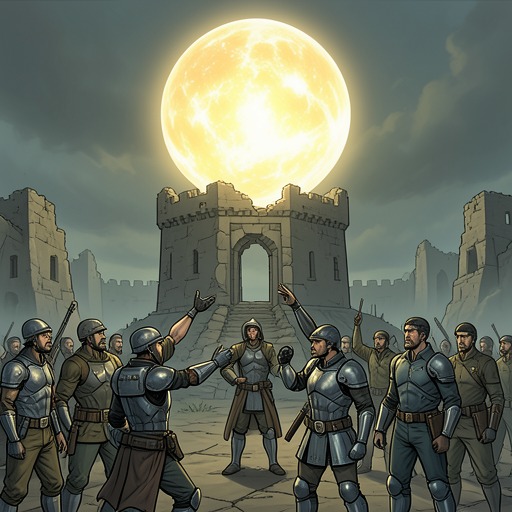
Cube of NATO
GunsoulCube of NATO is a Lost Age artifact whose recovery transforms a piece of buried history into a weapon capable of reshaping the political and physical future of the Unmade World. At first, Yuan Guang knows it only as an object he once carried and lost track of; after Mordiggian identifies what it contains, the cube becomes the reason powerful factions maneuver, compete, and prepare to betray one another. It is not merely valuable because it is rare. It is dangerous because it links a sealed demigod to thousands of weapons that may still be waiting underground for a signal to awaken.
Identity and Lost Age Origins
Cube of NATO originated during the Lost Age, when NATO was one of the greatest military alliances in a world divided among rival nations. As those powers prepared for an expected world war, they sought to bind the Demigods of Ultraviolence to their service. The Gun was too strong and savage to be controlled, but the Nuke proved more susceptible to imprisonment. NATO’s cultivators eventually trapped the Nuke inside the cube, although Mordiggian does not know precisely how they accomplished the feat.
The artifact is therefore both prison and instrument. The Nuke does not need to be physically present beside a weapon in order to influence it: as the Gun can empower other Gunsouls through bullets it did not personally fire, the Nuke can potentially rear its own children through the violent systems associated with it. This relationship explains how Nuclear cultivators can exist even while the Nuke remains sealed. The demigod’s influence travels through the weapons that sustain its violent existence rather than depending on direct physical presence.
The Nuke’s Seal and Its Possible Power
Mordiggian believes Cube of NATO was designed to bind the Nuke partially to a summoning contract. Whoever controls the artifact may be able to control its prisoner to a limited degree, compelling it to neutralize hostile nuclear weapons or sabotage an enemy arsenal. The same seal may explain why many nuclear weapons remain dormant beneath the earth: without the proper ritual, the Nuke’s imprisonment prevents others from activating them.
The scale of the dormant arsenal makes the cube’s threat concrete rather than symbolic. Mordiggian recalls a report claiming that four hundred nuclear weapons would be enough to wipe out humanity, while more than twelve thousand existed before Lord Kou’s ascension. Not all of those weapons have disappeared or rusted away. Many may still sleep underground, waiting for the signal that would begin the Nuclear Age. Cube of NATO consequently represents a system of delayed annihilation: its danger lies not only in what it contains, but in the buried stockpile that its influence might unlock, suppress, or redirect.
This possibility gives the object an unusual material agency within the story. The cube is carried, hidden, pursued, and negotiated over by people, yet its sealed contents reorganize their decisions before anyone has fully mastered it. Its physical recovery revives an old military architecture in which political authority depends on access to overwhelming violence. The artifact makes the Lost Age active in the present, not as memory alone but as an unfinished mechanism capable of producing a second world-ending catastrophe.
Discovery and Yuan Guang’s Concealment
Yuan Guang raises the subject while testing Mordiggian’s credibility. The Sin-Eater has made extraordinary claims, and Yuan suspects that he might be trying to impress him or excuse a Wayfinder’s crimes. Yuan therefore asks what Mordiggian knows about Cube of NATO. Mordiggian immediately recognizes the name and is shocked that the artifact may have been found, remarking that the world would have been safer had it remained lost.
Yuan admits only that he once carried the real cube and refuses to disclose its current location. He lies that he does not know where it is, while acknowledging that a Nuclear cultivator is searching for it and that he wants to understand why. Mordiggian’s answer reveals the decisive secret: he would search for the artifact relentlessly as well if his god were sealed inside it. The revelation changes Yuan’s understanding of the object from a mysterious relic into the prison of a nuclear demigod, and it leaves him frightened by the scale of what he has been carrying and pursuing.
The conversation also establishes that knowledge of the cube is itself dangerous. Yuan’s concealment is not simple caution about losing a valuable possession; he recognizes that telling a powerful cultivator where the artifact is could create immediate complications. The cube attracts anyone who understands its function, so information about it becomes another form of power and another reason for Yuan to control what he says.
Rival Claims and the Race for Destruction
The Yinyang Khan seeks Cube of NATO because control over the dormant Children of the Nuke would make him the most powerful warlord in the Unmade World. Nuclear weapons capable of destroying cities in an instant could eliminate his enemies and force everyone else to submit. The Khan’s interest therefore turns the artifact into an instrument of political domination: the cube could convert military supremacy into absolute leverage over the region.
The Khan uses that leverage to organize a competition. Kaguya explains that participants will select a target for the Khan to annihilate with an arrow of light, making destruction the special prize for victory. The contest is not a neutral sporting event but a mechanism for making rival sects struggle for the favor of a ruler who controls the final act of devastation. Yuan understands that winning may provide an audience with the Khan and create an opportunity to recover the cube, even though approaching the Khan also risks drawing his attention toward Yuan and his allies.
Slash is entrusted with the recovery of Cube of NATO, a responsibility that revises Yuan’s estimate of his enemy. Yuan had initially regarded Slash as a mere henchman, but the Khan would not send a low-ranking minion after a potentially world-ending artifact. Slash must belong to the Khan’s inner circle and may even be his direct apprentice. The cube thus intensifies the personal conflict between Yuan and Slash by placing their anticipated duel inside a larger contest over nuclear power and political succession.
Threat, Alliances, and Narrative Significance
Arc warns that Manhattan will attempt to steal the cube at the first opportunity, while the Moonlighters will manipulate events from behind the scenes in order to keep their own hands clean. She calls the artifact death-in-a-box and insists that it must be buried somewhere no one can ever find it again. Yuan agrees, though he does not yet know how such disposal could be accomplished. Their immediate plan is to win the competition, gain access to the Khan, and recover the artifact before deciding how to remove it from the world’s reach.
The cube also shapes the movement of Yuan’s group through the Khan’s territory. Battletown rises beside the Oil Sea as a settlement of neon lights, machine towers, cranes, steel structures, and a colossal metal pagoda. Its scale explains why much of the surrounding region pays tribute to the Khan, and its spectacle provides the political stage on which the race, the duel with Slash, and the struggle for the cube will unfold. Even the protection offered to racers is temporary: Slash announces that the Khan’s protection lasts only until the race begins, making the contest a controlled interval before violence resumes.
Yuan recognizes that a public victory over Slash could have consequences beyond personal revenge. Killing one of the Khan’s men before the warlord’s court might cause the Khan to execute Yuan, or might lead him to force Yuan and his allies into service. At the same time, the spectacle could distract the court long enough for the cube to be taken. Cube of NATO therefore produces a double bind: it must be recovered through the Khan’s system, yet every step toward recovery risks strengthening that system’s ability to absorb or destroy the people opposing it.
The artifact’s importance persists through the History Road competition, where old-world remnants become active instruments of violence. The race passes landmarks such as the metal pylon called the Eiffel Tower, whose stored qi erupts through its antenna before it rains fire upon the combatants. In this landscape, history is not safely preserved; it has been rebuilt, weaponized, and placed in motion. Cube of NATO stands at the center of that pattern. It is a fragment of an earlier civilization that still commands present action, a sealed archive whose contents can become a military command, and the material hinge between the Lost Age’s failed attempt to control the Nuke and the possibility of repeating its destruction.