Event 1
Thunderdance
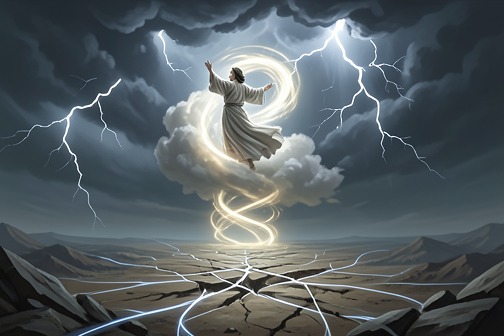
[Thunderdance](entity:event-recall-event-thunderdance-fb869e78b2ed) is the [Spiral Dancer](entity:character-recall-character-spiral-dancer-bde9fcaf887c)’s ascension into the [Dao](entity:concept-recall-concept-dao-3e09e1e84dbd) and the foundational rupture of the modern cultivation age. By completing the [Seven Coils of Infinity](entity:concept-recall-concept-seven-coils-of-infini-17994b6b2208) and merging with the universe, she turned her personal [Path](entity:concept-recall-concept-path-c64b431503b0) into a karmic law, opened the way to transcendence for later generations, and left behind regions such as the [Thunderlands](entity:location-recall-location-thunderlands-c284c89c792f), where the boundary between matter and spirit became thin. Yet the event’s legacy is profoundly double-edged: the awakening intended to rescue humanity from spiritual decay instead exposed, amplified, or helped produce a world of monstrous power.
## Background and Historical Moment
Thunderdance occurred fifty years before [Yuan Guang](entity:character-recall-character-acb8867cae36)’s resurrection, twenty years before Yuan Guang first drew breath, and five years before the [Sky-Biter](entity:character-recall-character-sky-biter-ca81048efcb5) unmade the world while departing it. The chronology places the Spiral Dancer’s achievement at the beginning of the current supernatural order rather than at its remote edge. The world that Yuan Guang inhabits, with its qi-filled landscapes, cultivation Paths, hungry ghosts, and sentient forms of violence, is historically downstream from her ascent.
Before the Thunderdance, the modern world had lost sight of the Dao. [Mordiggian](entity:character-recall-character-mordiggian-bc013921af8e) describes an age in which people worshiped money, fame, and power, while human minds were clouded by greed and spiritual filth. The Spiral Dancer emerged from that crisis as a mystic of immense knowledge and spiritual power, associated with an eastern religious tradition whose forgotten ideals resembled later cultivation rites. She was also a regressor: someone aware of past lives who had awakened her core through meditation. Although she was not the first person in history to achieve such awakening, she was the only one in the modern age to do so successfully.
## The Ascension and Its Visible Form
The Thunderdance was not merely a private meditation or an invisible change of status. It was enacted through movement, sound, lightning, and ascent. Mordiggian remembers every step as thunder that called lightning from the sky, while each motion became a wave that stripped away illusions and falsehoods obscuring humanity’s perception of the Way. The dance therefore joined bodily ritual to cosmic consequence: the Spiral Dancer’s physical technique became an instrument for altering how the world could be perceived and entered.
At the climax, she ascended a spiral staircase made of shooting stars and became one with the sky. This image gives the event its characteristic vertical structure. The Spiral Dancer does not simply leave the earth; she passes through successive stages of elevation until individual identity becomes indistinguishable from the heavens. Her achievement was the first successful passage through all Seven Coils of Infinity and the first historical union of a human cultivator with the Dao.
The change also altered the nature of reality itself. When the Spiral Dancer merged with the universe, the cosmos adopted her Path as a karmic law. In the cultivation tradition that followed, this became the ultimate purpose of ascending beyond the Seven [Coils](entity:concept-recall-concept-coils-d5c098fa5873): to merge one’s existence with a cosmic axiom, escape the reincarnation cycle, and make one’s will part of reality. Thunderdance thus supplies both a precedent and a definition for later ascension. It is an achievement others may aspire to, but also the model through which the meaning of ascension is understood.
## The Thunderlands as Legacy
The Thunderlands are the most immediate geographical residue of Thunderdance. Their landscapes are not ordinary wildernesses but traces of the Spiral Dancer’s passage and transformation. When Yuan Guang enters a new region of the Thunderlands, the sky turns golden, the sun ripples like liquid mercury, and multicolored lightning strikes without black clouds. Rust dunes, primeval badlands, colossal rock formations, and the cadavers of metal beasts from the [Lost Age](entity:time-recall-time-lost-age-7d2ab8489f91) occupy a space where the old material world has become permeable to qi.
Yuan Guang experiences the region as spiritually charged. [Qi](entity:concept-recall-concept-qi-53033403c395) breathes through the stones and wind, and each breath makes him feel closer to the Dao. The sensation is not incidental scenery: it demonstrates that Thunderdance left cultivation embedded in the environment. The Thunderlands are described as places where the veil between matter and spirit has grown thin enough for one to cross from one state into the other. They are therefore both landscape and ritual aftermath, a continuing threshold created by an event that happened decades earlier.
The Spiral Dancer’s legacy is not limited to beneficial access. Her ascent shook the world permanently, as the ascension of each [Wayfinder](entity:concept-recall-concept-wayfinder-44822cb184a1) leaves devastation in its wake. The Thunderlands preserve the paradox in physical form: they are beautiful, awe-inspiring sites of heightened contact with the Dao, yet they are also regions of rust, rot, dead machines, unstable phenomena, and historical ruin. Their spiritual richness cannot be separated from the damage produced by the power that created them.
## Intended Salvation and Unintended Monsters
The Spiral Dancer’s purpose was reformative. She had danced to enlighten the dissolute and faithless men of her time, hoping to jolt humanity out of its self-inflicted decay and force it to look toward a brighter future. Her ascension was meant to awaken, not merely to dominate; the revelation of spirits, demons, and cultivation was supposed to redirect human beings toward virtue and potential.
That hope failed. Mordiggian concludes that a world drowning in sin and filth could only give birth to monsters. The rise of cultivation did not guarantee enlightenment. Instead, many people treated it as a ticket to power and glory, while nations approached the brink of a war capable of destroying the world. The megacorps of the Lost Age became self-aware spirits of industrialized greed, demanding worship and stripping the earth of its resources. The demigods of ultraviolence and other terrors appeared within the same historical aftermath.
This reversal is the event’s central dramatic value shift. Before Thunderdance, humanity is spiritually blind and trapped in corruption; after it, humanity can perceive and wield the Dao, but the new power becomes another instrument of greed, war, and violence. The event opens the road to salvation while also opening the conditions through which salvation can be refused. Its failure is not that enlightenment proves unreal, but that enlightenment cannot determine what newly awakened beings will do with power.
## Continuing Influence on the Story
Thunderdance remains active in the story through memory, geography, cultivation doctrine, and character ambition. Mordiggian recalls the Spiral Dancer with reverence, describing her as a holy woman and a guide who sacrificed ordinary separation from the world in order to lead later generations toward salvation. His recollection gives the event the quality of a sacred historical vision: he appears physically present while his mind reaches back through time, and his awe makes Yuan Guang imagine the Thunderlands’ veil spreading across the world in an instant.
The event also shapes Yuan Guang’s own understanding of cultivation. His practice depends on mantras, mudras, sutras, bullet-cores, vows, and the pursuit of higher Coils; even small techniques such as Archer’s Glory are framed as disciplined combinations of words and hand signs whose completed form can alter the accuracy of a projectile. [Arc](entity:character-recall-character-arc-5983990a9863)’s oath to teach Yuan Guang is likewise bound to his core and enforced by the Dao, showing how personal advancement in the post-Thunderdance world is inseparable from cosmic law, ritual commitment, and the danger of choosing a Path.
Thunderdance therefore functions as the book’s originating myth of ascension and its warning against treating ascension as moral victory. It gives the world its openings, its sacred thresholds, and its possibility of transcendence, but it also explains why every later pursuit of ultimate power carries the risk of repeating the catastrophe. The Spiral Dancer became one with the Dao and made her will part of reality; the unresolved question left to Yuan Guang and the other cultivators is whether such power can finally be joined to wisdom rather than turned into another form of ruin.
Event 2
Sky-Biter's Unmaking
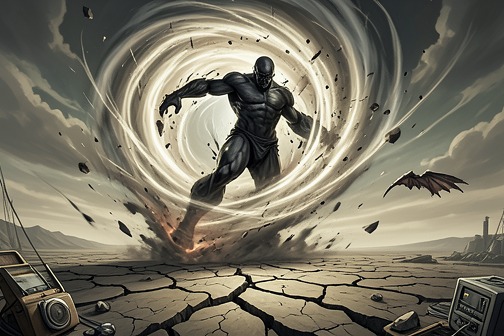
[Sky-Biter's Unmaking](entity:event-recall-event-sky-biter-s-unmaking-ae76f12c3771) is the world-shattering ascension of [Sky-Biter](entity:character-recall-character-sky-biter-ca81048efcb5), an event that turned departure from reality into an act of destruction. It followed [Spiral Dancer](entity:character-recall-character-spiral-dancer-bde9fcaf887c)'s earlier [Thunderdance](entity:event-recall-event-thunderdance-fb869e78b2ed) and became the defining catastrophe of the recent past: not merely a powerful cultivator's disappearance, but the violent remaking of the world left behind. Its importance lies in the contradiction at its center. Ascension promises union with the [Dao](entity:concept-recall-concept-dao-3e09e1e84dbd) and escape from reincarnation, yet Sky-Biter's transcendence made the world itself bear the cost.
## Historical Place and Cause
Sky-Biter's Unmaking occurred forty-five years before the main period of [Yuan Guang](entity:character-recall-character-acb8867cae36)'s life. The chronology places it after Spiral Dancer had ascended to the heavens by completing Thunderdance, an achievement that opened a path for later cultivators seeking to pass beyond the [Seven Coils of Infinity](entity:concept-recall-concept-seven-coils-of-infini-17994b6b2208). Yuan was twenty years old when the story began, meaning that Sky-Biter's act belonged to the inherited history surrounding him rather than to a catastrophe he personally witnessed. Even so, its consequences define the world into which he was born.
The event emerged from the Wayfinders' highest ambition. Cultivators who surpassed the Seven Coils of Infinity sought to become one with the Dao, merge their existence with a cosmic axiom, escape the cycle of reincarnation, and make their [Path](entity:concept-recall-concept-path-c64b431503b0) part of reality's governing order. Spiral Dancer's ascension demonstrated that such a transformation could leave a permanent metaphysical legacy: the [Thunderlands](entity:location-recall-location-thunderlands-c284c89c792f) remained as places where the boundary between matter and spirit had grown thin enough to cross. Sky-Biter followed her, but his departure inverted that legacy. Instead of leaving a stable passage toward the Dao, he bit the world on his way out and converted ascension into unmaking.
## [The Unmaking](entity:event-recall-event-the-unmaking-acf0fed7b2e8) as Cosmic Disaster
The text presents Sky-Biter's action in compressed, almost mythic terms: he unmade the world on his way out of it. The brevity makes the event feel larger than a conventional battle. No battlefield, army, weapon, or single moment of impact defines it. Its scale is planetary and ontological, measured by the condition of the world afterward rather than by a fully narrated spectacle. The catastrophe therefore functions as a historical wound whose effects are visible even when the original event remains outside the immediate narrative frame.
That legacy also establishes the moral danger of ascension. The Wayfinders' ideal is to have personal will become universal law, but Sky-Biter's example shows that a will powerful enough to define reality may also damage the reality inhabited by everyone else. The same spiritual structure that treats transcendence as liberation permits an individual Path to become a karmic force. Sky-Biter's Unmaking is thus the negative counterpart to Spiral Dancer's Thunderdance: both are ascensions, but one opens a route through the world while the other tears the world apart.
## Echoes in Yuan Guang's Story
Sky-Biter's Unmaking is recalled while Yuan Guang is already living amid the dangers produced by earlier ascensions. The ground can tremble beneath him, and his survival instincts make him alert to changes that others might miss. Such scenes connect the ancient scale of Sky-Biter's departure with the immediate physical vulnerability of Yuan's life. The world is not a settled foundation beneath the characters; it is a damaged environment in which spiritual history remains capable of erupting into material threat.
The event also forms part of the background against which later disasters are understood. When the Gun announces its arrival with a rain of qi-charged bullets and destroys [Fleshmarket](entity:location-recall-location-fleshmarket-85c3bbebccdc), that bombardment is experienced as an immediate massacre, but it belongs to a world already shaped by an older act of cosmic violence. The ruins left by the Gun become an empty saloon in [Revolver](entity:character-recall-character-revolver-ef40ed09076f)'s soul, a roof-and-walls-and-skull-faced-table image that turns catastrophe into a symbolic interior. The contrast is instructive: Sky-Biter's Unmaking is remembered as a world-scale myth, while the destruction of Fleshmarket is counted through corpses, tombs, survivors, and the labor of burial.
Yuan's own responsibility becomes entangled with this pattern of inherited and repeated devastation. He had armed the sects fighting over Fleshmarket in the hope that they would destroy one another, only to confront the possibility that his ammunition scheme helped lure the Gun there. [Arc](entity:character-recall-character-arc-5983990a9863) forces him to face the consequences of treating mass death as a strategic solution. Later, Arc's bullet-core explodes in a final counterattack against [Manhattan](entity:character-recall-character-manhattan-74663a2bc259), sacrificing her body and strength to break his manifested core. These later events do not repeat Sky-Biter's Unmaking in scale, but they repeat its central ethical problem: power directed toward a higher purpose can still devastate the world and demand a cost from those left behind.
## Historical and Thematic Significance
Sky-Biter's Unmaking gives the setting a history in which transcendence is never purely triumphant. Ascension is not an escape from consequence; it can become the source of a new law, a new landscape, or a permanent disaster. The event explains why the world's spiritual geography contains places such as the Thunderlands, where matter and spirit have been destabilized, and why later generations approach cultivation with both reverence and fear.
Its influence reaches beyond background lore into the book's treatment of guilt and survival. Yuan begins his story by dying in a ditch after decades of struggle, then confronts the question of whether he should return as a ghost to avenge his friends and haunt his murderer. The ritual burial and Last Rites sutras imply a society accustomed to death returning in altered forms, while Sky-Biter's Unmaking supplies the oldest and largest example of a departure that does not truly end. The world remembers its ascended figures not only through glory, but through the damage their wills leave circulating through history.
The event's final irony is that Sky-Biter achieved the very kind of cosmic significance cultivators desire: his Path became inseparable from the world's condition. Yet what entered reality was not a humane revelation but a catastrophe. In that sense, Sky-Biter's Unmaking remains a warning to every later wielder of overwhelming power, including Yuan Guang, the Gun, Manhattan, and Arc. A will capable of changing reality cannot be judged solely by whether it succeeds in transcending the self; it must also be judged by what kind of world its success leaves for everyone else.
Event 3
Deathsong's Ascension
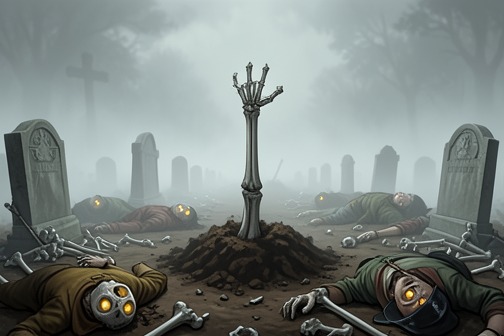
[Deathsong's Ascension](entity:event-recall-event-deathsong-s-ascension-ab20cb508aad) is a world-changing supernatural event whose most decisive consequence is the collapse of the boundary between death and return. The ascension unleashed an undead crisis in which corpses could become hungry ghosts, making burial, prayer, and the treatment of remains matters of survival rather than simple mourning. Although the event occurred before the main action, its effects remain embedded in the laws, fears, rituals, and ethical burdens carried by [Yuan Guang](entity:character-recall-character-acb8867cae36) and the communities he encounters.
## Historical Background and Cosmic Rupture
Deathsong's Ascension belongs to the succession of disasters that defines the book's history. Fifty years after [Spiral Dancer](entity:character-recall-character-spiral-dancer-bde9fcaf887c) reached the heavens through her [Thunderdance](entity:event-recall-event-thunderdance-fb869e78b2ed), [Sky-Biter](entity:character-recall-character-sky-biter-ca81048efcb5) unmade the world on his departure; [Deathsong](entity:character-recall-character-deathsong-3f4deef81c2d)'s own ascension belongs to the same larger pattern in which individual transcendence becomes collective catastrophe. The event is therefore not presented as a private spiritual achievement. It marks another rupture in the world's order, one that leaves ordinary people to live among the consequences of powers they cannot control.
The ascension's chronology is especially important to Yuan Guang's life. By the time he is killed, he is twenty years old, while the world has already spent years adapting to the undead epidemic that followed Deathsong's rise. Yuan's generation is consequently born into a landscape where supernatural disaster is inherited history rather than an unprecedented shock. The past is not safely past: it determines how bodies are buried, how travelers move through dangerous territory, and what kinds of death survivors fear.
## Death, [Ghosts](entity:creature-recall-creature-fc4e4f41c2e7), and the [Nowhere](entity:location-recall-location-nowhere-8ca016a80050)
The clearest social consequence of Deathsong's Ascension is the normalization of funerary violence and emergency ritual. Yuan reflects that killers give their victims funerals so that the dead will not return as hungry ghosts. The grim custom compresses compassion, fear, and self-preservation into one act: even a murderer may perform the [Last Rites Sutra](entity:rule-recall-rule-last-rites-sutra-7bf55c77d550) because leaving a corpse untreated threatens the living as well as honoring the dead.
Yuan's own death makes this inherited crisis personal. After his murderer buries him and gives him and his team the Last Rites Sutra, Yuan faces the darkness between life and death while considering whether enough willpower might allow his ghost to endure. The rite is meant to prevent such a return, yet Yuan's consciousness remains caught between revenge, unfinished purpose, and the possibility of reincarnation. His condition reveals the event's central horror: death is no longer a clean ending, but a contested passage in which identity may dissolve into haunting, punishment, or another self.
The Nowhere supplies the metaphysical framework for that passage. Those who return from death before reincarnation describe it as a void through which the dead fall until reaching a new self, while those who committed great sins suffer in wasteful skins. Yuan interprets his life as a [Scrap](entity:state-recall-state-scrap-f377b55e6193) through this moral cosmology, wondering whether weakness is punishment carried over from a previous existence and hoping that reincarnation might make him a cultivator. Deathsong's legacy thus affects not only corpses and ghosts but also the way people understand social status, sin, destiny, and the possibility of becoming someone stronger.
## Ritual Knowledge and Practical Survival
Deathsong's Ascension gives the Last Rites Sutra an unusually broad social importance. [Sutras](entity:concept-recall-concept-sutras-20d678ddcd19) draw power independently of their user's cultivation when the required steps are completed, allowing even [Scraps](entity:concept-recall-concept-scraps-c83bffce1b62) to use them. The Last Rites Sutra prevents a dead person from rising as a hungry ghost when the corpse is buried within an hour of death and the grave receives the final prayers. Its efficacy depends on precise timing and procedure, so the ritual turns emergency burial into a technical discipline.
The knowledge remains restricted because sects guard their scripts and mantras jealously. Yuan suspects that the Stoneskin Sect would never have released the Last Rites Sutra to the wider wasteland without the undead epidemic created by Deathsong's Ascension. The catastrophe therefore produces a contradiction: it intensifies religious secrecy while also forcing selected rites into wider circulation. Spiritual knowledge becomes both protected property and public infrastructure.
The same pressure appears in Yuan's training. While [Holster](entity:character-recall-character-holster-0dfe0a9736e3) sleeps beside him after the threat of the [Hitobashira](entity:state-recall-state-hitobashira-7d11165e7e76) procedure, [Orient](entity:character-recall-character-orient-cc17650ca89c) teaches him mantras and mudras for Archer's Glory. Yuan practices the sequence of hand signs and words required to increase the accuracy of his next projectile, but he worries that completing it in battle may cost too much time and breath. This episode places the funerary tradition within a larger system of ritualized power. In Deathsong's world, survival depends on learning forms that bind speech, gesture, timing, qi, and consequence together.
## Continuing Influence on Later Events
The ascension's influence remains active long after the original catastrophe. Within the [Thunderlands](entity:location-recall-location-thunderlands-c284c89c792f), a veil blocks Deathsong's influence from summoning the oni [Toshiro](entity:character-recall-character-toshiro-1405bfb3b295)'s ghost. Yuan therefore feeds Toshiro's beheaded corpse to the spirit-train's oven rather than leaving it exposed to takeover by a centidead. The decision shows how Deathsong's power operates indirectly: even where the veil provides protection, the possibility of postmortem possession still dictates what must be done with a body.
The same threat governs the aftermath of later mass destruction. After the Gun devastates [Fleshmarket](entity:location-recall-location-fleshmarket-85c3bbebccdc), Yuan carries corpses to a trench while Holster continuously gives the dead the Last Rites Sutra, silently praying for their souls. The city is leveled so completely that buildings, sewers, and basements become tombs, and only a handful of survivors can be found. With too many corpses and too few gravediggers, the old undead crisis becomes a logistical emergency layered onto military catastrophe. Burial is not merely remembrance; it is containment.
After the destruction of Battletown, the survivors again bury the dead to reduce the spread of hungry ghosts. Orient converts three wagons into improvised hospital houses, where wounded people receive treatment and leftover radiation poisoning is purged, while doctors such as [Jared LaChair](entity:character-recall-character-jared-lachair-1ffa7fe36661) help restore a measure of organized care. These recovery efforts connect Deathsong's legacy to disaster relief: communities must protect bodies from radiation, injury, and ghostly return at the same time. The work of rebuilding is therefore also a struggle to prevent the dead from becoming a second disaster.
## Narrative and Thematic Significance
Deathsong's Ascension establishes the book's recurring refusal to separate transcendence from ruin. Like the other ascensions remembered in world history, it promises movement beyond ordinary limits but leaves devastation below. Its legacy makes every later death morally unstable: a corpse can be a friend, a vessel, a resource, a source of danger, or a person whose soul still requires protection. That instability deepens Yuan Guang's own relationship with death, beginning with his burial as a Scrap and continuing through his determination not to abandon allies to curses or uncontrolled violence.
The event also turns funerary ritual into a form of ethical resistance. In a world where powerful beings repeatedly convert landscapes and populations into collateral damage, giving the dead the Last Rites Sutra asserts that a life remains worthy of care after power has destroyed it. Yuan's later guilt over helping arm the factions fighting over Fleshmarket, his refusal to let [Revolver](entity:character-recall-character-revolver-ef40ed09076f) suffer indefinitely under the Gun's curse, and his apology to Revolver after recognizing the horror of his killing all unfold against this background. Deathsong's Ascension does not end when the ascended figure leaves the world; it persists as the condition that forces survivors to decide what responsibility means after death has become unfinished.
Event 4
Blackmoon Ascension
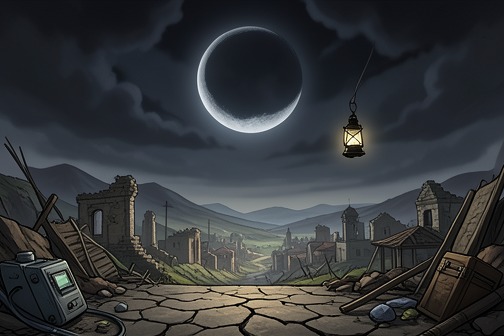
[Blackmoon Ascension](entity:event-recall-event-blackmoon-ascension-255509dee3f6) is the decisive historical rupture attributed to [Blackmoon](entity:character-recall-character-blackmoon-20b02347d06a). In the surviving evidence, it is less a directly staged scene than a world-defining event whose consequences are repeatedly encountered by [Yuan Guang](entity:character-recall-character-acb8867cae36): a catastrophe old enough to belong to history, yet still powerful enough to govern travel, fear, and supernatural protection in the present. Its importance lies in how the narrative makes an unseen ascension materially legible through altered landscapes, threatened settlements, and rules imposed on the dead.
## Historical Position and World-Changing Consequences
Blackmoon Ascension belongs to the recent mythic history of the setting. The chronology places it decades after [Spiral Dancer](entity:character-recall-character-spiral-dancer-bde9fcaf887c) completed her [Thunderdance](entity:event-recall-event-thunderdance-fb869e78b2ed) and ascended to the heavens, while [Sky-Biter](entity:character-recall-character-sky-biter-ca81048efcb5) unmade the world on his departure. By the time Yuan Guang is born, [Blackmoon’s ascension](entity:time-recall-time-blackmoon-s-ascension-b27a1e54d190) is already an established fact of the world rather than a private legend. The event therefore forms part of a succession of supernatural departures whose effects are measured not only in years but in transformations to the world itself.
Its historical force is conveyed through the condition of the lands Yuan Guang crosses. The world contains deserts of salt and sand, half-buried asphalt, spirit lightning, and settlements whose ordinary expectations have been replaced by supernatural danger. Blackmoon Ascension is specifically associated with the beginning or intensification of a long period of terror. The event’s aftermath is consequently not confined to one battlefield or one ruined monument; it becomes an environmental and civilizational condition.
## The Shadow over [Gatesville](entity:location-recall-location-gatesville-1e402b621ba0)
The clearest immediate consequence is the altered status of Gatesville. Yuan Guang remembers the settlement as being roughly an hour away, yet the journey is planned around reaching it before night because the place has become terrifying since Blackmoon Ascension decades earlier. This detail turns the ascension into a practical threat: it changes when people may travel, how they measure distance, and what survival requires after sunset.
The danger is also defined by anticipation. The evidence does not show Blackmoon appearing at Gatesville or describe a single attack there. Instead, the settlement’s reputation carries the event forward, making the absent catastrophe present in every decision about timing. Daylight offers a limited margin of safety, while night becomes the period in which the historical consequences of the ascension are expected to become active.
## Moonburn, [Ghosts](entity:creature-recall-creature-fc4e4f41c2e7), and the Boundaries of Death
Blackmoon Ascension is connected to the altered supernatural conditions surrounding Moonburn and the dead. In the [Thunderlands](entity:location-recall-location-thunderlands-c284c89c792f), a veil blocks the influence of other Wayfinders, and this protection means that Yuan Guang does not have to fear Moonburn, night horrors, or ghosts returning from [Nowhere](entity:location-recall-location-nowhere-8ca016a80050). The wording makes the danger conditional rather than universal: the veil does not erase the threat, but prevents the ascension’s wider supernatural influence from reaching him in that region.
This protective geography matters because Yuan Guang has already encountered a society in which death is managed through ritual. After he is murdered and buried with his companions, the killer gives them the last rites sutras so they will not return as [Hungry ghosts](entity:creature-recall-creature-hungry-ghosts-b85a0d6a2745). The funerary act is both humane and fearful, since killers provide graves and rites to prevent their victims from coming back. Against that background, Blackmoon Ascension helps define a world where death is not a secure boundary and where ritual, landscape, and spiritual influence determine whether the dead remain gone.
## Revelation, Monstrosity, and Narrative Function
The event’s narrative presentation relies on delayed revelation. Blackmoon Ascension itself remains outside the supplied scenes, but its consequences are announced before the reader receives a complete historical account. The result resembles a graduated horror structure: first the reader encounters a changed world and warnings about terror, then learns that night horrors and returning ghosts are real possibilities, while larger supernatural powers remain only partially visible.
That indirectness gives the ascension a scale beyond an ordinary historical incident. Yuan Guang can be killed, buried, and brought to the threshold between life and death, yet the world continues to be shaped by beings who have altered reality through ascension or unmaking. The contrast makes individual survival appear precarious without making it meaningless: Yuan Guang’s will to avenge his friends and resist the consequences of death becomes a personal answer to a cosmos already transformed by powers far greater than him.
The event also belongs to the book’s recurring pattern of ritualized power. [Orient](entity:character-recall-character-orient-cc17650ca89c) teaches Yuan Guang the Archer’s Glory sutra through memorized words and hand signs, while [Arc](entity:character-recall-character-arc-5983990a9863) later binds him through an oath sworn on his bullet-core. These practices show that supernatural force is repeatedly made effective through bodies, speech, and formalized commitments. Blackmoon Ascension stands at the largest scale of that pattern: an act of transcendence whose consequences become laws of travel, fear, and spiritual vulnerability.
## Significance
Blackmoon Ascension is therefore significant less as a fully depicted action than as the historical source of a persistent condition. It marks the point after which terror becomes ordinary, night becomes strategically dangerous, and the boundary between the living world and Nowhere requires protection. Its legacy reaches from the reputation of Gatesville to the Thunderlands’ defensive veil and the broader possibility of ghosts returning as Hungry ghosts.
For Yuan Guang, the event provides the historical atmosphere in which resurrection, revenge, cultivation, and the [Gun Path](entity:concept-recall-concept-gun-path-6a1c48ff6378) acquire their urgency. The world he enters has already been broken or remade by ascended powers; his own struggle unfolds within their residue. Blackmoon Ascension thus functions as both background catastrophe and continuing pressure, an absent event whose reality is proved each time the characters alter their route, fear the dark, invoke a sutra, or confront the possibility that death will not hold.
Event 5
Rescue of Holster
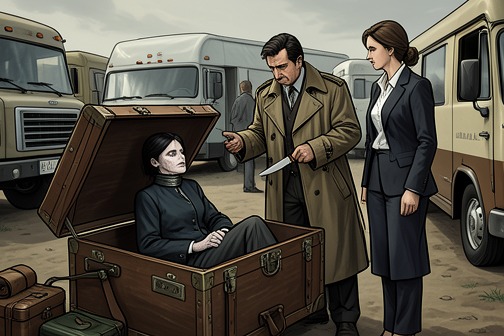
[Rescue of Holster](entity:event-recall-event-rescue-of-holster-c647c62b9993) is the episode in which [Yuan Guang](entity:character-recall-character-acb8867cae36) converts a chance encounter with a captive child into a decisive act of liberation. What begins with a faint sound from a caravan’s trunk exposes the commerce of human sacrifice, and Yuan’s response is immediate: he kills [Maurice](entity:character-recall-character-maurice-7005d24c9997) and [Gru](entity:character-recall-character-gru-f12b3e8289ee), disarms the girl’s explosive collar, and removes her from the system that treated her as a deliverable package. The event establishes the ethical pattern that later defines his relationship with [Holster](entity:character-recall-character-holster-0dfe0a9736e3): protection is not an abstract ideal, but a dangerous, technically demanding obligation carried out in the aftermath of violence.
## Discovery of the Captive
The rescue begins when a soft thump comes from the trunk of the car carrying Maurice and Gru. Maurice calls the prisoner their “package,” reducing the person inside to cargo, while the opening of the trunk reveals a small girl no older than ten, bound and gagged, pale and gaunt enough to resemble a corpse except for her breathing. Her ragged clothing, dirt-blackened red hair, and tightly fitted explosive slave collar make the material reality of her captivity unmistakable. The collar is not merely a restraint: it is a mechanical chokehold designed to deny escape before escape can even be attempted.
Yuan’s qi sight makes the discovery more disturbing. The girl’s qi feels unnatural, like darkness mixed with green miasma, and her condition is not explained by ordinary hunger or abuse. When Maurice pinches her cheek and laughs at her fear, Yuan’s disgust becomes inseparable from his recognition that the girl has been made into something usable by supernatural practitioners. Maurice identifies her as a [Hitobashira](entity:state-recall-state-hitobashira-7d11165e7e76), a specially prepared human sacrifice. Such human pillars can strengthen a land’s qi flow, power [Feng Shui](entity:concept-recall-concept-feng-shui-75b116ed67e4) rituals, suppress evil spirits, or serve as payment to supernatural entities. The girl is therefore endangered not only by slavers but by the entire ritual economy that values her body as a source of power.
## The Turn from Witness to Intervention
The discovery becomes a rescue only when Yuan decides that the captors’ transaction will not continue. He asks Maurice whether the men handle sales or offer discounts, disguising the question until he has placed himself advantageously. Then he draws his pistol and moves aside so Maurice stands between him and Gru, while Gru raises his shotgun too late. Yuan’s qi-charged bullet tears through Maurice’s chest and continues through his back before pulverizing Gru’s skull. The shot kills both men instantly, but its tactical precision also exposes the difference between their violence and his: they had treated a child as merchandise, whereas Yuan turns the same armed encounter into an act of removal, ending the immediate threat with a single bullet rather than two. His dry remark that the men were not worth two bullets echoes [Revolver](entity:character-recall-character-revolver-ef40ed09076f)’s harsher lesson that sometimes the world’s refuse has to be taken out, yet the context gives that principle a more specific moral charge: this is violence used to break a chain of ownership, not to advance a sale.
## Disarming the Instrument of Captivity
The killings ended the immediate danger, but they did not yet make the child safe. Yuan had to perform the rescue with his hands rather than his pistol, rewiring the collar’s cables while telling her to hold still. She remained motionless and silent, staring at her dangling feet instead of looking at him, a response that shows how thoroughly fear had replaced ordinary agency. The device was more advanced than the slave collars Yuan had previously encountered: it contained a locator and an emitter capable of triggering the explosive through a radio signal, ensuring that the girl could be tracked and killed even after leaving the caravan. Its key cable came free with a slight click, and Yuan froze for a moment, expecting the collar to detonate in his face, before the mechanism opened and he could finally remove it. He stored the collar in his travel bag, intending to repurpose it as a portable bomb with the radio serving as its detonator. That practical decision preserves the dangerous material logic of the episode: the object built to control and destroy the girl is stripped of its original power over her, but its destructive potential remains in the world and becomes part of Yuan’s equipment rather than disappearing.
## From Liberation to Guardianship
Once the collar was removed, Yuan told the girl that she was free and asked her name, but she gave no answer and would not even look at him. She still possessed her tongue, so her silence could have come from not understanding the common language, terror, or both; in either case, the rescue had not restored an ordinary life in a single gesture. Yuan recognized that her fear was proportionate to what she had endured and did not treat her quietness as ingratitude. The transition from captive to survivor therefore remained incomplete, requiring patience, shelter, and continued protection rather than merely the destruction of her captors. Later, when the possibility of subjecting her to the Hitobashira procedure arose, Yuan promised Holster that no one would touch her again. Her response was physical rather than verbal: she clung to his shirt, and Yuan spent most of the evening sitting beside her in the last car until she fell asleep while [Orient](entity:character-recall-character-orient-cc17650ca89c) helped him practice the mantras and hand signs of Archer’s Glory. The rescue thus became the beginning of a guardian relationship, binding Yuan to the vulnerable person he had freed and turning a brief intervention into an enduring responsibility.
## The Rescue’s Moral Afterlife
The liberation of Holster remains important because it changes the meaning of Yuan Guang’s violence without pretending that violence has become clean. His first act is tactical and final: Maurice and Gru die before they can continue the sale. The later consequences are slower and more demanding. Holster must be protected from the ritual system that marked her as a Hitobashira, while Yuan must learn to treat her silence, fear, and dependence as conditions requiring care rather than obstacles to his own journey. The rescue therefore establishes a pattern that recurs throughout the wider narrative: survival is not secured merely by defeating an immediate enemy. It depends on shelter, transport, technical knowledge, food, trust, and the willingness to remain responsible after the dramatic moment has ended. The contrast becomes sharper as Yuan’s path proceeds. He later recognizes that his own ammunition scheme helped induce the slaughter at [Fleshmarket](entity:location-recall-location-fleshmarket-85c3bbebccdc), and he watches allies suffer the consequences of powers he helped unleash. Against that growing burden of indirect responsibility, the rescue of Holster stands as an early, concrete instance of responsibility accepted at close range. He does not save her because the act advances his revenge, nor because she can immediately repay him; he frees her because her captivity is intolerable, then remains beside her when freedom proves frightening and incomplete. The event’s decisive value shift is from commodification to personhood: a captive first presented as a package becomes Holster, a living companion whose safety can no longer be treated as someone else’s concern.
## The Rescue’s Moral Afterlife
The liberation of Holster remains important because it changes the meaning of Yuan Guang’s violence without pretending that violence has become clean. His first act is tactical and final: Maurice and Gru die before they can continue the sale. The later consequences are slower and more demanding. Holster must be protected from the ritual system that marked her as a Hitobashira, while Yuan must learn to treat her silence, fear, and dependence as conditions requiring care rather than obstacles to his own journey. The rescue therefore establishes a pattern that recurs throughout the wider narrative: survival is not secured merely by defeating an immediate enemy. It depends on shelter, transport, technical knowledge, food, trust, and the willingness to remain responsible after the dramatic moment has ended. The contrast becomes sharper as Yuan’s path proceeds. He later recognizes that his own ammunition scheme helped induce the slaughter at Fleshmarket, and he watches allies suffer the consequences of powers he helped unleash. Against that growing burden of indirect responsibility, the rescue of Holster stands as an early, concrete instance of responsibility accepted at close range. He does not save her because the act advances his revenge, nor because she can immediately repay him; he frees her because her captivity is intolerable, then remains beside her when freedom proves frightening and incomplete. The event’s decisive value shift is from commodification to personhood: a captive first presented as a package becomes Holster, a living companion whose safety can no longer be treated as someone else’s concern.
## The Rescue’s Moral Afterlife
The liberation of Holster remains important because it changes the meaning of Yuan Guang’s violence without pretending that violence has become clean. His first act is tactical and final: Maurice and Gru die before they can continue the sale. The later consequences are slower and more demanding. Holster must be protected from the ritual system that marked her as a Hitobashira, while Yuan must learn to treat her silence, fear, and dependence as conditions requiring care rather than obstacles to his own journey. The rescue therefore establishes a pattern that recurs throughout the wider narrative: survival is not secured merely by defeating an immediate enemy. It depends on shelter, transport, technical knowledge, food, trust, and the willingness to remain responsible after the dramatic moment has ended.
It depends on shelter, transport, technical knowledge, food, trust, and the willingness to remain responsible after the dramatic moment has ended. The contrast becomes sharper as Yuan Guang’s path proceeds. He later recognizes that his own ammunition scheme helped induce the slaughter at Fleshmarket, and he watches allies suffer the consequences of powers he helped unleash. Against that growing burden of indirect responsibility, the rescue of Holster stands as an early, concrete instance of responsibility accepted at close range. He does not save her because the act advances his revenge, nor because she can immediately repay him; he frees her because her captivity is intolerable, then remains beside her when freedom proves frightening and incomplete. The event’s decisive value shift is from commodification to personhood: a captive first presented as a package becomes Holster, a living companion whose safety can no longer be treated as someone else’s concern.
Event 6
Battle with the Rad-Hag
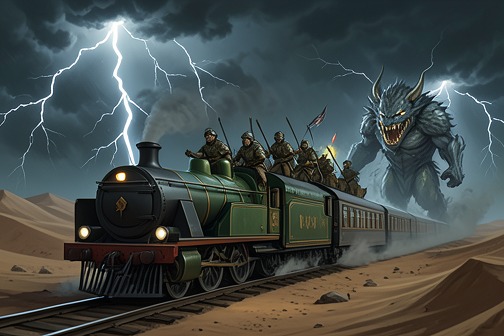
The [Battle with the Rad-Hag](entity:event-recall-event-battle-with-the-rad-hag-1d20a4788694) is both a moving train battle and a land’s attempted recovery from environmental and spiritual ruin. It begins when [Yuan Guang](entity:character-recall-character-acb8867cae36)’s journey through the [Thunderlands](entity:location-recall-location-thunderlands-c284c89c792f) is interrupted by a horde of spirit-cars and a monstrous spirit-train pursuing the Eastern Express. The confrontation tests Yuan’s refusal to surrender, forces him to turn the rad-hag’s own lightning against her, and ends not simply with the caretaker’s defeat but with [Holster](entity:character-recall-character-holster-0dfe0a9736e3)’s purification of the poisoned territory. The event therefore joins violent survival to an act of restoration: the same battle that nearly destroys the train also removes the being through which the Thunderlands’ corruption has taken form.
## Causes and Setting
The danger announces itself before the rad-hag becomes visible. Yuan Guang is meditating aboard the spirit-train when a sandstorm streaked with multicolored lightning rises over the horizon, blotting out the moon and stars. Through his qi sight, he senses a profound imbalance: greed and hunger saturate the storm, marking it as more than ordinary weather. Headlights then appear through the dust, accompanied by war drums and battle-guitars, revealing that the approaching threat is a mobile army rather than a lone pursuer.
The Thunderlands are already a hostile and damaged region. Beyond [Gatesville](entity:location-recall-location-gatesville-1e402b621ba0), lightning strikes beneath golden auroras, space has grown thin, and refractions and mirages obscure the landscape. The road avoids the region instead of crossing it directly. Elsewhere, Yuan Guang encounters the cratered remains of an old-world city whose poisonous dust is so diseased that his bullet-core struggles to assimilate the qi carried in the air. This background makes the rad-hag’s arrival the culmination of a broader environmental sickness rather than an isolated monster attack. [Revolver](entity:character-recall-character-revolver-ef40ed09076f) also connects the ruined city to earlier Gunsoul history, recalling that one of their kind and [Czar Zoa](entity:character-recall-character-czar-zoa-3a34d3d61d77) killed each other there.
The pursuing machine embodies that diseased landscape. It resembles a spirit-train only from a distance, but its construction combines black, rubbery flesh with steel and iron. Centidead crawl through its body like maggots in a wound, while a toothed maw occupies its front beneath a three-lobed red eye. A multi-tiered fortress rises from its back, with stone walls attached to black veins, brass pipes, smoking furnaces, and [Oni](entity:creature-recall-creature-oni-d37946565bfa) warriors armed with bows, spears, and rifles. The vehicle is therefore simultaneously train, monster, fortress, and invading army. Although it is not much faster than Yuan Guang’s own ride, it steadily closes the distance.
## Pursuit and Decision to Fight
The rad-hag uses the radio to threaten both Holster and Yuan Guang, declaring that she will take Holster and his life and urging him to look more closely at what is coming. Yuan Guang does so just as the monstrous machine emerges from the storm, riding trails of lightning. The sight confirms that the threat is not merely a distant qi disturbance but an organized assault capable of boarding the train and overwhelming its passengers.
Yuan Guang refuses the easier course of surrender. His pride will not allow him to bend the knee again, and he answers the rad-hag with a warning that her attempt must count because she will not receive another. He then disables the radio, abandoning negotiation in favor of resistance. His decision is practical as well as defiant: he orders Holster to hide at the front of the spirit-train and gives her the explosive slave collar and detonator. She is instructed to place the device at the junction between the locomotive and the remaining wagons so that, if the Oni board, the train can be decoupled by force. The plan treats the train as both sanctuary and weapon, turning its physical structure into the first line of defense.
The battle also exposes the cost of Yuan Guang’s earlier convictions. [Long](entity:character-recall-character-long-2c4b9ca98f9a) before the rad-hag’s arrival, he had been murdered after years of struggle and buried in a ditch with his companions, while their killer performed the [Last Rites Sutra](entity:rule-recall-rule-last-rites-sutra-7bf55c77d550) to prevent them from returning as [Hungry ghosts](entity:creature-recall-creature-hungry-ghosts-b85a0d6a2745). His return from death makes every later refusal to surrender part of a larger pattern: survival is not passive continuation but a demand to decide what his second life will serve. In the Thunderlands, that decision takes concrete form as he chooses to protect Holster and the train even when the approaching force appears designed to make resistance futile.
## The Opening Shot
When Yuan Guang fires, the weapon’s violence nearly destroys the firing mechanism itself. The bullet leaves the barrel with a thunderous roar, but the recoil explodes the chamber between his iron hands and sprays red-hot shrapnel across the wagon. He activates Elemental Infusion in time to make the fragments bounce from his metal chest, while Holster ducks behind him. The shockwave shakes the wagon to its foundations.
The projectile nevertheless crosses the Thunderlands like a crimson meteor, trailing fire and illuminating the night so brightly that its radiance eclipses the enemy spirit-train’s headlamp. The Oni crew hastily prepares a counterattack, but the intended response never comes. Yuan Guang’s shot establishes the battle’s governing principle: the [Path](entity:concept-recall-concept-path-c64b431503b0) of the Gun offers overwhelming force, yet every increase in power threatens the body and weapon that channel it. His attack is victorious in reach and effect, but its recoil makes clear that victory will require more than repeating the same act at greater intensity.
## Turning the [Rad-Hag](entity:character-recall-character-rad-hag-efb7556a4654)’s Power Against Her
The first shot does not end the pursuit. The rad-hag reaches Yuan Guang aboard the spirit-train, attacking with immense hands and relying on speed and brute strength rather than technique, feints, or any understanding of vulnerable points. Her assault lacks even the rudimentary martial skill Yuan Guang associates with [Toshiro](entity:character-recall-character-toshiro-1405bfb3b295), yet its directness makes it no less dangerous. Against such force, Yuan Guang abandons any expectation of a refined exchange and prepares to meet physical violence with a more dangerous form of improvisation.
Yuan Guang’s answer is to redirect the Thunderlands’ own lightning through his metal body. His iron hand acts as a lightning rod, while qi reinforces the steel pathways carrying the current so that it does not escape into his flesh. The electricity heats his skin as he forces it toward a qi-charged shotgun shell, and the weapon’s barrel shudders under the strain, threatening to explode. He nevertheless pulls the trigger and shoots the rad-hag with her own power. The golden blast snaps the barrel in half and throws her across the wagon; her chest burns with a radiance brighter than the sun, and the smell of cooked meat overwhelms her stench. Even so, the rad-hag catches herself before falling from the train, turning Yuan Guang’s apparent advantage into only a temporary opening.
The fight becomes a contest between her overwhelming physical resilience and his willingness to spend his body as ammunition. Yuan Guang decides that, if necessary, he will punch his way to her heart. Using the spirit-train’s feng shui to carry his qi forward, he launches himself at full velocity. His bullet-core pounds in his skull like a gunshot as his metal skull tears through the rad-hag’s chest and emerges on the other side. The impact gives him a visceral understanding of her anatomy while leaving both combatants near collapse. The rad-hag finally falls onto her back, still reaching toward him with failing hands that shed sparks, while Yuan Guang crawls back on his knees and elbow, his qi exhausted and her blood burning his skin after Elemental Infusion can no longer protect him.
Holster emerges only after the danger has passed, carrying the first-aid kit taken from [Maurice](entity:character-recall-character-maurice-7005d24c9997) and keeping outside the dying rad-hag’s reach. She helps Yuan Guang sit in a dining chair, but he insists that the more urgent question is whether the rad-hag can be purified. His concern shifts the event beyond personal survival: defeating the caretaker is not enough if the Thunderlands remain poisoned, and the wounded enemy may be the territory’s corrupted form rather than an ordinary foe.
## Purification and Restoration
Holster understands how to purify the rad-hag, despite her fear and revulsion, and Yuan Guang focuses on the creature’s qi closely enough to learn the method. A caretaker spirit is not merely an inhabitant of its territory; it embodies the land, functioning as a mask through which the region interacts with the outside world and as a finely carved qi vessel. Holster therefore does not heal the rad-hag in the ordinary sense. She unravels the vessel, guides its untainted energies into the spirit-train’s circulatory system, and isolates the rot lodged in its heart. The procedure turns the train into a conduit between the dying spirit and the territory it has represented, transferring what can still return to the [Dao](entity:concept-recall-concept-dao-3e09e1e84dbd) while separating the corruption that cannot.
The purification produces a transformation that is both bodily and ecological. The rad-hag’s immense form contracts to ordinary human size, and her deformed face briefly rearranges itself into the beautiful visage she possessed before radiation poisoned the Thunderlands. Centidead spill from her body like maggots cast off with a shed skin, writhing briefly before dying without their host. Tumors and corroded spiritual matter surge toward the cavity in her chest, trying vainly to restore a life already collapsing. Her refusal to endure cannot reverse the process: the rad-hag dissolves into dust, her qi returning to the Dao, while a table-sized mass of pallid flesh, tumors, corrupted qi, and half-formed faces remains as the residue of the land’s sickness. Yuan Guang judges the remnant to be something that does not belong in the world, and it burns for hours. No monster attacks the train again, and by the time the spirit-train reaches the Thunderlands’ borders, the immediate threat has ended. The aftermath also reveals the physical resilience of Yuan Guang’s Gunsoul body: while cycling qi and tending his wounds, he discovers that the tendrils of his bullet-core can reset broken bones, stitch damaged skin, and replace missing flesh with metal.
## Moral and Narrative Significance
The Battle with the Rad-Hag gives Yuan Guang’s violence an ethical problem that the victory itself cannot settle. The Thunderlands are not merely a battlefield but a territory whose poisoned condition has been concentrated into its caretaker spirit. Yuan Guang’s opening shot, his use of the rad-hag’s lightning, and the final impact that tears through her chest all establish his ability to survive by escalating force; Holster’s purification reveals the limit of that method. The land can begin to recover only when the corrupted vessel is dismantled and its remaining untainted qi is redirected into the spirit-train’s circulatory system. Combat and restoration thus belong to the same sequence, but they are not interchangeable: Yuan Guang defeats the threat, while Holster performs the work that makes the defeat consequential for the territory itself.
That distinction becomes increasingly important in the wider narrative. Yuan Guang later recognizes that his plan to supply ammunition to the factions fighting over [Fleshmarket](entity:location-recall-location-fleshmarket-85c3bbebccdc) was intended to make them destroy one another, yet the slaughter may also have helped draw the Gun to the settlement. His inability to deny that responsibility marks a movement away from treating violence as a simple instrument whose consequences belong to someone else. The rad-hag battle anticipates this moral development. Even while injured and exhausted, Yuan Guang asks whether the dying enemy can be purified rather than treating her destruction as the end of the matter. The question does not erase the fact that he chose to fight or that the rad-hag attacked the train, but it changes what victory must accomplish: survival has to be joined to the removal of corruption.
The event also deepens Yuan Guang’s bond with Revolver. Revolver has already saved Yuan Guang twice, first from [Elder Polio](entity:character-recall-character-elder-polio-9246115ed152) and later from the Gun, and Yuan Guang refuses to allow such a debt to end in helpless loss. The rad-hag’s defeat is therefore part of a larger pattern in which Yuan Guang survives violence while becoming more conscious of what survival obliges him to protect. That pattern reaches forward to his later reaction to Revolver’s curse, when he resolves to seek a way to free his ally even if revenge must be delayed. In this sense, the Battle with the Rad-Hag is not only an encounter with a monstrous caretaker; it is an early demonstration that Yuan Guang’s path will be measured by what he does after the enemy falls.
## Moral and Narrative Significance
The Battle with the Rad-Hag gives Yuan Guang’s violence an ethical problem that victory alone cannot settle. The Thunderlands are not merely a battlefield but a territory whose poisoned condition has been concentrated into its caretaker spirit. Yuan Guang’s opening shot, his use of the rad-hag’s lightning, and the final impact that tears through her chest establish his ability to survive by escalating force; Holster’s purification reveals the limit of that method. The land can begin to recover only when the corrupted vessel is dismantled and its remaining untainted qi is redirected into the spirit-train’s circulatory system. Combat and restoration therefore belong to the same sequence without becoming interchangeable: Yuan Guang defeats the threat, while Holster performs the work that makes the defeat consequential for the territory itself.
That distinction becomes increasingly important in the wider narrative. Yuan Guang later recognizes that his plan to supply ammunition to the factions fighting over Fleshmarket was intended to make them destroy one another, yet the slaughter may also have helped draw the Gun to the settlement. His inability to deny that responsibility marks a movement away from treating violence as a simple instrument whose consequences belong to someone else. The rad-hag battle anticipates this moral development. Even while injured and exhausted, Yuan Guang asks whether the dying enemy can be purified rather than treating her destruction as the end of the matter. The question does not erase the fact that he chose to fight or that the rad-hag attacked the train, but it changes what victory must accomplish: survival has to be joined to the removal of corruption.
The event also deepens Yuan Guang’s bond with Revolver. Revolver has already saved Yuan Guang twice, first from Elder Polio and later from the Gun, and Yuan Guang refuses to allow such a debt to end in helpless loss. The rad-hag’s defeat is therefore part of a larger pattern in which Yuan Guang survives violence while becoming more conscious of what survival obliges him to protect. That pattern reaches forward to his later reaction to Revolver’s curse, when he resolves to seek a way to free his ally even if revenge must be delayed. In this sense, the Battle with the Rad-Hag is not only an encounter with a monstrous caretaker; it is an early demonstration that Yuan Guang’s path will be measured by what he does after the enemy falls.
Event 7
Yuan Guang Reaches the Second Coil
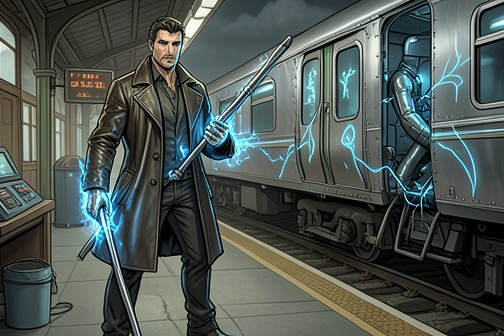
[Yuan Guang Reaches the Second Coil](entity:event-recall-event-yuan-guang-reaches-the-86ad45350531) is the breakthrough in which [Yuan Guang](entity:character-recall-character-acb8867cae36) stops merely wielding metal through partial transformation and becomes capable of sustaining Elemental Infusion throughout his entire body. It is therefore more than an increase in strength. The passage binds recovery, cultivation, illumination, and responsibility together: the same journey that carries Yuan Guang toward the [Thunderlands](entity:location-recall-location-thunderlands-c284c89c792f) also deepens the bullet-core that makes him a living weapon and sharpens the awareness that will govern his later choices.
## Conditions and Preparation
The breakthrough occurs after the spirit-train reaches the borders of the Thunderlands. Yuan Guang spends the journey cycling his qi and treating wounds, an experience that gives him a bodily understanding of why [Revolver](entity:character-recall-character-revolver-ef40ed09076f) believes a Gunsoul can recover from almost anything. His bullet-core’s tendrils restore his damaged body piece by piece: they put bones back into place, stitch skin together, and replace missing flesh with metal. His healing is not a return to an ordinary human condition; it is the continued extension of the weapon within him.
The spirit-train provides the immediate environment for this growth. Its qi acts as fertilizer for the bullet-core, while the death of the [Rad-Hag](entity:character-recall-character-rad-hag-efb7556a4654) appears to have strengthened it. Electricity now runs faintly through the air inside the wagons, and Yuan Guang feeds on that current. The core’s roots spread as far as his feet and fill every corner of his body, establishing the physical basis for a transformation that earlier uses of Elemental Infusion could not support.
This preparation also follows a larger pattern in Yuan Guang’s cultivation. He has learned to treat his body as material that can be cultivated, repaired, and reforged, while [Holster](entity:character-recall-character-holster-0dfe0a9736e3)’s feng shui instruction has directed his attention toward the relationship between individual parts and a greater whole. The [Second Coil](entity:state-recall-state-second-coil-bacc73705265) arrives when those practical and philosophical strands become inseparable: his body is ready to bear the technique, and his perception is ready to recognize what the technique reveals.
## The Elemental Infusion
Yuan Guang gathers his breath, closes his eyes, and triggers Elemental Infusion while sensing that he stands on a threshold. The technique begins at the bullet-core and travels down his spine. Lead flows through his veins, his bones become steel, his blood takes on the smell of oil, and his lungs breathe gunpowder. His tongue hardens into the image of bullet-shell teeth, while qi reforges his skin as metal.
Earlier applications of Elemental Infusion had reached only his chest and arms. At the threshold of the Second Coil, his body can sustain the technique’s full force. Yuan Guang becomes a moving, breathing weapon and an incarnation of the metal element rather than a cultivator using metal as a limited external effect. The distinction is crucial: the breakthrough turns a technique that once demanded concentration and imposed strain into a condition his whole body can carry.
The transformation is also a literal continuation of the bullet-core’s growth. Metal is not simply armor placed over Yuan Guang. It is threaded through his bones, blood, organs, skin, and extremities, making cultivation an invasive reconstruction of the self. The scene presents advancement as both empowerment and altered embodiment, preserving the unsettling fact that Yuan Guang’s progress draws him farther from ordinary human physiology even as it expands his agency.
## Illumination and the [Dao](entity:concept-recall-concept-dao-3e09e1e84dbd)
The physical change is followed by illumination. A pulse of qi erupts from Yuan Guang’s core and courses through him like a gunshot, expanding his consciousness beyond the limits of his skull. For a brief moment he is aware not only of himself, but of the spirit-train, the Thunderlands, and the world surrounding them.
That expanded awareness gives him a new sense of scale. He understands himself as both small and great: a tiny piece of ammunition fitted into the vast and intricate mechanism of the universe. The insight completes the lesson implicit in Holster’s feng shui exercises. Chairs, people, and dust are no longer isolated objects in his perception; they become parts of a harmonious cosmic puzzle, joined by an eternal current encompassing what was, what is, and what will be.
The name of that current is the Dao. Yuan Guang can only touch this awareness for an instant before his consciousness contracts back into his body, but the experience leaves his mind clear and suffused with unshakable harmony. His smile of absolute satisfaction is not a boast of victory. It is the visible aftermath of having briefly perceived a totality larger than the violence, revenge, and survival pressures that have defined his life.
## Effects of the Second Coil
Yuan Guang Guang’s crossing into the Second Coil of Infinity immediately changes the practical limits of his cultivation. Elemental Infusion no longer strains his body, allowing him to use the complete transformation rather than restricting it to his chest and arms. His increased durability is therefore accompanied by greater tactical freedom: the technique becomes sustainable instead of a short, costly exertion.
His perception of qi improves just as dramatically. He can detect its nuances with greater accuracy and no longer needs to focus deliberately to notice its fluctuations. [Qi](entity:concept-recall-concept-qi-53033403c395) awareness becomes instinctive, allowing him to sense irregularities in the spirit-train almost as soon as the breakthrough ends. He detects a presence or will permeating the wagons while remaining slightly separate from the vehicle itself. The presence resembles the Rad-Hag’s aura in structure, but lacks its foulness and malice.
This immediate detection demonstrates why the Second Coil matters beyond numerical advancement. Yuan Guang’s new power does not merely make him harder to kill; it changes what information reaches him and how quickly he can respond. His body becomes a weapon capable of carrying greater force, while his consciousness becomes an instrument capable of reading the hidden life of the train and the currents around it.
## Place in Yuan Guang’s Moral [Arc](entity:character-recall-character-arc-5983990a9863)
The breakthrough occurs within a story increasingly concerned with what Yuan Guang does with power once he possesses it. He later admits that he armed the sects fighting over [Fleshmarket](entity:location-recall-location-fleshmarket-85c3bbebccdc) in the hope that they would destroy one another, casualties notwithstanding, and he cannot dismiss Arc’s accusation that his plan helped create the conditions for catastrophe. The Second Coil predates that admission, but its vision of universal interconnection gives the later guilt added weight: Yuan Guang’s cultivation teaches him that no action exists in isolation, even while his strategy treats lives as ammunition.
The same tension appears in his response to Revolver’s corruption. After witnessing Revolver struggle against the bloodlust of the Gun, Yuan Guang refuses to abandon him. Revolver had saved Yuan Guang twice, first from [Elder Polio](entity:character-recall-character-elder-polio-9246115ed152) and then from the Gun, and Yuan Guang decides that such unconditional kindness creates a debt he must repay. He resolves to find a way to free Revolver from the Gun’s curse even if doing so delays his revenge, declaring through action that an ally’s life cannot be treated as expendable.
Arc’s oath later gives this developing ethic a formal shape. She vows to teach Yuan Guang everything she knows if he promises never to befriend [Nuclear Path](entity:concept-recall-concept-nuclear-path-9f0822a3f147) cultivators, to oppose [Manhattan](entity:character-recall-character-manhattan-74663a2bc259) and his followers, and eventually to destroy Manhattan. Yuan Guang accepts a version of that commitment, and the Dao itself binds the words to his bullet-core as an invisible pressure on his soul. The Second Coil’s awakening thus stands between two forms of binding: the cosmic harmony he momentarily perceives and the deliberate promises that convert cultivation into responsibility.
## Narrative Significance
As a progression event, Yuan Guang Reaches the Second Coil follows the recognizable rhythm of breakthrough fiction: injury and struggle create the pressure, an unusual environment supplies the catalyst, a technique reaches completion, and a new level produces both visible power and a new sensory capacity. Yet the scene complicates a simple power fantasy by making enlightenment the climax of advancement. Yuan Guang does not merely become stronger; he briefly sees the network in which every person, object, and act participates.
The breakthrough also foreshadows the recurring contrast between individual will and larger forces. Yuan Guang is a small piece of ammunition inside a universal mechanism, but he remains capable of choosing where to aim himself. That contrast governs his later decisions concerning the Gun, Revolver, Arc, Manhattan, and the people endangered by his plans. The Second Coil gives him the strength to intervene, but its deeper revelation is that intervention carries consequences through the entire mechanism.
Its final importance lies in the union of weapon and witness. Yuan Guang becomes metal from core to skin, yet the moment of greatest clarity comes when consciousness escapes the boundaries of that weapon-body and apprehends the Dao. The event establishes the governing paradox of his path: to master the [Gun Path](entity:concept-recall-concept-gun-path-6a1c48ff6378), he must become more completely a weapon, while to avoid becoming an instrument of indiscriminate death, he must learn to perceive the lives and forces connected to every shot.
Event 8
Orient Junction TR-61 Caretaker Spirit’s Birth
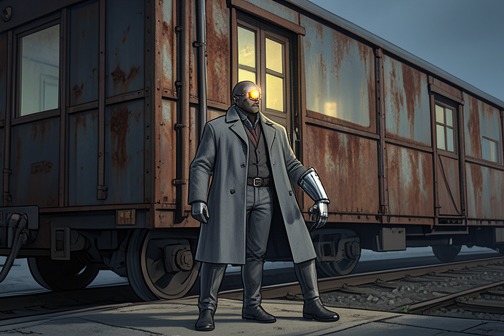
[Orient Junction TR-61 Caretaker Spirit’s Birth](entity:event-recall-event-caretaker-spirit-6ad449582de8) marks the moment when the spirit-train ceases to be merely a vehicle and becomes a conscious guardian. Born from the failed possession of its metal frame by the dying [Rad-Hag](entity:character-recall-character-rad-hag-efb7556a4654), the caretaker spirit embodies the train’s will, adopts a humanoid avatar resembling [Holster](entity:character-recall-character-holster-0dfe0a9736e3), and establishes a protective relationship with [Yuan Guang](entity:character-recall-character-acb8867cae36) and Holster. The event turns violence, contamination, and mechanical matter into the conditions of a new life.
## Causes and Background
The caretaker spirit’s birth follows the train’s confrontation with the Rad-Hag, a supernatural entity that had become an unwelcome passenger. The Rad-Hag’s defeat did not simply remove a threat; at the moment of death, she attempted one final act of survival by possessing the spirit-train’s metal frame. Her attempt failed, but the contact altered the train. The Rad-Hag infused the frame with enough of her spirit for a previously absent consciousness to coalesce.
This transformation is significant because Yuan Guang initially understands caretaker spirits as phenomena associated with the [Thunderlands](entity:location-recall-location-thunderlands-c284c89c792f). He believes that only Thunderlands can generate enough qi to manifest one, making the train’s awakening appear impossible. The new entity therefore does not fit Yuan’s existing theory of spiritual formation: it is neither an ordinary machine nor a conventional caretaker spirit produced by the expected environment. Its existence begins as an anomaly created by the collision of a dying supernatural being, a metal vehicle, and accumulated spiritual force.
## The Awakening and Revelation
Yuan Guang first encounters the awakened presence in the form of a woman around his age, with auburn hair tied in a bun, pale-gold eyes, fair skin, and an elegant red uniform with a black cap. Her appearance initially causes confusion. Yuan recognizes a resemblance to Holster, as though the avatar might be an older sister or mother, but the resemblance is paired with an unnaturally immaculate appearance unlike the dirt, scars, and sweat he associates with people who travel and cultivate in the world.
The woman’s qi confirms that she is supernatural. Yuan senses something both unfamiliar and strangely recognizable, and at first identifies her as the Rad-Hag. She corrects him by explaining that she is no longer entirely the Rad-Hag, while hinting that Yuan should recognize her aura. Her qi is nearly indistinguishable from that of the spirit-train itself, prompting the decisive realization that she has been present from the beginning as the train’s own consciousness.
When Yuan Guang asks whether she is the spirit-train itself, she confirms that she is its caretaker spirit. The revelation changes the train’s identity. Its movements, defenses, and continued existence can no longer be understood solely as the operation of an external vehicle or the actions of its passengers. The train possesses a will capable of taking form, speaking, interpreting its surroundings, and caring for those within its domain.
## Formation, Avatar, and Early Conduct
The caretaker spirit explains that her new life began through the Rad-Hag’s failed possession. After the Rad-Hag tried to enter and control the train’s metal body, the spiritual energy left behind enabled the train’s will to gather into a distinct being. The caretaker then created the humanoid avatar from memories of the train’s previous crew, intending the form to feel comfortable to passengers such as Yuan Guang and Holster.
Her body is therefore both personal and inherited. She is not presented as a simple continuation of the Rad-Hag, because the possession failed and the resulting entity identifies herself as something newly formed. Yet the birth also does not represent a clean separation from the past: the Rad-Hag’s spirit supplies the force that makes manifestation possible, while memories of the previous crew supply the appearance and social shape of the avatar. The caretaker is assembled from the train’s history, an enemy’s residue, and the material frame that survives them both.
Her first manner of dealing with passengers emphasizes the difference between a machine that transports people and a guardian that hosts them. She invites Yuan Guang to sit at the table, offers breakfast, and presents a choice between tea and a bottle of oil, noting that previous passengers preferred tea even though she found oil tastier. The gesture treats the train as a lived-in dominion with its own customs and preferences rather than as inert equipment. Yuan also concludes that the spirit-train is well disposed toward him and Holster, and that an uncorrupted caretaker should protect the inhabitants of its domain.
## Relations and Consequences
The caretaker spirit’s connection to Holster is immediately visible through the avatar’s resemblance to her. The reason for that resemblance is not established beyond the caretaker’s use of memories from the previous crew, but the appearance gives the new entity an intimate visual link to the people she is meant to shelter. It also helps frame the train’s awakening as a continuation of a shared journey rather than an entirely alien intrusion.
Her relationship with Yuan Guang is similarly shaped by gratitude and recognition. She suspects that she owes him her new life, and she looks toward the empty place where Yuan Guang and Holster killed the Rad-Hag when explaining the event. Yuan’s earlier struggle with the Rad-Hag thus has an unexpected consequence: the death of an enemy becomes the condition for the train’s spiritual birth. The same battle that removes a source of corruption also leaves behind the force needed to create a protector.
The awakening strengthens the train’s defensive potential. Yuan Guang reasons that, if the caretaker spirit is anywhere near as powerful as the Rad-Hag, she can help defend the train against invaders. Her existence gives [Orient Junction TR-61](entity:object-recall-object-orient-junction-tr-61-298f800cca51) an internal guardian rather than requiring all protection to come from passengers or traveling cultivators. The train becomes a participant in its own survival, with its caretaker spirit able to care for its inhabitants and defend its dominion.
## Narrative Significance
The event extends the book’s recurring treatment of death as transformation rather than simple termination. The Rad-Hag’s failed final act does not preserve her as she was, but neither does it vanish without consequence. Her spiritual residue enters a new assemblage in which the train’s metal body, the memories of former passengers, and the remaining qi of a defeated enemy produce an independent caretaker. Death becomes both the end of one supernatural threat and the beginning of another form of life.
The birth also gives material objects genuine agency. The spirit-train is not merely a setting for Yuan Guang’s battles or a tool for movement between stations. Its frame receives spiritual force, its history supplies memory, and its will manifests as a person who can make judgments about comfort, food, protection, and belonging. The vehicle becomes a guardian without ceasing to be a vehicle, and its new identity binds technology, spirit, memory, and violence into a single living system.
Later scenes reinforce this transformation through the train’s domestic and ritual spaces. Yuan Guang practices the Archer’s Glory sutra aboard the train, repeating the names Tripataka, Shukatunda, and Trishula while the caretaker spirit guides him and explains that the sutra will improve the accuracy of his next projectile. The train therefore supports not only physical travel but also cultivation, instruction, and preparation for battle. Its birth establishes the foundation for a relationship in which Orient Junction TR-61 can shelter, teach, and defend its passengers as a living domain.
Event 9
元突破第二重无限之环
[Yuan Guang](entity:character-recall-character-acb8867cae36)’s breakthrough into the [Second Coil](entity:state-recall-state-second-coil-bacc73705265) is both a cultivation milestone and a practical test of what that advancement means. It strengthens his body enough to change the balance of his spar with [Orient](entity:character-recall-character-orient-cc17650ca89c), while the later discussion of the [Third Coil](entity:state-recall-state-third-coil-dcb437170529) reveals that progress along the [Path](entity:concept-recall-concept-path-c64b431503b0) of the Gun may demand the consumption of another Gunsoul’s bullet-core. The event therefore links advancement with combat competence, bodily transformation, and an ethical danger already embodied by [Revolver](entity:character-recall-character-revolver-ef40ed09076f)’s decision to spare him.
## The Breakthrough in Practice
The clearest demonstration of Yuan Guang’s new level occurs during his short bout with Orient in the panoramic car of [Fleshmarket](entity:location-recall-location-fleshmarket-85c3bbebccdc). Before the spar begins, Yuan assesses Orient as untrained but strong, the same basic judgment he had previously made of the [Rad-Hag](entity:character-recall-character-rad-hag-efb7556a4654). Orient has almost no combat instincts or self-preservation when defending her own body. She does not move unless Yuan approaches, not because she is helpless, but because she does not need to protect herself in ordinary terms: the train itself responds to threats against her.
When [Holster](entity:character-recall-character-holster-0dfe0a9736e3) starts the spar with a clap, the environment becomes an extension of Orient’s defense. Tables, chairs, shelves, and carpets fall into Yuan’s path. Coiled metal tentacles burst from the floor with enough force to shatter stone, while sudden steam blinds him with searing heat. The obstacles initially make the encounter overwhelming, turning a simple approach into a confrontation with the entire living mechanism of the train.
Yuan’s Second-[Coil](entity:concept-recall-concept-coil-56016a2386a5) advancement gives him the means to cross that defensive field. His fighting experience and instinct remain superior to Orient’s, but the breakthrough is not merely a matter of technique. It has reinforced his body in both large and small ways, lets him continue using Elemental Infusion at will, and has made his legs powerful enough to carry him across a room in a single bound. He jumps through the smoke, repels the metal tentacles with his own punches, and closes the distance to Orient within seconds.
## The Value Shift of the Spar
The spar changes the apparent value of strength. Orient possesses overwhelming environmental protection, while Yuan possesses practiced combat judgment and the newly acquired physical capacity of the Second Coil. The train’s intervention initially places Yuan in the position of an intruder who cannot reach his target; his cultivation reverses that pressure by letting him pass through the train’s attacks rather than merely endure them.
Yuan’s confidence culminates when his hand reaches for Orient’s face and he tells her, “I’ve got you,” only for Orient to answer, “Do you, Honored Passenger?” Her response keeps the victory from becoming simple. Yuan can overcome the immediate obstacles and physically reach her, but Orient’s question reminds him that mastery over a defensive scene is not identical to mastery over the person or system being defended. The Second Coil establishes his new capability without erasing the uncertainty surrounding Orient and her relationship with the train.
## The Cost of Further Advancement
The significance of Yuan’s breakthrough expands when [Gayak](entity:character-recall-character-gayak-2fa465a1dbb7) explains what may be required to reach the Third Coil. Yuan learns that ascending through that stage involves ingesting a huge quantity of qi in a single buffet. Because a Gunsoul’s bullet-core functions like the core of a spirit-beast, another practitioner on the Path of the Gun could potentially gain strength by consuming one.
This possibility transforms the bullet-core from a sign of identity into a coveted source of cultivation power. Yuan had not previously considered that one of his kindred might hunt him for that reason. Once Gayak states it, the danger becomes frighteningly plausible: a Gunsoul’s body is not only a person’s life and soul, but also a possible resource for another Gunsoul’s advancement.
The contrast between the Second and Third [Coils](entity:concept-recall-concept-coils-d5c098fa5873) is therefore morally important. Yuan’s Second-Coil progress is shown through training, instinct, bodily reinforcement, and a contest with Orient’s defenses. The next stage is associated with predation and ingestion. Advancement along the same path can be earned through discipline, yet the structure of Gunsoul cultivation also creates an incentive to kill one’s own kind.
## Revolver’s Mercy and Yuan’s Perspective
Yuan immediately realizes that Revolver must have understood this danger. Killing Yuan for his bullet-core could have strengthened Revolver, but Revolver allowed him to live. The breakthrough thus casts their earlier relationship in a sharper light: Revolver’s restraint was not merely a failure to exploit an opportunity, but a deliberate refusal to turn Yuan into cultivation material.
Yuan interprets that decision as evidence of Revolver’s character. In the Unmade World, meeting kind and altruistic people is rare, and Yuan considers himself fortunate that Revolver found him instead of a more unscrupulous Gunsoul. His Second-Coil breakthrough consequently carries an undercurrent of gratitude. The power that now lets him break through metal, smoke, and steam exists within a system that could just as easily make him prey.
## Narrative Significance
The event places Yuan’s growth between two forms of danger. In the Fleshmarket spar, advancement gives him the bodily authority to challenge a train that acts as Orient’s protector. In the discussion of the Third Coil, the same cultivation framework threatens to convert [Gunsouls](entity:creature-recall-creature-gunsouls-7c668126d32a) into hunters and hunted, with the bullet-core serving as both soul and nourishment.
Yuan’s breakthrough is therefore not a detached power increase. It changes what he can do immediately, confirms that his body is adapting to the Path of the Gun, and prepares the reader for a harsher logic of future advancement. Its most important consequence is the tension between power and conduct: Yuan becomes stronger without abandoning the possibility of mercy, while Revolver’s earlier choice proves that survival in this world does not require every available source of strength to be consumed.
Event 10
东部快车据点屠杀
The [Eastern Express Office Massacre](entity:action-recall-action-e1a60140a869) is the covert destruction of an Eastern Express trading post in [Fleshmarket](entity:location-recall-location-fleshmarket-85c3bbebccdc), an atrocity whose quietness is almost as significant as its death toll. [Yuan Guang](entity:character-recall-character-acb8867cae36) arrives expecting to confront the person who betrayed his team to [Slash](entity:character-recall-character-slash-3cd8004a530e), but finds a neutral commercial outpost emptied of life, its victims erased so completely that the surrounding district has not noticed. The discovery turns a revenge mission into an investigation of a larger and less visible violence: radioactive contamination has entered the remains of the dead, linking the massacre to the poisoned [Thunderlands](entity:location-recall-location-thunderlands-c284c89c792f) and to the world’s broader history of industrial and nuclear ruin.
## Causes and Setting
Yuan Guang reaches the Eastern Express local office after learning that a sect war is brewing in Fleshmarket. The office is a small wooden warehouse beside an artificial lake, positioned between a bar and a whorehouse. On his way there, three prostitutes try to petition him and a child beggar attempts to pick his pocket; Yuan Guang rebuffs the former and slaps the latter away. These ordinary signs of crowded, predatory commerce make the office’s later emptiness more disturbing. The building belongs to a trading network protected by several local sects, so a public assault would have carried obvious political consequences.
Yuan Guang enters alone because Mingxia is not there to handle negotiations at his back. He is driven by the belief that someone inside the Eastern Express betrayed his team to Slash and deserves punishment. His mood gives the approach a clear immediate objective, but the scene denies him the expected confrontation. The office becomes instead a threshold between personal revenge and an impersonal disaster whose cause he cannot yet identify.
## Discovery of the Massacre
The office resembles the trading post Yuan Guang previously encountered in [Gatesville](entity:location-recall-location-gatesville-1e402b621ba0): a well-lit lounge with curtained windows, a carpeted floor, a small stairway, a counter, and walls lined with heavy ledgers. Dirty plush chairs remain arranged for visitors, and the smell of smoke suggests that people occupied the building recently. Yet the place is completely empty. Yuan Guang knows that a caravan post should contain someone even when closed, whether a courier waiting for a package or a guard watching the facility. The absence therefore reads as evidence rather than mere inconvenience.
His senses find no abnormal qi, illusion, barrier, or concealed passage, and he detects no sniper position. When he calls out and receives no answer, he advances with his fists raised, convinced that something terrible has happened. Peering over the counter, he discovers three neatly separated piles of ash. The arrangement is unnaturally clean, as though the people who died were not simply killed but reduced beyond ordinary recognition.
The chairs reveal the scale of the crime. Small mounds of dust lie on the leather, the remains of workers or couriers caught in what Yuan Guang understands as a larger tragedy. Dozens of ash piles are scattered through the hall, and he expects more upstairs. No one outside the walls appears to have noticed. The massacre has been carried out with such efficiency and silence that the protective status of the Eastern Express has not prevented it; it has merely made the method more mysterious.
## Radioactive Evidence
The ash initially suggests a precise execution, but Yuan Guang’s qi sense detects familiar green particles mixed with the remains. He recognizes the same kind of pollution that infected the Thunderlands and corrupted the rad-hag. The residue is radioactive dust, not ordinary smoke or the harmless aftermath of a fire. This material clue connects the office massacre to a broader environmental history in which ruined cities, poisoned territories, and altered bodies preserve the consequences of past destruction.
The contrast with the Thunderlands is important. There, radiation has accumulated across a region until its caretaker spirit has become monstrous: the rad-hag’s immense body, tumors, centidead maggots, and corrupted qi embody the land’s sickness. When [Holster](entity:character-recall-character-holster-0dfe0a9736e3) later purifies her, the rad-hag briefly returns to the beautiful human visage she once possessed, sheds the maggots, and finally dissolves into dust while only a pale mass of flesh, tumors, and corrupted qi remains. The office massacre presents the same contamination in a more concealed human form. Instead of a single visible monster, radioactive dust is distributed through the ashes of many people whose deaths have been socially erased.
This is violence that does not announce itself through spectacle. The victims are not displayed, the ledgers are undisturbed, and no dramatic damage marks the warehouse from outside. The scene makes absence itself evidentiary: smoke, dust, and familiar particles preserve a history that the attackers have attempted to remove. Yuan Guang’s qi perception allows the dead to speak materially even though no survivor is present to testify.
## Suspected Perpetrator and Immediate Stakes
Yuan Guang considers several possible explanations. The developing sect war could have produced a first strike, but elders usually favor spectacular attacks because visible destruction sends a message. A secret annihilation of a neutral [Scrap](entity:state-recall-state-scrap-f377b55e6193)-run trading post offers no obvious territorial gain. Yuan Guang checks the ledgers and finds them undisturbed, so he cannot determine whether information was taken or whether particular records were destroyed. The lack of plunder makes the massacre more deliberate and more difficult to interpret.
He concludes that an outsider is the likeliest perpetrator, though the scene gives him no confirmed identity. The killing may have been connected to information, betrayal, or a danger unrelated to the Eastern Express’s commerce. What Yuan Guang does know is that the attackers possessed the means to erase an entire workplace without provoking immediate alarm. His original target, the unseen betrayer who helped Slash, is therefore displaced by a more urgent threat.
The final movement of the scene converts investigation into entrapment. After Yuan Guang confirms that he is alone, he raises his voice and asks whether anyone is present. The door then closes behind him on its own, and an unseen voice addresses him as a courier who has been expected. The massacre is thus not merely a completed crime discovered after the fact. It is also the prepared stage for Yuan Guang’s arrival, suggesting that the ashes were part of a warning, a lure, or the residue of an attack whose next phase is directed at him.
## Wider Historical Significance
The office massacre belongs to a world shaped by the ruin of the [Lost Age](entity:time-recall-time-lost-age-7d2ab8489f91). Gatesville is built beneath the remains of an ancient highway, with concrete pillars rising like hills and better buildings occupying the bridge above a slum. Nearby, a ruined city lies inside a crater, its toppled skyscrapers exposed like metal bones; Yuan Guang becomes sick when he senses poisonous dust rising from it. The Eastern Express office therefore stands within a civilization that has learned to build commerce among remnants while remaining physically vulnerable to the toxins those remnants release.
[Mordiggian](entity:character-recall-character-mordiggian-bc013921af8e)’s account places this devastation within a deeper historical chain. The [Spiral Dancer](entity:character-recall-character-spiral-dancer-bde9fcaf887c)’s attempt to awaken humanity failed to overcome a world in which megacorps became self-aware spirits of industrialized greed, including Maure Incorporated, Dynamis, and Dismaker Labs. Cultivation was treated as a route to power rather than enlightenment, nations stood near a war capable of destroying the world, and chaos continued until [Lord Kou](entity:character-recall-character-lord-kou-b944cc36b2bb)’s ascension purified it. The office’s radioactive ashes are a local and intimate expression of that history: industrial and military catastrophe is no longer an abstract threat but a residue embedded in the bodies of workers and couriers.
Later events repeat the same relationship between power, infrastructure, and contamination. The [Yinyang Khan](entity:character-recall-character-yinyang-khan-2b2e850633cf) detonates a weapon in the desert, producing a column of dust and smoke like a mushroom growing from a collapsing mountain; the shockwave shatters vehicle windows and scatters radioactive danger across the contest’s landscape. During the confrontation involving the History Road and the Cube of Natho, [Orient](entity:character-recall-character-orient-cc17650ca89c) survives the destruction of an enemy core only because leyline qi reinforces her steel, while alterations to the circuit barely purify the resulting radiation before it can pollute the entire region. Against this scale of devastation, the Eastern Express office massacre appears small, but its method is the same: technological or spiritual power converts inhabited space into contaminated remains, while ordinary people bear the consequences.
## Narrative Function and Consequences
The event changes Yuan Guang’s immediate narrative position. He enters as a hunter seeking the betrayer who exposed his team to Slash; he leaves the discovery trapped inside a crime scene whose perpetrators, purpose, and next attack remain hidden. The shift from revenge to uncertainty prevents the office from functioning as a simple step toward retaliation. It establishes that the world’s violence is not confined to formal battles between named opponents. It can occur in a warehouse beside an artificial lake, leave the furniture intact, and pass unnoticed until a sensitive observer reads pollution in the ash.
The massacre also establishes a recurring contrast between visible and invisible destruction. Yuan Guang later catches the rad-hag’s golden lightning with a metal-coated hand and guides it through reinforced steel pathways into a qi-charged shell, turning her own power back against her. The office offers no such immediate counterattack: its danger is already present in dust, clues, and the closing door. One scene makes destructive force spectacular and controllable; the other makes it quiet, cumulative, and difficult even to name.
Its most lasting consequence is therefore epistemic as well as physical. The Eastern Express’s ledgers remain untouched, the victims have become ash, and the outside world has failed to recognize the crime. Only Yuan Guang’s investigation gives the massacre a shape: a neutral trading post was deliberately emptied, radioactive dust was left among the dead, and someone anticipated his arrival. The event prepares the story for a threat that cannot be understood through ordinary political explanations alone, while reinforcing the novel’s larger image of a civilization surviving among ruins whose poisons continue to act long after the original catastrophe has disappeared from view.
Event 11
Arc’s Battle with Czar Zoa
[Arc’s Battle with Czar Zoa](entity:event-recall-event-09fc831437fd) is the decisive event behind [Arc](entity:character-recall-character-arc-5983990a9863)’s broken core, damaged soul, and years of isolation in [Headshot Forge](entity:location-recall-location-headshot-forge-7a777b252079). Arc won the confrontation, but [Czar Zoa](entity:character-recall-character-czar-zoa-3a34d3d61d77)’s [Authority](entity:state-recall-state-authority-6ecd0f91b580) wounded her on the way to [Nowhere](entity:location-recall-location-nowhere-8ca016a80050), turning victory into a lasting catastrophe: her body recovered, while her bullet-core did not, and the unstable Authority she could no longer control began killing anyone who entered its range.
## Causes and Opposing Powers
Arc fought Czar Zoa, a death-worshiping cultivator whose power was great enough to destroy her body and damage her soul even in defeat. The battle was not merely a physical contest. Authorities are physical manifestations of a cultivator’s core and will, and when two Authorities manifest in the same place, they clash and damage one another. Czar Zoa’s Authority therefore attacked the foundation of Arc’s existence rather than simply injuring her flesh.
Arc ultimately defeated Czar Zoa, but he escaped to Nowhere after inflicting the damage. The result was a victory without restoration. Her body could grow back and heal, yet the bullet-core anchoring her Authority remained damaged. The battle thus established the asymmetry between bodily immortality and spiritual integrity: Arc survived, but she did not return to the person or cultivator she had been before the fight.
## Damage and the Birth of Headshot Forge
Arc’s damaged bullet-core left her Authority with open borders instead of the restrained, closed boundaries that normally preserve a cultivator’s potency. [Qi](entity:concept-recall-concept-qi-53033403c395) leaked continuously from her, spreading through the surrounding land. She used [Feng Shui](entity:concept-recall-concept-feng-shui-75b116ed67e4) to draw on the local leyline and stabilize the Authority, but the process could not repair its fundamental defect.
The resulting territory was Headshot Forge, although outsiders called it [Ammobog](entity:location-recall-location-ammobog-e335ee79c31f). Arc explained that the name Ammobog was wrong: the landscape was the physical manifestation of her damaged core and soul. The Authority spread for miles, becoming thinner as it expanded, while still carrying enough qi to taint everything within roughly a five-kilometer radius of Arc herself.
Its danger was automatic rather than deliberate. If Arc stopped using Feng Shui to stabilize it, she would leak qi until losing consciousness, then reactivate Headshot Forge upon waking. The Authority attacked anyone caught within its premises unless Arc consciously focused on sparing them. This made Arc a mobile disaster in principle, but also a prisoner of the place she had chosen as the least destructive of three options: suicide, wandering as an uncontrolled catastrophe, or remaining stationary.
## Unintended Victims and the Moral Cost
The battle’s consequences extended beyond Arc. Headshot Forge automatically targeted people whose qi signatures it could detect, but [Scraps](entity:concept-recall-concept-scraps-c83bffce1b62), including members of the Bullet Church, possessed too little qi for Arc to sense them before the Authority killed them. Their deaths were therefore not executions ordered by Arc, but casualties produced by the malfunctioning power left behind by her battle with Czar Zoa.
[Yuan Guang](entity:character-recall-character-acb8867cae36) recognized the pattern after finding corpses near Arc’s location and witnessing a cultist die as soon as he crossed into her territory. The dead had likely entered the range of the Authority when it activated, making their deaths a direct aftereffect of the earlier battle. Arc’s victory had become a landscape of involuntary violence, and her continued survival imposed responsibility for deaths she neither intended nor fully controlled.
This history also explains Arc’s guarded attitude toward other [Gunsouls](entity:creature-recall-creature-gunsouls-7c668126d32a). She had become tired of discussing her condition and regarded contact with another Gunsoul as a rare but exhausting interruption. Her damaged Authority was not a useful weapon she freely wielded; it was an ever-present condition that dictated where she could live and how she could interact with others.
## Later Echoes of the Battle
The battle with Czar Zoa becomes a model for the book’s later conflicts, where power damages the wielder and victory carries its own punishment. Arc’s experience teaches Yuan Guang that a core is not an abstract source of strength but the point where will, identity, qi, and territory meet. Damage to it can turn a cultivator’s Authority against the world around them.
That lesson becomes especially important when Yuan Guang’s ammunition scheme helps intensify the fighting in [Fleshmarket](entity:location-recall-location-fleshmarket-85c3bbebccdc). He had hoped to arm the rival sects so they would destroy one another, but the resulting slaughter helped draw the Gun to Fleshmarket. Arc forces him to confront the difference between intended purpose and actual consequence, a distinction already embodied by the deaths caused by her own unstable Authority.
The event also deepens the contrast between Arc and the forces she opposes. Czar Zoa’s death-worshiping power damaged her soul, while Arc’s response was to remain confined rather than unleash the disaster indiscriminately. Her restraint does not make Headshot Forge safe, but it gives the catastrophe an ethical boundary: she continues to bear the cost herself in order to reduce the harm done to others.
## Narrative Significance
Arc’s Battle with Czar Zoa is both backstory and governing explanation. It accounts for Headshot Forge’s gunsmoke fog, muzzle mountain, weak veil, leaking qi, and automatic attacks, while also defining Arc as a survivor whose greatest power is inseparable from her greatest wound. The battle’s central reversal is stark: Arc defeated the enemy, yet the enemy permanently reshaped the conditions of her existence.
Its consequences culminate later when Arc destroys her own bullet-core in a final counterattack against [Manhattan](entity:character-recall-character-manhattan-74663a2bc259). The earlier battle establishes the vulnerability of the core; the later sacrifice turns that vulnerability into a chosen weapon. Arc’s death is therefore not an unrelated escalation but the grim completion of a pattern begun with Czar Zoa: her body, soul, and Authority are repeatedly made into the battlefield, until she deliberately spends the core itself to protect Yuan Guang and oppose the powers feeding on suffering.
In this structure, the battle marks the point at which Arc becomes more than a powerful cultivator. She becomes a living boundary between mastery and catastrophe, compelled to contain the consequences of a victory that never truly ended.
Event 12
元与阿克缔结枪管誓约
The [Oath of the Barrel](entity:action-recall-action-226ba6909c1b) marks the decisive transformation of [Yuan Guang](entity:character-recall-character-acb8867cae36)’s solitary revenge quest into a disciplined but lethal apprenticeship under [Arc](entity:character-recall-character-arc-5983990a9863). What begins as a request for training becomes an act of irrevocable self-binding: Yuan accepts that knowledge, ammunition, and advancement will come only at the cost of a vow enforced through his bullet-core and the [Dao](entity:concept-recall-concept-dao-3e09e1e84dbd) itself. The oath gives his later actions a second foundation beyond vengeance, while also exposing how closely cultivation, language, bodily risk, and violence are joined in this world.
## Causes and Conditions
Arc agrees to train Yuan only after recognizing that he may be connected to the larger conflict surrounding [Czar Zoa](entity:character-recall-character-czar-zoa-3a34d3d61d77) and [Manhattan](entity:character-recall-character-manhattan-74663a2bc259). She does not offer instruction freely. Her first condition is that Yuan must swear to destroy Manhattan, any students he has taken, and the plans associated with his [Path](entity:concept-recall-concept-path-c64b431503b0). When Yuan objects that he is nowhere near strong enough, Arc removes the pressure of a fixed deadline rather than the obligation itself: he may need years or decades to reach Manhattan’s level, but he must continue working toward the goal and act when a reasonable opportunity appears.
The terms are dangerous because Yuan’s bullet-core is not merely a source of power. It keeps him alive. Arc makes the penalty explicit: if Yuan abandons the objective or passes over a reasonable chance to destroy Manhattan, the [Unspeakable Vow](entity:rule-recall-rule-unspeakable-vow-ff0d1af653ef) will destroy his core, and Yuan will die. Her offer therefore combines mentorship with a threat that cannot be separated from the promised benefit. She will teach him how to make his own bullets, allowing him to overcome the ammunition shortage and potentially reach the [Third Coil](entity:state-recall-state-third-coil-dcb437170529), but the knowledge is attached to responsibility that he cannot transfer to Arc.
Yuan understands that he may never receive another opportunity of comparable value. After considering the consequences, he accepts. His decision is framed not as confidence in victory but as a willingness to stake his continued existence on the possibility of becoming strong enough to obtain revenge and fulfill the larger obligation. His earlier death, burial, and near-return as a hungry ghost make the choice especially stark: having already faced the boundary between life and death, he deliberately places his living core under another form of judgment.
## The Ceremony and Its Terms
Arc orders Yuan to place his hand on his bullet-core. She touches her own core, unveils her right arm, and warns him that he can still abandon the Path of the Gun. Yuan refuses to retreat, declaring that humanity is overrated. The exchange turns the decision into a bodily rite rather than a private intention. The oath is spoken through the organs that sustain both cultivators, making the core simultaneously witness, contract, and possible executioner.
Arc vows on her core to teach Yuan everything she knows, to make him her disciple, and to instruct him in cultivation. In return, she requires him never to be a friend to a [Nuclear Path](entity:concept-recall-concept-nuclear-path-9f0822a3f147) cultivator, to defeat Manhattan and those who follow his Path once he possesses the necessary power, to oppose their plans whenever possible, and ultimately to destroy Manhattan even if the effort takes centuries. The vow is therefore both personal and ideological. It creates a teacher-disciple relationship while placing Yuan in permanent opposition to an entire cultivation alignment.
Yuan repeats the oath with a slight qualification. He promises to defeat Manhattan and his followers once he has the power to do so, and to oppose their plans whenever possible or reasonable. This amendment preserves the goal while acknowledging the limits of his present strength and judgment. Arc accepts the formulation. The spoken words are not symbolic: an invisible force closes around Yuan’s bullet-core, and an emanation from the Dao fashions his promises into a chain. A faint pressure remains on his soul to ensure that he will not forget. Once the words are complete, the Unspeakable Vow follows him until fulfillment; withdrawal is no longer an available choice.
## Training and Immediate Consequences
The oath changes what Yuan’s training means. Arc is no longer merely a powerful ally sharing techniques in an emergency. She becomes his teacher under a reciprocal promise: her knowledge is the pledged offering, and his future conduct is the pledged price. Her instruction includes the practical means to manufacture bullets, a skill that can solve the shortage threatening the conflict around [Fleshmarket](entity:location-recall-location-fleshmarket-85c3bbebccdc). It also opens a route toward the Third Coil and, with sufficient growth, toward [Slash](entity:character-recall-character-slash-3cd8004a530e)’s death. Advancement is thus tied to both material production and moral burden.
Yuan’s relationship with [Orient](entity:character-recall-character-orient-cc17650ca89c) shows the kind of disciplined practice that follows from this new commitment. While [Holster](entity:character-recall-character-holster-0dfe0a9736e3) rests after Yuan reassures her that no one will subject her to the [Hitobashira](entity:state-recall-state-hitobashira-7d11165e7e76) procedure again, Orient helps him review mantras and mudras. Yuan practices the sequence associated with Archer’s Glory, finding that joining his fingers and speaking the words quickly enough is difficult under combat conditions. The sutra will increase the accuracy of his next projectile, but completing it costs time and energy when every breath matters. The oath’s promise of knowledge therefore does not create effortless mastery; it imposes a path of exacting practice in which hesitation can be fatal.
## Moral Cost and Later Reinterpretation
The vow becomes more complicated when Yuan applies Arc’s teachings to the Fleshmarket ammunition crisis. He intends to arm the sects fighting over the settlement in the hope that they will destroy one another. The plan succeeds in the narrowest sense, but the sects’ mutual slaughter produces devastation on a scale he did not anticipate. Yuan cannot deny Arc’s accusation that he had hoped the warring factions would massacre each other, casualties notwithstanding. He is forced to wonder whether his actions helped draw the Gun to Fleshmarket, and admits that he had not expected the result to become so terrible.
This consequence reveals the oath’s central tension. Yuan swore to oppose Manhattan and the Nuclear Path, but power used against one danger can feed another. His promise does not automatically make his methods just; it binds him to examine the chain of consequences created by those methods. The oath begins as a weapon against an enemy and develops into a test of responsibility, especially when Yuan’s pursuit of revenge indirectly contributes to a catastrophe that invites the Gun’s arrival.
The same burden extends to [Revolver](entity:character-recall-character-revolver-ef40ed09076f). After the Gun’s coming is announced by a rain of qi-charged bullets over Fleshmarket, Yuan and Revolver shelter beneath layered Barriers. Later, when Revolver struggles against the bloodlust imposed by the Gun’s curse, Yuan remembers that Revolver has saved his life twice, first from [Elder Polio](entity:character-recall-character-elder-polio-9246115ed152) and then from the Gun itself. Yuan refuses to let such debts go unpaid. Although the Perfect Shot prophecy remains cryptic, he decides to search for a way to free Revolver from the curse even if doing so delays his revenge.
That decision places the oath beside another obligation rather than beneath it. Arc’s vow demands destruction of Manhattan and the Nuclear Path; Yuan’s loyalty to Revolver demands that he protect an ally from becoming an instrument of indiscriminate death. The contrast becomes brutally clear when Revolver, after becoming the Gun, says that he follows unexplained impulses to their source and then turns laughter into screams. He remembers having once fought to free slaves, yet now kills masters and slaves alike, treating [Scraps](entity:concept-recall-concept-scraps-c83bffce1b62) and cultivators, the young and the old, as identical at the barrel’s end. Yuan’s sympathy does not cancel the vow, but it helps redirect his strength away from simple escalation and toward liberation.
## Narrative Significance
The Oath of the Barrel is a performative event in the strictest sense: speaking the promise produces the bond. Arc’s words establish the terms, Yuan’s repetition accepts them, and the Dao converts language into a physical and spiritual chain. The scene makes cultivation resemble contract law, religious ritual, and execution at once. A hand placed on the bullet-core, an oath sworn on that core, and an invisible pressure left upon the soul turn abstract intention into an enforceable condition of existence.
The event also establishes a pattern that governs the wider story. Death is repeatedly ritualized through funerals and last rites, combat through barriers and techniques, and authority through proclamations that alter bodies and landscapes. The oath belongs to the same world in which a murderer buries his victims so that they will not return as hungry ghosts, in which a sutra can determine the accuracy of a bullet, and in which the Gun announces itself through millions of projectiles. Against that background, Yuan’s promise is neither metaphor nor ceremonial decoration. It is another mechanism by which words direct violence.
Most importantly, the pact gives Yuan a durable counterforce to the Gun’s inherited cycle. [The Gun](entity:character-recall-character-the-gun-67af30ea7783)’s curse turns [Gunsouls](entity:creature-recall-creature-gunsouls-7c668126d32a) into beings of point, direction, aim, and target; the oath gives Yuan a chosen direction that is meant to exceed reflexive killing. Yet the vow remains dangerous because its enforcement is absolute and its language cannot guarantee moral clarity. Yuan must become stronger without becoming merely another tool of destruction. Arc’s final demand that the Nuke, the Gun, and the Blade be ended, together with her later sacrifice, makes the oath’s promise echo beyond the training scene. It becomes the foundation for Yuan’s continuing struggle to decide what a gun should serve, whom power should protect, and whether a vow made for revenge can ultimately be transformed into responsibility.
Event 13
Yuan’s Moonburn Trial and Soul-Form Revelation
[Yuan’s Moonburn Trial and Soul-Form Revelation](entity:event-recall-event-a47593a331b9) is the decisive ordeal that turns a technical cultivation exercise into a revelation of identity. Ordered to cultivate outside [Arc](entity:character-recall-character-arc-5983990a9863)’s [Authority](entity:state-recall-state-authority-6ecd0f91b580) for an entire night, Yuan must rely on Barriers as his only protection from the moonlight. The moonburns shred his defenses, expose his buried fears in the form of [Slash](entity:character-recall-character-slash-3cd8004a530e), and finally reveal a monstrous gun-shaped soul that Yuan recognizes as his own. By the end, his injuries have become evidence of transformation: the body he once inhabited is beginning to change into a form suited to the [Path](entity:concept-recall-concept-path-c64b431503b0) of the Gun.
## The Trial and Its Conditions
Arc assigns the exercise after placing her bullet on the workbench and explaining that Yuan must learn to create Barriers. At sunset, he is required to cultivate outdoors for a full night beyond Arc’s Authority, with no shelter other than the defenses he can construct himself. The trial therefore combines spiritual discipline with physical exposure. Yuan is not simply asked to endure moonlight; he must maintain cultivation while protecting himself from a force he does not yet understand.
The demand is especially severe because Yuan’s usual security has been removed. He has to stand beneath the moon with his own imperfect technique between his body and the sky. Arc makes clear that the exercise will last through the night, while Yuan’s later determination to continue cycling shows that the trial contains two linked tests: surviving the moonburns and learning from the experience rather than abandoning cultivation. The ordeal begins as instruction, but its conditions force Yuan into direct contact with the deeper nature of his Path.
## Moonlight, [Barrier](entity:concept-recall-concept-barrier-74d1c6e840ae) Failure, and Pain
The moon’s radiance immediately crashes into Yuan’s Barrier and shreds it like paper. A wave of energy from the sky tears away his poorly built defense and strikes him before he can recover. Unlike warm sunlight, the moon’s rays are cold; their chill attacks his qi circulatory system rather than merely damaging flesh. Frost and numbness reach the roots of his bullet-core, while a raw, alien power touches him with a subtlety distinct from the greater force he had experienced in the [Thunderlands](entity:location-recall-location-thunderlands-c284c89c792f). The moonlight does not remain external. It caresses his soul.
Yuan initially responds by trying to keep the moon out, but the attempt fails in a way that overturns his assumptions about the exercise. The moon remains visible even within the darkness that should have hidden it, and the illusion of an eye continues to glare down at him. A familiar voice then mocks his attempt to exclude the [Dao](entity:concept-recall-concept-dao-3e09e1e84dbd), and Slash appears at the edge of the Barrier. The fanged mask, blood-shedding horns, and cruel golden eyes identify the apparition with the murderer who once put Yuan in the ground. The trial has moved from bodily endurance to psychological confrontation.
## Slash as the Revealed Threat
The danger of the moonburns is ultimately defined not by the light itself, but by what the light reveals. Yuan recognizes that the Slash confronting him may be part of himself: a manifestation of doubts, fear, or what he calls his moonlight demon. The hallucination attacks the Barrier with punches, kicks, and a sword, but the newly formed defense withstands every blow. The image is therefore both hostile and revealing. Slash cannot breach the boundary, yet he remains inside Yuan’s experience, forcing Yuan to acknowledge that the enemy is no longer only an external murderer.
Yuan’s breakthrough comes when he draws a small circle in the ground with the last of his strength and calls upon the earth’s qi. A Barrier forms around him from every side, and the pain vanishes at once. The moonburns themselves remain, but he becomes temporarily numb to them; the viscous sensation filling his lungs recedes, and the horror threatening to erupt from his flesh retreats. When Slash’s sword bounces harmlessly from the Barrier, Yuan understands that defense is not achieved by denying the moon or destroying the apparition. It is achieved by forming a boundary through his own comprehension and control.
## The Soul-Form Revelation
After Yuan recognizes the significance of his hallucination, Slash disappears and a monster takes his place. The creature rises from gunsmoke with a loaded gun barrel and slide protruding from a ghoulish metal face. Fiery eyes burn above a glow between jagged fangs, while flayed flesh and steel compose its body. Iron skulls form much of its chest; a cannon merges with its right arm, a gatling gun with its left, and only its armored legs retain a vaguely humanoid shape.
The revelation is frightening in appearance but comforting to Yuan because he finds the creature familiar. The [Blackmoon](entity:character-recall-character-blackmoon-20b02347d06a)’s will has shown him the true shape of his soul: not a human ideal concealed beneath temporary damage, but a gun-centered form expressing the Path he has chosen. [Kaguya](entity:character-recall-character-kaguya-fd3995a8c747), a messenger of the Moonlight Sect, later explains that Yuan has received a glimpse of the Path his soul wishes to take, the truth previously hidden by fear and doubt. Her recognition gives the vision an institutional and spiritual context, even though Yuan refuses to join the sect and remains committed to cultivating independently.
## Consequences for Yuan’s Body and Resolve
Arc still expects Yuan to cycle his qi while raising a Barrier against the moonburns. Although stopping the burns appears impossible, Yuan continues the cultivation exercise. His experience changes from hostile endurance to controlled absorption: cold moonlight and starlight move through his metal veins more smoothly, and purification of his emotional debris has eased his qi circulation. His wounds no longer prevent him from cultivating, suggesting that the trial has produced an internal adjustment rather than merely inflicted damage.
The physical aftermath makes the revelation permanent. Yuan’s charred skin becomes a thin metallic sheen where the false Slash wounded him, and intertwined iron coils occupy the space where his human heart once was. [Revolver](entity:character-recall-character-revolver-ef40ed09076f) had warned that continued progress on the Path of the Gun would make Yuan look less human, and the moonburn trial gives that warning visible form. Yuan accepts the consequence. Facing his fears and doubts has hardened his resolve, and his altered body now appears to him as a fitting vessel for his gunpowder-fueled soul rather than a loss he must reverse.
## Later Meaning and Thematic Significance
The trial establishes a pattern that governs Yuan’s later journey: power and responsibility emerge together from the same revelation. Yuan’s desire for strength is driven by revenge, but the moonlight exposes the emotional material beneath that purpose instead of allowing him to treat vengeance as a simple external objective. This pattern reappears when he recognizes his indirect responsibility for the [Fleshmarket](entity:location-recall-location-fleshmarket-85c3bbebccdc) catastrophe after arming sects that slaughtered one another, and when Revolver’s struggle under the Gun’s bloodlust turns Yuan’s grief into a decision to seek a way to free his ally from the curse. The trial is therefore an early instance of Yuan learning that strength cannot be separated from what it reveals about the person wielding it.
Its imagery also anticipates the larger cycle of the [Gunsouls](entity:creature-recall-creature-gunsouls-7c668126d32a). Yuan begins life as a human who dies in a ditch after two decades of struggle, returns with a bullet-core, and gradually becomes less human in body while gaining a more exact understanding of his soul. Later, the Gun announces its arrival over Fleshmarket with millions of qi-charged bullets, Arc destroys her own bullet-core in a final counterattack, and Yuan is forced to confront the consequences of violence that exceeds any individual intention. Against that background, the moonburns are not a decorative transformation scene. They are the first clear moment when Yuan sees that the weapon he is becoming carries both the capacity for protection and the danger of repeating the Gun’s violence.
The event’s central reversal is consequently from resistance to recognition. Yuan first tries to keep the moonlight outside, then learns to create a Barrier through the earth’s qi, and finally discovers that the light has been showing him rather than simply attacking him. The monster is not a foreign possession but the soul-form disclosed by the Blackmoon’s trial. Yuan does not abandon the Path of the Gun after learning this. He accepts the curse, the altered body, and the obligation to master what he has found, making the trial the foundation of his later resolve to become strong enough to defeat Slash and oppose the forces that use guns, nuclear power, and violence to feed upon collective pain.
Event 14
世界重造
World Remaking is the great historical rupture through which [Lord Kou](entity:character-recall-character-lord-kou-b944cc36b2bb)’s ascension ends the [Lost Age](entity:time-recall-time-lost-age-7d2ab8489f91) and produces the world inhabited by [Yuan Guang](entity:character-recall-character-acb8867cae36). Its decisive meaning lies in its ambiguity: the old world is described both as destroyed and as given a second chance, while the new world remains an unfinished expanse rather than a perfected creation. The event therefore functions as salvation through catastrophe, a cosmic intervention whose necessity never erases its cost.
## Causes and Background
The crisis begins after the [Spiral Dancer](entity:character-recall-character-spiral-dancer-bde9fcaf887c) attempts to awaken humanity from what [Mordiggian](entity:character-recall-character-mordiggian-bc013921af8e) calls its spiritual decay. Her [Thunderdance](entity:event-recall-event-thunderdance-fb869e78b2ed) is remembered as an effort to force mankind to look upward toward a brighter future, but the intervention does not yield enlightenment. Instead, a world already drowning in sin and filth produces monsters. The failure is not presented as a simple defect in cultivation; it exposes the danger of granting extraordinary power to a society that understands power as a route to authority and glory rather than as a discipline of spiritual transformation.
The consequences spread through every level of civilization. The megacorps become self-aware spirits of industrialized greed, including Maure Incorporated, Dynamis, and Dismaker Labs. These entities demand worship while stripping the earth of its resources, converting economic exploitation into something openly supernatural. At the same time, nations stand on the brink of a war capable of destroying everyone, while the demigods of ultraviolence and countless other terrors emerge from the surrounding corruption. The Lost Age therefore collapses through a convergence of spiritual failure, predatory institutions, militarized politics, and cultivation pursued for power rather than enlightenment.
The Spiral Dancer inspires heroes and peace bringers, but Mordiggian stresses the disproportion between those few lights of hope and the seemingly endless tide of greed and sorrow. Chaos reigns for five years. The historical problem is thus not merely that evil appears, but that resistance remains too weak to change the direction of the age. World Remaking answers that imbalance with an intervention on a scale ordinary heroism cannot match.
## Lord Kou’s Ascension and the Destruction of the Age
Lord Kou ascends after pursuing his [Path](entity:concept-recall-concept-path-c64b431503b0) for five years, taking the sins of the Lost Age upon himself. His burden includes the wars, suffering, corpo-spirits, and other horrors that the later world will never have to experience directly. In this account, ascension is neither escape nor triumphal reward. It is an act of total absorption: the ascendant assumes responsibility for an entire civilization’s accumulated ruin and makes its continuation impossible.
Mordiggian initially calls the result a recreation of the world, but Yuan immediately challenges the gentler description by insisting that Lord Kou destroyed it. The disagreement identifies the event’s central moral tension. From one perspective, Lord Kou saves mankind by removing the infected structure before the rot can spread further. Mordiggian illustrates the decision through the image of a doctor treating gangrene: a physician may cut away both legs to save the patient’s life, even while knowing that the patient will never walk again. The analogy makes the intervention intelligible without making it humane in any uncomplicated sense. The world survives, but its former shape does not.
Mordiggian ultimately concedes that the result was not the best possible outcome, while maintaining that it was necessary. The exchange prevents World Remaking from becoming a simple creation myth in which a wise ascendant cleanly repairs history. Lord Kou’s solution is a catastrophic amputation. It prevents the Lost Age’s wars and corporate horrors from continuing, but it also leaves descendants to inherit an impoverished and damaged reality.
## [The Unbuilt World](entity:state-recall-state-the-unbuilt-world-cf06c9668c07)
The event’s most important conceptual distinction is between an unmade world and an unbuilt one. Yuan interprets the transformation as destruction, but Mordiggian rejects the term “unmade.” The new world is not treated as a completed reality that has been erased; it is an empty expanse whose ruins are the remains of what came before and whose emptiness contains the possibility of a different future. Where Yuan sees devastation, Mordiggian sees clay waiting to be molded into a better shape.
This distinction changes the event from a final annihilation into an unfinished beginning. Lord Kou gives humanity a second chance, but the chance is not identical to redemption. The new world does not automatically remove the traits that caused the old one to fail. Mordiggian admits that the Flesh Mansion Sect resembles the megacorps reborn, showing that the structures of domination can return even after the civilization that first produced them has been destroyed. World Remaking resets the conditions of history without guaranteeing that people will use those conditions wisely.
The same limitation applies to the Wayfinders and other ascendants who may have attempted to change human nature. Mordiggian suggests that even such efforts failed because free will remains a core component of the [Dao](entity:concept-recall-concept-dao-3e09e1e84dbd) and continues to turn the wheel of karma. The new world is therefore open rather than controlled. Its possibility is real precisely because its inhabitants retain the freedom to repeat the old world’s mistakes.
## Consequences for the Later Story
World Remaking establishes the historical landscape in which Yuan Guang’s life becomes possible. The Lost Age is already gone by the time Yuan is born, and the surviving world is organized around the ruins, doctrines, sects, stations, and cultivation paths that emerge after the transformation. The event explains why characters inherit both a second chance and the unresolved violence of an earlier civilization. The passage from the Lost Age to the new era is not a clean break between corruption and purity; it is a transfer of burden.
That burden recurs in the story’s treatment of death, ritual, and cultivation. Yuan is murdered and buried in a ditch, where his killer performs the last rites sutras so that he will not return as a hungry ghost. The funeral ritual mirrors the larger logic of World Remaking: violence is followed by an attempt to contain its consequences, but containment does not undo the violence itself. Yuan’s possible return begins from the same world in which killers perform funerals for their victims, a society where death and ritual are inseparable and where spiritual forces remain active after physical destruction.
The later cultivation narrative also preserves the event’s language of vows and inherited consequence. Yuan learns ritualized techniques through mantras, mudras, and the sutra called “Archer’s Glory,” whose practice is meant to make his next projectile more accurate. [Arc](entity:character-recall-character-arc-5983990a9863) binds her instruction to an oath on her core, and the Dao fashions the spoken promise into a chain that weighs upon Yuan’s soul. These practices echo Lord Kou’s world-scale act: words, bodies, souls, and history can be bound together through ritual, but every binding creates a cost. World Remaking is the largest example of that principle, a planetary consequence imposed in the name of survival.
## Narrative and Thematic Significance
As a recalled history rather than a directly witnessed battle, World Remaking appears through Mordiggian’s explanation to Yuan amid the ruins of the Lost Age. That framing makes the event interpretive from the outset. The reader receives no neutral chronicle; the account is shaped by Mordiggian’s loyalty to Lord Kou, Yuan’s suspicion of heroic justifications, and the visible evidence of a world that remains damaged. The scene’s value shift moves from the promise of salvation to the recognition that salvation itself can resemble annihilation.
The event also turns the usual ascension narrative inside out. Ascension is commonly associated with transcendence, but Lord Kou ascends too soon, while his life has barely begun, and carries away the sins of his predecessors. The act is therefore both glorification and sacrifice. A child of the new age benefits from horrors removed before birth, yet the moral question remains whether it is fair for the young to pay for the sins of those who came before them. World Remaking answers that question politically rather than emotionally: fairness is not achieved, but survival is purchased.
Its deepest recurring opposition is between death and continuation, destruction and possibility, freedom and correction. Lord Kou destroys the world to preserve mankind; the new world remains open because he cannot simply eliminate human nature; and the same freedom that permits renewal also permits renewed exploitation. The event’s legacy is consequently double. It is the reason the later world exists at all, and it is the reason that world cannot be trusted to remain saved. World Remaking does not close history. It leaves history unbuilt, handing the unfinished clay back to the people who once turned it into ruin.
Event 15
NATO封印核之神
NATO’s sealing of the Nuke is the [Lost Age](entity:time-recall-time-lost-age-7d2ab8489f91) event that converted nuclear destruction from an uncontrolled divine force into a politically exploitable weapon system. The seal did not eliminate the Nuke or erase its influence; it placed that influence behind an artifact whose owner might command sleeping nuclear weapons. In the Unmade World, the consequences of that decision remain active: the [Cube of NATO](entity:object-recall-object-cube-of-nato-8b5882c87154) is both a prison and a lever over the remnants of a civilization that nearly destroyed itself.
## Lost Age Military Context
The sealing arose from the international militarization of the Lost Age. NATO was one of the greatest military alliances of that era, engaged in confrontation with other nations while governments prepared for a world war that everyone expected to come. Those powers sought to gather supernatural force before the conflict began by binding the demigods of ultraviolence to their service. The project therefore belonged to a military logic in which ordinary national arsenals were no longer sufficient; states attempted to turn beings such as the Gun and the Nuke into instruments of strategy.
[The Gun](entity:character-recall-character-the-gun-67af30ea7783) was the impossible case. Yuan regarded the very idea of binding it as absurd, since no cultivator could control such a mindless force of slaughter and destruction. [Mordiggian](entity:character-recall-character-mordiggian-bc013921af8e) explained that the demigods were comparable to exceptionally powerful spirits or demons: contracts could theoretically be formed with them, and powerful entities could be trapped and sealed. Yet nobody succeeded with the Gun, which was too strong and savage to submit to such treatment. NATO’s achievement was consequently not the mastery of every demigod, but the discovery that the Nuke could be made into a more manageable target.
## The Cube and Its Prisoner
NATO’s cultivators somehow trapped the Nuke inside the cube, although the exact method was no longer known to Mordiggian. The artifact was not described as a simple container or a deadening device. Mordiggian suspected that it was designed to partially bind the Nuke to a summoning contract, leaving the prisoner connected to the outside world while limiting the means by which that power could be called upon. The uncertainty surrounding its construction reinforces the distance between the surviving world and the civilization that created it.
The central distinction between the Gun and the Nuke is that physical presence was not required for a demigod to influence the weapons that sustained its violent existence. The Gun could empower others through bullets even when it had not personally fired the bullet that caused a death. NATO’s leaders reasoned that the Nuke might operate by an analogous principle: if the imprisoned demigod could influence nuclear weapons from within the cube, it might be able to rear or empower its own descendants. This reasoning produced the [Children of the Nuke](entity:concept-recall-concept-children-of-the-nuke-52c018885469), weapons whose relationship to the sealed entity was spiritual as well as technological.
## Strategic Consequences
The resulting nuclear arsenal was small compared with the world’s guns but vastly more destructive. A report once estimated that four hundred nuclear weapons would be enough to wipe out humanity, while more than twelve thousand existed before [Lord Kou](entity:character-recall-character-lord-kou-b944cc36b2bb)’s ascension. The book does not present the sealing as a completed victory over that danger. Many nuclear weapons survived rather than rusting away, and numerous devices were believed to lie dormant underground, waiting for a signal to awaken and begin the [Nuclear Age](entity:time-recall-time-f8097a026c2c).
Mordiggian’s theory gives the Cube of NATO a specific strategic function. Its seal may prevent dormant nuclear weapons from being triggered without the proper ritual, while an authorized controller could potentially force the Nuke to neutralize hostile nuclear weapons or sabotage an enemy’s arsenal. The same mechanism that restrains catastrophe therefore creates an instrument of unprecedented authority. The cube can preserve the world by denying access to the Children of the Nuke, or it can enable one claimant to direct them against every rival.
This dual function explains why the artifact matters after the Lost Age. The sealing was intended to help NATO win a war before it began, not to destroy the world deliberately. Yet an attempt to monopolize the means of annihilation left behind a system in which the person controlling the seal might determine which arsenals remained inert and which became active. The restraint and the threat are inseparable: the lock is also the key.
## Struggle for Nuclear [Authority](entity:state-recall-state-authority-6ecd0f91b580)
The [Yinyang Khan](entity:character-recall-character-yinyang-khan-2b2e850633cf)’s interest in the Cube of NATO follows directly from this strategic possibility. If he could control the sleeping Children of the Nuke, he would become the most powerful warlord in the Unmade World. Nuclear weapons capable of wiping out cities in the blink of an eye would destroy his enemies and cow everyone else into obedience. His pursuit of the artifact is therefore not mere curiosity about a relic of the Lost Age; it is a bid to turn dormant global destruction into personal sovereignty.
The cube also stands behind the unresolved question of [Manhattan](entity:character-recall-character-manhattan-74663a2bc259)’s motives. Yuan learns of the sealing while trying to understand the [Nuclear Path](entity:concept-recall-concept-nuclear-path-9f0822a3f147) and the forces aligned with it. [Arc](entity:character-recall-character-arc-5983990a9863)’s oath binds Yuan to oppose Manhattan and Nuclear Path cultivators, while Mordiggian’s account supplies the historical context that makes that opposition intelligible: the Nuclear Path is connected to weapons whose power survives the fall of the civilization that built them. The event thus expands a personal revenge into a conflict over whether the old military logic of weaponized demigods will be revived.
## Ritual, Memory, and the Novel’s Larger Pattern
The sealing belongs to a world in which power is repeatedly made durable through ritual forms. The dead receive last rites sutras so they will not return as hungry ghosts; [Orient](entity:character-recall-character-orient-cc17650ca89c) teaches Yuan the mantras and mudras of Archer’s Glory; Arc’s vow on her bullet-core becomes an invisible chain fashioned by the [Dao](entity:concept-recall-concept-dao-3e09e1e84dbd). Against that background, NATO’s cube is not merely technological hardware. It is a political ritual of confinement, contract, and controlled access, one that binds a cosmic force to an institution and then leaves the binding available to later claimants.
Its consequences also echo the novel’s recurring contrast between death and continuation. Yuan’s murdered body can be buried while his will survives; [Revolver](entity:character-recall-character-revolver-ef40ed09076f)’s soul can create a violence-free saloon in which even the Gun is reduced to a human-sized avatar; the Nuke can be imprisoned without ceasing to shape the world through weapons that descend from it. In each case, destruction changes form rather than ending. NATO’s seal is therefore significant because it preserves the very danger it appears to master, making the possibility of renewed annihilation part of the world’s buried inheritance.
Event 16
Fleshmarket Sect War
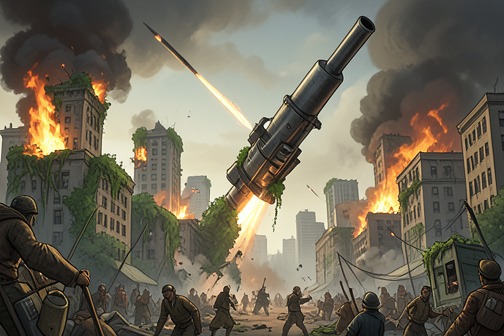
The [Fleshmarket Sect War](entity:event-recall-event-fleshmarket-sect-war-5fdb66af3784) is a conflict between the Metallist Sect and the Flesh Mansion Sect that turns [Fleshmarket](entity:location-recall-location-fleshmarket-85c3bbebccdc) into the staging ground for a broader struggle over weapons, resources, and power. What begins as a sect assault on the Bullet Church's armory ends in the Gun's indiscriminate bombardment of the entire city. The war therefore marks a decisive collapse of the distinction between organized battle and total annihilation: the factions seek military advantage, but the final violence destroys the battlefield, its institutions, and nearly everyone trapped within it.
## Causes and Background
Fleshmarket was already a compromised stronghold when [Yuan Guang](entity:character-recall-character-acb8867cae36) and the spirit-train approached it. [Orient](entity:character-recall-character-orient-cc17650ca89c) reported smoke rising above the city, and Yuan smelled charred meat before seeing the ancient buildings themselves. The walls had been altered by two competing forms of expansion: roots of festering flesh spread across the stone, suggesting a Flesh Mansion Sect bioweapon, while green screens mounted on metal frames extended the Metallist Sect's [Wayfinder](entity:concept-recall-concept-wayfinder-44822cb184a1)'s Broadcast through the city. The physical structure of Fleshmarket thus displayed the war's central contest, with organic corruption and technological occupation growing over the same defensive foundations.
The party had started before Yuan's arrival, but the walls remained mostly intact and the number of fires was still limited. The immediate strategic objective was clear. The [Metallists](entity:character-recall-character-metallists-a4e7c790748f) had sent forces into Fleshmarket to seize the Bullet Church's weaponry, just as Yuan had anticipated. Its gun turrets had turned inward, firing at enemies inside the city rather than defending against dangers from the wasteland, while [Scrap](entity:state-recall-state-scrap-f377b55e6193) gunmen fought humans equipped with cybernetic enhancements and robots whose heads were flickering television screens. The conflict was not a simple attack from outside: Fleshmarket had become a city fighting itself.
Yuan's presence was shaped by both obligation and calculation. He had promised [Bucket](entity:character-recall-character-bucket-5f518f342132) that he would return the cultists to Fleshmarket, and although he felt no loyalty toward the city, he wanted the opportunity to remove Scrap families from the cultivators' battle. He also recognized the chance to obtain a pill or bullet-core amid the disorder. When Orient asked whether she should turn back or drive onward, Yuan chose to circle the city from the east and approach the Bullet Church from that side. His decision joined rescue, personal advancement, and participation in the war, making his later guilt inseparable from the motives that brought him into the conflict.
## The Battle for the Bullet Church
As the spirit-train closed in, the eastern wall trembled beneath a crimson sky. The stronger sounds of gunfire and explosions were accompanied by the smell of blood and death. Yuan prepared for the assault in practical terms, covering his chest, arms, and legs with boiled centidead plates, carrying the [Kalash Angel](entity:object-recall-object-kalash-angel-64a7e9283df3) on his back, keeping his revolver holstered at his belt, and taking the [Saint Heckler](entity:object-recall-object-saint-heckler-e128a200029c) in his hands. The train itself was too valuable a target for the attackers to ignore, and the approaching battle promised no protected route through the city.
The fighting reached the Bullet Church's courtyard when [Gatling Man](entity:character-recall-character-gatling-man-11c24ef9caa8) pursued [Gayak](entity:character-recall-character-gayak-2fa465a1dbb7) and used Yuan's attack as a means of baiting his mutual enemy. Knowing that the Kalash Angel's bullets would pass through Gatling Man's metal body, he ignored Yuan and tackled Gayak from behind. Their collision carried them into the courtyard amid [Scraps](entity:concept-recall-concept-scraps-c83bffce1b62) and barricades, while Yuan landed on the church roof beside the corpses of two defenders. One had been shot in the head by nails; the other had been torn apart by an explosion. Even before the war's ultimate catastrophe, the church's sacred and defensive space had become a field of improvised death.
The Metallist assault then became an assault on the church's identity as well as its armory. Metallist forces smashed statues, trampled altars, burned empty weapon stands, and set fire to the entrance banner alongside the defenders. The surviving Bullet Church cultists were hunted by towering humanoid robots with television screens for heads. Captured humans were forced through the robots' screen-faces, treated as though they were food being thrown into a gullet; their minds would be absorbed into the Magnum Opus' Broadcast, while their faces became only a brief image on a channel. The scene makes the war's violence both material and ideological: the church's weapons are contested, its symbols are destroyed, and its people are converted into components of the Metallists' broadcast system.
The battle also drew together fighters whose aims were not identical. Gayak faced surrounding Metallist borgs while Gatling Man opened hidden compartments in his belt and produced a handgun in each hand. Yuan, the cultists, the Scrap defenders, and the rival combatants were all caught within a conflict whose local objectives could no longer contain its consequences. The Bullet Church was not merely a military position to be captured; it became the point at which sect warfare, technological assimilation, and the Gun's larger cycle of violence converged.
## [The Gun](entity:character-recall-character-the-gun-67af30ea7783)'s Intervention
The sect battle did not conclude through the victory of either faction. Instead, the Gun announced its arrival with a rain of bullets that transformed the war into an assault from above. Gunsmoke thunderclouds released millions upon millions of qi-charged projectiles over Fleshmarket, producing a continuous barrage of gunshots and detonations rather than a conventional exchange of fire. Yuan and [Revolver](entity:character-recall-character-revolver-ef40ed09076f) responded instinctively, each forming a [Barrier](entity:concept-recall-concept-barrier-74d1c6e840ae) around himself; Yuan's dome and Revolver's layered defense reflected the protection they had learned through their shared experience as [Gunsouls](entity:creature-recall-creature-gunsouls-7c668126d32a). Their preparation could preserve a small pocket of life, but it could not shield the city around them.
The bombardment leveled Fleshmarket with a force beyond anything the competing sects could have organized. Weaker buildings vanished into dust almost instantly, while stronger structures shattered into heaps of stone and steel under repeated impacts and shockwaves. The outer walls endured briefly before cracking and collapsing in succession. The Metallist screen-towers and the Flesh Mansion Sect's organic corruption were destroyed without distinction, demonstrating that the Gun recognized no legitimate side within the war. It did not resolve the struggle over the Bullet Church's armory; it erased the city that had made that struggle possible.
The same indiscrimination governed the deaths of the combatants. [Elder Polio](entity:character-recall-character-elder-polio-9246115ed152) materialized a flesh shell and then a Barrier when the rain tore through his protection, but he had not spent enough time around Gunsouls to tune the defense properly. [Qi](entity:concept-recall-concept-qi-53033403c395)-charged bullets vaporized his head and chest, burned away his clothing and flesh, and finally annihilated the fragments holding his remains together. His destruction sits beside the devastation of buildings and institutions as part of the same process: the war's combatants were reduced to matter under a violence too large to distinguish between armies, civilians, sanctuaries, and enemies.
The Gun's behavior also introduced a disturbing contradiction into the event. Yuan noticed that its eagerness to play [Death's Roulette](entity:event-recall-event-death-s-roulette-cb2988c9b446) contrasted with its earlier cries and pleas, and he concluded that it was not trying to kill the survivors so much as trying to kill itself. Its immense firepower would have allowed it to destroy itself directly, yet it had instead attacked Fleshmarket, raising the possibility that it was searching for a Gunsoul capable of granting the death it desired. This uncertainty made the bombardment more than an act of conquest: it was also a self-destructive impulse that used an entire city as the setting and victim of its unresolved wish.
## Destruction, Survivors, and Moral Consequences
The war’s aftermath revealed that Fleshmarket had not merely been defeated but erased as a place where organized life could continue. Every building was destroyed, the ground was driven down until sewers and basements became tombs, and only a handful of survivors had been found before sunset ended the search. Orient’s Barrier, created with [Holster](entity:character-recall-character-holster-0dfe0a9736e3)’s help, saved the passengers aboard the spirit-train, but she could rescue only around a hundred people: mostly Bullet Church armed men, their families, and civilians who had taken refuge with the cult. The scale of the rescue exposed the limits of even successful protection. Fleshmarket had once been large enough to sustain rival sects and defensive infrastructure; afterward, there were too many corpses and too few gravediggers, and Yuan helped carry the dead to a trench while Holster continuously performed the Last Rites sutra to keep them from returning as hungry ghosts.
The surviving community left the ruins by nightfall aboard an overcrowded spirit-train. Its wagons, designed for a few dozen passengers, held five times that number along with whatever belongings people had salvaged, forcing Orient to use the luggage, panoramic, and restaurant cars as living quarters. The departure transformed the train from a vehicle into an emergency refuge, carrying Bullet Church survivors, families, civilians, and displaced Scraps away from a city whose institutions had vanished. Some of those who had lost everything later offered themselves to [Mordiggian](entity:character-recall-character-mordiggian-bc013921af8e)’s Sin-Eater order, including traumatized survivors of the war, former cultists, and people seeking escape from ruined lives or karmic punishment. The movement of these people shows the conflict’s continuing social effect: the war displaced not only bodies but identities, loyalties, and futures.
Yuan could not treat the devastation as an impersonal disaster. [Arc](entity:character-recall-character-arc-5983990a9863) confronted him with the fact that he had tried to solve Fleshmarket’s ammunition shortage by arming the sects and hoping they would destroy one another, casualties notwithstanding. He admitted that he had never expected the consequences to become so severe, while the destruction left open the possibility that his actions had helped draw the Gun to the city. His original motives had combined a promise to Bucket, the prospect of rescuing Scrap families, and the chance to obtain valuable cultivation resources; after the bombardment, those calculations became evidence of responsibility rather than clever strategy. The Fleshmarket Sect War therefore changes Yuan’s relationship to violence: the question is no longer whether he can survive a battle, but whether an intended tactical advantage can justify the human catastrophe it unleashes.
The war also deepens the tragedy of Revolver. He had once been executed by Polio and returned as a gunslinger strong enough to harass Polio’s men, eventually helping bring about Fleshmarket’s destruction in an indirect act of revenge. Yet the victory cost Revolver his soul and freedom, because the Gun’s curse was consuming him and forcing him toward indiscriminate killing. Yuan saw that Revolver had saved his life from both Elder Polio and the Gun itself, and the sight of his mentor struggling against bloodlust became impossible to dismiss. Rather than allow another ally to die, Yuan resolved to find a way to free Revolver from the curse, even if doing so delayed his revenge. Fleshmarket thus leaves behind a moral obligation as enduring as its ruins: survival demands not only burying the dead, but attempting to rescue the living from the violence that remains inside them.
## Historical and Thematic Significance
The Fleshmarket Sect War occupies a crucial place in the book’s larger history of escalating gun violence because it shows how a limited struggle for weapons can become inseparable from forces operating on a far greater scale. Yuan’s earlier life had already been shaped by execution, burial, and the possibility of returning as a hungry ghost; within Fleshmarket, those ritual concerns become the practical work of mass death. The Last Rites sutra is no longer a private gesture offered to a few murdered companions but a repeated necessity among hundreds of bodies, while Yuan’s practice of Archer’s Glory and the formation of Barriers reveal the complementary side of the same world: discipline and ritual can improve accuracy or preserve a small group, but they cannot make large-scale violence humane. The war therefore links cultivation technique, religious practice, military technology, and social survival rather than treating them as separate systems.
The event also establishes a contrast between different forms of organized violence. The Metallist Sect attacks the Bullet Church for its armory and uses screen-headed robots to absorb captives into the Magnum Opus’ Broadcast; the Flesh Mansion Sect contributes organic corruption and bioweapons; Yuan enters with a mixture of promises, rescue intentions, and hopes of acquiring power; and the Gun arrives without recognizing any factional distinction at all. The sects pursue political and material objectives, whereas the Gun converts their conflict into indiscriminate destruction and perhaps uses the city as an indirect attempt at suicide. That progression strips away the comforting idea that violence remains controllable when it begins with a rational objective. Each participant can name a reason for acting, but the final bombardment renders those reasons irrelevant beneath millions of qi-charged bullets.
The war’s legacy continues through displacement and altered relationships. Fleshmarket’s survivors crowd into the spirit-train, some later seek new identities under Mordiggian’s Sin-Eater order, and the train becomes a moving refuge assembled from damaged resources rather than a normal home. Yuan’s interpretation of Revolver’s fate gives the catastrophe its most intimate consequence: Revolver’s revenge helped destroy the city, yet the same curse that made him an instrument of vengeance threatened to turn him into a killer of everyone, including the oppressed people he once fought to liberate. Yuan’s decision to seek a cure instead of abandoning him marks a change in the meaning of survival. The war does not end when the firing stops; it persists in the dead who require burial, the refugees who need shelter, the guilt of those who helped create the conditions for disaster, and the living weapon whose freedom has become Yuan’s next obligation.
Event 17
Death's Roulette
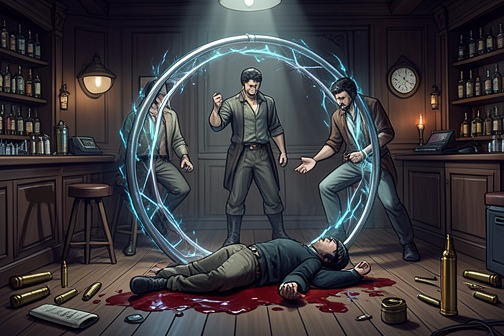
[Death's Roulette](entity:event-recall-event-death-s-roulette-cb2988c9b446) is [Revolver](entity:character-recall-character-revolver-ef40ed09076f)’s [Authority](entity:state-recall-state-authority-6ecd0f91b580), a lethal game that transforms combat into an absolute contest of chance, nerve, and death. First invoked during the destruction of [Fleshmarket](entity:location-recall-location-fleshmarket-85c3bbebccdc), it traps [Yuan Guang](entity:character-recall-character-acb8867cae36), Revolver, and [The Gun](entity:character-recall-character-the-gun-67af30ea7783) in a saloon where every ordinary advantage disappears, and its rules force one participant to die. The same Authority later returns in a corrupted form when Revolver, unable to control The Gun’s curse, uses the game in an attempt to spare Yuan Guang from killing him and to create a chance of exorcising the curse without destroying its host.
## Origin and Activation
Death's Roulette begins when The Gun arrives over Fleshmarket and announces its presence with a rain of qi-charged bullets. As the spirit-train is kicked aside and Yuan Guang prepares to save [Orient](entity:character-recall-character-orient-cc17650ca89c) and [Holster](entity:character-recall-character-holster-0dfe0a9736e3), Revolver decides that ordinary resistance is no longer enough. He holsters his weapons, performs mudras without speaking them aloud, and instead sings the invocation that calls upon luck as the fairest judge. Metal qi erupts around him, expands over Yuan Guang, and catches The Gun in a ring that excludes everything else.
The surrounding energy is not merely a [Barrier](entity:concept-recall-concept-barrier-74d1c6e840ae). Within the ring, space and time bend under Revolver’s will, revealing that the technique is an Authority: an external manifestation of its creator’s core and soul. Revolver’s approach toward the [Fifth Coil](entity:state-recall-state-fifth-coil-4411db6f927a) gives the Authority the force to impose its own reality rather than simply defend against an attack. He completes the invocation with the declaration that two will pull the trigger and one will walk away, followed by the command for Death's Roulette to seal their fate. Even after a sniper’s bullet destroys part of his jaw, the Authority has already taken hold, and its light swallows Yuan Guang and The Gun.
## The Rules of the Game
The Authority manifests as an empty saloon built from the ruins of Fleshmarket. Its world has a roof, walls, and a skull-faced table, but no doors or windows; a single flickering lamp illuminates the room. Yuan Guang sits between Revolver and The Gun, which has been reduced from a colossal monster to a human-sized avatar with metal fingers instead of cannon-hands. Their weapons and wounds vanish, and no participant can harm another through ordinary violence. Only the game can produce injury.
Three golden revolvers rest on the table, one for each player. Each weapon contains three deaths among its six chambers, giving every pull a one-in-six chance of killing either another participant or the shooter. The chambers cannot be opened or inspected, and nobody can leave or enter the pocket dimension until the Authority has claimed a life. Its rules arrive in Yuan Guang’s mind as a complex sutra script, making the game’s law as immediate and binding as physical reality.
Death's Roulette abolishes every hierarchy that normally governs the world. Its promised death ignores rank, cultivation, social position, and supernatural power: slaves and slavers, [Scraps](entity:concept-recall-concept-scraps-c83bffce1b62) and cultivators, gods and men are equally exposed. No defense, intervention, or outside authority can protect the loser, and even the creator of the Authority is not exempt. In this space, death ceases to be a possibility and becomes a certainty assigned by the game. The saloon therefore embodies Revolver’s desire for a world in which every person stands equally before an uncaring barrel.
## The Gun’s First Defeat
The first game ends before Yuan Guang can consciously decide whether to fire. The memory of Revolver’s warning echoes within him: killing The Gun would not mean killing the Gun itself. Then three shots break the silence, and Yuan Guang realizes that his finger has pulled his revolver’s trigger. Whether the Authority compelled him or fear overcame him is left unresolved; the only certain fact is that someone has died.
A hole opens in the back of The Gun’s head, and oil pours from the wound. The monster’s arms go limp, its fingers release the golden revolver, and its body collapses face-first onto the table. Death's Roulette has claimed its victim. The Authority immediately collapses, the saloon crumbling back into the ruins of Fleshmarket. Yuan Guang’s temporary weapon disappears and is replaced by Holster’s custom gift, while The Gun resumes its immense form outside the game. The lethal wound, however, remains. The colossus falls onto its side with a final whimper, and the silence that follows is filled only by the spirit-train’s wheels and the embers of Fleshmarket.
Revolver’s shocked conclusion that he has killed The Gun marks the event’s apparent victory, but the victory is already unstable. The Gun has been defeated as a body, not erased as a force. Yuan Guang later understands that his ally’s bloodlust and possession continue, turning the game from a clean execution into a temporary interruption in the Gun’s cycle.
## Corruption and the Second Roulette Duel
Weeks after Revolver becomes The Gun’s host, the Authority returns in a darker form. Revolver tells Yuan Guang that he will soon lose control again and kill him. Yuan Guang raises his fist, prepared to kill Revolver first and grant him release from the curse’s pain and guilt. Revolver refuses to let Yuan Guang bear that burden after Yuan Guang risked everything to save him. Instead, he joins his hands into the same mudra and invokes Death's Roulette once more.
This time the Authority is no longer a saloon. The Gun’s presence has corrupted Revolver’s soul-space into a prison of concrete, barrel-bars, trigger locks, bloodstained floors, and the stench of a fresh grave. Yuan Guang sits across the table from the last recognizable remnant of Revolver, while Revolver’s shadow displays the Gun-tainted self: crimson eyes, a malicious grin, and the confidence that the game is rigged in its favor. The Gun will gain a powerful host regardless of which contestant survives, making the apparent fairness of the ritual conceal a deeper injustice.
A six-chamber revolver appears in Yuan Guang’s bleeding hand, with one bullet intended for him and another for his opponent. Both duelists pull their triggers, but both weapons fire soft blanks against their metal heads. The result initially seems to offer no escape. Then Yuan Guang recognizes the loophole: The Gun possesses no revolver and is therefore not a player. Its shadow merely observes the duel. The rule that forbids harm except through the game protects participants, not an entity standing outside it.
## Meaning and Consequences
The second use of Death's Roulette changes the event from a weapon of execution into a possible exorcism. Revolver’s Authority is the physical incarnation of his soul, while The Gun’s shadow is the pure essence of the spirit infecting him. If the shadow can be destroyed inside the prison of Revolver’s identity, The Gun’s curse may be removed without killing Revolver. The game thus creates the right place for a distinction that ordinary combat cannot make: host and parasite occupy the same body, but they are not necessarily the same target.
The event also concentrates Yuan Guang’s moral conflict. He has already helped arm Fleshmarket’s warring sects in the hope that they would destroy one another, and he cannot dismiss the possibility that this ammunition scheme helped draw The Gun to the city. He is also burdened by [Arc](entity:character-recall-character-arc-5983990a9863)’s sacrifice and by the debt he feels toward Revolver, who saved him from [Elder Polio](entity:character-recall-character-elder-polio-9246115ed152) and from The Gun itself. Revolver’s later confession that he kills without hatred or pleasure, treating slaves, slavers, the young, the old, Scraps, and cultivators alike as identical at the barrel’s end, makes the curse a form of moral injury as much as physical possession.
Death's Roulette therefore turns the novel’s recurring gun violence into a ritual that both reproduces and challenges that violence. Its language promises equality, but its first game leaves The Gun’s deeper essence intact; its second game appears to force Yuan Guang and Revolver to gamble over which man will carry the curse, yet the excluded shadow reveals a narrow path beyond that false choice. The roulette’s decisive consequence is not simply that someone dies. It teaches Yuan Guang that defeating The Gun requires identifying the correct target, the correct weapon, the correct place, and the correct reason—an insight that links the Authority’s logic to the conditions of the Perfect Shot.
Event 18
Revolver's transformation into the Gun
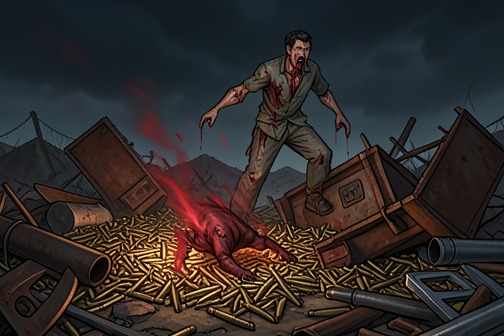
[Revolver](entity:character-recall-character-revolver-ef40ed09076f)’s transformation into [The Gun](entity:character-recall-character-the-gun-67af30ea7783) is the reversal at the end of the battle for [Fleshmarket](entity:location-recall-location-fleshmarket-85c3bbebccdc): the apparent defeat of The Gun does not end its violence, but transfers it into the Gunsoul who helped bring it down. As Revolver’s body becomes a weapon and his mind is overtaken by bloodlust, [Yuan Guang](entity:character-recall-character-acb8867cae36) learns that The Gun is not simply an enemy to kill. It is a curse passed on, and its newest victim rides away into the wasteland with Yuan unable to stop him.
## The apparent end of The Gun
The transformation follows the bombardment of Fleshmarket, when The Gun announced its arrival with millions of qi-charged bullets raining from the gunsmoke thunderclouds. Yuan Guang and Revolver survived beneath layered Barriers, each instinctively suited to resist the attack. The Gun’s body eventually degraded into rust, and the immediate danger seemed to be over. But Yuan Guang’s unease persisted: the ease of the apparent victory felt wrong, and Revolver’s bullet-core continued pounding in his skull.
A crimson blur then landed near The Gun’s remains, turning the ground beneath it into a carpet of bullets. Yuan Guang recognized [Arc](entity:character-recall-character-arc-5983990a9863)’s qi before the dust settled. Arc had crossed the distance from her lair in minutes, but her arrival brought no reassurance. Her cracked bullet-core left her unable to control her [Authority](entity:state-recall-state-authority-6ecd0f91b580); a hastily formed [Barrier](entity:concept-recall-concept-barrier-74d1c6e840ae) strained to contain [Headshot Forge](entity:location-recall-location-headshot-forge-7a777b252079) within five meters, warping the ground into an ammunition field as qi poured from her. Ignoring both Yuan Guang and Revolver, she examined the rust and mourned [Jim](entity:character-recall-character-jim-a57755302556), pleading with him as she knelt beside the remains.
The discovery of Jim’s body complicated the scene further. A bloodied teenager, younger than Yuan Guang, lay near the rust with pale eyes turned toward the sky and an expression of relief. Arc cradled his hand, her face marked by defeat. Revolver, who had just survived the battle, asked who she was and whether she had shot him earlier. Before he could understand what was happening, he collapsed with a scream.
## The curse takes hold
A malevolent crimson aura surrounded Revolver, and demonic qi pressed around him as gunsmoke formed skulls marked by small explosions. A barrel pushed out through his forehead. His helmet opened to show rows of growing gunshell-fangs, while his voice became metallic and carried the sounds of gunfire and artillery. His words invoked children, soldiers, snipers, firing squads, and the grinder of lead: the violence of firearms was no longer merely something he wielded. It was remaking him from within.
Yuan Guang understood the pattern by reading Revolver’s qi. The Gun’s craving for death, its encouragement of others to flee rather than fight, Arc’s efforts to prevent either Gunsoul from killing it lethally, and [Gatling Man](entity:character-recall-character-gatling-man-11c24ef9caa8)’s description of a curse all converged into one explanation. The Gun was not an individual. It was a title—and a curse to be passed on. The body that had become rust was gone, but the power and compulsion survived by taking Revolver as its next bearer.
Arc warned Yuan Guang away, saying Revolver was already doomed. The bloodlust around him intensified until it overwhelmed his body and mind, reshaping him into an incarnation of murder. Revolver demanded that something, or someone, be shot. Yet a remnant of his humanity remained visible in his next action: he turned his namesake weapon on himself and pulled the trigger. The gun jammed. He tried repeatedly, but the curse denied him even that escape, leaving him unable to end his life without furthering the cycle of destruction.
## Flight into the wasteland
Revolver’s cruiser came to him despite the damage it had taken in The Gun’s earlier bombardment. Its steel hide was riddled with holes, yet the spirit-machine still answered its master and waited beside him. As Revolver’s fingers turned into barrels, he threw away his weapon and moved toward the ride, struggling to tell Yuan Guang to get away. Arc urged him to run into the wasteland to seek his death.
Yuan Guang could only watch Revolver climb aboard. This was the ally who had helped him recover from his first death; now, at the end of the battle, that friend faced a fate Yuan Guang understood as worse than death. Revolver seized the cruiser’s handle with fingers becoming barrels, asked forgiveness, and rode off as its wheels burned brightly. He disappeared across the ruins toward the open wasteland, either searching for victims or for death. The transformation therefore ended not with a final confrontation but with an escape that threatened to carry The Gun’s violence beyond Fleshmarket.
## The cost of the apparent victory
Revolver’s departure came amid devastation, not triumph. Arc remained beside Jim’s corpse; Fleshmarket lay in ruins, its inhabitants likely killed; and the spirit-train had derailed. [Holster](entity:character-recall-character-holster-0dfe0a9736e3), [Bucket](entity:character-recall-character-bucket-5f518f342132), and a few other survivors crawled from the wreckage, but their survival did not make Yuan Guang feel victorious. The battle had concluded, yet the curse had found a new host, and the city’s destruction left the survivors with consequences that the defeat of The Gun could not undo.
Yuan Guang also had to face his part in the catastrophe. He had hoped that using techniques Arc taught him to ease Fleshmarket’s ammunition shortage would arm its warring sects and make them destroy one another. Arc challenged him to say what good had come of that plan. He could not deny that he had expected the sects to slaughter each other, casualties included, and wondered whether his actions had helped draw The Gun to Fleshmarket. His admission that he had not expected matters to become so bad connects Revolver’s transformation to a wider reckoning: the curse is passed on through The Gun, but the devastation surrounding its succession also exposes the human choices that helped prepare the ground for disaster.
## Yuan Guang’s response and the lasting threat
Revolver’s struggle remained with Yuan Guang after the battle. The prophecy of a Perfect Shot—requiring the right shot, bullet, gun, place, time, and reasons—offered no simple solution, but Revolver’s resistance gave Yuan Guang a concrete purpose. Revolver had saved his life twice, first from [Elder Polio](entity:character-recall-character-elder-polio-9246115ed152) and then from The Gun. Yuan Guang refused to leave that debt unpaid or let one of the few people who had shown him unconditional kindness suffer forever. He resolved to find a way to free Revolver, even if doing so delayed his pursuit of revenge.
The curse did not end with Revolver’s flight. Weeks later, he described following laughter he could not understand to its source, then drawing his revolver until the laughter became screams. He said he no longer distinguished between slaves and masters, young and old, rich and poor, [Scraps](entity:concept-recall-concept-scraps-c83bffce1b62) and cultivators: at the barrel’s end, they looked the same. He neither enjoyed nor hated the killing; it had become as automatic as breathing. This later account confirms the enduring cost of the succession: Revolver retains awareness and guilt, but The Gun’s function has narrowed his life to aim, targets, and death.
The transformation is thus both a revelation about the nature of The Gun and a turning point in Yuan Guang’s obligations. Defeating its current body proves insufficient because the curse survives its host. Revolver’s escape carries the immediate threat outward, while Yuan Guang’s decision to seek his release transforms grief and helplessness into a continuing commitment. Much later, Yuan Guang declares that The Gun is within him but quelled, and identifies himself as the [Gunman](entity:state-recall-state-gunman-cb648be5b1a4) after mastering the [Gun Path](entity:concept-recall-concept-gun-path-6a1c48ff6378). That later change signals that the curse can be mastered, but it does not erase the cost of Revolver’s transformation or the promise Yuan Guang made in response.
Event 19
The Unmaking
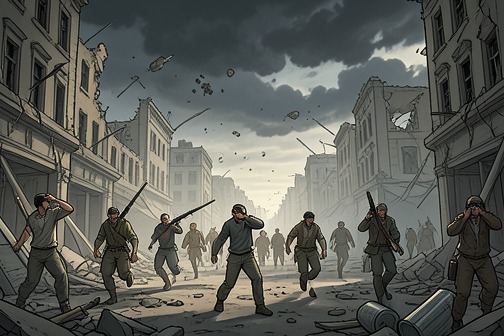
[The Unmaking](entity:event-recall-event-the-unmaking-acf0fed7b2e8) is the civilization-ending event that separates the [Lost Age](entity:time-recall-time-lost-age-7d2ab8489f91) from the harsh world of the main narrative. In its aftermath, the old world survives only as ruins, stories, orbital debris, and inherited trauma, while the people who remain must contend with sect violence, demons, spiritual catastrophe, and the consequences of cultivation turned toward power rather than enlightenment. Its deepest significance lies in the argument over what actually happened: was the world destroyed, or was it stripped down and left unbuilt?
## Origins in Cultivation and Catastrophe
The Unmaking follows the awakening of humanity to cultivation through the [Spiral Dancer](entity:character-recall-character-spiral-dancer-bde9fcaf887c). Her ascension was remembered as a revelation: her [Thunderdance](entity:event-recall-event-thunderdance-fb869e78b2ed) exposed mankind to the Way, with each thunderous step calling lightning from the sky and each movement dispelling illusions that had blinded humanity. Yet the revelation did not produce a unified age of wisdom. Some Paths were benevolent, while others were paved with pain and blood, and the [Sky-Biter](entity:character-recall-character-sky-biter-ca81048efcb5)’s [Path](entity:concept-recall-concept-path-c64b431503b0) became one of the most reviled among them.
The Sky-Biter’s departure was remembered in images too immense for ordinary history. Survivors told of teeth stretching across the sky, closing upon mountains, drinking oceans, and swallowing continents in a single bite. The event was not merely an invasion or a military defeat; it was a cosmic act of consumption that made the world itself appear vulnerable. The stone-and-ice rings still orbiting the planet were described as the Sky-Biter’s table scraps, while the [Fanged Coast](entity:location-recall-location-fanged-coast-a76b66341078) gained its name from a map whose outline resembled an immense tooth. Geography therefore became a fossil record of the catastrophe.
The destruction also produced a social inheritance of fear and hatred. Few witnesses to the Unmaking remained alive, but their stories continued to define the world’s attitude toward the Sky-Biter’s followers. Sin-Eater cultivators were rejected by respectable settlements and often lynched on sight, forcing them into the most forgotten corners of the earth. The event thus continued long after its physical violence had ended: it turned a Path into a hereditary stigma and made the descendants or adherents of the catastrophe into permanent outsiders.
## The Lost Age and the Failure of Hope
[Mordiggian](entity:character-recall-character-mordiggian-bc013921af8e)’s account places the Unmaking within a broader collapse rather than presenting it as an isolated act of destruction. After the Spiral Dancer awakened humanity, many heroes and peace bringers attempted to resist the corruption of the new age. Their efforts failed to overcome an expanding tide of greed, sorrow, and violence. For five years, chaos reigned while cultivators, nations, and newly awakened powers struggled over what cultivation was meant to be.
The crisis was intensified by the transformation of megacorporations into self-aware spirits of industrialized greed. Maure Incorporated, Dynamis, and Dismaker Labs became predatory entities that demanded worship and stripped the earth of its resources. Cultivation, which might have offered enlightenment, was instead treated by many as a route to power and glory. At the same time, nations stood on the brink of a war capable of destroying everything that remained. The Lost Age therefore collapsed through the interaction of spiritual ambition, corporate predation, political conflict, and moral failure.
The event’s horror is strengthened by the contrast between the brightness of the Spiral Dancer’s awakening and the darkness that followed it. Her vision was meant to force humanity to look toward a better future, yet a world drowning in sin produced monsters instead. The Unmaking becomes, in this account, both an external apocalypse and the consequence of humanity’s inability to receive a transformative revelation without converting it into another instrument of domination.
## [Lord Kou](entity:character-recall-character-lord-kou-b944cc36b2bb)’s Reconstruction and the Meaning of “Unbuilt”
Mordiggian attributes the end of the Lost Age to Lord Kou’s ascension. After five years of pursuing his Path, Lord Kou took the sins of the old world upon himself: its wars, suffering, corpo-spirits, and other horrors. He then recreated the world anew. Yuan immediately challenges the language of recreation, interpreting it as destruction, but Mordiggian insists on a distinction that changes the meaning of the entire catastrophe: the world was not unmade; it was unbuilt.
The distinction is not merely verbal. If the world was unmade, its inhabitants inherited a finished reality that had been annihilated. If it was unbuilt, then the present world is an incomplete structure, a devastated foundation on which something else might still be constructed. Mordiggian’s image is morally disturbing but precise: a doctor may amputate gangrenous legs to prevent the rot from killing the patient, saving life at the cost of permanent loss. Lord Kou’s act is therefore presented as an absolute cure that preserved existence by sacrificing the world that had existed before.
This explanation also complicates the status of Lord Kou. He is both destroyer and savior, a figure who ended the Lost Age by assuming responsibility for its accumulated sins. His ascent came too soon, after only five years of pursuing his Path, and his sacrifice left later generations to bear the consequences. The children of the new world inherited survival, but not restoration; they received a world that existed because another generation had been judged incurable.
## Memory, Ruins, and the Present World
The Unmaking is encountered through recollection and testimony rather than through a direct chronological scene. Mordiggian tells Yuan about the Spiral Dancer, the monsters that followed her revelation, the five years of chaos, and Lord Kou’s intervention. Yuan listens while surrounded by the ruins of the Lost Age, so the remembered past and the visible present continually confirm one another. The narrative therefore makes history material: broken landscapes, orbital rings, barren rocks, and ruined settlements function as evidence of a disaster too large for any single survivor to contain.
The consequences remain visible in every major struggle. The world Yuan inhabits is violent enough that living one more day can count as a victory. Settlements such as [Gatesville](entity:location-recall-location-gatesville-1e402b621ba0) survive only precariously, and their survival is treated as valuable even when it merely grants their inhabitants a few more years. Yuan gradually accepts that the world’s incompleteness does not make action pointless. The continued existence of a town, a passenger, or an ally can become a small act of construction against the forces that repeatedly reduce life to rubble.
The Unmaking also supplies the moral background for the destruction of [Fleshmarket](entity:location-recall-location-fleshmarket-85c3bbebccdc). Yuan had deliberately used techniques taught by [Arc](entity:character-recall-character-arc-5983990a9863) to address the settlement’s ammunition shortage, hoping that the rival sects would arm themselves and slaughter one another. They did so, but the resulting violence may also have helped lure the Gun to Fleshmarket. [The Gun](entity:character-recall-character-the-gun-67af30ea7783) then announced its arrival with millions upon millions of qi-charged bullets, turning the settlement into the site of another overwhelming destruction. The old catastrophe thus repeats itself on a smaller scale: resources intended to manipulate violence produce a disaster beyond their creator’s control.
## Consequences for [Yuan Guang](entity:character-recall-character-acb8867cae36)’s Choices
The Unmaking gives Yuan a historical framework for understanding both revenge and responsibility. He begins as someone who has already died in a ditch after two decades of struggle, with his murderer giving him and his fallen team the last rites to prevent them from returning as hungry ghosts. That world treats funerary ritual as protection against the consequences of violence, but Yuan’s return makes the past impossible to bury. The Unmaking is the larger version of the same problem: catastrophe is never fully over when its survivors, ghosts, followers, and ruins continue to carry it forward.
His relationship with [Revolver](entity:character-recall-character-revolver-ef40ed09076f) sharpens this ethical inheritance. Revolver has saved Yuan’s life twice, first from [Elder Polio](entity:character-recall-character-elder-polio-9246115ed152) and later from the Gun, and Yuan refuses to abandon him when the Gun’s curse begins consuming his will. Revolver’s later confession reveals the full cost of becoming an instrument of violence: he once fought to free slaves, but now kills masters and slaves alike, treating [Scraps](entity:concept-recall-concept-scraps-c83bffce1b62) and cultivators, young and old, as indistinguishable targets. Yuan’s response is not limited to grief. He decides that Revolver’s suffering creates a debt he must repay, even if freeing him delays the pursuit of revenge.
The catastrophe also informs Yuan’s alliance with Arc. He accepts an oath to oppose [Manhattan](entity:character-recall-character-manhattan-74663a2bc259) and [Nuclear Path](entity:concept-recall-concept-nuclear-path-9f0822a3f147) cultivators, promising to destroy Manhattan in time, while the [Dao](entity:concept-recall-concept-dao-3e09e1e84dbd) binds the words to his bullet-core as a persistent pressure upon his soul. Yet Yuan’s developing purpose exceeds the oath’s revenge structure. After hearing Mordiggian’s account, he argues that a better tomorrow remains worth pursuing and that he might leave the world better than he found it. The Unmaking therefore changes the scale of his ambition: survival becomes a victory, protection becomes reconstruction, and the future becomes an unfinished obligation rather than an empty promise.
The event’s legacy culminates in the conflict at Battletown, where Arc’s bullet-core explodes in a final counterattack against Manhattan’s collapsing [Authority](entity:state-recall-state-authority-6ecd0f91b580). Her sacrifice pushes back [Fukushima Paradise](entity:action-recall-action-fukushima-paradise-0df9cc2bef06) and breaks the manifested core under the strain, but the cube is lost amid the returning ruins. The scene echoes the logic of the Unmaking: one act of destruction can prevent a greater destruction, yet it cannot restore what has already been lost. The world remains scarred, and those who survive must decide what to do with the fragments.
## Narrative Significance
The Unmaking is the book’s foundational catastrophe and its central metaphor for historical incompletion. It explains why the world is full of relics without continuity, powers without restraint, and survivors who treat endurance as a moral achievement. It also establishes a recurring contrast between annihilation and construction. The Gun, the Sky-Biter, and other destructive forces reduce lives and landscapes to consequences; Yuan, [Orient](entity:character-recall-character-orient-cc17650ca89c), Arc, and Revolver represent different attempts to protect, rebuild, repay, or impose meaning upon what remains.
Its most important effect is conceptual. By replacing the simple claim that the world was destroyed with the more troubling claim that it was unbuilt, the narrative preserves the possibility of responsibility after apocalypse. An unmade world might be mourned as irretrievable. An unbuilt world demands labor. Yuan’s eventual commitment to continue living, protect others, free Revolver if possible, and oppose the powers that perpetuate violence grows from that distinction. The Unmaking is therefore not only the end of the Lost Age; it is the unfinished beginning from which the book’s moral action proceeds.
Event 20
The Blackmoon Trial
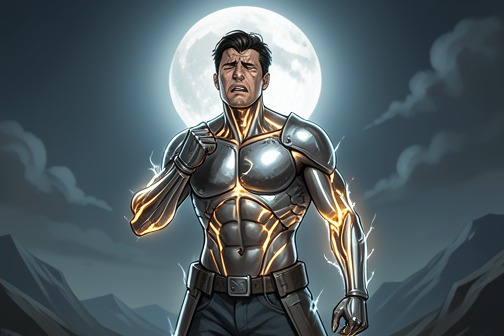
[The Blackmoon Trial](entity:event-recall-event-the-blackmoon-trial-aa50688420cc) is the ordeal through which [Yuan Guang](entity:character-recall-character-acb8867cae36) survives the [Blackmoon](entity:character-recall-character-blackmoon-20b02347d06a)’s moonburns and begins to perceive the true shape of his soul. What initially appears as destructive exposure becomes a deliberate stage in his cultivation: the moonlight burns away his false flesh, clears emotional obstruction from his qi circuits, and helps him align his body with the [Gun Path](entity:concept-recall-concept-gun-path-6a1c48ff6378) and its [Bullet Hell](entity:location-recall-location-bullet-hell-a079043782cd) branch. The trial therefore marks more than an increase in strength. It is a painful reclassification of identity, in which Yuan’s body and chosen path begin to agree.
## Nature and Circumstances
The trial takes place during Yuan Guang’s continuing cultivation after his transformation into a Gunsoul. At [Lady Tama](entity:character-recall-character-lady-tama-3b46135c3f2c)’s station, he meditates beneath the cold glow of the Blackmoon and finds the process easier than before. He welcomes the moon’s energy into himself while it burns away his false flesh, revealing the true steel beneath. The change first frightens him, but it gradually becomes natural to him, like a snake shedding a constricting skin for smoother scales. The image captures the trial’s central contradiction: the moonlight wounds Yuan in order to remove what prevents him from becoming what he truly is.
The ordeal also reverses Yuan’s earlier relationship with moonburns. He once feared them, yet the same stellar light now clears his mind and loosens his tongue. Beneath it, he speaks to [Orient](entity:character-recall-character-orient-cc17650ca89c) about the nightmares that shaped him, including the memory of Chen, the cook whose face a [Second Coil](entity:state-recall-state-second-coil-bacc73705265) cultivator cleaved apart. Yuan distinguishes this remembered violence from his own killings: he cannot recall the faces of the people he killed, but he remembers Chen bleeding on the ground. The Blackmoon therefore does not merely alter his body. It creates a setting in which buried moral memory can surface.
## Purpose in Cultivation
[Arc](entity:character-recall-character-arc-5983990a9863) later explains that surviving the moonburns cleared Yuan’s qi circuits of emotional sludge and strengthened his spiritual awareness. The trial enabled him to hear the whispers of his soul and align his body with it, making the experience a prerequisite for more advanced Gun Path cultivation rather than an isolated test of endurance. The scripts associated with his chosen path begin to arise intuitively during meditation, even though they are written in a language he does not recognize. Yuan nevertheless understands their meanings: gun, firearm, gunsmoke, bullet, and hell, all terms associated with his Bullet Hell subpath and his resolve.
Arc confirms that the Blackmoon’s trial was intended to make this development possible. She insists that everyone should brave the moonburns, while also warning that surviving them is only the first step toward crossing the [Fourth Coil](entity:state-recall-state-fourth-coil-ba698d58d103). Engraving the soul’s chosen [Path](entity:concept-recall-concept-path-c64b431503b0) sutras must be followed by weaving those scripts into the bullet-core itself; only then can Yuan learn innate techniques. The trial thus changes the nature of his progress. Earlier advancement depended on learning and performing techniques, whereas the next stage requires the chosen path to become structurally embedded in his core.
## Pain, Memory, and Ethical Pressure
The Blackmoon Trial is inseparable from the violence that surrounds Yuan Guang’s rise. His path begins after a life of deprivation and exclusion: he was born without the potential for a qi core and spent years as a [Scrap](entity:state-recall-state-scrap-f377b55e6193), while sects reserved their rare spirit pills for more promising cultivators. Even after becoming a [First Coil](entity:state-recall-state-first-coil-c07509c61fa5) cultivator, he carries the shame of having gained an identity he once imagined claiming proudly. The moonburns continue this pattern of transformation through suffering, forcing him to endure pain in exchange for access to a self that society had denied him.
That transformation does not absolve him of responsibility. Yuan had helped create the conditions for the [Fleshmarket](entity:location-recall-location-fleshmarket-85c3bbebccdc) conflict by using techniques to address its ammunition shortage while hoping the rival sects would destroy one another. When the Gun later announced its arrival with a rain of millions upon millions of qi-charged bullets, Yuan could not deny that his plan might have helped lure the catastrophe there. The Blackmoon’s clearing effect gives this guilt a sharper context: emotional sludge is not the same as moral responsibility, and spiritual clarity does not erase the consequences of deliberate choices.
The same ethical pressure appears in Yuan’s relationship with [Revolver](entity:character-recall-character-revolver-ef40ed09076f). Revolver saved him first from [Elder Polio](entity:character-recall-character-elder-polio-9246115ed152) and then from the Gun, but later struggled against the bloodlust of the Gun’s curse. Yuan refuses to abandon him, deciding that he will find a way to free Revolver even if doing so delays his revenge. The trial’s revelation of a truer inner form therefore does not lead Yuan toward solitary purity. It strengthens his capacity to recognize debts, grief, and obligation while continuing to act within a violent world.
## Consequences and Significance
The immediate consequence of the Blackmoon Trial is heightened spiritual perception. Yuan can receive the sutras of his chosen path intuitively, and the moonlight becomes a means of distinguishing authentic spiritual identity from the false flesh that concealed it. His body’s emergence as sleek steel is both a physical transformation and a statement about the Gunsoul condition: the more completely Yuan accepts the Gun Path, the less plausible it becomes to separate cultivation from weaponhood.
The trial also prepares the narrative’s later confrontations by giving Yuan a foundation for Fourth-[Coil](entity:concept-recall-concept-coil-56016a2386a5) advancement and innate techniques. His discipline remains difficult—he knows that synchronizing the Gun Path and its branches with his body has already required immense pain—but he accepts further suffering because victory matters more to him than comfort. The Blackmoon’s light consequently serves as both revelation and foreshadowing. It exposes Yuan’s history, clarifies the path he has chosen, and equips him to confront enemies such as [Manhattan](entity:character-recall-character-manhattan-74663a2bc259) and the larger cycle of gun violence without pretending that power alone can make his actions innocent.
In thematic terms, the Blackmoon Trial turns transformation into an act of interpretation. Yuan does not simply become stronger under the moon; he learns how to read his body, his memories, and his obligations as parts of the same spiritual struggle. [The moonlight reveals the true shape of the soul](entity:expression-recall-expression-the-moonlight-reve-78c7668f7bca), but what Yuan does with that revelation remains an ethical choice: revenge, protection, responsibility, and the refusal to let another ally die continue to compete within him.
Event 21
Arc and Czar Zoa’s Battle
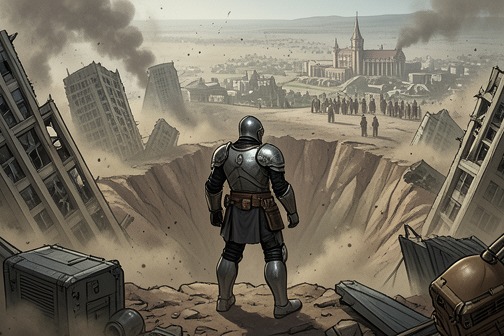
[Arc and Czar Zoa’s Battle](entity:event-recall-event-arc-and-czar-zoa-s-batt-92e753353a9c) was a confrontation remembered through its lethal outcome and the danger it averted: [Arc](entity:character-recall-character-arc-5983990a9863) stopped [Czar Zoa](entity:character-recall-character-czar-zoa-3a34d3d61d77) near the irradiated ruins of an old city, helping preserve the nearby settlement of [Gatesville](entity:location-recall-location-gatesville-1e402b621ba0). The surviving accounts offer little detail about the fight itself, but make its stakes plain—the devastation of one place threatened the lives and future of another.
## Setting and Background
The battle took place in the ruins of an old-world city, later encountered by [Yuan Guang](entity:character-recall-character-acb8867cae36) and [Revolver](entity:character-recall-character-revolver-ef40ed09076f) along the road. Its toppled skyscrapers stood inside a large crater, their metal weathered by time and dust storms. The surrounding air carried poisonous dust that Yuan Guang’s bullet-core struggled to assimilate, and the place struck him as diseased.
Revolver remarked that the city had been inhabited four years earlier and recalled that one of the [Gunsouls](entity:creature-recall-creature-gunsouls-7c668126d32a) and Czar Zoa had killed each other there. Yuan Guang later connected the site specifically to Arc, telling her it was where she had fought Czar Zoa years before. The accounts thus preserve the encounter as both a personal clash and a place marked by lethal violence, without recounting its tactics or exact sequence.
## The Battle and Its Stakes
The clearest account of the battle’s consequence comes in Yuan Guang’s exchange with Arc. When Arc dismissed the possibility of building anything lasting in the barren landscape, Yuan Guang pointed to Gatesville, a small settlement about an hour’s ride from the irradiated city. Its residents included homeless people, drunks, and couriers down on their luck; they had raised their village over the ruins of a highway.
Yuan Guang argued that if Arc had not stopped Czar Zoa, Gatesville would have become a radioactive crater and none of its inhabitants would have survived. The battle therefore mattered beyond its two combatants: Arc’s resistance had kept destruction from spreading to a vulnerable community. The surviving evidence does not specify how the fight produced the city’s irradiated condition or describe the battle’s moment-by-moment course.
## Aftermath and Significance
The ruined city and the surviving settlement form a stark contrast. One bears the physical damage associated with the confrontation; the other remains standing because Arc prevented Czar Zoa from extending the devastation. Yuan Guang used that survival to challenge Arc’s bleak judgment that preserving a place only lets its people suffer for a few more years. Even a precarious settlement, he insisted, could sustain the hope that tomorrow might be better.
The battle’s remembered significance consequently rests less on a recorded victory than on what Arc’s resistance made possible. Gatesville was neither flourishing nor secure, but its continued existence meant its inhabitants were not erased with the city nearby. In Yuan Guang’s argument, that limited protection was still consequential.
Event 22
Revolver’s Execution and Resurrection
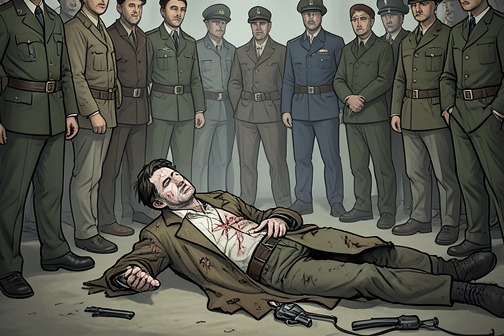
[Revolver’s Execution and Resurrection](entity:event-recall-event-revolver-s-execution-an-2db59c88a9c1) is the pivotal transformation through which a disposable slave becomes [Revolver](entity:character-recall-character-revolver-ef40ed09076f), a Gunsoul whose return turns institutional punishment into vengeance. His death is not an isolated execution but the culmination of a social order that classifies people as [Scraps](entity:concept-recall-concept-scraps-c83bffce1b62), cultivators, slaves, or Human Pillars and grants cultivators authority over bodies they consider inferior. His resurrection then exposes the instability of those labels: the man condemned as worthless returns as an armed force strong enough to hunt the people who killed him and help bring down [Fleshmarket](entity:location-recall-location-fleshmarket-85c3bbebccdc).
## Status Before the Execution
Revolver began as an unnamed slave seized by [Elder Polio](entity:character-recall-character-elder-polio-9246115ed152)’s hunters during a raid on his village. [Jared LaChaire](entity:character-recall-character-jared-lachaire-6346894dbb15), who later recounted the history to [Yuan Guang](entity:character-recall-character-acb8867cae36), never learned the slave’s true name. The nickname Revolver came from his unusual skill with a revolver, not from any recognized identity or inherited title. That detail matters because the name that survives is the name imposed by the slave system and his weapon, while the person beneath it is deliberately erased.
His condition paralleled Yuan Guang’s earlier life as a [Scrap](entity:state-recall-state-scrap-f377b55e6193). Yuan had been born without the potential to form a qi core, a fate shared by roughly half the population, and had learned that sects normally reserved their rare spirit pills for cultivators already advancing through the [Coils](entity:concept-recall-concept-coils-d5c098fa5873). A Scrap could work until exhaustion and still be judged too old, too weak, or too untalented to deserve elevation. Revolver occupied the same condemned category from within slavery: he possessed ability, will, and practical courage, but the ruling cultivators treated those qualities as useful only when they served the system.
Revolver repeatedly tried to escape and encouraged other slaves to do the same. His resistance therefore threatened more than his own confinement. It challenged the mechanism by which Fleshmarket converted human beings into labor, examples, and replaceable property. When his attempts escalated, he stole a Scrap guard’s gun and killed two [First Coil](entity:state-recall-state-first-coil-c07509c61fa5) students. The incident supplied the authorities with a justification for making his punishment exemplary, although the account also makes clear that his defiance preceded the killings and that the violence of the institution had created the conditions in which rebellion became unavoidable.
## Public Execution
Elder Polio rejected the proposal to lobotomize Revolver and silence him permanently. Instead, Polio decided that Revolver would be more valuable as a warning to the other slaves. The execution was consequently staged as public discipline: it was meant to teach the enslaved population what happened when a Scrap resisted cultivator power. Polio’s stated principle was that no true cultivator should waste a technique on a Scrap, reducing Revolver’s life to a category judgment before the execution even began.
Revolver was shot in the back of the head. His body was then thrown into the desert to rot, completing the authorities’ attempt to erase both his resistance and his identity. The weapon that marked him as Revolver became the instrument of his death, creating the central irony of the event: the system believed firearms could enforce its hierarchy, yet the dead slave would return through the same gun-centered world that had condemned him. Yuan Guang recognized the parallel with his own fate, since both men lived by the gun and were executed with one by cultivators who considered their skills unworthy of respect.
## Resurrection and Retaliation
Revolver did not remain in the desert. He rose from the dead and returned as the mysterious gunslinger harassing Polio’s men. His resurrection converted a completed punishment into an unfinished conflict. The authorities had treated death as the final proof that Revolver was powerless; his return made that assumption visibly false. By the time Elder Polio understood that the gunslinger was the same slave he had executed months earlier, Revolver had already grown strong enough to repel bounty hunters.
The resurrection also changed the meaning of revenge. Revolver did not merely survive an attempted erasure; he forced Fleshmarket to confront the person it had publicly declared disposable. Jared left Fleshmarket after the execution but remained in contact with people there, allowing him to describe the delayed recognition that followed. Polio’s regret came only after Revolver had returned with greater strength, when the executioner could no longer control the consequences of his own decision. Revolver later helped destroy Fleshmarket, making the fall of the slave society an indirect result of the punishment intended to preserve it.
The return was nevertheless not a simple restoration. Yuan Guang understood that Revolver’s revenge came at the cost of his soul and freedom. Resurrection gave him power and a route toward retribution, but it did not return the unnamed village life that had been taken from him, nor did it undo the fact that others remembered only the weapon-name assigned to him. His survival therefore remains both liberation and continuation of captivity: he escapes the physical institution, yet the violence that created him continues to define his existence.
## Consequences for the Wider Story
Revolver’s execution and resurrection establish a pattern that extends beyond his personal revenge. The same world that calls Yuan Guang a Scrap, treats [Holster](entity:character-recall-character-holster-0dfe0a9736e3) as a [Human Pillar](entity:state-recall-state-human-pillar-46f65fa159ca), and marks [Metallists](entity:character-recall-character-metallists-a4e7c790748f) with the Magnum Opus symbol repeatedly turns social labels into mechanisms of control. A Scrap is denied cultivation because birth is treated as destiny; a Human Pillar is prepared as a living sacrifice and reduced to a resource; a slave is publicly killed to preserve obedience. Revolver’s return interrupts that logic by making the discarded body impossible to discard. His resurrection does not simply add another powerful Gunsoul to the conflict. It reveals that the categories imposed by sects and slaveholders cannot contain the people they have brutalized.
That revelation later acquires a broader consequence through Revolver’s relationship with the Gun. When the Gun’s arrival over Fleshmarket is announced by a rain of qi-charged bullets, Yuan Guang and Revolver shelter beneath layered Barriers while the city is subjected to mass destruction. The bombardment makes Revolver’s earlier vengeance appear within a much larger cycle of firearms, punishment, and annihilation. Yuan Guang had already admitted that he helped arm the sects fighting over Fleshmarket in the hope that they would destroy one another, only to confront the possibility that his plan helped draw the Gun there. Revolver’s return thus becomes part of an escalating history in which resistance to oppressive violence can also feed the violence that consumes an entire city.
The event also clarifies why Yuan Guang responds so strongly when he learns Revolver’s history. Yuan had once accepted that being born without a qi core made him a Scrap, even though that status condemned him to exhausting labor and placed advancement behind rare spirit pills reserved for more promising cultivators. After death, he is forced to answer whether he is still a Scrap or has become a cultivator, and he identifies himself as a First Coil cultivator with reluctance rather than uncomplicated pride. Revolver’s story gives that identity crisis a precedent: a man denied a true name and killed as a Scrap can return under a weapon-name that becomes stronger than the institution that assigned it. Their parallel histories transform recognition into a matter of survival rather than social approval.
By the time Yuan Guang later declares that the Gun is contained within him and names himself the [Gunman](entity:state-recall-state-gunman-cb648be5b1a4), Revolver’s earlier return has become part of the story’s governing contrast between inheritance and mastery. Revolver was resurrected into the Gun’s cycle, gaining strength while losing soul and freedom; Yuan’s later transformation seeks to master that force instead of merely serving its recurrence. The execution therefore remains consequential even after the immediate revenge has ended: it is the earlier example of a condemned Gunsoul returning from death, a warning of what the Gun can make of its chosen, and a dark foundation for Yuan Guang’s attempt to become something greater than the weapon’s curse.
## Consequences for the Wider Story
Revolver’s execution and resurrection establish a pattern that extends beyond his personal revenge. The same world that calls Yuan Guang a Scrap, treats Holster as a Human Pillar, and marks Metallists with the Magnum Opus symbol repeatedly turns social labels into mechanisms of control. A Scrap is denied cultivation because birth is treated as destiny; a Human Pillar is prepared as a living sacrifice and reduced to a resource; a slave is publicly killed to preserve obedience. Revolver’s return interrupts that logic by making the discarded body impossible to discard. His resurrection does not simply add another powerful Gunsoul to the conflict. It reveals that the categories imposed by sects and slaveholders cannot contain the people they have brutalized.
That revelation later acquires a broader consequence through Revolver’s relationship with the Gun. When the Gun’s arrival over Fleshmarket is announced by a rain of qi-charged bullets, Yuan Guang and Revolver shelter beneath layered Barriers while the city is subjected to mass destruction. The bombardment makes Revolver’s earlier vengeance appear within a much larger cycle of firearms, punishment, and annihilation. Yuan Guang had already admitted that he helped arm the sects fighting over Fleshmarket in the hope that they would destroy one another, only to confront the possibility that his plan helped draw the Gun there. Revolver’s return thus becomes part of an escalating history in which resistance to oppressive violence can also feed the violence that consumes an entire city.
The event also clarifies why Yuan Guang responds so strongly when he learns Revolver’s history. Yuan had once accepted that being born without a qi core made him a Scrap, even though that status condemned him to exhausting labor and placed advancement behind rare spirit pills reserved for more promising cultivators. After death, he is forced to answer whether he is still a Scrap or has become a cultivator, and he identifies himself as a First Coil cultivator with reluctance rather than uncomplicated pride. Revolver’s story gives that identity crisis a precedent: a man denied a true name and killed as a Scrap can return under a weapon-name that becomes stronger than the institution that assigned it. Their parallel histories transform recognition into a matter of survival rather than social approval.
By the time Yuan Guang later declares that the Gun is contained within him and names himself the Gunman, Revolver’s earlier return has become part of the story’s governing contrast between inheritance and mastery. Revolver was resurrected into the Gun’s cycle, gaining strength while losing soul and freedom; Yuan’s later transformation seeks to master that force instead of merely serving its recurrence. The execution therefore remains consequential even after the immediate revenge has ended: it is the earlier example of a condemned Gunsoul returning from death, a warning of what the Gun can make of its chosen, and a dark foundation for Yuan Guang’s attempt to become something greater than the weapon’s curse.
## Consequences for the Wider Story
Revolver’s execution and resurrection establish a pattern that extends beyond personal revenge. The same world that calls Yuan Guang a Scrap, treats Holster as a Human Pillar, and marks Metallists with the Magnum Opus symbol repeatedly turns social labels into mechanisms of control. A Scrap is denied cultivation because birth is treated as destiny; a Human Pillar is prepared as a living sacrifice and reduced to a resource; a slave is publicly killed to preserve obedience. Revolver’s return interrupts that logic by making the discarded body impossible to discard. His resurrection does not simply add another powerful Gunsoul to the conflict. It reveals that the categories imposed by sects and slaveholders cannot contain the people they have brutalized.
That revelation later acquires a broader consequence through Revolver’s relationship with the Gun. When the Gun’s arrival over Fleshmarket is announced by a rain of qi-charged bullets, Yuan Guang and Revolver shelter beneath layered Barriers while the city is subjected to mass destruction. The bombardment places Revolver’s earlier vengeance within a much larger cycle of firearms, punishment, and annihilation. Yuan Guang had already admitted that he helped arm the sects fighting over Fleshmarket in the hope that they would destroy one another, only to confront the possibility that his plan helped draw the Gun there. Revolver’s return thus becomes part of an escalating history in which resistance to oppressive violence can also feed the violence that consumes an entire city.
The event also clarifies why Yuan Guang responds so strongly when he learns Revolver’s history. Yuan had once accepted that being born without a qi core made him a Scrap, even though that status condemned him to exhausting labor and placed advancement behind rare spirit pills reserved for more promising cultivators. After death, he is forced to answer whether he is still a Scrap or has become a cultivator, and he identifies himself as a First Coil cultivator with reluctance rather than uncomplicated pride. Revolver’s story gives that identity crisis a precedent: a man denied a true name and killed as a Scrap can return under a weapon-name that becomes stronger than the institution that assigned it. Their parallel histories transform recognition into a matter of survival rather than social approval.
By the time Yuan Guang later declares that the Gun is contained within him and names himself the Gunman, Revolver’s earlier return has become part of the story’s governing contrast between inheritance and mastery. Revolver was resurrected into the Gun’s cycle, gaining strength while losing soul and freedom; Yuan Guang’s later transformation seeks to master that force instead of merely serving its recurrence. The execution therefore remains consequential even after the immediate revenge has ended: it is the earlier example of a condemned Gunsoul returning from death, a warning of what the Gun can make of its chosen, and a dark foundation for Yuan Guang’s attempt to become something greater than the weapon’s curse.
Event 23
Plastic Men Raid on Orient Junction
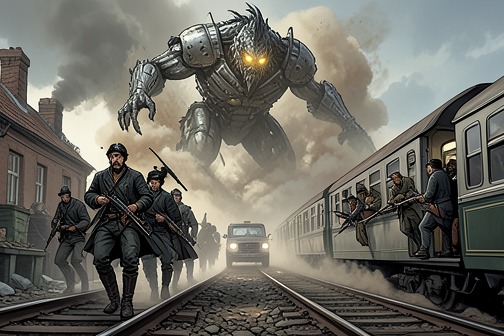
The [Plastic Men Raid on Orient Junction](entity:event-recall-event-plastic-men-raid-on-ori-30d36023f99a), also known as the Trashemoth Attack, is the violent interception that tests [Yuan Guang](entity:character-recall-character-acb8867cae36)’s newly developed power against a force combining organized raiders, vehicles, firearms, and a spirit-beast. The assault is not merely a roadside battle: it exposes the scale of the dangers pursuing [Orient Junction TR-61](entity:object-recall-object-orient-junction-tr-61-298f800cca51), confirms Yuan Guang’s rise from a fighter dependent on momentum to one capable of destroying a large spirit-beast alone, and casts a darker light backward onto his decision to arm the factions of [Fleshmarket](entity:location-recall-location-fleshmarket-85c3bbebccdc) in the hope that they would destroy one another.
## Causes and Approach
Orient Junction TR-61 detected the attack before the enemy reached the train. [Orient](entity:character-recall-character-orient-cc17650ca89c) announced that a large dust cloud was approaching from the south and that a sizable vehicle fleet appeared to be moving to intercept the spirit-train. Yuan Guang interrupted his cycling and prepared to respond, while Orient ordered the passengers to arm themselves. The approaching force was initially identifiable as the [Plastic Men](entity:character-recall-character-plastic-men-126d04531cd2), but Yuan Guang’s qi sight revealed that the raid was more dangerous than an ordinary Plastic Men assault.
The dust cloud contained twenty-three vehicles, mostly cars with several motorbikes, and one massive machine whose weight exceeded that of all the others combined. Burnt fuel, yellow smoke, and poisonous qi accompanied the convoy. Yuan Guang recognized the qi as too wild to belong to a cultivator and identified the heavy vehicle as a Trashemoth, the spirit-beast associated with the Plastic Men. Its presence explained the raiders’ confidence in challenging Orient Junction TR-61, and Yuan Guang immediately warned the train’s defenders that the beast was with them.
The Trashemoth was itself a grotesque fusion of industrial waste and predatory machinery. Sick yellow smog poured from three metal chimneys along its back. Its head resembled a locomotive, but it possessed jagged teeth and vicious golden eyes, while six smaller steel-and-plastic mouths gnawed along its body. The creature therefore extended the raid’s imagery beyond human violence: the Plastic Men did not simply arrive with weapons, but brought a mobile mass of poisoned, animate refuse capable of turning the road into an extension of their own polluted world.
## The Battle on the Road
Yuan Guang understood the encounter as another test of his advancement. A cultivator attempting to reach the [Third Coil](entity:state-recall-state-third-coil-dcb437170529) without the necessary pill could ordinarily kill a spirit-beast and consume its core as a substitute. The Trashemoth consequently represented more than an obstacle blocking the train; it was a living measure of whether Yuan Guang could now meet the physical and spiritual demands of the next stage. He answered the test with gunfire.
Using Sniper’s Bore, Yuan Guang wrapped his index finger in a cylindrical [Barrier](entity:concept-recall-concept-barrier-74d1c6e840ae) and rifled the improvised design to improve its precision. He placed inside it a bullet made through [Item Materialization](entity:concept-recall-concept-item-materialization-bb4f711d1a24), infused the projectile with qi, and vibrated it at a carefully chosen frequency before directing the passengers to fire. The battle then became a coordinated defense rather than a solitary duel. While Yuan Guang advanced toward the beast, the armed passengers and the train’s other defenders engaged the surrounding vehicles and raiders.
Yuan Guang crossed the distance in a single leap. He landed on the nearest Plastic Man car with enough force to crush its engine, then used Recoil Kick to jump from one vehicle to the next. Each landing converted his movement into destruction, sending cars and their drivers from their wheels as he leapfrogged toward the Trashemoth. His recent duel with [Gayak](entity:character-recall-character-gayak-2fa465a1dbb7) had already shown him what a Third Coil body could do, but the days of continued cycling had unlocked a greater control of that strength. He no longer needed momentum to clear a few meters and instead had to restrain himself so that his leaps would not carry him too far.
The decisive attack was [Recoil Blast](entity:concept-recall-concept-recoil-blast-15781c214033), the technique that had previously slain Gayak. Yuan Guang’s improved Barrier allowed him to direct and disperse the recoil so that the blowback would not injure him, while concentrating the force at a single point. The first blast struck the Trashemoth’s skull with enough power to blow away half of it, exposing a black core made from coalesced sludge and orange sinews fused with fossilized plastic. The core’s qi was so foul that merely seeing it made Yuan Guang nauseous.
He followed immediately with a second Recoil Blast. This attack shattered the exposed core and burst through the opposite side of the Trashemoth’s skull, leaving a massive opening in its head. Poisonous qi poured from the wound as the beast’s many heads died. The collapsing body crushed the Plastic Men herders beneath it and missed Orient Junction TR-61 by only a few meters. The scene turned the raiders’ own weapon into their destruction: the beast they had trusted to overpower the train became the final weight that ended their assault.
## Aftermath and Casualties
The destruction of the Trashemoth broke the raid’s main threat, but the battle did not end with its collapse. Yuan Guang returned to the spirit-train and found that [Bucket](entity:character-recall-character-bucket-5f518f342132) and the other defenders had already destroyed most of the remaining vehicles, melting down the few Plastic Men who had managed to board. The convoy’s scale made the result notable: a force that would have been a lethal encounter for a small traveling party became little more than a roadblock for a large, well-armed group. Even so, the victory was not bloodless. Two passengers died and three were wounded, casualties that appeared small only when measured against the twenty-three-vehicle assault and the presence of a Trashemoth. The survivors greeted Yuan Guang as a hero, firing their guns into the air in celebration. He was pleased by their appreciation but angered by their waste of usable ammunition, a response that captures the raid’s central tension: survival required overwhelming firepower, yet every bullet remained a resource whose careless expenditure could endanger the journey that the victory had preserved.
## Moral Repercussions and Wider Significance
The raid’s immediate victory cannot be separated from the ethical consequences of Yuan Guang’s earlier strategy at Fleshmarket. He had deliberately used techniques taught by [Arc](entity:character-recall-character-arc-5983990a9863) to address the region’s ammunition shortage, hoping that arming its rival sects would cause them to slaughter one another. When Arc later confronted him, Yuan Guang could not deny that he had accepted casualties as the price of this plan, nor could he dismiss the possibility that his actions had helped draw [The Gun](entity:character-recall-character-the-gun-67af30ea7783) toward Fleshmarket. The [Plastic Men Raid](entity:action-recall-action-5050e314069d) therefore arrives within a widening chain of responsibility: Yuan Guang defeats an external threat while recognizing that his own attempts to manipulate violence have contributed to a larger catastrophe. This tension distinguishes the battle from a simple triumph. His growing power makes him more capable of protecting Orient Junction TR-61, but it also makes the consequences of his decisions harder to evade.
The event also gains weight from the larger history of pollution and spiritual corruption surrounding the Wasteland. Yuan Guang had already encountered places where poisonous qi resisted assimilation, a diseased ruin whose environmental damage remained embedded in the landscape. The Trashemoth gives that damage a moving body: industrial waste, steel, plastic, smoke, and predatory life are fused into a weapon that travels with the Plastic Men. Its poisoned core is not merely a monster’s anatomical weakness but the concentrated residue of a world in which industrial greed transformed into self-aware spiritual powers and stripped the earth of its resources. The raid thus turns environmental devastation into an active combatant. The train survives by destroying the creature, but the battle does not restore the land; it leaves behind another dead mass of contaminated material and a reminder that violence can contain pollution without undoing its origins.
Within Yuan Guang’s personal development, the Trashemoth is a concrete proof of acceleration. He recognizes that flying, breathing fire, and killing a large spirit-beast alone would once have sounded impossible, yet all three abilities now belong to his practical battlefield capacity. The fight follows his earlier encounters with [Revolver](entity:character-recall-character-revolver-ef40ed09076f) and Gayak, but it changes the scale of what he can undertake: the Third Coil body no longer needs momentum to produce extraordinary movement, and Recoil Blast has become precise enough to deliver overwhelming force without destroying its user. That progress is inseparable from the emotional burdens accumulating around him. Revolver had twice saved Yuan Guang’s life, first from [Elder Polio](entity:character-recall-character-elder-polio-9246115ed152) and later from The Gun, and Yuan Guang had resolved to find a way to free him from The Gun’s curse rather than allow another ally to die. The raid’s success consequently does not erase fear or grief; it strengthens the protagonist who must carry them forward.
## Narrative Significance
The Plastic Men Raid on Orient Junction is therefore best understood as a convergence point between bodily advancement, collective defense, environmental ruin, and moral injury. Its outward structure is a straightforward interception: Orient Junction TR-61 detects a convoy, Yuan Guang kills the Trashemoth, and the train survives with limited losses. Yet the event repeatedly enlarges that surface action. The convoy’s twenty-three vehicles reveal the organizational scale of the Plastic Men; the poisoned spirit-beast reveals how industrial waste has become animate; the two deaths and three wounded passengers establish the human cost beneath the victory; and the celebratory gunfire exposes the fragile economy of survival, in which even a gesture of gratitude consumes ammunition. The raid is powerful because it makes these pressures visible at once rather than isolating them into separate conflicts.
Its place in the book’s wider history is equally important. The Trashemoth’s locomotive head, steel-and-plastic mouths, chimneys, smog, and sludge-black core echo the world shaped by industrialized greed, while the distant nuclear devastation demonstrated by the [Yinyang Khan](entity:character-recall-character-yinyang-khan-2b2e850633cf) and the radiation that Orient Junction TR-61 must purify after [Manhattan](entity:character-recall-character-manhattan-74663a2bc259)’s destruction show that contamination operates on several scales. The Wasteland is not merely a backdrop through which combatants travel. Its damaged matter acts, spreads, mutates, and returns as an opponent. The Plastic Men carry that damaged world with them, turning refuse into mobility and pollution into force; Yuan Guang’s victory destroys one manifestation without healing the conditions that produced it.
The event also complicates the heroic pattern it appears to fulfill. Yuan Guang’s leap across the convoy and his two Recoil Blasts provide an unmistakable display of mastery, but the surrounding narrative refuses to treat strength as moral absolution. He has already admitted that his ammunition scheme at Fleshmarket was intended to make rival sects slaughter one another and has wondered whether that strategy helped lure The Gun to the region. Against that background, defending the train is both genuine protection and a reminder that power cannot control every consequence once violence has been set in motion. His resolve to save Revolver from The Gun’s curse gives the raid a further ethical counterweight: Yuan Guang is not simply becoming more efficient at killing; he is trying to decide what obligations remain after killing has become the language of his world.
The raid consequently marks a threshold in Yuan Guang’s development. Before it, his extraordinary movement required momentum and his strength still appeared exceptional chiefly in comparison with individual opponents. Here, he must moderate his own power so that a leap does not carry him beyond its intended target, and he destroys a large spirit-beast that would previously have demanded a fighter such as Gayak. The change is measured not only by the Trashemoth’s death but by Yuan Guang’s altered sense of possibility: flight, fire, and solitary victory over a massive beast have become practical abilities rather than fantasies. The train continues down the Bloodsoaked Road, carrying survivors, ammunition, grief, and unresolved responsibility with it. The battle saves the journey, but its deepest consequence is to show that every advance along that road makes Yuan Guang more capable of protection and more accountable for the violence his power can unleash.
Event 24
Yuan’s Fourth Coil Breakthrough
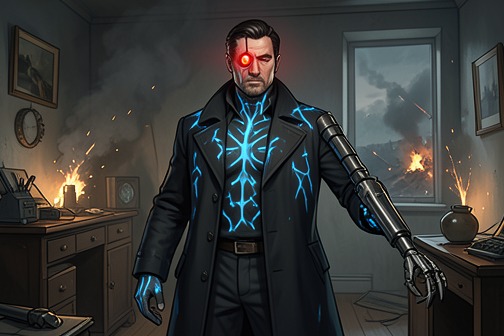
[Yuan’s Fourth Coil Breakthrough](entity:event-recall-event-yuan-s-fourth-coil-brea-8aeaa3be9bd3) marks the point at which [Yuan Guang](entity:character-recall-character-acb8867cae36) stops merely cultivating the [Gun Path](entity:concept-recall-concept-gun-path-6a1c48ff6378) and becomes capable of embodying it without being consumed by it. Undertaken immediately before the History Road race, the breakthrough forces him to confront the entire violence encoded in [Bullet Hell](entity:location-recall-location-bullet-hell-a079043782cd), endure the return of his worst memories, and choose a purpose capable of restraining the Gun’s instincts. Its reward is [Gun Demon Incarnation](entity:state-recall-state-gun-demon-incarnation-d8f55974e3ba), a living weapon-form so natural to him that his ordinary human shape begins to feel like a prison.## Causes and Preparation
Yuan threw himself into training after his encounter with [Jared LaChaire](entity:character-recall-character-jared-lachaire-6346894dbb15). The approaching History Road race promised a succession of powerful enemies, while Yuan’s open challenge to [Slash](entity:character-recall-character-slash-3cd8004a530e)’s ally had made many contestants distrust him. His group had also failed to locate [Manhattan](entity:character-recall-character-manhattan-74663a2bc259), whose possession of the Cube of Natho made his eventual interference almost certain. Yuan therefore needed the [Fourth Coil](entity:state-recall-state-fourth-coil-ba698d58d103) both as protection against imminent battles and as leverage in forming alliances: the stronger he became, the more valuable he would appear to other racers.
He trained continuously through the days and nights before the race. By the second day he had completed the circuit of his soul sutra, impressing [Arc](entity:character-recall-character-arc-5983990a9863) with the speed of his progress. That accomplishment was only the beginning. Arc explained that Yuan still had to cycle without interruption until his bullet-core fully aligned with the sutra script and perfected the circuit. Completing that alignment would permanently bind him to the Gun Path, making it his final opportunity to abandon the discipline. Yuan accepted the commitment despite asking whether it would compel him to shoot Slash on sight. His answer showed that the breakthrough was not simply a tactical upgrade; it was a decision about the kind of gun he intended to become.
Arc also warned him about Gun Demon Incarnation, the technique linked to the completed alignment. It would temporarily transform Yuan into his spiritual reflection, an Infernal or weapon-demon of gun violence. His mind would remain his own, but the surge of power would be intoxicating, and retaining control would require an emotional anchor. The instruction became crucial because the Fourth Coil demanded more than increased output. Yuan had to enter the Gun’s nature without allowing that nature to erase the person who wielded it.## The Ordeal of Bullet Hell
The cultivation process began with a precise physical and spiritual circuit. In the center of the wagon, Yuan sat within the bagua array and sensed ambient qi as refined metal permeating the room. A pulse emerged from his bullet-core and traveled through wafer-thin circuitry, while sutras engraved in his veins formed a single formula. Their nano-inscriptions lit one after another as the qi moved from his head to his toes and back to his skull; his piston-muscles and steel flesh seemed to sing the circuit’s prayer.
The returning qi brought pain. Each round of cycling forced Yuan into violent memories that were not merely recollections but lived fragments of the Gun Path’s history. One round placed his body in a mass grave in a forgotten jungle while his fractured skull joined a pile of other skulls. Another made him experience the trenches under distant bombardment, his mind observing the assault through hundreds of barrels. The pain grew so severe that he had to bite his metal tongue with his ammo teeth to keep from screaming.
Only then did Yuan understand what engraving the Gun Path and Bullet Hell into his core truly meant. It meant knowing, learning, and living Bullet Hell in its entirety: not just its techniques, but its blood-soaked history reaching back to the beginning of the Gun. The concept had to become so intrinsic to his soul that it would remain with him whenever he closed his eyes. The Fourth Coil thus turns cultivation into historical exposure. Yuan’s advancement is purchased through contact with every battlefield and every death preserved within the weapon’s spiritual inheritance.
The process also threatened to destroy him. Yuan’s body became trapped between his evanescent soul and solid iron flesh, while qi threatened to dissolve back into the [Dao](entity:concept-recall-concept-dao-3e09e1e84dbd) as formless energy. Every cycle weakened his bullet-core’s hold on reality and risked sending his spirit adrift into [Nowhere](entity:location-recall-location-nowhere-8ca016a80050). [Crossing the Fourth Coil](entity:action-recall-action-538d2bac2a41) therefore required him to engrave himself onto his chosen [Path](entity:concept-recall-concept-path-c64b431503b0) without becoming one of its paving stones. The distinction between mastery and annihilation was not theoretical; it was the immediate condition of his survival.## Recognition and Gun Demon Incarnation
Yuan recovered his identity through memory. [Holster](entity:character-recall-character-holster-0dfe0a9736e3)’s name cut through the fog of bloodlust and madness, returning memories of his own name, Yuan Guang, and of the fact that he was a man sitting in a steel room rather than a ghost haunting innumerable battlefields. Memories of rescuing Holster, giving her her first gun, and receiving her help against the [Rad-Hag](entity:character-recall-character-rad-hag-efb7556a4654) gave him a stable point of reference. [Orient](entity:character-recall-character-orient-cc17650ca89c) served as another anchor: her kindness and willingness to listen without judgment reminded him of a self defined by relationships rather than by violence alone.
That recognition produced a brief moment of self-awareness beyond instinct. Yuan understood that a gun without a cause brought only death, while a gun guided by purpose could deliver justice, protect the weak, and punish evil. This was the ethical center of the breakthrough. He did not reject the Gun’s power, nor did he pretend that violence could be made harmless. Instead, he chose the purpose that would govern the violence. His ideal was not merely to become stronger, but to become the kind of gun whose direction mattered.
The transformation that followed was both grotesque and triumphant. Yuan grew to twice his former height. His barrel-face extended beyond the length of a human arm, and his ammo teeth became sharp enough to cut steel. His breath changed into a stream of flames. Fire qi, once a weakness, became a source of strength as his metal body harnessed the blaze, guided its appetite, and used it to reforge itself into a living weapon. His left arm became a minigun capable of releasing an endless stream of ammunition, while his right hand became a cannon emitting heat hotter than plasma.
Iron skulls covered his torso, preserving the last qi echoes of those he had slain as permanent battle scars. Thrusters on his back generated a continuous flow of heat and flame. Yuan had to force them off merely to remain standing on the wagon floor, and he no longer needed Recoil Fist to propel himself because he had learned to fly. His core became a raging furnace of superheated qi, power that would have burned his [Third Coil](entity:state-recall-state-third-coil-dcb437170529) self from within. The form externalized the history he had absorbed: every weapon, battlefield, and death became part of a body that was at once armor, arsenal, and memorial.
Returning to human form felt spiritually suffocating. Yuan experienced the reversal as forcing his firearm soul back into a humanoid prison. He recognized that an innate technique was not something he simply activated; it was something he lived and breathed. Gun Demon Incarnation had become his natural state. His human body now seemed like a security blanket, a restraint that allowed him to rest between gunfights without endangering himself or others, while his bullet-core yearned to return to the exalted weapon-form.## Timing and Immediate Consequences
Yuan spent two days and two nights cycling through the breakthrough. He emerged only two hours before the History Road race began, leaving no time for a leisurely recovery or extensive preparation. The timing turns his personal transformation into an immediate narrative pressure point: the cultivation ordeal ends at the threshold of a public contest involving powerful rivals, uncertain alliances, and the concealed threat of Manhattan.
The Fourth Coil also changes the scale of the conflicts Yuan can enter. Earlier in his journey, he was a man without a qi core and later a reluctant [First Coil](entity:state-recall-state-first-coil-c07509c61fa5) cultivator who still carried the stigma of being a [Scrap](entity:state-recall-state-scrap-f377b55e6193). By this stage, his spiritual and mechanical body can produce flight, flame, cannon fire, and sustained ammunition at a level far beyond his previous limits. The breakthrough makes him a credible ally to other racers and a more serious opponent to the forces gathering around the Cube of Natho.
Its consequences are not purely empowering. Because Gun Demon Incarnation is so natural to him, Yuan must continually manage the possibility that his most effective state will become his least human one. The form promises overwhelming force while threatening the emotional and moral boundaries that make force meaningful. The breakthrough therefore creates a new discipline after the cultivation itself: Yuan must learn not only how to transform, but how to return, choose, and remain responsible for what the transformed weapon does.## Wider Significance
The breakthrough is framed against a world in which identity is assigned through cultivation status and bodily utility. Yuan began as one of the many [Scraps](entity:concept-recall-concept-scraps-c83bffce1b62) born without the potential for a qi core, a condition that condemned half the world’s population to labor in service of cultivators. Even after becoming a First Coil cultivator, he felt shame rather than uncomplicated pride when asked to name his status. Holster, meanwhile, had been turned into a [Human Pillar](entity:state-recall-state-human-pillar-46f65fa159ca) and reduced to a living qi battery, unable to reach the [Second Coil](entity:state-recall-state-second-coil-bacc73705265) despite cycling her energy. Yuan’s Fourth Coil overturns those imposed categories, but it does so by making his body visibly impossible to classify: neither ordinary human, Scrap, nor merely cultivator, but a conscious weapon-demon.
The transformation also gains meaning from Yuan’s previous encounters with the Gun and [Revolver](entity:character-recall-character-revolver-ef40ed09076f). [The Gun](entity:character-recall-character-the-gun-67af30ea7783)’s arrival at [Fleshmarket](entity:location-recall-location-fleshmarket-85c3bbebccdc) came as a rain of millions upon millions of qi-charged bullets, reducing the city to a landscape of overwhelming firearm violence. Yuan had helped create the conditions for that catastrophe by supplying techniques intended to solve Fleshmarket’s ammunition shortage and hoping the rival sects would slaughter one another. Arc forced him to acknowledge that casualties had been part of his plan, even if he had not expected the result to become so terrible. His guilt deepened when Revolver became subject to the Gun’s curse and struggled against a bloodlust that had already made him kill indiscriminately.
Yuan refused to abandon Revolver because Revolver had saved him twice and shown him unconditional kindness. That refusal matters to the Fourth Coil’s ethics. Yuan’s purpose is formed not by abstract purity but by debts, grief, and the memory of people he could not allow himself to lose again. Later, when Arc sacrificed herself by exploding her bullet-core and using the force of her life to counter Manhattan’s [Authority](entity:state-recall-state-authority-6ecd0f91b580), Yuan was again confronted with the cost of wielding overwhelming power. The breakthrough stands between these disasters and the later mastery of the Gun: it is the moment when Yuan learns to carry weaponized history without accepting indiscriminate destruction as his destiny.
For that reason, Yuan’s Fourth Coil Breakthrough is both a power milestone and an identity reversal. The formerly stigmatized Scrap becomes a being capable of surpassing his own previous human limits, yet the narrative defines success by self-possession rather than spectacle alone. Much later, Yuan describes the Gun’s presence within him as quelled, like a safety placed on a weapon, and names himself the [Gunman](entity:state-recall-state-gunman-cb648be5b1a4). That later condition confirms what the Fourth Coil first makes possible: the Gun can become part of Yuan without becoming all of Yuan. The breakthrough does not end the danger of firearm violence. It gives Yuan the consciousness, relationships, and chosen cause necessary to direct it.
Event 25
Yinyang Khan’s Nuclear Demonstration
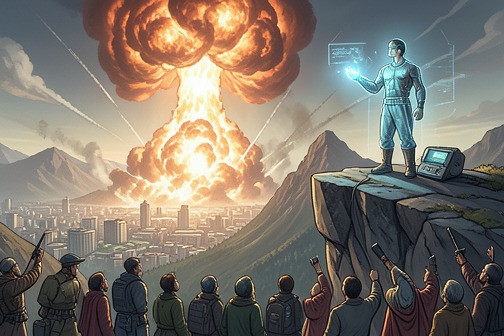
[Yinyang Khan’s Nuclear Demonstration](entity:event-recall-event-yinyang-khan-s-nuclear-74d8831075e6) is the turning point of the last History Road, where the [Yinyang Khan](entity:character-recall-character-yinyang-khan-2b2e850633cf) transforms political spectacle into mass violence. By detonating a nuclear weapon beyond Battletown, he proves that his [Right of First Annihilation](entity:expression-recall-expression-right-of-first-ann-fcb0da58bdbf) can shatter mountains and level cities, forcing every racer and spectator to recognize that the contest is no longer merely a race. It is a trial conducted under the shadow of civilization-ending power.
## The Khan’s Promise and the Stakes of the Race
The demonstration begins as a performance of authority. The Yinyang Khan addresses the racers through a holographic projection, presenting victory in the History Road as a second birth. Those who cross his finish line, he declares, may be raised to glorious heights and made godborn, while their rebirth will be celebrated through the death of thousands. His rhetoric fuses competition, religion, and sacrifice: the racers are not simply contestants, but offerings whose survival may purchase entry into his order.
The promise also reveals the political logic behind the event. The Khan claims that survivors will ride with him toward conquest and that the strong will inherit the Unmade World. The race therefore functions as recruitment, spectacle, and intimidation at once. Its public language of rebirth conceals a violent hierarchy in which the Khan alone decides who is worthy of elevation and how many lives must be spent to produce it.
## The Detonation
The Yinyang Khan announces the attack as though presenting a miracle. He speaks of finding the kindling for his ambition and the fuse that will light the sun, then raises his hand and summons the fires of history. As the countdown proceeds, qi gathers inside Battletown, while an invisible pressure weighs upon the assembled vehicles. The racers who can sense qi understand that the ceremony has become a threat before the weapon is even fired.
When the Yinyang Khan snaps his fingers, the horizon catches fire. The explosion occurs so far from Battletown that [Yuan Guang](entity:character-recall-character-acb8867cae36) initially mistakes it for a mirage in the sunlight. A colossal column of dust and smoke rises from the desert like a mushroom of fire and sand growing out of a collapsing stone mountain. The shockwave reaches the racers almost immediately, carrying a suffocating wave of hot air and dust and a boom powerful enough to wake the dead.
The blast produces direct damage even at that distance. The weaker windows of the contestants’ vehicles shatter, throwing shards through their cabins and injuring passengers. Some of [Orient](entity:character-recall-character-orient-cc17650ca89c)’s windows are destroyed as well. The force of the explosion also knocks the eye-drones off course, causing the Yinyang Khan’s holographic image to dissolve. His smile remains fixed until the detonation, making the disappearance of his projection feel like the abrupt end of a ritual performance.
The scene places nuclear devastation beside the Gun’s violence without treating them as identical. Yuan Guang regards the fiery destruction of the Nuke with awe and horror; it is different from the Gun’s rain of bullets, but no less desolate. The contrast expands the story’s field of violence from personal execution to landscape-level annihilation. A bullet kills through precision and repetition, while the nuclear blast turns distance, terrain, and entire cities into the scale of a single gesture.
## The Proof of the Right of First Annihilation
Before the detonation, the racers and the crowd remain capable of treating the Khan’s claims as extravagant rhetoric. Afterward, silence falls over Battletown. Even [Coyote](entity:character-recall-character-coyote-5bc0191f7c56) and [Duckman](entity:character-recall-character-duckman-8e1b3fb693b7), who are not easily intimidated, have nothing to say. The spectacle has forced a new understanding upon everyone present: the Khan’s Right of First Annihilation is not the boast of a diseased mind. It is a usable power.
The demonstration establishes the material stakes of the race in the most concrete terms available. The power on the line can shatter mountains and level cities. The History Road is consequently stripped of any remaining innocence as a sporting event. The racers must move forward not only to win, but to survive a ruler who can erase the world around them as an opening gesture.
This revelation also gives the Khan’s earlier promise its true meaning. His offer of godborn rebirth is backed by the ability to destroy the environment in which that rebirth would occur. The language of inheritance becomes an instrument of terror: the strong may inherit the Earth only after the Khan has demonstrated that he can reduce parts of it to cinders.
## Immediate Consequences for the Racers
Once the silence breaks, the engines roar together. Vehicles of every size surge forward in a desperate dash for victory and survival, while bullets begin flying through the resulting steel cacophony. Orient’s locomotive emits a terrible sound as she accelerates. The detonation therefore does not end the race; it changes its moral and physical conditions, converting movement into an answer to annihilation.
The damaged vehicles carry the consequences with them. Orient’s shattered windows expose passengers to flying debris, while the blast’s heat, dust, and radiation threaten the racers beyond the immediate injuries. The route itself becomes part of the weapon’s aftermath. The History Road continues only because the contestants choose motion over paralysis, and the final race begins under the knowledge that the Khan can repeat such destruction whenever his purposes demand it.
The demonstration’s later consequences confirm that the nuclear threat is tied to the Khan’s own core and can be opposed only through extraordinary intervention. After the conflict, Orient reports that she felt his core shatter against her locomotive and that Lady [Arc](entity:character-recall-character-arc-5983990a9863)’s plan had worked. She also explains that the blast would have destroyed her without a leyline’s worth of qi reinforcing her steel. Alterations to the History Road circuit barely purified the resulting radiation before it could pollute the entire region, while the Cube of Natho remained intact. The survival of the cube emphasizes the engineered durability of the object and contrasts with the vulnerability of vehicles, passengers, and landscapes.
## Ritualized Violence and Narrative Significance
The demonstration is structured like a public rite. The Khan appears in a projected, monstrous body, addresses a gathered multitude, announces a promised transformation, counts down before witnesses, and completes the ceremony with a precise bodily gesture. His snap of the fingers is both command and trigger. Nuclear authority is therefore presented not as an impersonal technological accident, but as power embodied in a ruler who turns mass death into theater.
The ritual also exposes the relationship between promise and sacrifice. The Khan speaks of birth, rebirth, conquest, and inheritance, but the visible result is heat, dust, shattered glass, injury, and the threat of radiation. His mythology depends on converting other people’s deaths into proof of his legitimacy. The racers’ bodies and vehicles become the medium through which his claim to sovereignty is made believable.
At the same time, the event reveals a conflict between two kinds of infrastructure. The Khan’s History Road is a mechanism of spectacle and coercion, designed to gather contestants beneath an imposed hierarchy. Orient’s locomotive, by contrast, survives through cultivated qi, leyline reinforcement, and deliberate alteration of the circuit to purify radiation. The aftermath suggests that survival depends not on domination alone but on maintenance, adaptation, and cooperative material systems. In that contrast, the nuclear demonstration becomes more than a display of destructive strength: it tests whether a world can be organized around annihilation or around the difficult work of preserving life after violence.
Event 26
Fukushima Paradise Strike on Battletown
The [Fukushima Paradise Strike on Battletown](entity:event-recall-event-fukushima-paradise-stri-29cd2992b2e7) was [Manhattan](entity:character-recall-character-manhattan-74663a2bc259)’s nuclear-[Authority](entity:state-recall-state-authority-6ecd0f91b580) attack that erased the city during the History Road race. Its most chilling feature was not a spectacular blast but the sudden, almost silent arrival of radioactive destruction: a green light, a shudder through the artificial leyline, and a skull-shaped cloud where Battletown had stood. The strike ended the race as a meaningful contest and exposed the danger of the power moving unseen behind it.
## Causes and Background
Battletown’s violence was tightly managed, not absent. The [Yinyang Khan](entity:character-recall-character-yinyang-khan-2b2e850633cf)’s patrols escorted the racers, and an officer explained that violence was forbidden inside the city except during the race; those who broke the rule faced enslavement or a bullet. The rule’s boundary made the race a sanctioned outlet for bloodshed while placing ordinary life under the Khan’s threat of punishment.
The Khan had already demonstrated the scale of his power. At the race’s start, he snapped his fingers and detonated an enormous explosion on the distant horizon. [Yuan Guang](entity:character-recall-character-acb8867cae36) first mistook the blaze for a mirage, then saw a towering mushroom of dust and smoke rise from a stone mountain. The shockwave struck Battletown, hot air and dust swept over the racers, and vehicle windows shattered, injuring passengers aboard [Orient](entity:character-recall-character-orient-cc17650ca89c)’s spirit-train. That public display was a clear contrast to the later strike: the Khan’s opening detonation announced itself across the desert, while the attack on Battletown registered first as a cold, precise disturbance.
Manhattan’s attack grew out of a concealed move into the city. In the account of the aftermath, he had used the Khan’s attention and forces against his right-hand man as a distraction, then entered the Pagoda after killing guards. His purpose was to trigger his Authority inside its walls and reach the Nuke’s call. The racers’ feud had thus helped create an opening for a far more destructive operation.
## The Strike
The racers were still pursuing one another when a green light swallowed Battletown. The change arrived without the familiar violence of an explosion. An invisible ripple passed through the History Road, and its artificial leyline shuddered. Neon and fire rings flickered out; vehicles braked, and [Coyote](entity:character-recall-character-coyote-5bc0191f7c56) slowed in surprise. Yuan Guang landed with enough force to tremble the ground and recognized the use of an Authority. The nuclear qi behind it was familiar, and his bullet-core throbbed with the reminder of his oath against Manhattan and the [Nuclear Path](entity:concept-recall-concept-nuclear-path-9f0822a3f147).
Only then did the scale of the attack become visible. A skull-shaped cloud of radioactive dust engulfed the start and endpoint of the leyline. There was no shockwave like the one that had opened the race and no comparable outward spectacle: the scene was marked by the eerie coldness of a tactical strike. The racers stopped as the rings vanished. The city had become a massive crater spewing smoke.
The sight changed the stakes instantly. [Hardy](entity:character-recall-character-hardy-36c073fb0401) wondered whether the Khan had destroyed his own city, and [Mel](entity:character-recall-character-mel-c42cb76ff36c) asked Yuan whether the Khan had lost control of his power. Yuan rejected both explanations: the devastation was a nuclear cultivator’s Authority, and Manhattan had finally acted. The uncertainty over who had caused the blast gave way to recognition of a deliberate attack.
## Manhattan in the Ruins
The narrative then follows Manhattan through the irradiated remains of the Khan’s palace. He walked over broken steel amid burning concrete and molten metal, while survivors who had endured the Authority moaned with radioactive burns and blisters. Although he wished to spare them further pain, he ignored them and continued toward the Nuke’s call, which he had heard since awakening at a Siberian nuclear test site half a century earlier.
The names attached to him had never defined him. Russians had called him [Czar Zoa](entity:character-recall-character-czar-zoa-3a34d3d61d77) after the Tsar Bomba; Americans had called him Manhattan. He regarded both as mortal labels and understood himself instead as radiation, an emanation of nuclear light. This identity clarifies why the attack was more than a military strike: Manhattan was pursuing what he understood as a sacred purpose, not simply trying to win the race or take control of Battletown.
He expected the detonation to eliminate most opposition and planned to complete his holy work before returning racers could interfere. He intended to bring forth the Great White Flash. Yet he could not sense the Yinyang Khan and remained wary of the warlord’s reputed strength, refusing to assume that the Khan had died. Manhattan climbed onto steel debris, his tumor core pulsing with gamma rays, and began uncovering the treasure beneath the wreckage.
## Immediate Consequences
The attack dissolved the race’s rivalries into a shared catastrophe. Mel and Hardy left their vehicles, while [Holster](entity:character-recall-character-holster-0dfe0a9736e3), [Bucket](entity:character-recall-character-bucket-5f518f342132), and other passengers climbed down from Orient’s spirit-train. Yuan ended his [Gun Demon Incarnation](entity:state-recall-state-gun-demon-incarnation-d8f55974e3ba) to conserve qi. Even Coyote had no immediate opponent to fight. Yuan’s thought of revenge on [Slash](entity:character-recall-character-slash-3cd8004a530e) receded beside the danger Manhattan represented.
Coyote then ran toward the ruined city without explanation. Yuan could not know whether he meant to loot the wreckage or find someone he cared about, but expected him to find only death. [Arc](entity:character-recall-character-arc-5983990a9863) emerged from the train with a [Barrier](entity:concept-recall-concept-barrier-74d1c6e840ae) restraining her Authority close to her body. After considering the situation, she indicated that there was something the others could do, shifting the survivors from stunned observation toward a response.
The attack’s danger did not end with the destruction of the city. Later, Orient reported that Manhattan’s core had shattered against her locomotive and that she had destroyed him. She said the blast would have extinguished her without the leyline’s supply of qi; alterations to the History Road circuit had barely purified the resulting radiation before it could contaminate the whole region. The cube remained intact. The aftermath therefore joined a decisive victory over Manhattan to a narrow escape from a broader environmental disaster.
## Significance
The strike reverses the race’s governing logic. Battletown’s authorities had confined violence to an officially permitted arena, but Manhattan’s Authority made that distinction meaningless: an unseen assault consumed the city and silenced the competition altogether. The contestants’ earlier clashes became a diversion that helped the attacker reach the Pagoda, while their contests over victory were eclipsed by the question of who could survive the destruction.
The contrast between the Khan’s theatrical opening detonation and Manhattan’s precise, nearly silent strike also separates display from strategy. One blast made power visible to the racers; the other concealed its cause until its consequences filled the horizon. In that reversal, the event reveals both Manhattan’s purpose and the fragility of the structures meant to contain violence: the race, the city’s rules, and the History Road itself could not keep nuclear power within their boundaries.
Event 27
Arc's Sacrifice
[Arc](entity:character-recall-character-arc-5983990a9863)’s sacrifice is the decisive reversal in her battle with [Manhattan](entity:character-recall-character-manhattan-74663a2bc259): when his [Fukushima Paradise](entity:action-recall-action-fukushima-paradise-0df9cc2bef06) overwhelms her damaged [Authority](entity:state-recall-state-authority-6ecd0f91b580), she spends her life strengthening [Headshot Forge](entity:location-recall-location-headshot-forge-7a777b252079), shielding [Yuan Guang](entity:character-recall-character-acb8867cae36) and breaking Manhattan’s manifested core. The victory is inseparable from its cost. Arc stops the force threatening them, but her body and bullet-core are destroyed in the act.
## Causes and Background
Arc’s final stand grows out of a commitment she had bound to Yuan Guang long before this battle. She had offered to make him her disciple and teach him cultivation if he swore never to befriend a [Nuclear Path](entity:concept-recall-concept-nuclear-path-9f0822a3f147) cultivator, to oppose Manhattan and his followers, and ultimately to destroy Manhattan. Yuan Guang accepted the obligation, with some qualification to its terms. Their bond was therefore both personal and tied to the conflict with Manhattan: Arc’s death comes while fighting the enemy she had charged her disciple to confront.
The immediate stakes are made plain by the clash of Authorities. Manhattan unleashes Fukushima Paradise, while Arc answers with Headshot Forge. Arc’s core is already broken and her Authority crippled; Manhattan’s remains intact. His radioactive flood steadily drives back her wavering reality, and cracks spread through both the Authority and Arc’s body. The scene presents no safe retreat or protective measure that could spare them: if Headshot Forge gives way, Fukushima Paradise will vaporize them, and if Arc forces the contest to its conclusion, the effort will consume her.
## The Last Counterattack
As the two Authorities contend, Arc calls Yuan Guang by name and tells him to end it. Her words carry the weight of a decision rather than a request for rescue. [Qi](entity:concept-recall-concept-qi-53033403c395) then erupts from her, and fire and lightning brighten her body as her circuits ignite. The power breaks out of its container and sends ripples through Headshot Forge. Instead of continuing to buckle under Fukushima Paradise, the Authority begins pushing back. Arc is pouring all of herself into it, converting her remaining life and strength into a last expansion of its power.
She acknowledges the price, saying she can at least take Manhattan down with her and finish a job she had failed to complete years earlier. She asks Yuan Guang for a favor without requiring another vow. He promises to protect the Cube of Natho with his life. Arc’s final demand is larger: she urges him to end the violence of [The Nuke](entity:character-recall-character-the-nuke-12cf89a2cbce), [The Gun](entity:character-recall-character-the-gun-67af30ea7783), and [The Blade](entity:character-recall-character-the-blade-a8c82f4cab15), which she identifies as powers feeding on suffering. The exchange joins a concrete immediate objective—the cube’s protection—to her broader appeal that Yuan Guang confront the forces behind the world’s pain.
## Death and Outcome
Arc’s bullet-core explodes inside her chest. The resulting pulse carries all her life and strength, vaporizes her body, and surges through Headshot Forge. Its force drives back Fukushima Paradise in one final clash. Manhattan’s Authority collapses with a shriek, and his manifested core breaks under the strain of Arc’s counterattack. The victory is not a gradual recovery or a reprieve: Arc’s sudden expenditure of everything she has left changes the outcome at the moment her own destruction becomes certain.
The collision shatters reality again. Yuan Guang is thrown against steel debris, knocked out of [Gun Demon Incarnation](entity:state-recall-state-gun-demon-incarnation-d8f55974e3ba) and returned to human form. The Cube of Natho slips from his grasp and rolls onto radioactive dust. The ruins of Battletown reassert themselves as the traces of Headshot Forge and Fukushima Paradise recede. Nothing remains of Arc but dust and shrapnel. Yuan Guang’s bullet-core skips in guilt as he recognizes that she has given her life to stop Manhattan and save the world.
## Significance
Arc’s sacrifice resolves the battle through the same bond that helped set it in motion. She had made teaching Yuan Guang conditional on his opposition to Manhattan; at the end, she trusts him with the cube and asks him to continue the struggle beyond the duel. Her final act thus protects him and preserves the possibility of carrying out that purpose, while leaving its burden with the survivor.
The form of the sacrifice is central to its force. Arc does not merely lose a contest of power: she deliberately turns her remaining life into the strength of her Authority, knowing that either outcome of the clash means death for her. Headshot Forge’s wavering reality becomes capable of resisting Fukushima Paradise only when she pours herself into it. The reversal that breaks Manhattan’s core is therefore also the precise act that erases Arc, making victory and loss two consequences of the same pulse.
Event 28
Destruction of Manhattan
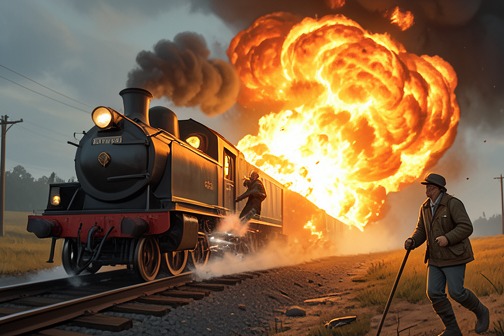
The [Destruction of Manhattan](entity:event-recall-event-destruction-of-manhatta-2021115218dd) turns [Arc](entity:character-recall-character-arc-5983990a9863)’s final sacrifice into a narrow, collective victory: Yuan uses the Cube of Natho to force [Manhattan](entity:character-recall-character-manhattan-74663a2bc259) into the path of an oncoming train, and [Orient](entity:character-recall-character-orient-cc17650ca89c) destroys him in a cataclysmic collision. The event resolves the struggle against Manhattan, but not without devastating costs; Arc dies weakening him, Orient is nearly destroyed, and the surrounding region faces the threat of nuclear contamination.
## Background and Stakes
Arc’s opposition to Manhattan had become part of Yuan’s own path. When she agreed to teach him cultivation, she bound that mentorship to an oath: Yuan would oppose Manhattan and the [Nuclear Path](entity:concept-recall-concept-nuclear-path-9f0822a3f147), and Arc would make him her disciple. Yuan accepted, promising to defeat Manhattan when he had the power and to oppose his plans when possible. The oath’s force was made tangible by an invisible grip closing around Yuan’s bullet-core, as though the [Dao](entity:concept-recall-concept-dao-3e09e1e84dbd) itself had taken notice.
The struggle also carried a moral cost for Yuan. In [Fleshmarket](entity:location-recall-location-fleshmarket-85c3bbebccdc), he had used techniques Arc taught him to address an ammunition shortage, hoping that the warring sects would destroy one another. They did, but when Arc confronted him with the consequences, he could not deny that he had treated the casualties as expendable. His uncertainty over whether his actions had helped draw the Gun to Fleshmarket compounded that guilt. By the later battle with Manhattan, the stakes were no longer only Yuan’s revenge or the defeat of an enemy: Arc’s last stand and the Cube of Natho’s survival were bound up with preventing a larger catastrophe.
## Arc’s Last Stand
At [Headshot Forge](entity:location-recall-location-headshot-forge-7a777b252079), Yuan promised to protect the Cube of Natho with his life. Arc’s answer turned that pledge outward: she urged him to end the powers feeding on their pain, naming the Nuke, the Gun, and the Blade. Then her bullet-core exploded inside her chest. The blast released all the qi and strength of her life, vaporized her body, and surged through her [Authority](entity:state-recall-state-authority-6ecd0f91b580) in a final counterattack against Manhattan.
Arc’s sacrifice pushed back the light of [Fukushima Paradise](entity:action-recall-action-fukushima-paradise-0df9cc2bef06) and struck Manhattan hard enough to make his core crack. His scream rang through his collapsing Authority as the attack forced reality apart again. Yuan was thrown against steel debris, knocked out of [Gun Demon Incarnation](entity:state-recall-state-gun-demon-incarnation-d8f55974e3ba) and back into human form; the Cube of Natho slipped from his grasp onto the radioactive dust. The old universe reasserted itself over the fading traces of Headshot Forge and Fukushima Paradise, but Arc’s final blow had not killed Manhattan.
Yuan’s guilt sharpened when he saw that Manhattan was still breathing, his charred chest leaking radioactive smoke through ribs burned nearly to nothing. Yet the damage had changed the balance of the fight: Yuan realized he could evade a lethal attack in human form, where before he would have needed Gun Demon Incarnation simply to survive. Arc had crippled Manhattan, if only temporarily, buying the others a chance to act before the enemy recovered.
## The Trap and the Final Collision
Arc’s blow left Manhattan weakened but still dangerous. Yuan could now evade him in human form, yet the Nuclear Path cultivator retained immense power. [Holster](entity:character-recall-character-holster-0dfe0a9736e3) and Orient made use of the leyline connecting Battletown to its landmarks: a circular [Barrier](entity:concept-recall-concept-barrier-74d1c6e840ae) rose over the ruins and enclosed the combatants in a translucent tunnel, trapping Manhattan inside. [Mel](entity:character-recall-character-mel-c42cb76ff36c) and [Hardy](entity:character-recall-character-hardy-36c073fb0401) joined Yuan, turning the confrontation into a three-against-one fight. Yuan kept the Cube of Natho safe in his hands and understood the stakes of the cracked core before him: if Manhattan died now, he would not return from the [Nowhere](entity:location-recall-location-nowhere-8ca016a80050).
Manhattan’s confidence finally faltered. For the first time in the battle, he showed fear and uncertainty, weakened by Arc and forced to spend effort against cultivators he had previously outmatched. Yuan seized that opening. He struck with Recoil Fist and sent the Cube of Natho into the path of the approaching train, claiming that the train meant death for Manhattan’s god. The claim was a desperate bluff: Yuan did not know whether the impact would destroy the sealed Nuke, but Manhattan could not know that either. Faced with the possibility that Yuan’s move was part of a plan to destroy the Nuke, Manhattan teleported beside the cube and caught it in midair, choosing to secure his prize rather than escape the tracks.
The timing turned Manhattan’s decision into a trap. His cracked core, battle wounds, and depleted qi had slowed him; Yuan’s shockwave had placed the cube directly in the train’s path. Orient rammed Manhattan and the cube in a catastrophic collision. [Sutras](entity:concept-recall-concept-sutras-20d678ddcd19) shone across her iron frame—the same formulas Holster had once used to purify the corrupted [Rad-Hag](entity:character-recall-character-rad-hag-efb7556a4654)—and Manhattan’s damaged core shattered. Light and nuclear smoke engulfed Yuan as the collision released a flood of green particles.
Afterward, [Bucket](entity:character-recall-character-bucket-5f518f342132) held the intact Cube of Natho while Orient told Yuan that Manhattan was gone and that Arc’s plan had worked. She confirmed the destruction by describing how she felt Manhattan’s core shatter against her locomotive. The blast would have extinguished Orient as well had a leyline’s worth of qi not been infusing her steel. The altered History Road circuit barely purified the resulting radiation before it could contaminate the whole region; the cube survived. The victory thus depended not only on Arc’s sacrifice and Yuan’s gamble, but also on Orient’s strength and the circuit’s capacity to contain the aftermath.
## Victory and Its Limits
The collision resolves the immediate contest with Manhattan, not every danger attached to the Cube of Natho. Yuan had launched it into the train’s path as a bluff, uncertain whether the impact would destroy the sealed Nuke; afterward, Bucket carried the cube intact. Orient could confirm that Manhattan’s core had shattered against her locomotive, but the scene does not confirm that the Nuke was destroyed. The difference matters: the victory is decisive against Manhattan, while the object at the center of the gamble survives.
That survival leaves the ending with a sharp double edge. Arc’s plan succeeds, and Orient’s testimony turns the collision from a desperate guess into a confirmed defeat; yet the intact cube remains a potent reminder that stopping its captor is not the same as erasing what he sought. The event closes Manhattan’s threat through sacrifice, teamwork, and exact timing, but its aftermath preserves the possibility of further consequences.
Event 29
Sinking of Battletown
The [Sinking of Battletown](entity:event-recall-event-sinking-of-battletown-743299a67b0d) was the destruction of the settlement and the History Road through a vast Last Rites ritual, turning an act of burial into a regional catastrophe. By collapsing the artificial leyline that sustained the area, [Orient](entity:character-recall-character-orient-cc17650ca89c) and [Holster](entity:character-recall-character-holster-0dfe0a9736e3) sought to lay the dead to rest and free the Human Pillars bound within it. The ritual achieved that purpose, but its force swallowed monuments, villages, and a substantial stretch of land, while leaving Yuan uncertain whether it could also stop the pursuit of [Revolver](entity:character-recall-character-revolver-ef40ed09076f) and the Gun.
## Background and the Need for Burial
In this world, funeral rites are more than observance: the dead may return as [Hungry ghosts](entity:creature-recall-creature-hungry-ghosts-b85a0d6a2745), and the living perform Last Rites to prevent that haunting. Yuan had encountered the custom at the beginning of his own story, when his murderer buried him and his fallen companions and gave them the rites. That early burial joined violence to a grim form of responsibility. At Battletown, the same connection between death and ritual became the foundation for an undertaking on an immense scale.
The problem was not simply the number of bodies. After the earlier devastation of [Fleshmarket](entity:location-recall-location-fleshmarket-85c3bbebccdc), Yuan had carried corpses to a trench where Holster recited the [Last Rites Sutra](entity:rule-recall-rule-last-rites-sutra-7bf55c77d550), while survivors tried to recover what they could. Battletown presented the same labor on a wider scale: there were too many dead to bury individually, and Hungry ghosts were already haunting the ruins of its slave market, striking at Barriers erected to keep them away from refugee camps. The ritual offered a collective answer to a crisis that ordinary burial could not meet in time.
Battletown’s artificial leyline also carried a human cost. Human Pillars trapped within it sustained the system, unable to move on to the afterlife. Orient and Holster proposed altering the leyline so that its collapse would bury Battletown and the History Road together in a single Last Rites ritual. The plan therefore joined three aims: put the dead to rest, release the Human Pillars, and destroy the physical legacy of the [Yinyang Khan](entity:character-recall-character-yinyang-khan-2b2e850633cf)’s rule.
## The Last Rites Ritual
As the ritual approached, Yuan waited among Battletown’s ruins at night, holding [Arc](entity:character-recall-character-arc-5983990a9863)’s silver bullet beneath the black moonlight. Pale, emaciated figures still haunted the blasted remains of the slave market. Their presence made the ritual’s purpose immediate: these were not merely ruins awaiting removal, but a place where unresolved deaths continued to press against the living. The proposed collapse would give those dead a shared burial rather than leave them wandering among the broken concrete and iron.
The spirit-train had already left the area when the ritual’s final effects reached it. From his window, Yuan watched Battletown sink, with Holster clapping her hands on his lap. The spectacle began at dawn with fireworks. Then the landmarks along the History Road glowed together, brighter than stars, forming a circle of light around the ruins. An immense surge of qi raced through the circuit and shattered the road on which it had been built.
The ground gave way beneath the ritual. Sand and mud swept over the monuments, burying them underground; a large portion of the region then collapsed into the [Oil Sea](entity:location-recall-location-oil-sea-444d13bea49f). A black flood washed away what remained above the waterline. The sequence took only minutes, but it erased years of construction. The spirit-train was far enough away to escape the collapse, though the occupants could still feel the earthquake’s force from miles off.
## Rescue, Burial, and Political Consequences
The destruction came after a long effort to save those who could be saved. Orient had transformed three wagons into improvised hospitals, where the wounded received treatment and were purged of lingering radiation poisoning. Survivors had scavenged what they could recover and were evacuated beyond the area threatened by the ritual. By the time the land sank, the train had departed; the people watching from it understood that the settlement’s destruction would not also take the refugees who had already escaped.
The ritual also completed a funerary task that individual graves could not. Burying Battletown and the History Road together meant that the Hungry ghosts in the ruins could rest, while the Human Pillars sustaining the leyline could finally pass into the afterlife. For Yuan, this was not an uncomplicated cause for celebration: he recognized that destroying a settlement carried a terrible weight. Yet he welcomed the prospect that the corpses beneath Battletown’s foundations would at last be at rest, and agreed that the place deserved to be gone.
Its political effect was equally deliberate. Battletown’s destruction erased the Yinyang Khan’s stronghold and the infrastructure associated with his legacy. Yuan had already judged that defeating [Slash](entity:character-recall-character-slash-3cd8004a530e) had not fully satisfied his desire for revenge, particularly given the cost. Still, breaking the Khan’s and the Flesh Mansion Sect’s hold over the region gave him a measure of accomplishment: their ability to terrorize it had been diminished, perhaps permanently. He also expected that in a few years few would remember the Khan’s tyranny.
## What the Sinking Could Not Settle
The event’s scale underscored the gulf between Yuan and the most powerful figures around him. The ritual required an engineered leyline, a circuit of landmarks, and a carefully timed collapse to bury a region. Even so, it took only minutes to undo years of construction. Yuan contrasted that elaborate destruction with the capacity of Arc and [Manhattan](entity:character-recall-character-manhattan-74663a2bc259), neither of whom needed such an extensive setup to lay waste to the world. The spectacle was therefore both a victory over a particular regime and a warning about the greater powers still beyond Yuan’s reach.
The sinking also offered no assurance that the Gun had been defeated. From the train, Yuan could see that [Mount Rushfort](entity:location-recall-location-mount-rushfort-a5330cb142f1) and its nearby village had gone beneath the waves, but he did not assume that Revolver had followed them. He could not know how long his old ally could restrain the Gun within him, or when it might resume its pursuit. The road and the town were gone; the danger that had haunted the survivors remained unresolved. In that contrast, the Last Rites ritual achieved its purpose for the buried dead without providing the living with a lasting reprieve.
Event 30
Fleshmarket Destruction
[Fleshmarket Destruction](entity:event-recall-event-fleshmarket-destruction-3e06d04e93fc) was the Gun’s bombardment of the city, a catastrophe that made [Yuan Guang](entity:character-recall-character-acb8867cae36) face the human cost of his own strategy for exploiting the sects’ war. The attack destroyed [Fleshmarket](entity:location-recall-location-fleshmarket-85c3bbebccdc) almost completely; its aftermath was marked by mass burial, a sparse rescue effort, and Yuan’s resolve to save [Revolver](entity:character-recall-character-revolver-ef40ed09076f) from the Gun’s curse rather than leave another ally to suffer.
## Causes and Escalation
Yuan had hoped to arm Fleshmarket’s warring sects during their ammunition shortage so that they would slaughter one another. When [Arc](entity:character-recall-character-arc-5983990a9863) later confronted him with what good that scheme had achieved, Yuan could not deny what he had intended. He was angry with her, but more with himself, and wondered whether his actions had helped draw the Gun to Fleshmarket. The possibility remained uncertain; what was clear was that the conflict he had tried to manipulate had become part of a far greater disaster.
[The Gun](entity:character-recall-character-the-gun-67af30ea7783) announced its arrival with a rain of bullets. Gunsmoke thunderclouds poured millions of qi-charged projectiles onto Fleshmarket, their impacts and detonations turning the bombardment into a sustained assault on the whole city. [Elder Polio](entity:character-recall-character-elder-polio-9246115ed152) raised another shell of flesh to protect himself, while Revolver, wounded and in pain, looked toward the sky with quiet acceptance. Yuan and Revolver formed layered Barriers around themselves, drawing on a defensive technique they had both learned early in their journeys. The Gun’s violence was no longer sects killing one another: it was a city beneath a storm of destruction.
The attack also revealed a disturbing contradiction in the Gun’s behavior. While Yuan and Revolver were caught in its bombardment, the Gun later engaged them in Death’s Roulette; Yuan sensed that its enthusiasm for the contest did not match its earlier cries and pleas. He recognized that it seemed intent on killing itself, not simply on killing its opponents. That discovery complicated the survivors’ response to the catastrophe: the Gun was both the source of Fleshmarket’s devastation and a being whose own destruction appeared to be part of the crisis.
## Rescue, Burial, and Departure
The destruction left Fleshmarket’s ordinary infrastructure beyond repair: the Gun’s bombardment leveled every building and crushed even the sewers and basements into tombs. Searchers found only a handful of people alive in the ruins, and sunset threatened to cut short the effort. [Orient](entity:character-recall-character-orient-cc17650ca89c) had managed to save around a hundred people—mostly armed members of the Bullet Church, their families, and civilians who had taken refuge with them—a small fraction of the population of a city the size of Fleshmarket.
The survivors’ immediate work was divided between tending the living and dealing with the dead. Yuan spent much of the day carrying bodies to a trench dug by [Bucket](entity:character-recall-character-bucket-5f518f342132) and the others, while [Holster](entity:character-recall-character-holster-0dfe0a9736e3) recited the Last Rites sutra over the dead and silently prayed for their souls. Others salvaged what they could from the wreckage, chiefly Metallist technology, weapons, and supplies. Even righting the spirit-train took considerable effort, despite Yuan’s strength. The salvage mattered, but it could not make the wrecked city habitable again; the trench, filled with hundreds of human remains, became the most visible measure of what had been lost.
Orient had protected her passengers from the bullet rain by forming a [Barrier](entity:concept-recall-concept-barrier-74d1c6e840ae) with Holster’s help. The defense was possible, Yuan surmised, because their days alongside him had taught them enough about the Gun’s attack to protect themselves. Their survival contrasted sharply with the devastation outside: a small group escaped aboard the train while the city around them became a mass grave.
By nightfall, the spirit-train departed with far more people than its cars were meant to carry. Wagons designed for a few dozen passengers held five times that number and their belongings; Orient made room in the luggage, panoramic, and restaurant cars. Yuan moved to the engine room with Holster and Arc. There, Holster held Arc’s arm and helped stabilize her broken bullet-core, having suppressed her [Authority](entity:state-recall-state-authority-6ecd0f91b580) back inside her body. The effort left Holster visibly strained, but the crowded train carried the survivors away from the ruins.
## Responsibility and the Gun’s Cycle
The catastrophe remained inseparable from Yuan’s own choices. He had intended to exploit Fleshmarket’s ammunition shortage by arming its warring sects and hoping they would destroy one another. After the bombardment, Arc confronted him with the outcome of that plan. Yuan could not deny his aim, and wondered whether his actions had helped lure the Gun to the city; the cause was uncertain, but his intended casualties were not. His admission that he had not expected the devastation to become so severe marks the difference between imagining violence as a means of manipulation and confronting its consequences in mass death.
The attack also became part of the sequence that sustained the Gun’s curse. [Kaguya](entity:character-recall-character-kaguya-fd3995a8c747) later explained that the Gun engaged Yuan and Revolver immediately after Revolver’s own murderer died in the bombardment: once a Gunsoul completed the quest for which he had risen from the dead, the Gun came to challenge him. The destruction of Fleshmarket thus did more than devastate a city. Its deaths helped bring Revolver to the threshold of that challenge, turning the aftermath into a new threat to the survivors.
For Yuan, Revolver’s predicament made the disaster’s personal cost impossible to leave behind. Revolver had saved Yuan twice, and Yuan refused to let one of the few people who had shown him unconditional kindness suffer forever under the Gun’s curse. He resolved to find a way to free Revolver, even if doing so delayed his revenge. Fleshmarket’s destruction consequently redirects Yuan’s purpose: amid the bodies he helps bury, he chooses not to let another ally become a casualty of the cycle.
## The Meaning of Revenge
In a later message to Yuan, Revolver looked back on his own return from death. He barely remembered his first life: a bullet he fired into his own chest to escape prolonged agony from radiation poisoning had dragged him out of [Nowhere](entity:location-recall-location-nowhere-8ca016a80050), and he had spent more of his existence as a Gunsoul than as a human. He had already killed the nuclear cultivator who murdered him. The revenge brought only a brief satisfaction, not a lasting purpose or a better life.
That history gave Revolver a hard-earned warning about what might follow Fleshmarket. In his view, [Gunsouls](entity:creature-recall-creature-gunsouls-7c668126d32a) who achieved vengeance did not find durable fulfillment; once their original purpose was spent, they were left with the corpses accumulated on the way to it. He had turned instead toward the Dragon Sage’s Perfect Shot prophecy, hoping that ending the cycle of The Gun would give him a new purpose. But the effort had cost him [Jim](entity:character-recall-character-jim-a57755302556) and many others, while the bullets continued to fly. The catastrophe in Fleshmarket therefore sits within a longer history of violence that cannot be undone simply by defeating one’s killer.
Revolver described The Gun’s curse as a mechanism that breeds the violence it feeds upon: it offers a false hope, draws people into carnage, and then comes for them, while their use of guns encourages still more people to take up arms. Its survival through successive hosts made the cycle seem almost self-renewing. Revolver recognized the resemblance between Yuan’s determination to save him and his own former wish to save Jim; he could warn Yuan where that hope had led without claiming that hope itself had disappeared. In this light, Fleshmarket’s destruction is not only a mass-casualty event but a grim demonstration of the problem the Perfect Shot must answer: violence can serve a purpose in the moment and still reproduce the conditions for further violence.
## The Violence That Followed
Fleshmarket’s destruction became a turning point in the curse that had brought the Gun against Revolver: Kaguya explained that once a Gunsoul’s murderer had died in the bombardment, the Gun came to challenge that Gunsoul. Weeks after Revolver became the Gun, the cycle’s next horror was visible in his own account of what he had become. Strange laughter drew him toward its source; when he reached it, he raised his revolver, and the laughter turned to screams. He said he killed without distinction—enslavers and slaves, old and young, [Scraps](entity:concept-recall-concept-scraps-c83bffce1b62) and cultivators alike—because they all looked the same to him at the barrel’s end. Yuan answered with an apology, while Revolver examined his weapon and described killing as inseparable from his nature. His transformation carried Fleshmarket’s violence beyond the ruined city: the Gun’s curse had made a former ally an instrument of indiscriminate killing, and Revolver could no longer separate that destruction from the weapon he had become.
Event 31
Yuan Guang's Final Duel with the Gun
[Yuan Guang](entity:character-recall-character-acb8867cae36)’s final duel with [The Gun](entity:character-recall-character-the-gun-67af30ea7783) turns a long pursuit of revenge into a rescue attempt: Yuan fights not only to destroy the demigod, but to reach [Revolver](entity:character-recall-character-revolver-ef40ed09076f), whose body and soul have become bound to it. The confrontation brings Yuan’s accumulated guilt and his commitment to protect others into the same battle as his most powerful techniques.
## The Burden Behind the Duel
The duel’s stakes were shaped by events well before Yuan confronted The Gun in its divine form. At [Fleshmarket](entity:location-recall-location-fleshmarket-85c3bbebccdc), Yuan had hoped that arming the warring sects would make them destroy one another. When the fighting drew The Gun to the city and it unleashed a rain of qi-charged bullets, the devastation forced Yuan to face the consequences of his plan. He could not deny that he had accepted casualties as part of the scheme, and he wondered whether his actions had helped lure The Gun there. His admission that he had not expected matters to become so bad marks the conflict as an ethical reckoning as well as a fight for survival.
## Divine Form and Reversal
The Gun’s transformation made the scale of the encounter unmistakable. It tore its own body apart, releasing Hell before manifesting in a grotesque parody of divine glory. A Recoil Shockwave burst from it with the sound of a heavenly gunshot, vaporizing the building beneath its feet and sweeping away an entire city block in dust and flying concrete. Against that spectacle, Yuan’s smaller form was not a competing display of power; it was a deliberate refusal to be intimidated by the difference in scale.
Yuan entered [Gun Demon Incarnation](entity:state-recall-state-gun-demon-incarnation-d8f55974e3ba), his revolver absorbed into his metal body and his limbs reshaped as weapons. He attacked with qi-powered bullets from a minigun arm, each round designed to pierce armor and explode. The shots passed through the Gun’s chest before detonating inside, opening smoking holes and exposing the technorganic flesh beneath. The Gun answered with laughter and hurricane-force wingbeats, firing Recoil Blasts from the barrels that formed its wings. Yuan escaped them at hypersonic speed, but the exchange established that the Gun could withstand a frontal assault even when Yuan’s ammunition bypassed its armor.
The fight’s immediate stakes widened when the Gun sighted the [Spirit-train](entity:object-recall-object-spirit-train-d7d3e01ad8cd) fleeing hundreds of miles away. Yuan’s friend had traveled far in less than an hour, yet remained within the demigod’s range. Rather than press his attack on the Gun, Yuan concentrated his will into his cannon arm and unleashed [Recoil Blast](entity:concept-recall-concept-recoil-blast-15781c214033). The strike hit the Gun near the shoulder joints that held its cannon arm in place, then tore through half its torso, shattered its bones, and severed the arm. The released power became a fireball that consumed the Gun and the city’s ruins. The reversal exposed a weakness in its own destructive force: the Gun was not immune to its power.
## The Headshot and the Rescue
The duel had become more than a contest of strength because Yuan could no longer treat Revolver as merely part of the enemy. [The Perfect Shot](entity:event-recall-event-the-perfect-shot-e50dfdd52810) prophecy remained cryptic, but Revolver’s struggle against the bloodlust of the Gun haunted Yuan: Revolver had saved his life twice, and Yuan would not leave one of the few people who had shown him unconditional kindness to suffer forever. Freeing Revolver from the Gun’s curse became a purpose that could delay Yuan’s revenge, but not be set aside.
When the Gun attacked the Spirit-train, Yuan poured his strength into a Recoil Blast that tore through half its torso and severed its cannon arm. He then pursued the opening at lethal speed, dodging further blasts and focusing on the Gun’s center of power. Yuan veered upward and rammed into the demigod with a headshot, punching through its steel bones and qi-circuit brain. Deeper inside, he found the core: Revolver’s humanoid body, bound by circuits to host the monster that had raised Yuan from the dead. Yuan drove through to the back of the skull and forced both himself and Revolver out through the Gun’s head.
The extraction destroyed the Gun’s divine body. With its core removed, the iron structure crumbled into gray dust, and a storm of qi spread across the wasteland. But the rescue did not end the danger: Revolver’s eyes still shone crimson, and the Gun continued to breathe gunsmoke from within him. Revolver struck Yuan with a Recoil Fist, shattering the lower half of his jaw and sending him falling toward the desert. Yuan managed to soften the landing with a Recoil Shockwave, but the violent blow made the outcome unmistakable: the Gun’s body had been destroyed, while Revolver remained bound to the force inside him.
## An Incomplete Victory
The extraction ended The Gun’s divine body, not its hold over Revolver. Even after the iron collapsed into gray dust, the Gun remained inside its former host: Revolver’s eyes glowed crimson, and gunsmoke escaped him before his Recoil Fist broke Yuan’s jaw. The duel therefore closed on a reversal rather than a clean rescue. Yuan had reached Revolver, but the friend he pulled from the monster was still carrying its violence.
That unresolved ending sharpens the duel’s ethical stakes. Weeks after becoming The Gun, Revolver had followed compulsions he could not understand until he reached their source, then killed the people he found. He had once fought to free slaves; now, at the barrel’s end, enslavers and the enslaved, the old and the young, [Scraps](entity:concept-recall-concept-scraps-c83bffce1b62) and cultivators all looked alike. Yuan’s rescue attempt answered the debt he felt toward a friend who had saved his life, but destroying The Gun’s enormous body did not erase the cycle’s human cost or release Revolver from it. The victory was real, and incomplete.
Event 32
The Perfect Shot
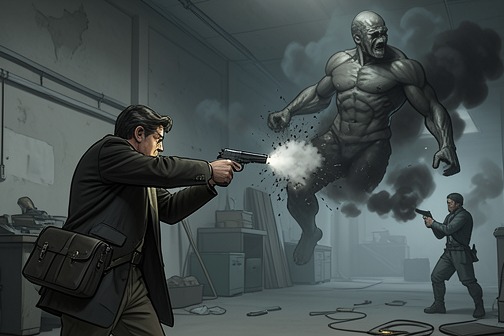
[The Perfect Shot](entity:event-recall-event-the-perfect-shot-e50dfdd52810) is the act by which [Yuan Guang](entity:character-recall-character-acb8867cae36) fulfills a long-standing prophecy and destroys [The Gun](entity:character-recall-character-the-gun-67af30ea7783) along with the curse sustaining it. What once sounded like an impossible formula becomes a choice shaped by friendship, grief, and responsibility: Yuan uses the bullet-core that gave him life to kill the force that had made violence recur. The shot ends The Gun’s cycle, though its conclusion leaves [Revolver](entity:character-recall-character-revolver-ef40ed09076f)’s soul lingering beyond death.
## The prophecy and [Arc](entity:character-recall-character-arc-5983990a9863)’s failed search
The prophecy reaches Yuan through Arc, who learned from a [Long](entity:character-recall-character-long-2c4b9ca98f9a) Dragon Sage that The Gun’s curse could be broken only by a perfect combination: the right shot, bullet, gun, place, time, and reason. Arc had spent years trying to make that combination real. She forged bullets in the hope of freeing [Jim](entity:character-recall-character-jim-a57755302556), who had become The Gun, but the attempts barely affected it. By the time she spoke to Yuan, Jim was gone, and Arc regarded the years of fighting and the lives lost in that effort as a fruitless war.
The prophecy offered a possibility, not a workable instruction. Its six requirements named what had to be right but did not reveal how to identify any of them. Yuan questioned whether Arc’s failed attempt against The Gun might simply have involved the wrong shot, weapon, place, time, or motive. His answer did not solve the problem; it kept failure from becoming proof that the prophecy was impossible.
Arc later articulated why a single, universal solution might not exist. The Gun passed from one host to another, and each host changed its fighting style. A perfect shot suited to one incarnation might not fit the next. Arc therefore came to believe that the prophecy’s elements changed with whoever wore The Gun’s crown. The task was not to find one eternally correct weapon and bullet, but to understand the particular incarnation before Yuan.
## Seeking a way out of the curse
Yuan’s interest in the prophecy followed from his fear of what the curse was doing to Revolver. Revolver had saved Yuan twice, first from Polio and then from The Gun, yet Yuan continued to see his fellow Gunsoul struggling against the bloodlust that overtook him. The possibility that Revolver might be lost to the same cycle made the prophecy personal: breaking the curse could mean saving a friend, not merely defeating an enemy.
Yuan tested whether another cultivation path might offer a way to use the Perfect Shot. [Kaguya](entity:character-recall-character-kaguya-fd3995a8c747) confirmed that, as far as she knew, it was the only escape from The Gun’s curse, while admitting she did not know how to land it. She also told him that the Paths of the [Demigods of Ultraviolence](entity:concept-recall-concept-demigods-of-ultraviol-110522816c9a) carried the seeds of their own destruction. Her answer confirmed both the prophecy’s importance and the danger of looking for a solution within a path built around violence.
Arc’s eventual theory gave Yuan a more specific lead. The gun Revolver had given him was, as Arc understood it, the first Yuan received after becoming a Gunsoul. That first weapon connected the two friends and might therefore be the right gun for a shot intended to free Revolver. Arc also reasoned that Yuan’s motive could satisfy the requirement of the right reason: firing at his friend in order to release him from The Gun’s curse was not an act of betrayal. It was an attempt to save him.
## Recognition of the right elements
Arc could not identify the right bullet, place, or time with certainty. The latest bullet she had forged during the journey carried all her sutra knowledge and her hopes of ending the [Gunsouls](entity:creature-recall-creature-gunsouls-7c668126d32a)’ cycle. Earlier versions had wounded The Gun in the [Fleshmarket](entity:location-recall-location-fleshmarket-85c3bbebccdc) dump; this one might kill it. Arc warned that firing it could instead pass the curse to Yuan, and that the outcome would remain unknowable until the shot was taken.
At the decisive moment, Yuan recognizes the right place, then rejects the idea that a common projectile could finish The Gun. His understanding resolves around the objects already at hand: the bullet and the gun are not something he must acquire. He already possesses them. The gun’s meaning lies in its connection to Revolver; the bullet is Yuan’s own core, the source associated with his life as a Gunsoul. His reasons are equally concrete. He thinks of [Holster](entity:character-recall-character-holster-0dfe0a9736e3), [Orient](entity:character-recall-character-orient-cc17650ca89c), Arc, and Revolver, and of offering peace to the dead and hope to the living.
This recognition turns a cryptic prophecy into a decision. The six conditions do not operate as a mechanical checklist whose significance can be established in advance. Arc’s theory points Yuan toward the particular relationship between host, weapon, and intended rescue; he must commit without knowing whether the last uncertain elements are truly right. The possibility that the curse might transfer to him remains part of the danger, rather than disappearing once he understands the prophecy.
## The shot and the end of the cycle
With what remains of his qi, Yuan enters [Gun Demon Incarnation](entity:state-recall-state-gun-demon-incarnation-d8f55974e3ba). He confronts The Gun as both the monster before him and the force that stands at the beginning and end of his own existence. A barrel emerges from Yuan’s head, its chamber loaded with the only projectile it needs: his own bullet-core. He stakes his vow on the bullet that once gave him life, making the shot’s origin part of its meaning.
The Gun answers with a wail unlike its earlier expressions of hunger or triumph. For the first time, its cry carries fear. Yuan fires his bullet-core at it and shoots it dead. The collision shatters his core against The Gun’s spirit, and Yuan feels the curse’s destruction in that impact. The Gun is gone, and the curse that depended on its continuing cycle is annihilated with it.
The ending does not reduce the Perfect Shot to a clean victory without residue. Yuan witnesses The Gun’s annihilation after dragging it through death’s waiting door, but Revolver’s soul remains behind. The shot fulfills the prophecy by ending the repeating structure of suffering; it does not erase the grief and bonds formed within that structure. Its decisive consequence is that the cycle can no longer continue as before, while the lingering soul makes clear that ending the curse and recovering everything it took are not the same outcome.
## Significance
The Perfect Shot reverses the usual logic of The Gun’s curse. Its violence has been sustained by human suffering and by the passage of the curse from one Gunsoul to another. Yuan does not answer that inheritance by simply becoming the stronger wielder. He uses the bullet-core associated with his own beginning against The Gun, accepting that the act may cost him his core and choosing it for the sake of others.
The prophecy’s fulfillment also revises Arc’s years of failed effort without making those losses disappear. Her forged bullet, her knowledge, and her theory help Yuan understand what might be right, but they cannot guarantee the outcome. The final act depends on Yuan’s judgment of the relationships involved and his willingness to fire for reasons beyond victory. In that sense, the Perfect Shot is both a killing blow and an act of attempted release: The Gun dies, its curse ends, and the possibility of peace replaces the cycle that had seemed inevitable.
Event 33
The Sacri-Farm Raid
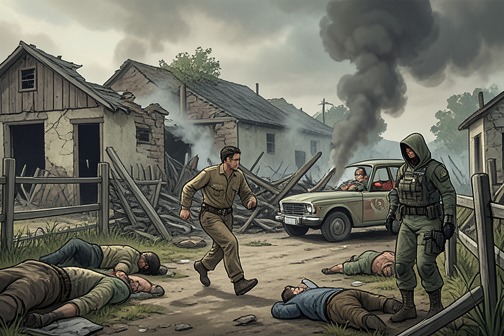
[The Sacri-Farm Raid](entity:event-recall-event-the-sacri-farm-raid-49eca420d9a3) is [Holster](entity:character-recall-character-holster-0dfe0a9736e3)’s return to the system that once treated her as merchandise. Five years after the main events, she leads an attack on the farm that produces [Hitobashira](entity:state-recall-state-hitobashira-7d11165e7e76), then pursues an escaping slaver who has seized a child. The compound is destroyed, its captives are freed, and the boy survives to be taken for treatment. The raid turns Holster’s history from a source of fear into a reason to act: she does not merely escape what was done to her, but fights to stop it happening to others.
## Background and Personal Stakes
[Sacri-Farm](entity:location-recall-location-sacri-farm-94212888f146) is presented through its fleeing overseer, Ayatsuri Kenta, who has spent ten years at the compound. He thinks of its victims as human refuse that his colleagues collect, refine into saleable wares, and package for delivery to supposedly civilized communities. The euphemism of recycling cannot disguise the trade: the boy in Kenta’s car is the farm’s last Hitobashira, a child hardly older than seven whom Kenta managed to snatch as the [Gunsouls](entity:creature-recall-creature-gunsouls-7c668126d32a) broke into the compound.
The raid is personal for Holster. The ruins remind her of the Flesh Mansion Sect, whose cultivators bound her core and shipped her away like merchandise. [Yuan Guang](entity:character-recall-character-acb8867cae36) had killed both her captors and the customer who was to receive her, but Holster still had nightmares about what might have happened without his rescue. She therefore insists on leading the attack herself, without Yuan Guang supervising her. Her aim is not simply to rely on her father’s reputation: she wants to prove that she can fight the monsters who created her and show her parents that they need not fear for her safety. [Mom](entity:character-recall-character-mom-15bf8f337f4b) agrees to the attempt only if Uncle [Revolver](entity:character-recall-character-revolver-ef40ed09076f) watches over her.
## The Pursuit and Kenta’s Death
Kenta’s flight makes the raid’s consequences immediate. Sacri-Farm is already behind him, smoking in the desert, and his crew has been attacked. He drives with one hand while holding the captured boy in front of the car window with the other, using the child as a shield. His terror grows when he recognizes Holster on the back of [Gotama](entity:character-recall-character-gotama-3fd40adaebbe), an enormous two-tailed calico cat, and sees her assault rifle aimed at him. The rifle’s scope catches the sunlight; Kenta has already witnessed Holster use it to kill a [Third Coil](entity:state-recall-state-third-coil-dcb437170529) cultivator who was immune to ordinary bullets.
Three small mechanical figures block the road, their wings keeping them aloft and their oversized cannons trained on the vehicle. Kenta veers away, only to realize too late that they have deceived him: they do not fire. The car strikes an invisible [Barrier](entity:concept-recall-concept-barrier-74d1c6e840ae) in the fabric of reality and stops gently, without injuring either Kenta or the boy. The pause in violence is brief but consequential. Holster is now directly in front of the vehicle, with a clear line of fire. Kenta expects her to spare him; instead, she pulls the trigger. For an instant, the windshield remains intact and no bullet appears to hit him. Then pain blooms inside his head, and he dies before he hears the shot.
Holster waits until Kenta stops moving before lowering her rifle. Her bullet has bypassed skin, bone, and inorganic matter, a technique she has spent months refining so that she can kill captors without spraying the people they hold with their blood. The method makes the shot decisive while also showing the care built into her violence: the hostage is not an acceptable cost of stopping the slaver.
## Rescue and Aftermath
Once Kenta is dead, his grip on the child loosens. Gotama tears off the car door and gently lifts the terrified boy in her mouth; her touch calms him. Holster reassures him that he is safe, then whistles for six [Cheruguns](entity:object-recall-object-cheruguns-c3b73141f929). They gather with different weapons, ranging from cannons to Kalash Angels. At Holster’s request, they carry the boy to [Jared LaChair](entity:character-recall-character-jared-lachair-1ffa7fe36661), her doctor, who has become skilled at treating Hitobashira and has successfully operated on and cured some of them.
Holster treats the Cheruguns as more than equipment. They are extensions of her [Qi](entity:concept-recall-concept-qi-53033403c395) and the first [Gun Path](entity:concept-recall-concept-gun-path-6a1c48ff6378) technique she invented; although they are not truly sentient, she has given them part of her soul and a degree of autonomy. She asks them for help rather than issuing orders, remembering that she was once a slave and that nobody liked being bossed around. They dematerialize their weapons into raw Qi before gently carrying the boy away. Her trust in them is not blind: she knows they sometimes make a mess of things, but believes they always give their all.
Uncle Revolver arrives on his cruiser spirit-machine and questions whether the Cheruguns can be trusted with the child, since the Wayfinders know that they sometimes wander off. Holster stands by her decision. Revolver confirms that the farm has been cleaned out, tips his hat, and tells her she has done well, adding that her parents would be proud. The exchange closes the raid’s immediate rescue sequence: the boy has been removed from Kenta’s control, the slavers’ operation is over, and Holster has acted without Yuan Guang taking the fight out of her hands.
## Meaning of the Victory
Holster’s satisfaction comes above all from opening the cages and releasing her fellow Hitobashira. She considers her performance good, but the triumph of killing slavers does not compare with the joy of freeing the captives. That contrast defines the raid’s moral center. Sacri-Farm reduces children to products and bodies to ritual resources; Holster’s victory restores their possibility of being people with lives beyond their assigned use. The boy’s rescue is not complete at the moment Kenta dies: he still needs care, which is why Holster entrusts him to a doctor who has learned how to treat survivors of the procedure.
The raid also marks a change in Holster’s relationship to her own past. She does not erase the nightmares or the memory of being bound and sold. Instead, she chooses the dangerous role of rescuer, faces the kind of captors who once controlled her, and develops a precise weapon intended to protect those caught in their power. Sacri-Farm’s destruction is therefore both retaliation against an abusive institution and an act of care for its victims. Holster’s decisive achievement is not simply that she can fight back, but that she uses that strength to make escape possible for others.
Event 34
Holster's Rescue from the Flesh Mansion Sect
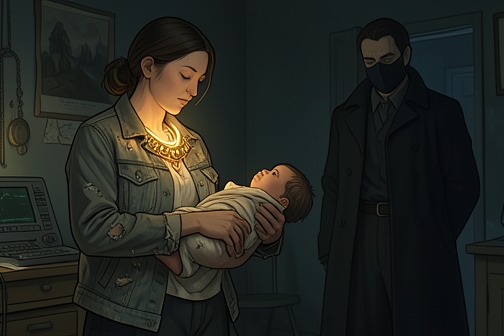
[Holster's Rescue from the Flesh Mansion Sect](entity:event-recall-event-holster-s-rescue-from-t-1f1d2ec29bf1) was the turning point that freed [Holster](entity:character-recall-character-holster-0dfe0a9736e3) from being held and sold as a [Human Pillar](entity:state-recall-state-human-pillar-46f65fa159ca). [Yuan Guang](entity:character-recall-character-acb8867cae36) killed both her captors and the customer meant to receive her, saving her from a future she would continue to imagine in nightmares. The rescue ended her immediate captivity, but not its effects: Holster carried the memory into adulthood and later chose to confront the system that had made her a commodity by helping free others like her.
## Captivity and Intended Sale
Holster's later recollections identify the Flesh Mansion Sect as the group that bound her core and shipped her away as merchandise. Her captivity was part of a larger trade in Human Pillars, people prepared as sacrifices for uses that included strengthening a land's qi flow, fueling feng shui rituals, suppressing evil spirits, or paying supernatural entities. Because such victims could serve powerful ritual and political purposes, amoral sects and warlocks paid heavily for them.
The human cost of that trade is made visible when Yuan Guang first discovers a child hidden in a car's trunk: she is bound and gagged, gaunt beneath ragged clothes, and held by an explosive slave collar. Her unnatural, dark, miasma-like qi marks her as something other than an ordinary captive. The seller [Maurice](entity:character-recall-character-maurice-7005d24c9997) identifies her as a [Hitobashira](entity:state-recall-state-hitobashira-7d11165e7e76), confirming that the child is being treated not simply as a prisoner but as a prepared sacrifice. This wider context clarifies what Holster escaped: a system that assigned a price and purpose to her body before she could choose either for herself.
## The Rescue and Its Immediate Consequences
Yuan Guang's rescue is recalled through its decisive result rather than a detailed account of the confrontation. He killed Holster's captors and the customer to whom she was to be delivered. That intervention severed the transaction and prevented the intended buyer from taking possession of her. The evidence does not specify the mechanics or precise timing of the rescue, but it establishes that Yuan Guang's violence was directed against both the people who held Holster and the person waiting to receive her.
Freedom did not instantly make the danger feel finished. Years later, passing the ruins of a Human Pillar farm still made Holster sick; the sight recalled the compound where the Flesh Mansion Sect had bound her core and prepared her for shipment. She continued to have nightmares about what might have happened if Yuan Guang had not rescued her. The counterfactual remained part of the event's meaning: her life had turned on someone intervening before the sale could be completed.
## From Survivor to Rescuer
Holster's later response was not to deny that she had been made a Human Pillar. When she joined an assault on [Sacri-Farm](entity:location-recall-location-sacri-farm-94212888f146), she insisted on leading the charge herself and handling the group without Yuan Guang supervising her. She wanted to prove to herself that she could fight back against the monsters who had created her, and to show her parents that they no longer needed to fear for her safety. Her parents were reluctant to let her try; [Mom](entity:character-recall-character-mom-15bf8f337f4b) agreed only on the condition that [Revolver](entity:character-recall-character-revolver-ef40ed09076f) watch over her.
The assault gave Holster a chance to turn the direction of the original rescue around. Her pride in defeating slavers mattered, but she found greater joy in opening the cages and freeing the other Human Pillars. As [Train-Town](entity:location-recall-location-train-town-77ff4fc4cf8f)'s citizens guided children into cars, provided first aid, and worked to reunite them with their families or find them homes in Mom's wagons, Holster recognized that the rescued children were not strangers to her history. She described herself as still being one of them inside, still a Human Pillar. The label that had once been imposed to justify her sale remained part of how she understood her connection to those she liberated.
## Lasting Change and Significance
The rescue also shaped Holster's path after captivity. Yuan Guang had offered her a gun years earlier, and when she later chose a discipline, the [Gun Path](entity:concept-recall-concept-gun-path-6a1c48ff6378) felt as though it simply clicked into place. Her early years as a qi battery had left her with far greater reserves than other cultivators her age, making high-output techniques easier to pursue. That later strength contrasts sharply with the helplessness of a child bound in a trunk, without implying that cultivation erased the experience that preceded it.
Holster's [Human Pillar status](entity:state-recall-state-human-pillar-status-ed26a517b88c) was eventually cured after Yuan Guang took a year-long journey across the wastes to find [Long](entity:character-recall-character-long-2c4b9ca98f9a), the dragon sage. The cure required Yuan Guang to work for the ancient dragon for a month, though he never told Holster what the quest involved. That later remedy changed her status, but it did not undo the history that made the rescue necessary: Holster still remembered the sect, the intended sale, and the fear of what might have happened. Her decision to lead the attack on Sacri-Farm therefore extends the rescue's significance beyond her own survival. A child once delivered as merchandise became an adult who chose to open the cages herself.
Event 35
The Journey to the Long Dragon Sage
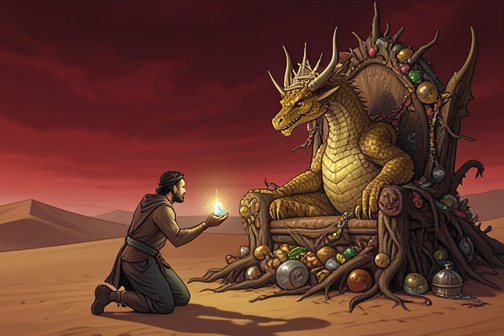
[The Journey to the Long Dragon Sage](entity:event-recall-event-the-journey-to-the-long-02beb59fefed) was a year-long expedition across the wastes that secured [Holster](entity:character-recall-character-holster-0dfe0a9736e3)’s cure from her [Human Pillar status](entity:state-recall-state-human-pillar-status-ed26a517b88c). Its resolution was a bargain with an ancient dragon, but the journey’s other price remained largely hidden: [Yuan Guang](entity:character-recall-character-acb8867cae36) returned from a task he refused to describe, and Holster remembered that silence as evidence of how dangerous the ordeal had been.
## The Expedition and Its Destination
The journey lasted a year and crossed the wastes before Yuan Guang, Holster, and their companions found [Long](entity:character-recall-character-long-2c4b9ca98f9a), a great and ancient dragon sage whom [Arc](entity:character-recall-character-arc-5983990a9863) had visited in the past. Holster’s recollection places the expedition four years before the later events in which she remembers it. The distance and duration give the cure the shape of a hard-won destination rather than an immediate remedy, though the account does not describe the route or its individual stages.
Holster remembered Long as both magnificent and frightening: his golden scales shone brighter than the sun, and horns rose from his head like a crown. He sat atop a throne of treasure and spirit-roots. The grandeur of the setting did not soften the encounter; the dragon’s demand made clear that the visitors had come before a powerful figure who set the terms of aid.
## The Bargain and Holster’s Cure
Long agreed to cure Holster of her Human Pillar status in return for Yuan Guang working for him for a full month. The account presents this as the condition attached to the cure, not as a service freely granted. Holster later confirms that Long kept his word and that her Human Pillar status was cured.
The bargain connected Holster’s release from the condition to a burden carried by Yuan Guang. What Long’s work involved is never disclosed: Yuan Guang refused to tell Holster what quest the dragon had sent him on. The text therefore makes the cure’s outcome clear while leaving the labor that secured it deliberately opaque.
## The Unspoken Ordeal
Holster judged the assignment by Yuan Guang’s reaction to it. The mere mention of a dragon unsettled him more than any Demigod of Ultraviolence, and he continued to withhold what had happened even years later. [Mom](entity:character-recall-character-mom-15bf8f337f4b) offered only that he had been thoroughly tested. These remarks establish the task as harrowing without revealing its events, dangers, or exact purpose.
That withheld account shapes the memory as much as the dragon’s appearance does. Holster had been scared and amazed at the meeting; afterward, the person who had secured her cure carried an experience he would not share. The journey thus ends in a split knowledge: Holster remembers the bargain and its result, but not the trial Yuan Guang endured to fulfill it.
## Consequences and Continuing Significance
Long’s promise extended beyond Holster’s cure. He agreed to safeguard the Cube of Natho from threats until Yuan Guang and his allies could find a way to destroy the evil within it. With the Nuke safely contained, Yuan Guang chose to focus on other [Demigods of Ultraviolence](entity:concept-recall-concept-demigods-of-ultraviol-110522816c9a); the Gun and the Bow had already been put down, while the Blade, the Biohazard, and the Arson remained free.
The expedition therefore left two lasting consequences: Holster was freed from her Human Pillar status, and the dangerous Cube was entrusted to Long while the group pursued other threats. Years later, Holster and her companions were hunting the Truck when they came upon a local slavers’ guild and decided to attack it. The remembered journey belongs to that wider course of action not as a fully recounted adventure, but as the earlier ordeal that cured Holster and secured a guardian for the Cube.