Train Church
GunsoulTrain Church is an improvised religion aboard Orient’s spirit-train, significant because it transforms a vehicle for survival into a mobile community with shared beliefs, duties, hierarchy, and ritual. It does not begin as an established institution with a formal theology. Instead, it grows out of catastrophe, persuasion, and the practical needs of passengers who must continue living together while traveling through a violent world.
Formation and Religious Substitution
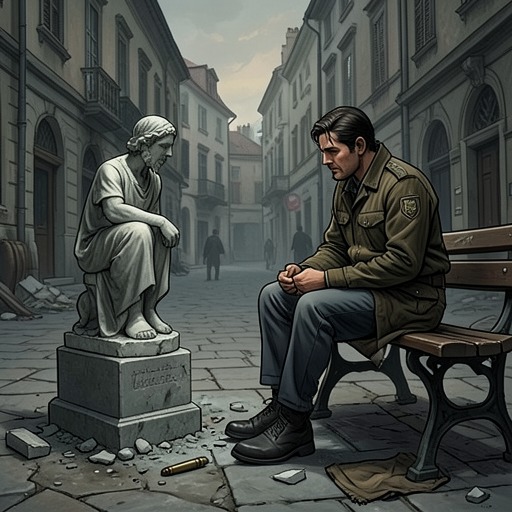
Train Church arises after the Fleshmarket disaster shatters Bucket’s faith. Rather than abandoning belief altogether, Bucket accepts Yuan Guang’s suggestion that he place his faith in a deity who might appreciate his worship. The suggestion is taken literally: Bucket begins venerating Lady Tama, installing a small metal statue of her in the cabin where former Bullet Church cultists have gathered. The result is both comic and serious. A broken system of belief is not replaced by skepticism but redirected toward a new object, creating a religion assembled from emotional need rather than doctrinal authority.
The setting gives this conversion an especially concrete form. Bucket removes the berths from a double-sized cabin to make room for a small group of former Bullet Church cultists and their altar. Their worship is therefore not merely private conviction; it reorganizes the train’s architecture. A passenger compartment becomes sacred space, and the metal statue becomes the visible center of a new communal identity. The Train Church is born through the occupation and reinterpretation of ordinary material surroundings.
Doctrine, Ritual, and Leadership
Bucket treats Orient as the living authority of the train. He greets Yuan Guang with the exuberant cry, “Railing, railing, master conductor!” and bows before Orient while imitating her train whistle. He addresses her as the “Train Mother,” while Orient answers him as the “Honored Brakeman Bucket.” These titles create a playful hierarchy in which railway labor, religious service, and communal governance overlap. Orient is not simply a vehicle or conductor: within the Train Church’s emerging vocabulary, she becomes a sacred guide who gives passengers life and direction.
The group’s promised destination is likewise given theological meaning. Bucket declares that the passengers are ready to continue toward the Promised Station, a destination foretold by the Goddess Tama. Travel is thus converted into pilgrimage. The train’s route is no longer only a logistical passage between dangerous locations; it becomes a religious narrative that gives movement purpose and makes endurance intelligible.
Orient’s participation remains ambivalent. When Yuan asks whether she is comfortable with the new religious practice, she admits that she is not entirely enthusiastic. Nevertheless, she recognizes that the passengers need something to believe in and suggests that Lady Tama may appreciate the attention. She even explains that Lady Tama has agreed to lend them a cat stationmaster to bless the passengers with meows and purrs. Orient therefore accommodates the faith without wholly endorsing its literal claims, using religious language as a means of caring for a frightened and unstable population.
The train’s other practices show how belief becomes routine. Passengers are expected to clean up after themselves, place luggage where it belongs, and follow Orient’s demands exactly. Their devotion produces discipline and organization, not only worship. The same cabins also contain sniper nests, allowing members to fire upon enemies when necessary. Train Church consequently joins liturgy to defense: its followers are passengers, believers, workers, and armed protectors of the moving community.
The Train as Sacred Community
Train Church cannot be separated from the material agency of Orient’s spirit-train. The train departs Fleshmarket at sunset on its first courier job, carrying six Bullet Church cultists and cargo under Yuan Guang’s arrangement with Bucket. In exchange for transport and security, Yuan receives money, supplies, and his choice of weapons and ammunition. This practical contract supplies the conditions in which the religious community can travel, work, and survive.
The train itself later crosses a Barrier without difficulty as phantom tracks manifest over buried railways. Flowers sustaining the Barrier move aside to let the vehicle pass, while a wave of wood qi reveals an environment capable of concentrating and purifying particular energies. These details reinforce the train’s role as more than a passive container. Its routes, wagons, barriers, and passengers form an active network in which transportation, protection, cultivation, and communal life interact. Train Church gives that network a language of blessing and pilgrimage, while the train provides the physical continuity that allows the institution to exist.
The community also develops in contrast to the death rituals of the wider world. In Yuan Guang’s era, killers may bury their victims and recite the Last Rites Sutras so the dead will not return as hungry ghosts. Such rites bind violence and religion together through fear of the dead. Train Church instead responds to disaster by giving survivors a shared object of devotion and a reason to continue moving. Its rituals do not erase the violence surrounding the passengers, but they attempt to prevent catastrophe from dissolving the group into isolated despair.
Internal Contradictions and Narrative Function
The Train Church is deliberately unstable. Its central doctrine begins as a literal misunderstanding, its deity is represented by a small metal statue, and its sacred conductor appears to perform enthusiasm that she does not fully feel. Orient’s nervousness and forced grin reveal the gap between ceremonial participation and personal conviction. Yuan Guang’s decision to “wash his hands off the mess” also indicates that he sees the passengers’ faith as a delusion he would rather tolerate than directly confront.
Yet the institution’s absurdity does not make it useless. The passengers’ newfound mania produces order, cooperation, and readiness. Faith gives them habits that purely practical instructions might not sustain: they clean, organize luggage, obey the conductor, prepare defenses, and accept a common destination. The Train Church therefore occupies an ambiguous position between consolation and control. It can preserve communal life, but it also turns authority into sacred command and makes obedience part of religious belonging.
Its emergence parallels other forms of binding in the story. Sutras can improve a projectile’s accuracy; hand signs and spoken words can focus power; an Unspeakable Vow can place an invisible chain upon a cultivator’s soul. In the same world, the Train Church binds passengers through titles, rituals, objects, and expectations rather than through a single supernatural oath. The comparison shows that belief is not separate from material power: words, bodies, vehicles, weapons, and sacred spaces all participate in shaping conduct.
Legacy and Significance
Train Church’s importance lies in its conversion of mobility into belonging. The spirit-train carries refugees, couriers, weapons, supplies, and competing beliefs, but the Church makes those passengers imagine themselves as a people traveling toward a promised destination. Its religious language supplies continuity after Fleshmarket’s destruction, while its practical discipline helps the train function as a defended social unit.
The organization also reflects the larger movement of Yuan Guang’s story from solitary revenge toward collective responsibility. Yuan begins as a murdered Gunsoul whose final concern is vengeance for his fallen team. Later, he protects Holster, cooperates with Orient, negotiates transport, and helps create conditions in which passengers can survive. Train Church is one expression of that wider shift: a damaged group is not restored through certainty or conventional institutions, but through an improvised arrangement of faith, labor, humor, and mutual dependence.
Its final meaning remains deliberately unresolved. Bucket’s worship is ridiculous enough to provoke Yuan’s doubt, while Orient’s reluctant cooperation exposes the belief’s constructed nature. Nevertheless, the altar, the titles, the Promised Station, the blessings, the rules of conduct, and the sniper nests all become real social forces. Train Church may begin as a substitute faith invented in the aftermath of disaster, but it becomes a working community because people act as though its rituals matter. In a world where death, cultivation, transportation, and authority are inseparable, that performance is itself a form of survival.