Plague quarantine order
HamnetThe Plague quarantine order confines the inhabitants of a household to their home until the plague passes, forbidding them to go outside or walk the streets. It enters the narrative not as a written proclamation or an order attributed to a named authority, but as a command delivered by a spectre at the house door. Its reach is sharply defined: it regulates movement, while a separate town decree governs how quickly plague victims must be buried.
Announcement at the Door
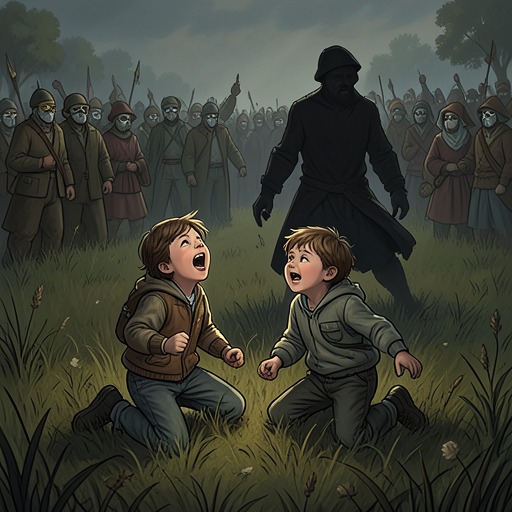
Hamnet tries to shut the door against the spectre, but it forces the door open with supernatural strength. His grandmother steps in, moves him aside, apologizes to the apparition, and invites it into the house to see the patient. The spectre refuses: it cannot enter. It then announces that the residents are henceforth required to stay inside and off the streets until the plague has passed. The order is thus delivered in a brief, uncanny encounter, with the figure itself subject to a boundary even as it imposes one on the household.
Scope and Enforcement
The command applies to the people living in the house and takes effect immediately. It specifies both what they must do—remain indoors—and what they must not do—walk in the streets. Its stated duration is conditional rather than fixed: the residents are to stay inside until the plague is over. The scene identifies no issuing institution or process of enforcement beyond the spectre’s supernatural presence and the force with which it pushes against the door.
Hamnet retreats from the apparition and collides with Agnes, who goes to the window and opens the shutter used for dispensing goods so she can look out. He runs to her and, for the first time in years, takes her hand; she squeezes it without looking at him. The order’s arrival is therefore registered not only as a rule about movement but as a physical threat that draws mother and son together in alarm.
Quarantine and the Burial Decree
The quarantine order is distinct from the town’s requirement that plague victims be buried on the day they die. After Hamnet’s death, the women prepare his body and shroud under that time pressure: they have cleared and aired the room, brought warm water, cloths, a white sheet, thread, and needles, and remind Agnes that there is no time to lose because the town has ordered rapid burial. That decree governs the handling and burial of the dead; the spectre’s order governs the movement of the living. Together, the two rules frame different parts of life during the outbreak without the text identifying them as a single policy.