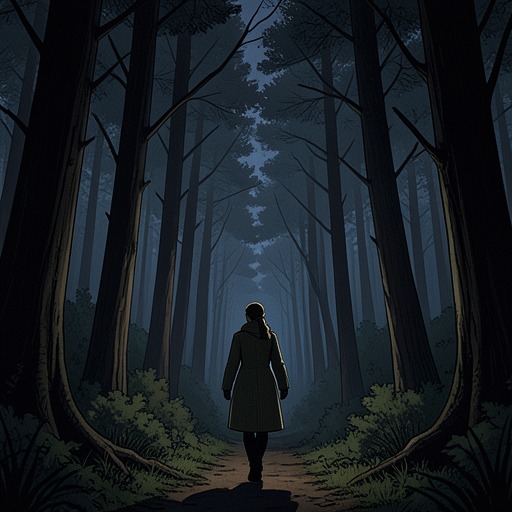
The taboo against entering the forest alone
HamnetThe taboo against entering the forest alone is a practical warning reinforced by stories of a place where paths turn travelers aside and people, animals, and even familiar landmarks may vanish. It gives the forest a powerful presence in local life: the woods are not simply a route through the landscape but a boundary approached with fear, caution, and ritual.
The Rule and Its Scope
Children who live near the forest are taught from the cradle never to enter it alone. The warning is especially strict about solitary entry; maidens are advised more broadly not to go near the trees, for fear of what may be lurking in the undergrowth. The account presents these instructions as inherited local custom rather than as a formal law, with caution passed down through teaching and stories.
The taboo belongs to a landscape regarded as actively disorienting. The forest is thick with brambles and interwoven ivy, and its trees stand so close together that some parts are said never to receive light. Paths loop back to their starting points and draw travelers away from their intended way. Untraceable breezes, music, whispers, and voices calling someone by name make the danger seem at once physical and uncanny.
Stories That Sustain the Taboo
Local belief gives the warning vivid examples. Humanlike forest inhabitants are said to have lived their entire lives among the trees without ever setting foot outside. A remarkable hunting dog, pursuing a deer into the thickets, is also said never to have returned: the forest closed behind it and kept it. These stories turn the fear of getting lost into a fear of being claimed by a place from which ordinary paths offer no reliable escape.
The forest’s reputation shapes behavior even when crossing it cannot be avoided. Travelers stop to pray at an altar and cross, asking for protection from the Lord and from the forest beings, spirits, and leaf-creatures believed to roam there. The cross itself has been overtaken by vegetation; some say ivy smothered it in a tight tangle. Its condition makes the boundary between religious protection and the forest’s encroaching power part of the landscape, not merely a matter of belief.
Protective Practices and Significance
Other travelers turn to offerings at shrines around the forest. They tie strips of their own clothing to branches or leave beer, bread, pieces of bark, and strings of bright beads, hoping to appease the tree spirits and secure passage. Prayer and offerings differ in form, but both answer the same uncertainty: anyone compelled to enter must seek help from forces imagined to govern the way through.
The taboo therefore marks the forest as a threshold that should not be crossed casually or alone. Its rules and protective customs establish the danger before the children living beside it become part of the story, and make the woods’ call feel consequential: the forest can draw people from their intentions, while local warnings and rituals try to keep them safe.