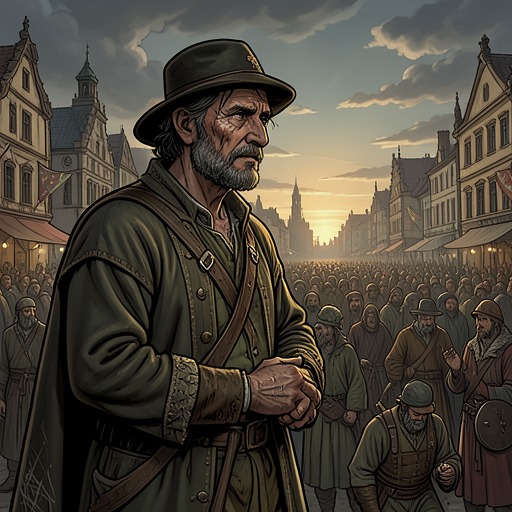
Alm-Uncle's estrangement and reconciliation
HeidiAlm-Uncle's estrangement and reconciliation describe his movement from social isolation and a reputation for being dangerous to a renewed place among the people of Dorfli. Heidi’s voluntary return from a comfortable home makes the villagers question their assumptions about him; his own acknowledgment of past resistance, followed by his return to church and an apology to The pastor, turns that doubt into a public welcome. The reconciliation is practical as well as symbolic: he agrees to live in Dorfli for the winter because the mountain cold is too severe for Heidi, and he resumes relations with neighbors who had thought themselves shut out of his life.
Estrangement and the village's assumptions
The village’s view of Alm-Uncle is presented through what its people say about him, not through a separate account of the events that first produced their distrust. When Heidi reaches Dorfli, the bystanders describe him as having grown worse over the past year: they say he does not speak and looks as if he would like to kill anyone he meets. Their response to her apparent distress is to assume she is afraid to return to him. The story thereby makes clear how strongly his reputation shapes their interpretation of her actions, even before they know why she has come back.
The miller challenges that interpretation with information he has learned during the journey. A kind gentleman had brought Heidi to Mayenfeld, arranged her departure, and paid the miller’s fare as well as extra money. More important to the villagers’ judgment, Heidi had said she had wanted for nothing in her former home and that returning to her grandfather was her own wish. The contrast between material comfort and chosen homecoming unsettles the picture of Alm-Uncle as simply cruel or unkind. By evening, the news has spread throughout Dorfli: Heidi has given up a luxurious home to return to him. Her choice does not erase the villagers’ suspicions, but it gives them a reason to reconsider them.
A return to church and an apology
Alm-Uncle’s reconciliation becomes visible when he enters the church at Dorfli with Heidi and sits at the back. The congregation notices him before the hymn is over; people whisper, turn to look, and lose their place in the singing. His presence is initially treated as an astonishing departure from expectation. Yet the congregation’s attention shifts as the sermon moves them, and after the service Alm-Uncle takes Heidi by the hand and goes to The pastor’s house. The gesture of holding her hand is itself noticed outside: some villagers take it as evidence that their picture of him may have been exaggerated.
In private, Alm-Uncle tells The pastor that he has come to ask forgiveness for the words spoken during the pastor’s earlier visit and for having stubbornly rejected well-meant advice. He accepts that The pastor had been right and that he had been wrong. He also identifies a concrete reason for changing course: Heidi is not strong enough to endure the bitter winter cold on the mountain, so he has decided to find a place for himself in Dorfli for the season. His apology joins personal admission to practical responsibility. He does not ask the villagers to forget their mistrust; he recognizes that their suspicion is his own fault and asks The pastor not to share it.
From suspicion to welcome
The pastor answers with a warm greeting rather than reproach. He tells Alm-Uncle that he is welcome as a friend and neighbor, welcomes the prospect of spending winter evenings together, and looks forward to finding companions for Heidi. In walking Alm-Uncle and Heidi to the door and shaking hands with him where the waiting villagers can see, The pastor makes his acceptance public. The scene allows the village to witness the peaceful outcome it had been watching for, rather than relying on rumor about what happened inside the house.
Once Alm-Uncle emerges, the villagers hurry forward to greet him. They offer handshakes and express pleasure at seeing him among them again; when he says he expects to return to his old quarters in Dorfli for the winter, their collective response is welcoming. Many accompany him and Heidi partway up the mountain and ask him to call when he next comes down. This change is more than a reversal in public opinion: the neighbors who had regarded him as distant now seek renewed contact and anticipate future visits. His return to village life is made tangible through these ordinary gestures of greeting and invitation.
Reconciliation's personal meaning
After the villagers have gone, Alm-Uncle watches them depart with a brightness the narration associates with an inner change. Heidi observes that he looks nicer than she has ever seen him. He answers that he is happier than he deserves and happier than he had thought possible, and describes the state he has reached as being at peace with God and people. He also credits God with sending Heidi to his hut. The passage connects the public restoration of neighborly relations with a private religious understanding: reconciliation is not only acceptance by the village but a peace Alm-Uncle recognizes as bound up with his relationship to God and his gratitude for Heidi.
That restored relationship reaches beyond the church and the pastor’s house. Alm-Uncle enters Peter's Grandmother’s home and speaks to her about doing more patching before the autumn winds arrive. She receives him with pleased surprise, thanks him for what he has done for her, and asks him not to send Heidi away again before her death. Her plea shows what Heidi’s presence means to her and makes clear that Alm-Uncle’s renewed place among the villagers matters within a network of care as well as public standing. The account thus closes this movement from isolation toward fellowship with signs of continuing practical help and a family’s hope that Heidi will remain near.