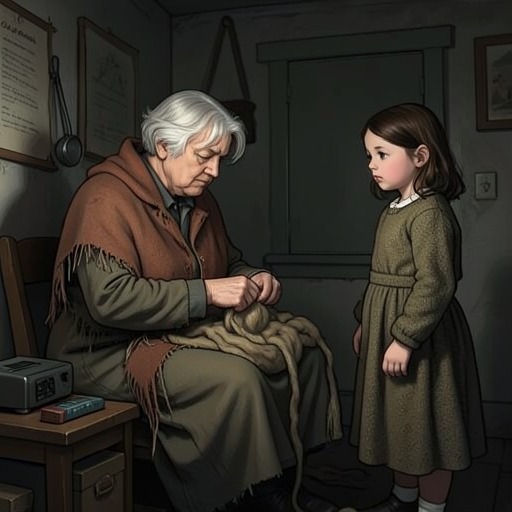
Grandmother’s blindness
HeidiPeter's Grandmother's blindness is presented as an irreversible condition, but its consequences extend beyond the fact that she cannot see: it leaves her frightened by a deteriorating home and makes the ordinary passage of the day feel monotonous and joyless. Heidi cannot cure the darkness, yet her visits change what that darkness is like to endure. The story connects the grandmother's loss of sight with both her dependence on sound and the practical care that gradually makes her household less threatening.
The limits of sight and the fear of the house
When Heidi visits, she notices that a shutter is flapping and worries that it may eventually break a pane. She can inspect the room and point out the particular shutter; Peter's Grandmother cannot. Her reply makes clear that her blindness is not a temporary dimness that a small adjustment might correct: she sees nothing, and neither moving the shutter nor bringing her outside can restore light. The distinction matters to Heidi, who initially approaches the problem as if it might be fixed by letting more brightness into the room.
The grandmother's account also shows how blindness shapes her experience of the cottage. She hears its rattling and creaking in the wind and feels the draught coming through cracks and holes. At night, when the others are asleep, those sounds feed her fear that the house will give way and kill them. She cannot see what needs repair, and she says that Peter does not know how to mend it. Her vulnerability therefore lies not only in the loss of vision itself but in living with a building whose condition she cannot inspect and whose noises suggest danger.
Heidi tries several imaginable sources of light against the grandmother's certainty that none can reach her eyes: an open shutter, the white snow outside, and the bright summer scene she remembers. She pictures the mountains glowing at sunset and yellow flowers shining in the sun, expecting that the return of summer might make the world visible again. Peter's Grandmother tells her that she will see neither the mountains nor the flowers again on earth. The exchange establishes the permanence of the blindness through Heidi's gradual recognition of what the older woman has already accepted.
Heidi's grief and the comfort of being heard
That recognition overwhelms Heidi. She breaks into loud crying and repeatedly asks whether anyone can make it light for Peter's Grandmother. The questions arise from Heidi's effort to find a remedy, not from any evidence that one exists; the grandmother has already explained that neither sunlight nor snow can restore her sight. Heidi's distress shows how concretely she imagines the scenes she wants the older woman to share, and how painful it is for her to understand that such shared seeing is no longer possible.
Peter's Grandmother tries to quiet Heidi, but the child's sobbing lasts because she is deeply troubled when she cries. Instead of pretending that the blindness can be overcome, the grandmother redirects her toward a form of closeness that remains available. She tells Heidi that a kind word is especially welcome to someone who cannot see, and that hearing the child talk gives her pleasure. She asks Heidi to sit beside her and describe life up on the mountain, including what Alm-Uncle does. Listening becomes a genuine source of companionship, not a substitute cure: the darkness remains, while conversation makes it less lonely.
The grandmother later says plainly that she feels the darkness much less when Heidi is with her. This does not reverse the earlier declaration that she will never see again. Instead, the contrast locates the change in the lived experience of blindness: the condition remains constant, but company alters the hours spent within it. Heidi's lively accounts give the grandmother something to attend to and a connection to the mountain life she has not heard about for many years except through Peter, who says little.
Visits that change the passage of time
Over the winter, Heidi's visits become a dependable event in Peter's Grandmother's days. At daybreak she listens for the child's light footsteps; when the door opens, she is glad to know Heidi has really come again. The repeated arrival turns waiting into expectation. The grandmother is no longer left with days that feel alike, empty of pleasure or change: she has a visit to anticipate and conversation to look forward to.
The afternoons also seem to pass differently. As Heidi talks, Peter's Grandmother becomes so absorbed that she does not notice the time going by. After Heidi leaves, she remarks that the afternoon seemed short, and Brigitta agrees that it feels as if she has only just cleared away the midday meal. The departure carries its own tenderness: the grandmother asks whether Heidi looks well and strong, and Brigitta describes her as bright and rosy. These exchanges show that the visits sustain an ongoing concern for the child as well as a momentary pleasure in listening to her.
On every fine winter's day, Heidi travels down in her sleigh to see Peter's Grandmother. Alm-Uncle takes her, without raising objections, and carries her safely rather than leaving her to sit alone in the sleigh, where her wrappings might fall away and expose her to the cold. This practical detail places the visits within a pattern of care: the grandmother receives Heidi's company, while Alm-Uncle makes the journey possible and protects the child on the way.
Repairs alongside care
The grandmother's fear about the cottage receives a practical answer as well as an emotional one. Alm-Uncle brings a hammer and other tools down in the sleigh and spends many afternoons making the goatherd's cottage sound and tight. Earlier, he knocks around the house and climbs its narrow steps to work on the roof, using up the nails he has brought. The repairs address the conditions that had made the grandmother lie awake listening to the wind: the cottage no longer groans and rattles through the night, and she can sleep in peace after many winters of unease.
Peter's Grandmother says she will never forget what Alm-Uncle has done for her. His work does not restore her eyesight, and the account does not suggest that her blindness ends. Rather, it changes a separate hardship that had become entangled with her inability to see: the house is less exposed to the weather and less frightening to inhabit. Heidi's presence and Alm-Uncle's repairs answer different needs, one through attentive company and the other through skilled labor.
The account thus holds permanent darkness beside changes that remain possible. Peter's Grandmother cannot recover the sight of the snow, the summer flowers, or the mountains at sunset, but she can hear Heidi arrive, listen to her talk, and sleep more peacefully in a repaired cottage. Her blindness is neither cured nor erased by kindness; the narrative shows its continuing limits while giving concrete weight to the relationships and practical actions that make life within those limits less desolate.