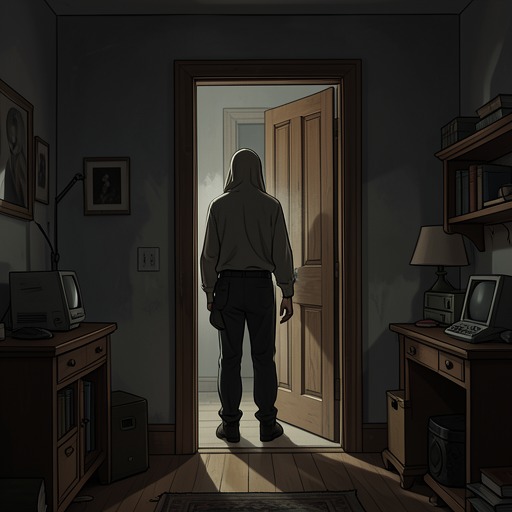
Heidi's sleepwalking
HeidiHeidi’s sleepwalking is the hidden cause of the Sesemann household’s nightly disturbance: the front door repeatedly stands open by morning, despite being locked and barred. Its eventual discovery transforms an apparent haunting into a sign of Heidi’s distress. The night wanderings expose what the household has failed to see while she is awake: her longing for Alm-Uncle and the mountains has become so consuming that, in sleep, she seems to return there physically.
The unexplained open door
For several mornings, the servants find the front door standing wide open, though the house has been secured at night. Their first explanation is a possible thief hiding in the building: they search the rooms and corners, but nothing has been stolen or disturbed. The locks and wooden bar are no protection against the repeated opening. Even when the servants get up unusually early, they arrive too late to see it happen; the surrounding houses remain shut, and the household is still asleep. The unexplained gap between the door’s careful securing and its open position turns an ordinary domestic threshold into the focus of growing alarm.
The fear changes how the household moves through its own rooms. Fraulein Rottenmeier has begun looking behind her in corridors and dark corners and avoids going alone into parts of the house. Tinette, in turn, calls Sebastian to accompany her, and Sebastian brings John along when sent to distant rooms. Each person gives the others a practical-sounding reason for company, although there is nothing that needs carrying. The servants’ chain of escorts makes the fear visible in their everyday routines: a disturbance no one has witnessed is already shaping the whole house.
A watch is arranged after persuasion from Fraulein Rottenmeier. Sebastian and John sit up in the room next to the council-chamber, equipped with weapons and spirits intended to help them keep their courage. The precautions do not immediately produce a clear explanation. As midnight passes, the drink makes the watchers first talkative and then sleepy; Sebastian wakes, while John is difficult to rouse. Their failed vigilance extends the mystery rather than resolving it, leaving the household to interpret the open door without knowing who has passed through it.
The night of discovery
The decisive watch takes place with Herr Sesemann and The doctor present. At one o’clock, they hear the bar being softly pushed aside, then the key turned and the door opened. Herr Sesemann reaches for his revolver, and both men take lights and weapons as they advance into the hall. Moonlight falls through the open entrance onto a motionless white figure. Until the figure turns and cries out, the household’s fears have taken shape as an unknown presence at the threshold.
The figure is Heidi, barefoot in her white nightgown, staring wildly at the lights and revolvers and trembling. The men recognize her with surprise, and Herr Sesemann asks what she is doing downstairs. He puts away his revolver, takes her gently by the hand, and leads her back upstairs. The doctor carries her to bed, covers her, and waits beside her until she is calmer. The scene replaces the imagined intruder with a vulnerable child whose nighttime actions she cannot account for herself.
When The doctor asks where she had meant to go, Heidi says she had not intended to go anywhere and had not known she was downstairs. She describes dreaming night after night of the same return: she thinks she is with Alm-Uncle, hears the fir trees outside, sees the stars, opens the door, and runs out into beauty. Waking, she finds herself still in Frankfurt. Her account links the repeated opening of the door to a dream of home, while the painful contrast between the dream and her actual location brings her long-suppressed grief into speech. She breaks into violent weeping as the memory and excitement overwhelm her.
The explanation and its stakes
The doctor tells Herr Sesemann that Heidi is a sleepwalker and identifies her as the figure who has opened the front door. He also says that she is consumed with homesickness and has become nearly a skeleton. In his judgment, the sleepwalking is due to over-excited nerves, and the remedy for it and for her homesickness is the same: she must return to her native mountain air. The open door is therefore not merely an isolated oddity in the house; it is the visible consequence of a serious condition that has gone unnoticed.
Herr Sesemann is alarmed that Heidi, who arrived healthy and happy, has become so emaciated in his care without anyone recognizing what was happening. He initially resists sending her home in such a state and asks The doctor to make her well first. The doctor’s explanation forces the adults to reconsider the meaning of the household disturbance: what appeared to be a threat from outside has come from Heidi’s suffering within the house. The proposed solution is not a more effective lock or a more determined watch, but a return to the place she is dreaming of.
Precautions and meaning
Herr Sesemann arranges for Sebastian to take Heidi home after Dete declines to make the journey. He instructs Sebastian to stay with her in Basle, ensure that the windows are firmly fastened, and lock her bedroom door from the outside after she is in bed. The measures are meant to keep her from wandering into danger in an unfamiliar hotel. Sebastian understands that the supposed ghostly visitations have had a human explanation all along. The household’s fear gives way to embarrassment, while Herr Sesemann rebukes its members for their cowardice and foolishness.
The sleepwalking brings together two kinds of separation. Heidi is physically in Frankfurt, away from Alm-Uncle and the familiar mountain home, while her dreams repeatedly restore that home so vividly that she moves toward its remembered doorway. The story does not present her nighttime wandering as a conscious attempt to escape: she explicitly says she does not know that she has gone downstairs. Its force lies in the gap between her unknowing body and the longing she can describe after waking. Once the mystery is solved, the open door becomes less a sign of a supernatural intruder than an unintended disclosure of how urgently Heidi needs to return home.