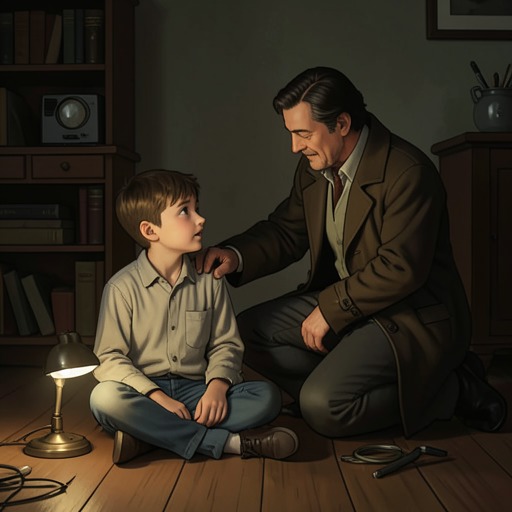
William Keeble—Jack Owlesby: Guardianship and Upbringing
HomunculusWilliam Keeble’s relationship with Jack Owlesby is one of long-term guardianship and care, made visible in the household they share, Keeble’s confidence in Jack’s judgment, and the painstaking birthday gift he prepares for him. Keeble’s craftsmanship also enters Jack’s inheritance: he builds a protective box for the emerald left to Jack by Sebastian Owlesby, tying personal care to the novel’s chain of mistaken identities and contested possessions.
A Place in Keeble’s Household
Keeble describes Jack as having been with the household for fifteen years and says he will soon turn eighteen. His wording places Jack’s upbringing within the home Keeble shares with Winnifred Keeble and Dorothy Keeble. The account establishes a sustained domestic bond, rather than a brief period of assistance, though it does not specify the legal terms of Keeble’s guardianship.
Keeble’s regard for Jack includes intellectual respect. In explaining the mechanical alligator he has made, he identifies Jack as the only person he fears sees such inventions with the right sort of eye. The remark makes Jack’s place in the household more than simply that of a young person being cared for: Keeble sees him as an unusually receptive observer of the work that occupies him.
The Birthday Invention
Keeble’s care takes a distinctive form in the clockwork box he has spent twelve years perfecting. When opened by turning it, a miniature cayman rises from within and devours four small birds, which return after a pause to repeat the cycle. Keeble has made the device for Jack’s birthday, treating the astonishing, self-repeating mechanism as a personal present rather than merely a demonstration of technical skill.
At the birthday gathering, Keeble produces a square parcel that St. Ives recognizes as the box containing the clockwork scene. The company raises a toast to Jack, who blushes at being made the center of attention. St. Ives regrets that he did not know the occasion in advance and could bring a small gift of his own; Keeble, by contrast, has prepared a creation shaped by years of work. The scene presents their different gestures of affection without making them equivalent: Keeble’s gift embodies a long investment of time and attention.
Inheritance and the Emerald Box
Keeble’s practical care also connects him to Jack’s inheritance. Sebastian Owlesby had withdrawn his interest in the West African Gem Company in the form of a great emerald intended for his son. He prevailed upon Keeble to construct a box for it, nearly identical to the lead-lined cube used to contain the homunculus. Keeble thus gives form to an inheritance that must be protected, while the near-identity of the two boxes later makes that protection vulnerable to confusion.
The boxes’ resemblance becomes consequential when Nell Owlesby admits that, in her agitated state, she might have mixed them up. Her account leaves open whether Dr. Birdlip has the emerald or the homunculus, showing how Keeble’s careful handiwork becomes part of a larger uncertainty over who possesses which object. The box is not just a container made at Sebastian’s request: it is the material link between Jack’s inheritance and the peril surrounding the other box.
The Relationship’s Closing Image
In the epilogue, Jack stands beside Dorothy Keeble, recovered and holding his arm, while Captain Powers displays an open Keeble box containing a great emerald. The emerald had been identified as Jack’s inheritance, and its appearance in a Keeble-made box brings the inheritance and Keeble’s craftsmanship together in the closing image. Keeble is not present in that moment, but his work remains central: the box that once made the emerald difficult to distinguish from the homunculus’s container now holds the jewel before Jack and Dorothy, giving the relationship’s practical and familial dimensions a tangible conclusion.