Hall of the Five Hundred
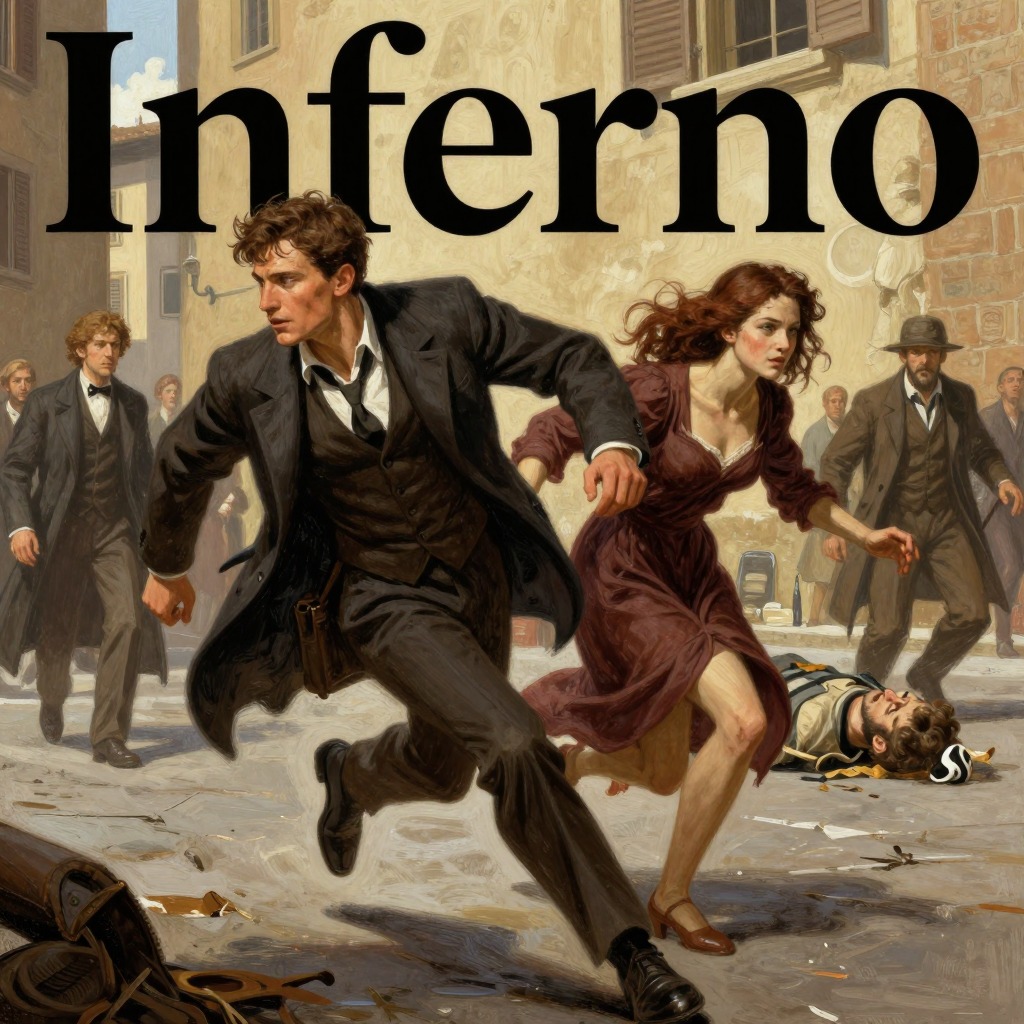
InfernoThe Hall of the Five Hundred is the largest and most historically charged room in the Palazzo Vecchio, Florence's medieval seat of government. Built in 1494 to accommodate the republic's Consiglio Maggiore—a council of precisely five hundred members from which the hall takes its name—the room was later renovated and substantially enlarged at the behest of Cosimo I, the most powerful man in Italy, who chose the great Giorgio Vasari as the project's overseer and architect. Vasari raised the original roof, permitting natural light to flow in through high transoms on all four sides, creating an elegant showroom for some of Florence's finest architecture, sculpture, and painting. The crimson stone parquet, overlaid with a black grid, gives the twelve-thousand-square-foot expanse an air of solidity, depth, and balance.
Architecture and Art
The hall's floor immediately announces that this is no ordinary space. Langdon's eye is drawn to the far side of the room, where six dynamic sculptures—The Labors of Hercules—line the wall like a phalanx of soldiers. Among them, Michelangelo's breathtaking "Genius of Victory" dominates the central niche in the south wall; at nearly nine feet tall, this sculpture was intended for the tomb of Pope Julius II, a commission Langdon finds ironic given the Vatican's stance on homosexuality, as the statue depicts Tommaso dei Cavalieri, the young man with whom Michelangelo was in love for much of his life. The hall's enormous murals have a bizarre history that includes a failed experimental painting technique by Leonardo da Vinci, which resulted in a "melting masterpiece," and an artistic "showdown" spearheaded by Piero Soderini and Machiavelli, pitting Michelangelo against Leonardo and commanding them to create murals on opposite walls of the same room.
The Vasari Mural and "Cerca Trova"
Langdon's primary interest is Vasari's "Battle of Marciano," a military confrontation absolutely massive in scale—fifty-five feet long and more than three stories tall, rendered in ruddy shades of brown and green as a violent panorama of soldiers, horses, spears, and banners colliding on a pastoral hillside. Near the top of the painting, barely visible without binoculars, Vasari painted the words "cerca trova" in tiny letters on a green battle flag. Plenty of theories exist as to why he did this, but no conclusive proof has ever been discovered. The leading theory is that it was a clue to future generations of the existence of a lost Leonardo da Vinci fresco hidden in a three-centimeter gap behind that wall. Langdon, having deciphered the code from the modified Botticelli "Map of Hell" projected from the bone-sheathed device, now stands before this mural, hoping it will jar his memory and reveal why he is carrying the projector and what he is meant to find.
The Theft of Dante's Death Mask
Security footage from the hall's museum reveals that Langdon and Ignazio Busoni—the director of the Museo dell'Opera del Duomo, known affectionately as "il Duomino"—stole Dante's death mask from its display case the previous night. The video shows Langdon pulling on surgical gloves while Busoni acts as lookout, then opening the antique cabinet and lifting out the mask. Langdon holds it up to the light, apparently examining something on the back, and Busoni recoils, fumbling for his spectacles and pacing in agitation. The two men seal the mask in a Ziploc bag and place it in Busoni's briefcase before Marta Alvarez returns from the restroom. Langdon, suffering from retrograde amnesia, has no memory of this theft and is as shocked as Marta by the revelation. The discovery that the mask's owner was Bertrand Zobrist—a fanatical Dante scholar and biochemist who advocated population control through plague—deepens the mystery and the danger.
Narrative and Thematic Significance
The Hall of the Five Hundred functions as the novel's central locus of revelation and reversal. It is here that Langdon's amnesia collides with irrefutable evidence of his own past actions, forcing him to confront the possibility that he is not merely a victim but an active participant in the unfolding crisis. The hall's layered history—its construction for republican governance, its transformation under Medici absolutism, its murals encoding secrets across centuries—mirrors the novel's own method of burying meaning beneath visible surfaces. The "cerca trova" message, hidden in plain sight for centuries, becomes the key that unlocks the entire conspiracy, leading Langdon from Florence to Venice and ultimately to Istanbul. The hall also witnesses the death of Vayentha, the Consortium agent who falls through the ceiling after Sienna pushes her over the viewing platform railing, a moment that transforms Sienna from a helper into a killer and deepens the moral ambiguity of her character.