Vasari Corridor
InfernoThe Vasari Corridor is a covered, elevated passageway in Florence, designed by Giorgio Vasari in 1564 for Grand Duke Cosimo I de' Medici. It runs nearly a kilometer from the Palazzo Vecchio, across the Ponte Vecchio and through the Uffizi Gallery, to the Pitti Palace and the Boboli Gardens. In the novel, it serves as the secret escape route that allows Robert Langdon and Sienna Brooks to evade their pursuers and reach the Palazzo Vecchio, where they seek the hidden meaning of the modified Botticelli map.
Design and Purpose
Commissioned by the Medici ruler Grand Duke Cosimo I, the Vasari Corridor was designed by Giorgio Vasari in 1564 to provide a safe, private passage from the duke's residence at the Pitti Palace to his administrative offices in the Palazzo Vecchio. The corridor stretches nearly a full kilometer, crossing the Arno River via the Ponte Vecchio and snaking through the Uffizi Gallery. Similar in concept to Vatican City's famed Passetto, it was the quintessential secret passageway of Renaissance Florence. Today, the corridor serves as a secure gallery for artwork, housing countless rare paintings, including the most extensive collection of self-portraits in the world, as overflow from the Uffizi Gallery.
Role in the Escape
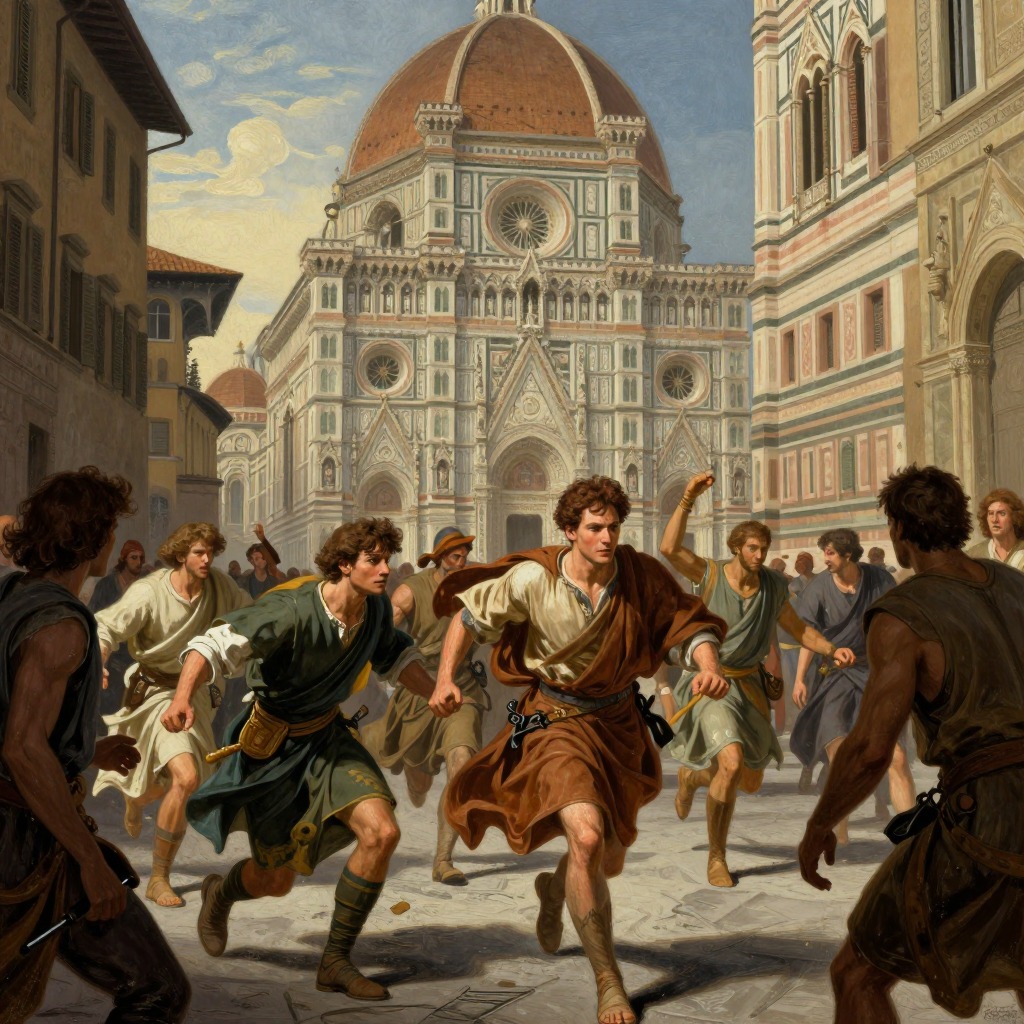
After being trapped in the Boboli Gardens by the SRS team and the Italian military police, Langdon and Sienna reach the Pitti Palace. Langdon recalls that the Vasari Corridor, which he had traveled on a private tour years before, provides a hidden route into the old city. To access it, they must first get through a small gray door near the Buontalenti Grotto, which is guarded by security guard Ernesto Russo. Sienna subdues Russo using a dim mak pressure-point technique, forces him to reveal the combination for the lock, and the pair enters the corridor. Once inside, they run through the narrow, whitewashed passageway, which seems to stretch for eternity, occasionally turning to avoid obstacles but always moving east toward the Palazzo Vecchio. The corridor's viewing portals allow them to gauge their progress; from one, they see the Ponte Vecchio below, crowded with tourists. The distant whine of the surveillance drone fades behind them as they advance.
Arrival at the Palazzo Vecchio
The corridor leads directly into the heart of the Palazzo Vecchio. Langdon and Sienna arrive at a heavy wooden door equipped with a horizontal push bar for emergency exit. After listening for sounds on the other side, Langdon pushes the door open, and they step into a quiet alcove inside the palace. From there, they navigate through a crowded atrium of government employees, with Sienna speaking rapid Italian about farm subsidies to avoid suspicion, and proceed to the Hall of the Five Hundred, where Vasari's mural Battle of Marciano—containing the hidden message "cerca trova"—is located. The corridor thus becomes the critical link that enables them to bypass the police cordon at the Porta Romana and reach the heart of their investigation.
Narrative Significance
The Vasari Corridor embodies the novel's central theme of hidden knowledge and secret passageways. It is a physical manifestation of the layered history of Florence, where the Medici's need for security created a hidden infrastructure that still exists today. For Langdon, a scholar of symbols and hidden meanings, the corridor is a tangible link to the past, a path that allows him to literally follow in the footsteps of Renaissance power brokers. Its successful use also marks a turning point in the narrative, as Langdon and Sienna finally gain the upper hand, moving from being hunted fugitives to active investigators who can now confront the mystery of the modified Botticelli map and the Dante death mask.