the opening morning
Breakfast Flock
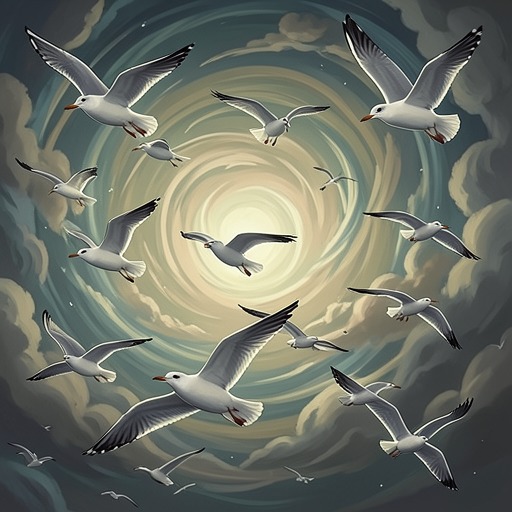
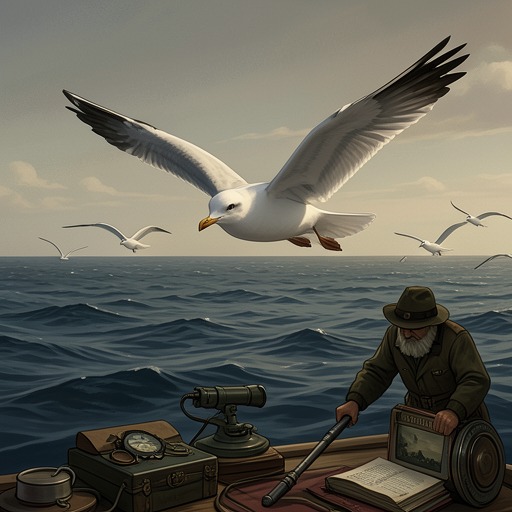
As dawn gilds a gentle sea, a fishing boat scatters bait and draws a thousand hungry [Seagulls](entity:creature-recall-creature-seagulls-6dd8ecd85e6e) into a noisy contest for scraps. Their day begins in the familiar round of feeding and fighting, a routine that defines what most of the flock believes life is for.
Far beyond boat and shore, [Jonathan Livingston Seagull](entity:character-recall-character-jonathan-livingston-8d1d8cb8422a) practices alone. His strenuous attempt to hold a slow, tight turn ends in a stall, a disgrace to ordinary gulls but a challenge he is willing to face.
that morning and the days that follow
A Different Purpose
[Jonathan Livingston Seagull](entity:character-recall-character-jonathan-livingston-8d1d8cb8422a) cares more about flight than food. He tests low glides over the water, discovers that flying close to its surface saves effort, and experiments with streamlined landings that alarm his parents.
His mother urges him to live like the rest of the flock, while his father warns that winter will make food scarce and insists that flying is only a means to eat. Jonathan tries to obey, joining the scrambles around boats, but drops a hard-won anchovy rather than keep fighting for it. He returns to the open sea, hungry but glad to be learning.
during the following week
The First Speed Trials
Alone at sea, [Jonathan Livingston Seagull](entity:character-recall-character-jonathan-livingston-8d1d8cb8422a) turns from gliding to speed. He dives from a thousand feet, but at seventy miles per hour his wings become unstable; repeated attempts send him into uncontrolled spins and crashing falls.
He reasons that high speed requires still wings. Diving from greater height, he holds them steady and reaches ninety miles per hour, a seagull record. Yet his pullout triggers the same catastrophic failure, and the impact leaves him battered in the dark water.
later that night
The Night Flight Insight
Floating in moonlight with ragged, heavy wings, [Jonathan Livingston Seagull](entity:character-recall-character-jonathan-livingston-8d1d8cb8422a) believes his failure has proved that a gull is limited by its nature. He resolves to return to the flock and stop pursuing the foolish ambition of flying beyond ordinary bounds.
On the way shoreward, he decides to make himself ordinary and climbs to fly as other gulls do. The dark sky prompts the familiar warning that gulls cannot fly at night—but the warning itself suggests an answer. Remembering a falcon’s short wings, he realizes that folding most of his wings might make high speed controllable.
that night
The Folded-Wing Breakthrough
[Jonathan Livingston Seagull](entity:character-recall-character-jonathan-livingston-8d1d8cb8422a) climbs above the black sea, folds his forewings against his body, and dives with only the narrow tips extended. The strain at high speed is far less than before, and a slight movement of the wingtips brings him out of the dive under control at 140 miles per hour.
The discovery sweeps away his promise to live like an ordinary gull. He has found a way through the limit that defeated him, and the pleasure of learning outweighs the comfort of conformity.
by the next sunrise
The Record Dive
From five thousand feet, [Jonathan Livingston Seagull](entity:character-recall-character-jonathan-livingston-8d1d8cb8422a) dives into the wind and reaches 214 miles per hour. At terminal velocity he feels the danger of unfolding his wings, yet experiences the speed as power and beauty.
He begins to pull out directly toward the fishing boat and Breakfast Flock, unable to stop or turn at that velocity. Closing his eyes, he shoots through the center of the crowd at more than 200 miles per hour. No one is killed, and he pulls up far above the sea, exhilarated by the breakthrough.
later that day
New Aerobatics
After the record dive, [Jonathan Livingston Seagull](entity:character-recall-character-jonathan-livingston-8d1d8cb8422a) sets out to learn how to turn at speed. He discovers that moving a single wingtip feather can create a smooth curve, while moving more than one sends him spinning like a rifle ball.
He continues practicing past sunset, discovering loops, rolls, spins, and other maneuvers. To him, these are not empty stunts but proof that life can be more than the repetitive commute between food and shore.
that night
Summoned to the Center
Dizzy and tired, [Jonathan Livingston Seagull](entity:character-recall-character-jonathan-livingston-8d1d8cb8422a) returns to the beach and imagines sharing his discovery with the flock. He believes flight could give gulls a purpose beyond feeding: a way to learn, develop skill, and become free.
The gulls are gathered for a [Council of the Flock](entity:organization-recall-organization-54e6ea1bc380). When the Elder orders him to [Stand to Center](entity:expression-recall-expression-stand-to-center-4c3be9dbb7c5), Jonathan first expects an honor for the morning’s spectacular flight, but the summons is instead a public judgment.
during the Council Gathering
Expelled from the Flock
The Elder condemns [Jonathan Livingston Seagull](entity:character-recall-character-jonathan-livingston-8d1d8cb8422a) for reckless irresponsibility and violating the Gull Family’s traditions. The [Council of the Flock](entity:organization-recall-organization-54e6ea1bc380) declares that life is unknowable except for the need to eat and survive, and banishment to the [Far Cliffs](entity:location-recall-location-1bf926f4fded) becomes his sentence.
Jonathan argues that pursuing a meaning beyond food is the more responsible life, and begs for a chance to show the others what flight can reveal. The flock closes its ears, declares the Brotherhood broken, and turns its back on him. He loses his place among them, but not his conviction that flight’s promise is worth sharing.
during his years at the Far Cliffs
Learning in Exile
Alone beyond the [Far Cliffs](entity:location-recall-location-1bf926f4fded), [Jonathan Livingston Seagull](entity:character-recall-character-jonathan-livingston-8d1d8cb8422a) continues to expand what he can do. He learns to dive for fish beneath the surface, sleep while flying across the night, rise above sea fog, and ride strong winds inland to find insects.
The abilities make him independent of boats and scraps, but his greater gain is inner: boredom, fear, and anger no longer govern his life. He accepts the cost of exile because he has gained the freedom and joy of flight he once hoped the flock would discover with him.
one evening after years of exile
The Radiant Visitors
Two brilliant gulls arrive beside [Jonathan Livingston Seagull](entity:character-recall-character-jonathan-livingston-8d1d8cb8422a), holding exact formation as he flies. He tests them with an exceptionally slow glide, a fast dive, and a vertical roll; they match each maneuver with effortless precision.
They tell him they are his brothers from his Flock and have come to take him higher, home. Jonathan objects that he is an Outcast and cannot climb beyond the wind’s limits, but they insist he has learned enough for one school to end and another to begin. Seeing the truth in their claim, he agrees to go.
immediately after leaving the Far Cliffs
Arrival in the New World
[Jonathan Livingston Seagull](entity:character-recall-character-jonathan-livingston-8d1d8cb8422a) rises with the two radiant birds into a dark sky and arrives in a new world. His body has become bright and smooth, and it flies with much less effort than his earthly form, though he soon discovers that even this body has limits.
He finds a sparse shore where only a few gulls work the cliffs and distant horizon. The birds welcome him without speaking, and he lands among them exhausted. His first day in the new world ends in sleep before he can even explore it.
the days after his arrival
A School of Flyers
Rested, [Jonathan Livingston Seagull](entity:character-recall-character-jonathan-livingston-8d1d8cb8422a) discovers that the new world holds as much to learn as the life he left behind. Its gulls share his belief that the highest purpose is to reach toward perfection in what they love, and they practice advanced flight for hours each day.
For a time he forgets the flock of his former world. Then, while resting with his instructor [Sullivan](entity:character-recall-character-sullivan-bf74bd08e1ea) after a session of snap rolls, he asks why this world has so few gulls when his old one was crowded with thousands.
during Jonathan’s early training
The Long Journey of Learning
[Sullivan](entity:character-recall-character-sullivan-bf74bd08e1ea) tells [Jonathan Livingston Seagull](entity:character-recall-character-jonathan-livingston-8d1d8cb8422a) that most gulls progress slowly through many lives and worlds. They may pass through thousands of lives before discovering that life is more than eating, fighting, or gaining status, and further lifetimes before they begin pursuing perfection.
What they learn shapes the next world they enter. Jonathan has advanced unusually quickly, Sullivan explains, because he learned so much at once. The lesson frames his arrival not as a final reward but as another stage of a continuing education.
one evening during his studies
Questions About Heaven
As night-flying gulls gather, [Jonathan Livingston Seagull](entity:character-recall-character-jonathan-livingston-8d1d8cb8422a) approaches the Elder [Chiang](entity:character-recall-character-chiang-204ce7d0b751) and asks whether their world is heaven. Chiang answers that heaven is not a place or time but a state of being perfect.
When Jonathan asks what comes next, Chiang challenges his pride in speed. A number, no matter how great, remains a limit; perfect speed is not a record-breaking velocity but the ability to be present wherever one wills. With that claim, Chiang turns Jonathan’s ambition toward a new kind of flight.
during that conversation
Chiang’s Instant Journey
[Chiang](entity:character-recall-character-chiang-204ce7d0b751) vanishes and appears at the water’s edge, then returns instantly to [Jonathan Livingston Seagull](entity:character-recall-character-jonathan-livingston-8d1d8cb8422a)’s side. He explains that he can go to any place and time he can imagine, while those who chase travel for its own sake may never truly go anywhere.
Jonathan, dazzled by the demonstration, asks to learn. Chiang agrees, but tells him the first step is knowing that he has already arrived. The instruction unsettles the assumptions on which Jonathan’s earlier flight training depended: mastery now requires changing how he understands himself.
for many days after Chiang’s lesson
Learning Thought-Speed Flight
[Jonathan Livingston Seagull](entity:character-recall-character-jonathan-livingston-8d1d8cb8422a) struggles to travel through thought, trying fiercely day after day but moving no measurable distance. [Chiang](entity:character-recall-character-chiang-204ce7d0b751) tells him that faith is not enough: just as flight required understanding, this ability requires understanding too.
At last Jonathan recognizes himself not as a body confined by wingspan and performance charts, but as a perfect, unlimited gull. In a flash he and Chiang stand on a different shore beneath a green sky and twin suns. The world has changed because Jonathan has grasped the idea behind the journey, though Chiang warns that his control still needs work.
that night after the journey
The Flock’s Congratulations
When [Jonathan Livingston Seagull](entity:character-recall-character-jonathan-livingston-8d1d8cb8422a) returns, the others have seen him disappear and look at him with awe. He refuses their congratulations, insisting that he is still a newcomer and has more to learn from them.
[Sullivan](entity:character-recall-character-sullivan-bf74bd08e1ea) tells him that he has shown less fear of learning than any gull in ten thousand years. [Chiang](entity:character-recall-character-chiang-204ce7d0b751) proposes that they work on travel through time next, then turn toward the more difficult lesson of kindness and love. Jonathan’s rapid progress has brought him to a deeper challenge than flight technique.
about a month later
Chiang’s Final Lesson
[Jonathan Livingston Seagull](entity:character-recall-character-jonathan-livingston-8d1d8cb8422a) learns at extraordinary speed under [Chiang](entity:character-recall-character-chiang-204ce7d0b751), absorbing new ideas about time and flight. One day Chiang speaks to the gulls about continuing their practice and understanding the invisible principles of life; as he speaks, his feathers brighten until they become impossible to look at.
Before disappearing, Chiang gives Jonathan one final instruction: to keep working on love. The loss leaves Jonathan without his teacher, but the lesson redirects his learning toward service and care for others.
after Chiang’s departure
The Decision to Return
Thinking of [Earth](entity:location-recall-location-dd4e41a8f628), [Jonathan Livingston Seagull](entity:character-recall-character-jonathan-livingston-8d1d8cb8422a) wonders how much more meaningful his first life might have been if he had known what he now knows. He imagines a gull there struggling against ordinary limits, perhaps even an Outcast for insisting that flight means more than getting food.
The more he practices kindness and tries to understand love, the more strongly he wants to return and teach. [Sullivan](entity:character-recall-character-sullivan-bf74bd08e1ea) warns that the gulls on Earth may not listen, and reminds Jonathan that the gull sees farthest who flies highest. Jonathan accepts the risk anyway: he believes one or two learners may need the chance he never received.
just before Jonathan returns
Goodbye to Sullivan
[Sullivan](entity:character-recall-character-sullivan-bf74bd08e1ea) doubts that the flock that once banished [Jonathan Livingston Seagull](entity:character-recall-character-jonathan-livingston-8d1d8cb8422a) will welcome him now. Jonathan stays with the decision, arguing that if friendship depends on space and time, then overcoming those limits should not destroy their bond.
Sullivan laughs and accepts the farewell, trusting Jonathan to help grounded gulls see farther. Jonathan holds an image of the distant flock and understands himself as an idea of freedom rather than a body limited by bone and feather. He sets out for the world he left behind.
at the Far Cliffs in the world Jonathan left
Fletcher’s Outcast Anger
On [Earth](entity:location-recall-location-dd4e41a8f628), the young [Fletcher Lynd Seagull](entity:character-recall-character-fletcher-lynd-seagu-d31ff90e9a0e) flies toward the [Far Cliffs](entity:location-recall-location-1bf926f4fded), furious that the flock has made him an Outcast for a playful barrel roll. He insists that flight must mean more than moving from place to place and vows to prove the flock wrong.
A calm voice addresses him from beside his wing. [Jonathan Livingston Seagull](entity:character-recall-character-jonathan-livingston-8d1d8cb8422a) asks whether Fletcher truly wants to fly—and whether he wants it enough to forgive the flock, learn, and eventually return to help it understand. Fletcher admits that he does, and Jonathan begins his instruction with level flight.
early in Jonathan’s teaching
Fletcher’s First Lessons
[Fletcher Lynd Seagull](entity:character-recall-character-fletcher-lynd-seagu-d31ff90e9a0e) is a powerful, quick student with a fierce desire to learn. He struggles with a sixteen-point vertical slow roll and, after a failed attempt, calls himself stupid and beyond help.
[Jonathan Livingston Seagull](entity:character-recall-character-jonathan-livingston-8d1d8cb8422a) identifies the problem: Fletcher is forcing the pull-up and losing speed at the entry. He asks Fletcher to practice in formation and make the movement smooth rather than hard. The correction turns frustration into a lesson in patience and disciplined control.
by the end of the first three months
Teaching the Outcasts
[Jonathan Livingston Seagull](entity:character-recall-character-jonathan-livingston-8d1d8cb8422a) gathers six more students, all Outcasts curious about the idea of flying for its own sake. They relish the speed and aerobatics, but have trouble accepting his claim that precise flight expresses a gull’s deeper nature.
Jonathan teaches that their bodies are thought made visible and that breaking the chains of thought can break bodily limits. His students often fall asleep before grasping the philosophy. Still, practice gives them the confidence to test what they can do, preparing them for the return Jonathan has planned.
about a month after the students gather
The Return Is Proposed
[Jonathan Livingston Seagull](entity:character-recall-character-jonathan-livingston-8d1d8cb8422a) tells his students that it is time to return to the flock. Henry Calvin Gull objects that the Outcasts are unwelcome and cannot simply force their way back.
Jonathan answers that they are free to go where they wish and rises toward the home grounds. His students hesitate under the old rule that an Outcast never returns, but [Fletcher Lynd Seagull](entity:character-recall-character-fletcher-lynd-seagu-d31ff90e9a0e) points out that they are no longer bound to obey a flock from which they have been cast out. They choose to follow their instructor.
the morning the students return
The Formation’s Return
[Jonathan Livingston Seagull](entity:character-recall-character-jonathan-livingston-8d1d8cb8422a) leads seven students in a tight double-diamond formation across [Council Beach](entity:location-recall-location-f4783644c44f). Moving at high speed, they roll together and then each bird loops into a controlled, slow landing on the sand.
Eight thousand eyes watch the returning Outcasts. Jonathan immediately begins critiquing their join-up, treating the performance as a lesson rather than a challenge to the flock. The spectacle unsettles the expected confrontation: the birds have returned, and their skill cannot be dismissed as mere defiance.
within an hour of the return
The Flock Turns Away
Word spreads that the Outcasts have come back. Young gulls are astonished by their flying, but the Elder’s order soon passes through the flock: ignore them, and any gull who speaks to or looks upon an Outcast will also be banished.
Gray backs turn toward [Jonathan Livingston Seagull](entity:character-recall-character-jonathan-livingston-8d1d8cb8422a) and his students. Jonathan does not stop teaching. He holds practice sessions over [Council Beach](entity:location-recall-location-f4783644c44f), pressing each student to demonstrate what they have learned, even as the flock tries to make them invisible.
during the weeks after the return
Students Demonstrate Their Skill
[Jonathan Livingston Seagull](entity:character-recall-character-jonathan-livingston-8d1d8cb8422a) pushes his students to test the limits of their abilities above the beach. Martin William Gull discovers astonishing low-speed control, Charles-Roland Gull climbs to twenty-four thousand feet, and [Fletcher Lynd Seagull](entity:character-recall-character-fletcher-lynd-seagu-d31ff90e9a0e) masters his slow roll and adds a triple cartwheel.
Jonathan flies beside them through night, cloud, and storm. The flock remains on the ground, but curiosity grows: at night, unseen gulls form a listening circle around the students. The banishment order still holds publicly, yet its grip is beginning to weaken.
about a month after the return
Terrence Crosses the Line
Finally, among the gulls, one gull approached the gull Jonathan Livingston to ask about flying. When Terrence Lowell gull spoke, he violated the rule of not contacting the exiled, and became an exiled. Terrence became the eighth student. His choice showed that the practice and
the night after Terrence joins
Kirk Asks to Fly
[Kirk Maynard Gull](entity:character-recall-character-kirk-maynard-gull-b18eead0d21d) crosses the sand with his left wing dragging and collapses at [Jonathan Livingston Seagull](entity:character-recall-character-jonathan-livingston-8d1d8cb8422a)’s feet. He says that he wants to fly more than anything, but believes his injured wing makes flight impossible.
Jonathan tells him that he is free to be his true self here and now. When Kirk asks whether that means he can fly, Jonathan answers that he is free. Kirk spreads his wings and rises into the night, shouting that he can fly.
by the following sunrise
A Crowd Begins to Listen
By sunrise, nearly a thousand gulls have gathered outside the circle of students to watch [Kirk Maynard Gull](entity:character-recall-character-kirk-maynard-gull-b18eead0d21d), no longer concerned with hiding their interest. [Jonathan Livingston Seagull](entity:character-recall-character-jonathan-livingston-8d1d8cb8422a) speaks of flight as a gull’s right and freedom as the nature of being, calling on them to set aside whatever ritual, superstition, or limitation stands against it.
When asked whether even the flock’s law should be set aside, Jonathan replies that the only true law is the one that leads to freedom. He rejects the claim that he and his students are divinely special, pointing instead to their practice and growing understanding. The crowd grows each day, a mixture of questions, admiration, and scorn.
a week after the crowd gathers
The Son of the Great Gull Rumor
[Fletcher Lynd Seagull](entity:character-recall-character-fletcher-lynd-seagu-d31ff90e9a0e) tells [Jonathan Livingston Seagull](entity:character-recall-character-jonathan-livingston-8d1d8cb8422a) that some gulls are calling him the Son of the [Great Gull](entity:concept-recall-concept-great-gull-f9d7f9989f7b), while others claim he is a thousand years ahead of his time. Jonathan recognizes the familiar cost of being misunderstood: a teacher may be treated as either devil or god.
Fletcher rejects the idea that their flying is ahead of time. The techniques have always been available to anyone willing to discover them, he says; they are ahead only of the fashion and habits of the flock. Jonathan accepts the distinction, resisting the myth that would make learning seem inaccessible to ordinary gulls.
a week after the rumor
Fletcher’s Collision
While demonstrating high-speed flight to new students, [Fletcher Lynd Seagull](entity:character-recall-character-fletcher-lynd-seagu-d31ff90e9a0e) pulls out of a dive only inches above the beach. A young gull glides into his path, and Fletcher swerves sharply at more than 200 miles per hour to avoid it, striking a granite cliff.
The impact becomes, for Fletcher, a sudden passage into a strange state of fear and confusion. [Jonathan Livingston Seagull](entity:character-recall-character-jonathan-livingston-8d1d8cb8422a)’s voice reaches him, urging patience and reminding him that they have not yet reached the stage of flying through rock. Fletcher believes he may have died, but Jonathan tells him that he has changed consciousness rather than ended his life.
immediately after Fletcher’s crash
The Choice to Return
[Jonathan Livingston Seagull](entity:character-recall-character-jonathan-livingston-8d1d8cb8422a) tells [Fletcher Lynd Seagull](entity:character-recall-character-fletcher-lynd-seagu-d31ff90e9a0e) that he may stay in the higher state and learn there or return to work with the flock. Fletcher chooses to return because he has barely begun teaching the new group.
Following Jonathan’s reminder that the body is thought made visible, Fletcher opens his eyes at the base of the cliff, among the flock gathered around him. The gulls cry that he has risen from the dead, and their wonder quickly curdles into accusations that Jonathan has performed a miracle or come to destroy them.
moments after Fletcher returns
The Mob and Escape
As the crowd closes in, four thousand gulls shout that [Jonathan Livingston Seagull](entity:character-recall-character-jonathan-livingston-8d1d8cb8422a) is a devil. Fear turns into a threat to destroy him and [Fletcher Lynd Seagull](entity:character-recall-character-fletcher-lynd-seagu-d31ff90e9a0e).
Fletcher says he would not object to leaving the mob. In an instant, the two stand half a mile away, beyond the flashing beaks. Fletcher is astonished by the movement, and Jonathan explains that, like everything else, it takes practice. The escape exposes how difficult it is to convince a bird of a freedom it could test for itself.
the morning after the mob attack
Learning to Love the Flock
[Fletcher Lynd Seagull](entity:character-recall-character-fletcher-lynd-seagu-d31ff90e9a0e) cannot understand how [Jonathan Livingston Seagull](entity:character-recall-character-jonathan-livingston-8d1d8cb8422a) can love a flock that has just tried to kill them. Jonathan distinguishes love from approval of hatred or evil: it means practicing until the good in each gull becomes visible, then helping the gulls see it in themselves.
He recalls Fletcher’s own angry, bitter beginning as an Outcast and sees how far the young gull has come toward building a better life and leading others. The lesson makes love a discipline of perception and action, not a feeling reserved for those who behave kindly.
later that morning
Jonathan Prepares to Leave
[Jonathan Livingston Seagull](entity:character-recall-character-jonathan-livingston-8d1d8cb8422a) tells [Fletcher Lynd Seagull](entity:character-recall-character-fletcher-lynd-seagu-d31ff90e9a0e) that he may soon leave for other flocks that need an instructor. Fletcher protests that he is only an ordinary gull and that Jonathan cannot abandon the work.
Jonathan rejects Fletcher’s image of him as the Son of the [Great Gull](entity:concept-recall-concept-great-gull-f9d7f9989f7b). He says Fletcher must keep discovering his own unlimited nature and learn to teach from within himself. As Jonathan begins to shimmer and turn transparent, he asks Fletcher not to let the flock turn him into a god.
near the ending
Jonathan’s Departure
[Fletcher Lynd Seagull](entity:character-recall-character-fletcher-lynd-seagu-d31ff90e9a0e) calls out as [Jonathan Livingston Seagull](entity:character-recall-character-jonathan-livingston-8d1d8cb8422a) vanishes into empty air. Jonathan’s last words urge him not to trust the limits reported by his eyes, but to look with understanding and find the knowledge already within him.
Fletcher is left with the students and the flock, responsible for continuing the teaching without turning its founder into a legend. Jonathan’s departure transfers the work of instruction to the gulls he has taught and tests whether they can carry his message beyond his presence.
immediately after Jonathan’s departure
Fletcher Takes Up Teaching
[Fletcher Lynd Seagull](entity:character-recall-character-fletcher-lynd-seagu-d31ff90e9a0e) drags himself into the sky and faces a new group of eager students. He begins with [Jonathan Livingston Seagull](entity:character-recall-character-jonathan-livingston-8d1d8cb8422a)’s teaching: a gull is an unlimited idea of freedom, and the body is thought made visible.
The young birds look puzzled, wanting a practical rule for a loop. Fletcher sighs and starts again with level flight, recognizing that his friend was no more divine than he is. He sees his students for a moment as they truly are, loves what he sees, and begins his own race to learn.