Seagulls
Jonathan Livingston SeagullSeagulls are both the communal force that measures flight by its usefulness and the varied individuals who can discover flight as a discipline in its own right. Their conventions condemn stalling as dishonor and turn the daily search for food into a flocking contest; yet, in another community, they practice advanced flight for its own sake, and, at home, a crowd gathers to listen when freedom is presented as a gull’s natural condition. Across these contrasting settings, the birds make the story’s central tension visible: a flock can enforce limits, but its members are not reducible to those limits.
Identity and Social Life
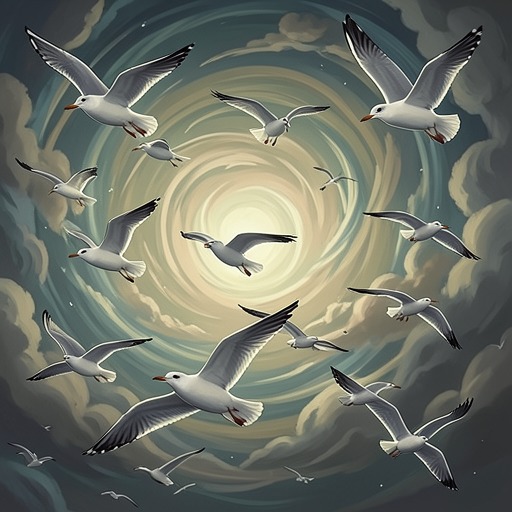
At the fishing grounds, Seagulls gather in a Breakfast Flock when a boat scatters food across the water. A thousand birds crowd together to dodge and fight for the scraps, and the day begins as a familiar competition. The scene establishes a society organized around feeding: for most gulls, flight is chiefly the practical route between shore and food, not an end in itself.
That priority is reinforced by a strong expectation about how a gull should fly. Seagulls are said never to falter or stall; losing lift in the air is treated as disgrace and dishonor. The rule turns a physical difficulty into a social judgment, making the very failures through which a flyer might learn into signs of shame. Jonathan Livingston Seagull’s repeated stalls therefore distinguish him not merely as an unconventional flyer but as a bird testing the flock’s definition of acceptable conduct.
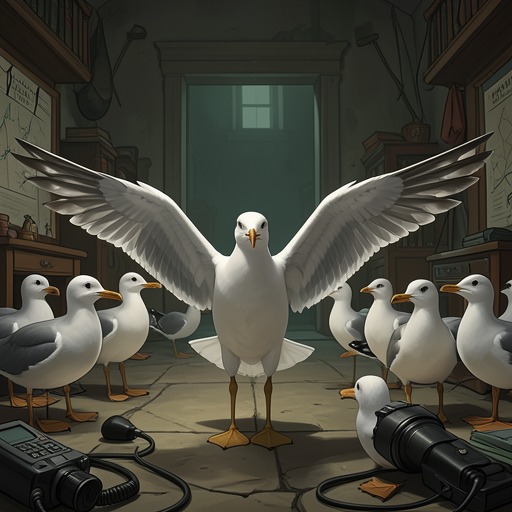
The flock’s collective power is expressed through formal gatherings as well as through feeding. When Jonathan returns to the beach after his breakthrough, the gulls are already assembled at the Council Gathering and waiting. The Elder’s call for him to stand at the center can signify either great honor or great shame; the assembly instead summons him for shame. The same communal stage that marks leaders can mark an individual for exclusion, showing how recognition and punishment share the flock’s public rituals.
Two Measures of Flight
Jonathan’s practice runs against the ordinary measure of usefulness. While other gulls seek food, he spends his time flying alone and experimenting, driven by the importance of flight itself. His difference makes his parents dismayed and leaves him at odds with the assumptions of the birds around him. The contrast is not between flight and no flight, but between flight as transportation and flight as a valued activity that can be pursued toward greater skill.
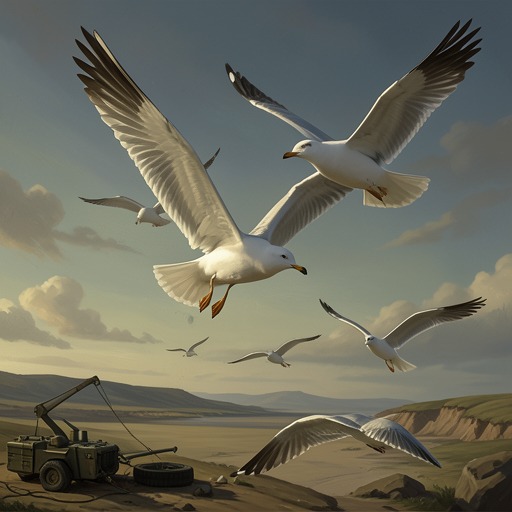
The new world he reaches offers a revealing counterexample to the food-centered flock. There, the gulls share Jonathan’s conviction that the most important thing in living is to reach toward perfection in what they love doing. They practice for hours and test advanced aeronautics. Flight remains something learned through effort, but its purpose has changed: it is no longer merely a way to reach food. Jonathan initially forgets the old world, whose gulls keep their eyes shut to the joy of flight and use their wings to find and fight over food, though he remembers it intermittently.
The difference is not presented as a difference in species, but in what a community permits flight to mean. One group makes eating its dominant concern and treats stalling as dishonor; another treats sustained practice as a shared aspiration. Jonathan’s own path between these worlds gives the flock’s conventions a wider context: they are powerful, but they are not the only possible way for Seagulls to live together.
Teaching, Freedom, and the Flock
Jonathan’s teachers connect skill in flight to a larger account of perfection. Chiang tells him that heaven is not a place or a time but being perfect, and that perfect speed is not a higher numerical velocity: any number would set a limit, whereas perfection has none. Learning to fly is thus both technical practice and a way of changing what the gull understands as possible. Chiang later urges Jonathan to keep learning and striving to understand the perfect invisible principle of life, and his final words to Jonathan are to keep working on love.
That instruction redirects Jonathan’s attention toward the birds he left behind. The more he practices kindness and seeks to understand love, the more he wants to return to Earth. He imagines that some gull there may be struggling to break out of limits, or may have been made an outcast for speaking truth before the flock. For Jonathan, teaching becomes the way to offer another bird the chance he sought: not simply a technique for moving through the air, but the opportunity to see flight differently.
When Jonathan explains his teaching to the gathered birds, he speaks of flight as a gull’s right and freedom as fundamental to its being. Whatever opposes that freedom, he says, should be set aside, whether ritual, superstition, or limitation. A voice from the multitude immediately asks whether that principle includes the Law of the Flock. The question exposes the conflict between an inherited communal rule and the freedom Jonathan is asking individual gulls to claim; the crowd is listening, but the challenge shows that listening does not itself dissolve the rule.
Change and Significance
Seagulls in the home flock are not only a mass enforcing tradition. By sunrise, nearly a thousand birds stand outside the circle of Jonathan’s students, curious about Kirk Maynard’s flight and listening to Jonathan. Their presence marks a change in the scene: the flock that once assembled to condemn Jonathan now gathers around an example of flight that appears to make freedom possible. The evidence does not show every listener abandoning the flock’s rules, but it does show an audience emerging where there had been only communal judgment.
The crowd’s response can also turn sharply. After Fletcher Lynd Seagull crashes and is restored to life, some birds call Jonathan the Son of the Great Gull, while others call him a devil who has come to break the flock. Four thousand frightened gulls close in, their eyes glazed and beaks sharp, with the cry of “DEVIL!” passing through them. The scene makes communal feeling dangerous: wonder and fear compete in the same multitude, and the flock’s reaction threatens to destroy the birds it had just witnessed.
Taken together, these gatherings give Seagulls a role larger than that of background scenery or a single undifferentiated crowd. Their food-seeking routines and prohibitions make the cost of Jonathan’s experiments legible; their alternative community of practitioners shows what a shared devotion to flight can look like; and their later audiences register the reach, uncertainty, and danger of his teaching. The story’s question is therefore not simply whether a gull can fly beyond an inherited limit, but whether a flock can make room for members who discover a different purpose in flying.