
Providence and the Problem of Evil
JustineThis flow follows Justine’s changing questions about divine justice as suffering accumulates and the novel’s framing voice interprets her fate.
increasing Bearing strength in each event
 decreasing
Bearing strength in each eventdecreasingFaith as Consolation
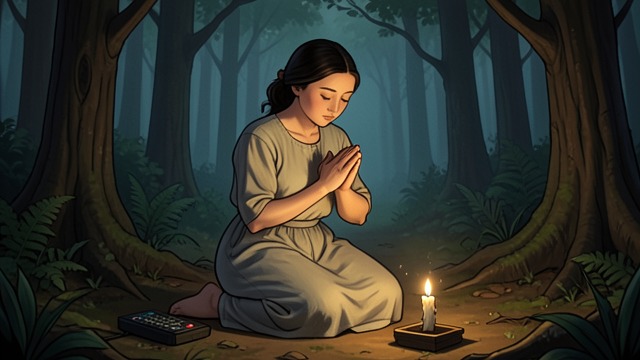
Faith as Consolation
Prayer after betrayal
After Saint-Florent abandons her injured and robbed, Justine turns to prayer in the forest. Her faith gives her a means to endure when human protection has failed.
A difficult gratitude
She interprets survival as evidence of divine care while acknowledging that her choices have led to repeated suffering. The tension between consolation and bewilderment accompanies her through later crises.
Why Virtue Suffers

Why Virtue Suffers
A question sharpened
After du Harpin’s false accusation, Justine sees that refusing crime has brought her closer to execution than compliance might have. Her experience makes divine justice difficult to reconcile with earthly outcomes.
Hope retained
She nonetheless treats future justice as her only consolation. Faith does not prevent her doubts; it gives her a framework in which the apparent triumph of injustice may not be final.
The Monastery’s Challenge

The Monastery’s Challenge
Religious refuge corrupted
Justine seeks a sacred place and instead encounters men who use religious standing to protect cruelty. The reversal makes institutional religion part of the problem she must interpret.
A private faith persists
The monks’ sacrilege and ridicule do not persuade Justine to abandon her beliefs. Her faith becomes a personal commitment separated from the behavior of those who claim to represent it.
Freedom as a Possible Sign

Freedom as a Possible Sign
Gratitude renewed
Justine gives thanks for reaching open country and compares her survival with the captivity of women she left behind. A pause in hardship briefly appears to her as a sign of divine care.
The interpretation undone
She is almost immediately abducted again. The sharp reversal forces her to ask whether Providence has answered her prayers or merely permitted another persecution.
Final Reliance Beyond Life

Final Reliance Beyond Life
A record of unanswered questions
Justine reviews the punishments that followed her most generous acts and the prosperity of those who harmed her. Her reflections state the problem of evil in the concrete terms of her life.
Hope after earthly justice
She turns toward the possibility of divine justice beyond death, not because events have confirmed it but because she has no reliable earthly court left. The novel leaves that faith as both a consolation and an unresolved wager.
After the attack in the Forest of Bondy
During the first imprisonment
During Justine’s confinement at Saint Mary-in-the-Wood
After escaping the monastery
During the journey to Paris
