Never urge unwilling daughters
KalevalaNever urge unwilling daughters is a warning spoken by Aino’s grieving mother, who condemns the act of driving a daughter from her father’s home to a bridegroom she does not love. Its force comes from the speaker’s position: this is not detached advice but a lesson formed from her own acknowledged failure, delivered through tears and addressed to other mothers.
The warning and its audience
The mother begins by calling for attention: “Listen, all ye mothers, listen,” she says, before asking them to “Learn from me a tale of wisdom.” The repeated appeal to listen makes the line an act of transmission. Her experience is offered not as a private sorrow alone, but as knowledge that other parents should receive before they make the same choice. The lesson’s direct audience matters: the speaker addresses mothers, the people whose authority over daughters’ marriages gives the warning its immediate practical target.
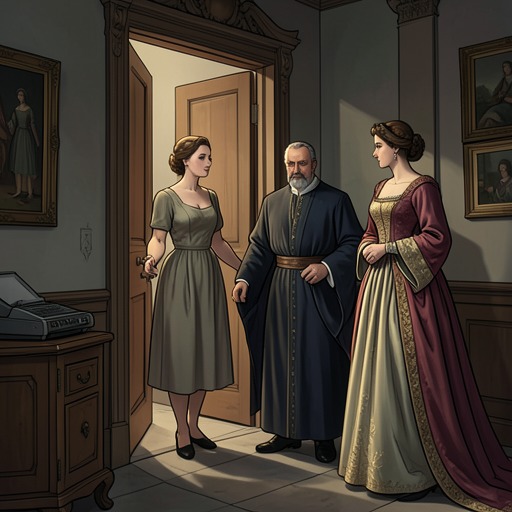
The counsel itself is expressed as a prohibition. “Never urge unwilling daughters” is followed by the circumstances that define the wrong: daughters are urged “From the dwellings of their fathers,” and sent “To the bridegrooms that they love not.” The paired movement away from the father’s household and toward an unwanted bridegroom gives the warning a concrete shape. The issue is not marriage in the abstract; it is the coercive removal of a daughter who does not desire the match. By making unwillingness the decisive condition, the expression places the daughter’s preference at the center of the mother’s retrospective rule.
A lesson grounded in remorse
The speaker immediately measures the rule against her own conduct. She identifies herself as “inhuman mother” and confesses, “Drove away my lovely Aino.” The movement from general command to first-person admission prevents the advice from sounding like a maxim offered at no cost. The person who warns others is the person who violated the warning. Her moral authority arises from self-accusation rather than from a claim to have acted wisely all along.
The expression “my lovely Aino” also makes the loss personal within the public lesson. The mother does not refer to an anonymous daughter or an abstract wrong: she names the child she drove away and remembers her affectionately. “Fairest daughter of the Northland” enlarges that remembrance into praise, giving the confession a tenderness that stands against the harsh description “inhuman mother.” The contrast is severe: the daughter is remembered in language of beauty and attachment, while the mother assigns the cruelty to herself. The passage does not soften her admission by distributing blame elsewhere.
Grief as the form of the counsel
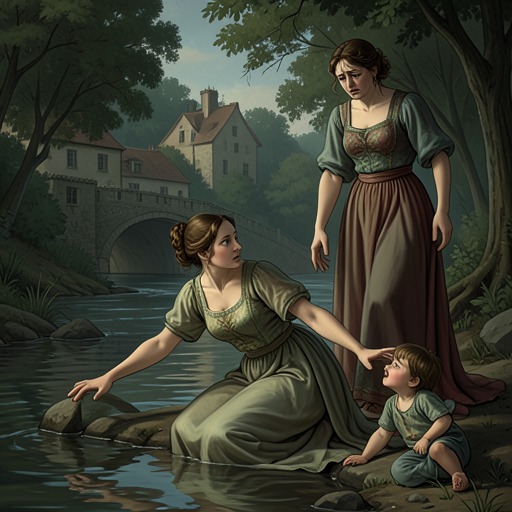
The warning is framed by visible and audible grief. The ancient mother “Sadly weeps”; tears fall from her “blue-eyes”; and her answer comes in “sad and wailing measures.” She is “Broken-hearted” as she speaks. These details establish that the injunction does not arrive as calm instruction. Its rhythm and authority belong to lament: sorrow is the circumstance in which the lesson can be spoken, and the mother’s remembered action is what gives that sorrow its cause within the passage.
The stanza also returns to weeping after the warning and confession. The mother is described again as the “gray-haired mother,” and the tears that fall are again called bitter. This return gives the counsel no easy release. Speaking the lesson does not erase what she remembers; the warning remains enclosed by the grief that produced it. The change from “ancient” to “gray-haired” keeps attention on the same bereaved speaker while making age and sorrow part of the scene’s sustained image. The expression therefore survives as a public rule, but its emotional source remains unmistakably particular.
Meaning and narrative work
The expression converts one mother’s regret into an ethical injunction about parental authority and a daughter’s consent. Its logic is sharply bounded by the lines themselves: an unwilling daughter should not be pressed away from her father’s home toward a bridegroom she does not love. The mother’s self-description and named confession make the warning more than a general preference for kindness; they present the act of forcing the match as a wrong for which she accepts responsibility.
At the same time, the passage keeps the cost of its wisdom in view. The command is memorable because it is spoken after the mother has driven Aino away, not before; the structure places action and understanding on opposite sides of an irreversible recollection. Her appeal to all mothers tries to make later choices answer to the lesson her own experience has taught her. The expression thus joins admonition to lament: it states what should never be done, while the surrounding tears show why the speaker cannot offer that rule without grief.