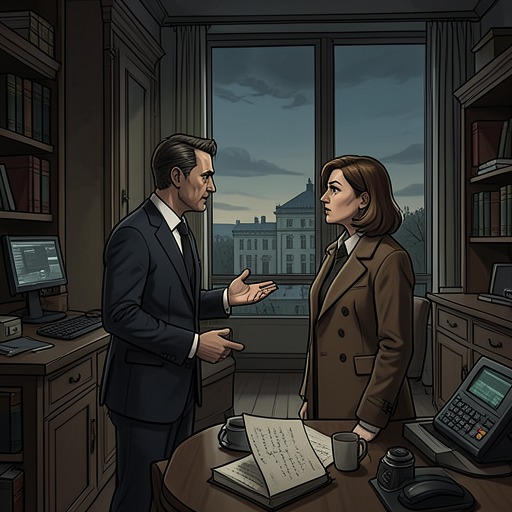
Helen–Vance relationship
Klara and the SunThe Helen–Vance relationship is a former five-year partnership whose reunion exposes both the injuries that ended it and the affection that has survived decades of silence. Their encounter occurs when Helen asks Vance to help her son Rick; the request opens a way toward assistance for Rick, but also forces Helen and Vance to confront their history in front of him. The meeting ends without a clear reconciliation, leaving care, resentment, apology, and hope unresolved.
A Shared Past and a Long Silence
Vance describes the rupture in terms of its duration: twenty-seven years in which Helen refused to communicate with him. He says that, at the beginning, he pleaded persistently and may have sounded emotional, but insists he did not threaten or harass her. Helen accepts that description, distinguishing his persistence from unpleasantness. The exchange establishes a long separation without depicting it as a simple story of one person pursuing and the other responding: Helen acknowledges that she behaved badly toward him, while Vance makes clear that the damage was intensified by what they had once shared.
That shared life had lasted five years. Vance invokes it to reject Helen’s attempt to place him among the many people she says she treated badly. In his account, he was not merely one injured person among many: he had been her partner, and the years of silence followed a particularly intimate history. The contrast between five years together and twenty-seven years without communication gives their reunion its weight, while the scene withholds a complete account of what first caused the break.
Rick’s Request Becomes Their Reckoning
The immediate reason for the meeting is Rick’s future. Helen tells Vance that she is asking him to exercise favoritism, but he points out that the request changes when she makes herself its personal center. He had been responding to Rick’s drawings and to Rick’s promise as a young man who might succeed at Atlas Brookings; Helen’s intervention turns the question into whether Vance will do her a favor after all these years. Vance does not deny that he wants to help Rick. He says the difficulty is Helen asking.
Vance insists that Rick should hear the whole exchange rather than be shielded from its personal stakes. Helen objects to discussing their past in front of her son, and Rick tries to stop the conversation when it becomes painful for her. Yet Vance gives Rick’s presence a different meaning: Rick is the person who stands to win or lose from the decision, and concealing the history would conceal what is shaping it. The appeal for a practical favor thus becomes a public confrontation in which the son is both the beneficiary of the request and a witness to his mother’s unresolved past.
Apology, Specific Injuries, and Fragility
Helen first describes her wrongdoing broadly, saying that her awfulness was distributed among everyone and that she would like to apologize to each person in turn. Vance resists being absorbed into that general confession. Because they shared a life, he wants her to name what she did to him. The difference is central to their exchange: Helen presents remorse as a wish to make amends to a whole succession of people, while Vance asks her to recognize the particular history between them.
He names one incident at Miles Martin’s house, where Helen told the others that Vance had not yet read the Jenkins Report and earned a laugh at his expense. Helen admits that she was out of control and vindictive, and apologizes. Vance then raises a voicemail she left him in a hotel in Portland, Oregon. Helen calls the message despicable and says she still hears it in her mind, repeatedly imagining how she might edit it into something less awful. Because she never heard the message played back, she says, she sometimes feels that it might still be possible to amend it; she also recalls that she did not know how to erase a message after leaving it. Her recollection makes the injury more than a past offense: it has persisted as a recurring act of self-reproach.
The apologies turn increasingly into pleading. Helen offers to keep punishing herself until she has made things up to Vance and even suggests meeting again in two years so he can check whether she has kept her promise. Vance stops her, saying that if Rick were not present he would tell her what he thought of that. The moment exposes the strain between remorse and repair: Helen offers continuing self-punishment, but the scene does not show that this can restore trust or settle what happened between them.
The appeal also reveals Helen’s sense of her changed condition. When Vance says she has become fragile, she agrees that she is now so fragile she might break in a puff of wind. She says she lost her beauty not to age but to this fragility, and asks whether he can forgive her at least in part. She insists she has little to offer beyond pleading for him to help Rick. Vance’s language of fragility therefore meets Helen’s own admission of vulnerability, but neither recognition nor apology resolves the original estrangement.
Departure and an Uncertain Opening
Rick eventually says that he does not want Vance’s assistance and asks to leave, concerned that the confrontation is doing his mother no good. Helen urges Vance not to go and appeals to their remembered familiarity by reminding him that he used to love doughnuts. He nevertheless agrees with Rick that continuing is not good for her. Before leaving, he tells Rick that he likes the drawings and likes him, advises him to take care of himself, and says goodbye to Helen. His departure ends the meeting without a promise to help Rick and without an explicit declaration of forgiveness.
After Vance walks out, Rick and Helen remain seated together, looking down at the tabletop. Klara then tells Helen that, from what she observed, she believes Vance will decide to help Rick because he is still very fond of Helen. The hope is Klara’s interpretation, not a confirmed outcome: Vance’s expressed regard for Rick and the lingering affection Klara perceives coexist with his decision to leave. The relationship’s ending in this encounter is consequently suspended between a practical possibility and an emotional reconciliation that has not yet occurred.