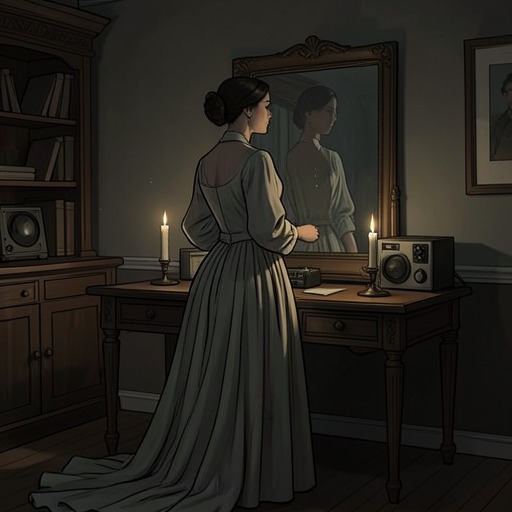
«Una goccia del sangue paterno»
Leila“Una goccia del sangue paterno” names a small but consequential act of self-recognition in Lelia: she allows that some part of her may resemble her father, Girolamo da Camin, without conceding that his character defines her. The thought occurs first as she keeps a secret plan to herself, then returns in sharper, more ironic form when her father asks about the money she has been given. Across the two moments, the phrase moves from an acknowledgment of kinship to a limit placed on what kinship can mean.
First Recognition
The first occurrence follows Lelia’s encounter with a plan devised for her by Don Emanuele. He imagines steering her toward religion and a contemplative order, believing that religious life might offer her health and peace after her attempted suicide. Lelia does not disclose the design already forming in her mind. Instead, she thinks, “Forse, una goccia del sangue di mio padre ce l'ho bene” (“Perhaps I do have a drop of my father’s blood”). The thought is brief, but its placement matters: it comes as she holds her intention in secret, with her heart racing and her body trembling. In this first use, paternal blood suggests a capacity for resolve or self-direction that she recognizes in herself, though she does not explain the resemblance further.
The phrase also sits against Lelia’s earlier effort to define herself against her family inheritance. She has treated her parents’ dishonor and what she calls tainted blood as reasons to demand an exceptional purity from herself, and she has sworn never to love again. Her fear that passion might take root in her seems to confirm her suspicion that instinct is inherited. The first “drop” therefore complicates, rather than simply overturns, her self-denial: she can imagine a paternal trait in herself even while trying to escape the identity she associates with her birth.
Inheritance and Estrangement
The expression gains a material context when the agent’s letter reports that Lelia is the universal heir to the late Marcello Trento’s estate. The same letter conveys a telegram from Girolamo da Camin, who identifies himself as her father, sends condolences, and announces his arrival. It also records a discrepancy: Lelia says she is twenty years and a few months old, whereas Marcello had believed her older; the telegram, meanwhile, calls her a minor. The inheritance makes the question of family connection more than a matter of feeling, but the evidence does not make Lelia’s inheritance equivalent to dependence on her father.
Girolamo approaches Donna Fedele with a carefully restrained performance of humility. His private calculations, however, are financial: with only a few months of control remaining, he means to extract as much as possible from the movable assets, appear contrite so Lelia may grant him generous support when she comes of age, and persuade his associate Francesco Molesin to accept a favorable settlement with creditors. He believes that bringing Lelia home could let him dominate her and, through her, the Trento estate; at the same time, he does not intend the complete seizure Molesin hopes for. His relationship with Carolina Gorlago further constrains him: he cannot imagine keeping both women under his roof, and he is unwilling to dismiss Gorlago. This portrait sharpens the contrast implicit in Lelia’s later wording. She shares descent from this calculating father, but the phrase does not make his purposes hers.
The Money at the Door
When Girolamo visits Lelia at the Rose Villa, she receives him standing, rigid and grave. He kisses her cheeks; she endures the embrace without returning its warmth. He praises her proposed journey to Turin, then gives her a packet of ten-lira notes, calling them her money and promising to account for it in a few months. His question about whether he will have to account for it makes his financial position within the relationship unmistakable: the money is hers, but he still speaks as the person managing it.
Later, he puts his head partway through her bedroom door to ask whether she needs money and whether she still has the five hundred lire. Lelia is about to say that she has spent or lost some and to ask for more. A shudder of repugnance stops her. She answers that she needs nothing, and the narrative gives the phrase its fullest, most pointed form: “Una goccia del sangue paterno l'aveva nelle vene; due, no.” The first drop admits kinship; the second marks a refusal. Her father presses to keep some of the money in his custody, but, seeing her expression, withdraws. The exchange turns the image of blood into an economical measure of resemblance: one trace may be present, but it does not amount to surrendering her judgment or her money to him.
Repetition and Meaning
The two uses of the expression belong to different pressures. In the first, Lelia silently recognizes a possible inheritance of determination while concealing a plan from those who would direct her toward a religious vocation. In the second, her father’s questions make money the immediate test, and she uses the image to separate descent from conduct. Its repetition is not a simple claim that she has become like Girolamo. Rather, it gives her a compact way to acknowledge an unwelcome connection while limiting its force.
The distinction also sits within a wider movement in Lelia’s emotional life. She has tried to make her future a punishment for her own desires, treating fidelity to Andrea’s memory and distrust of her parentage as reasons never to love again. Yet her secret plan is bound to her feelings for Massimo Alberti, whose letter confesses that his religious crisis has not made him want death: he would rather live, love, and do good, but says that his renewed passion for Lelia is consuming him. Later, in Valsolda, Lelia reproaches herself for the suffering Donna Fedele has endured in coming to her, and recognizes the maternal protection that has made even a chair through the night feel more restful than a bed without it. These later scenes do not repeat the blood phrase, but they place its guarded self-definition beside choices shaped by love, care, and responsibility. The phrase’s significance lies in that tension: inheritance may name a trace, but it does not settle what Lelia will do with it.