Yeltsin's second term
LimonovYeltsin’s second term, spanning 1996 to 2000, is the book’s account of a democracy whose economic and political openings were rapidly occupied by private wealth. The period’s defining pattern is the conversion of economic advantage into political power: oligarchs helped secure Boris Yeltsin’s reelection, then backed an heir they believed they could control. Against that ascent, Eduard Limonov tried to give disaffected young people an organized opposition, while the narrator traces how the country’s new freedoms could narrow again under the next leader.
Dates and the inherited economic settlement
The term begins amid the aftershocks of reforms launched earlier in the 1990s. Yeltsin had turned to Yegor Gaidar, a former member of the Communist nomenklatura who believed fervently in liberal markets. Their rapid program, called shock therapy, liberalized prices and helped produce inflation of 2,600 percent. A voucher scheme was meant to give citizens a share in national wealth and draw them into private enterprise: on September 1, 1992, vouchers worth ten thousand rubles were mailed to every Russian citizen over one year old. But by the time the vouchers arrived, inflation had drained their value. Some recipients could exchange one for a bottle of vodka; others sold theirs to buyers offering only slightly more.
The account treats this failure not as a passing technical mistake but as part of the conditions that shaped the second term. People were told to become investors after decades in which, in theory, they worked for the collective; yet they received assets already devalued and faced a business environment with no established rules, laws, banking system, or taxation. The opportunities created by privatization therefore accrued disproportionately to those equipped to seize them. The economic transition did not simply establish a market: it concentrated the means to influence what the state would do next.
Wealth, crisis, and oligarchic power
Among the buyers who profited from the collapse in voucher value were Boris Berezovsky, Vladimir Gusinsky, and Mikhail Khodorkovsky. The narrator uses these three as representatives of the oligarchs, describing a new class that became extraordinarily wealthy within months. Their fortunes were tied to raw materials rather than technological production, generated little public wealth, and moved through opaque offshore networks in places such as Liechtenstein and the Cayman Islands. Khodorkovsky, for example, paid $168 million for Yukos, an oil company bringing in three billion dollars a year.
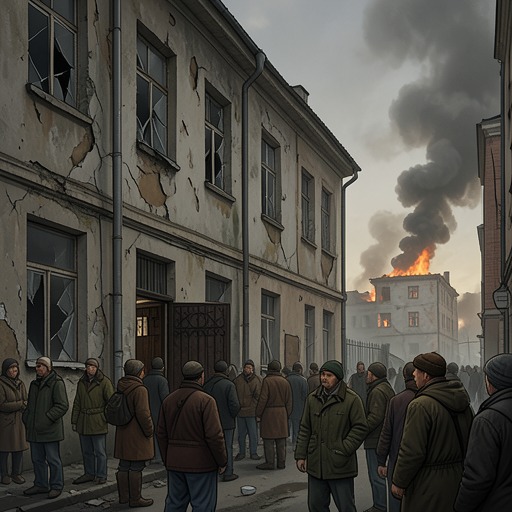
The lavishness of the new elite stands against the precariousness of everyone excluded from it. Foreign visitors remembered the second Yeltsin term as a wild, exhilarating period in Moscow, with extravagant nightlife and spending; the narrator emphasizes that this experience belonged to those able to pay. When the 1998 crash erased modest savings for the second time in a decade, those with little money did not appear in the streets. They sat in shabby cafés watching images of a separate world: gold cards paying for sushi priced beyond a teacher’s yearly income, and young men travelling by private jet with bodyguards to Courchevel. The contrast makes the period’s spectacle inseparable from its silence: the poor are present in the scene, but largely as stunned spectators of wealth.
Economic advantage also became direct political leverage. As Yeltsin’s term approached its end, the oligarchs feared that Communist candidate Gennady Zyuganov might challenge the arrangement that promised them control of valuable state assets. Under the loans-for-shares scheme, banks lent money to an empty state treasury and took shares in major natural-resource industries as collateral; if the state failed to repay within a year, the lenders could take the companies. The deadline came after the presidential election, making Yeltsin’s continued rule essential to the scheme’s beneficiaries.
Berezovsky responded to the perceived electoral danger by calling six other powerful oligarchs and proposing that they set aside their rivalries. Their media influence was extensive: newspapers, radio stations, and television channels promoted Yeltsin as the alternative to chaos and broadcast accounts of Soviet terror to discourage a return to Communist rule. This coordinated campaign joined economic interests to political messaging. The oligarchs did not merely accumulate private fortunes; they used media power to shape the contest that would protect the conditions under which those fortunes could grow.
Limonov’s opposition and its constituency
The period also changes the narrator’s understanding of Limonov’s political position. Reading a collection of Anna Politkovskaya’s articles, the narrator learns that she had defended forty National Bolshevik Party militants sentenced after occupying and vandalizing the presidential administration’s offices. She described them as courageous people of integrity and a rare source of hope for the country’s moral future. The narrator had regarded Limonov as a fascist leading skinheads, so Politkovskaya’s defense, alongside Yelena Bonner’s favorable view of the party’s members, unsettles that fixed judgment. Several months later, the formation of The Other Russia under Garry Kasparov, Mikhail Kasyanov, and Limonov makes the change in Limonov’s public position harder to ignore. The coalition joins figures whose reputations and political histories would ordinarily seem incompatible.
Limonov’s own party offered a more durable base than the narrator had expected. Several hundred delegates travelled to its convention from across Russia, although the party counted about seven thousand members in all. Some early arrivals slept in a bunker; others were accommodated in a workers’ hostel. Finding a venue was difficult: places that initially agreed to host the gathering withdrew the next day, apparently after police warnings. Even so, the convention opened. Limonov, standing at the podium, saw the gathering as the result of three years spent carrying copies of the party paper to railway stations for distribution beyond the major cities.
The delegates were not the idealized heroic figures Alexander Dugin had imagined. The narrator depicts many as awkward, poor provincial adolescents, embarrassed by their money and wary of ridicule. In Limonov’s account of their appeal, the party had given people who might otherwise have drifted toward alcoholism or delinquency a style, purpose, and ideal. The convention’s importance lies in that exchange: a political organization turns marginality into a shared identity and offers its members a cause larger than private frustration.
Limonov nevertheless argued that the party should not try to seize power immediately. He believed the political moment was not ripe and rejected alliances with Orthodox anti-Semites or Stalin’s descendants. Instead, he directed attention beyond Russia’s borders, toward Russians in former Soviet republics whom he portrayed as abandoned and marginalized after the Soviet Union’s collapse. He identified the Baltic states and Central Asia as targets for organizing, pointed to the party’s established presence in the Baltic region and its roughly hundred members in Riga, and announced a canvassing tour of Central Asia. A hundred hands went up when he asked for volunteers, an enthusiastic response that gave the convention the character of an opening toward a new frontier.
The succession and the limits of opposition
As Yeltsin’s second term neared its end, Berezovsky proposed Vladimir Putin as a successor who would remain cooperative with the oligarchs. Putin was a former intelligence officer in East Germany who had later worked at the Federal Security Service, where he had quietly served as its head for the previous year. Berezovsky presented his loyalty to superiors as the decisive qualification and assured the other oligarchs that they would be able to guide him. He travelled by private jet to Biarritz, where Putin was vacationing with his family at a midpriced hotel, and offered him the role. Putin initially demurred; Berezovsky pressed the offer.
The narrator’s account then moves forward to expose the reversal built into that calculation. Three years after the Biarritz meeting, Berezovsky and Gusinsky would be forced into exile, while Khodorkovsky would be arrested and sent to Siberia after what the narrator calls a rigged trial. The man selected as a compliant successor becomes, in retrospect, the instrument by which the oligarchs are removed or disciplined. This later outcome casts the succession not as a smooth continuation of their influence, but as a misjudgment with consequences for the very men who arranged it.
The closing movement also brings Limonov’s party into direct conflict with state power. A law banning extremism and fascism left the authorities room to decide what those labels meant, and officials told the National Bolshevik Party that the decree applied to it. Limonov met the minister in a suit and tie to argue that the party was not extremist and to point out that it had seven thousand adherents, unlike many officially registered parties that existed only on paper. The party was nevertheless denied authorization and lost the right to exist legally. Limonov warned that forcing a real organization underground could push young people toward extremism and terrorism; his warning also reveals the perilous boundary between opposition rhetoric and a state’s justification for suppression.
By the later account of Limonov’s political life, The Other Russia has disappeared after failing in the presidential elections, and Garry Kasparov has become a rival rather than an ally. Limonov persists through Strategy 31, organizing demonstrations on Triumfalnaya Square on the thirty-first day of months that have one. The typical gathering attracts around a hundred demonstrators and five times as many police officers; several dozen protesters are arrested, and Limonov regularly spends a few days in prison. These later details mark the afterlife of the second-term political landscape: an opposition that once assembled delegates and imagined action across former Soviet republics is reduced to repeated, tightly policed claims to the constitutional right to demonstrate. The period’s central reversal is therefore not only the rise of oligarchic influence, but the narrowing of the space in which organized dissent can operate.