Event 1
Assassination of Anna Politkovskaya
[Anna Politkovskaya](entity:character-recall-character-anna-politkovskaya-25444347edd7)’s assassination on October 7, 2006, is presented as more than the killing of a journalist: it becomes a test of how Russians and Western observers interpret power, impunity, and political dissent. Shot dead in the elevator of her apartment building, she was transformed in the West into an icon of freedom of expression, while the circumstances and meaning of her death remained fiercely disputed. [Emmanuel Carrère](entity:character-recall-character-emmanuel-carr-re-4e52f3cdc3e1) recounts the event through conversations and later discoveries that complicate any simple division between liberal heroes and political outcasts.
## The killing and its immediate aftermath
Carrère was traveling frequently to [Russia](entity:location-recall-location-e36341713c23) when news broke that Politkovskaya had been killed. A magazine asked him to fly to [Moscow](entity:location-recall-location-19aceb5ce281), not to investigate the murder but to speak with people who had known and loved her. He spent a week in the offices of [Novaya Gazeta](entity:organization-recall-organization-e0b72c39e6d3), where she had been a star reporter, and among human-rights associations and committees of mothers whose sons had been killed or wounded in [Chechnya](entity:location-recall-location-63a9bb7e3d65). These were small, poorly lit offices with old computers; the activists were few, and the circle was so close-knit that its members all seemed to know one another. Carrère describes them as constituting practically the entire democratic opposition in Russia.
The contrast between Politkovskaya’s posthumous reputation and her visibility before her death is stark. Carrère writes that, apart from people closely following the Chechen wars, few knew her name before she was killed. Afterward, her determined face became an emblem in the West of freedom of expression. That transformation gave the assassination a public meaning beyond the loss of one reporter, even as Russian acquaintances of Carrère questioned whether her work had mattered to most people in Russia.
## Competing accounts of responsibility
Among Carrère’s Moscow acquaintances were French expatriates, journalists, and businessmen who regarded the belief that the FSB, or Putin himself, had ordered the killing as absurd. Pavel, a Franco-Russian academic turned businessman, focused on the coincidence that Politkovskaya was killed on Putin’s birthday. He mocked the idea that state security officials would arrange such an obvious birthday gift for the president, arguing that the scenario belonged in a gangster film rather than real life.
Pavel’s skepticism did not resolve the question of responsibility; instead, it exposed the distance between competing interpretations. He repeated Putin’s reported view that the assassination and the resulting scandal had hurt the Kremlin more than Politkovskaya’s articles had, since they appeared in a newspaper that few people read. Carrère listened to such defenses of the authorities in wealthy Moscow apartments, where the argument was that conditions could be worse and that Russians were content so long as they could get rich. He set this complacency against accounts from exhausted women describing nighttime kidnappings, soldiers tortured by their own superiors, and justice denied. The book records the dispute without establishing who ordered the killing.
## Her work and the unexpected political alliance
Politkovskaya’s own writing and advocacy resist the assumption that her role can be reduced to a predictable alignment with liberal opposition figures. Two years before her death, she had covered the trial of forty [National Bolshevik Party](entity:organization-recall-organization-d9e15bd528ae) militants accused of occupying and vandalizing the presidential administration’s offices while shouting for Putin to go. They received lengthy prison sentences. Politkovskaya publicly defended them, describing them as courageous young people of integrity and among the few who could offer hope for the country’s moral future.
Carrère found this defense difficult to reconcile with his prior image of [Eduard Limonov](entity:character-recall-character-eduard-limonov-fbb1fb9b4f1c) as a fascist leader of a skinhead militia. He was equally struck to find [Yelena Bonner](entity:character-recall-character-yelena-bonner-3182875ffebc), the widow of [Andrei Sakharov](entity:character-recall-character-andrei-sakharov-c04d8a2087d6), supporting the National Bolsheviks despite reservations about their party’s name. Politkovskaya’s stance therefore connected her defense of political prisoners to a broader question: whether opposition to the authorities could be recognized even when it came from groups that many observers considered repellent. After her death, her support for the jailed militants contributed to Carrère’s reconsideration of Limonov’s position in Russian politics.
## Political significance and the limits of certainty
The assassination’s significance deepens in the account as Carrère follows the changing status of Limonov and the opposition. Months after discovering Politkovskaya’s defense of the militants, he learned that Limonov was joining [The Other Russia](entity:organization-recall-organization-e5deb52beabd), a coalition that also included [Garry Kasparov](entity:character-recall-character-garry-kasparov-4744d0dee2bf) and former prime minister Mikhail Kasyanov. The combination unsettled Carrère’s expectations and helped lead him to choose Limonov as the subject of a magazine’s first issue. Politkovskaya’s writing thus becomes an unexpected guide to a political realignment: her judgment of imprisoned activists made visible an opposition landscape that Carrère had previously treated as morally straightforward.
Later, Limonov told Carrère that he had been placed on a list of enemies of Russia, alongside Politkovskaya, Alexander Litvinenko, and [Mikhail Khodorkovsky](entity:character-recall-character-61f5b419de2c). He presented the list as one of people to be killed or otherwise targeted and treated himself as a likely next victim. This is Limonov’s claim within the narrative, not an independently established account of Politkovskaya’s murder. Its recurrence nevertheless links her killing to the atmosphere of danger surrounding critics of the Kremlin. The event remains unresolved in Carrère’s telling: its public symbolism is undeniable, but the competing claims about state responsibility are left in tension rather than settled by the narrative.
Event 2
Moscow Theater Hostage Crisis
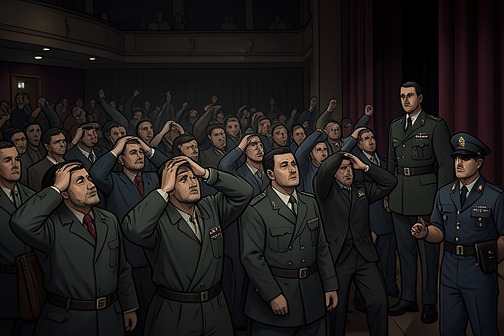
The [Moscow Theater Hostage Crisis](entity:event-recall-event-208f2d8f7a80) began on the evening of October 23, 2002, when Chechen terrorists took the audience of the musical Nord-Ost hostage. Fifty-seven hours later, Russian special forces used gas against the hostage-takers and their captives. The official death toll remained disputed, while the families’ yearly candlelit commemorations became closely watched gatherings. The crisis also exposed a contrast that would preoccupy [Eduard Limonov](entity:character-recall-character-eduard-limonov-fbb1fb9b4f1c): ordinary offenders punished for their crimes, and state agents whose lethal decisions could be defended as firmness.
## Seizure and assault
The hostage-taking unfolded before a worldwide television audience. For three days, the crisis dominated broadcasts as the terrorists held the theater’s entire audience. Negotiation was foreclosed; the authorities chose to resolve the standoff by releasing gas inside the building. At dawn on October 26, after fifty-seven hours, the attack killed hostages as well as hostage-takers. The account describes about eight hundred people in the theater when the gas was used, and stresses that the special forces’ action did not distinguish between those who had taken hostages and those trapped there.
The number of civilian casualties remained in question. Official estimates put the total at around 150, but the uncertainty itself became part of the aftermath: the families could not simply accept a public account and mourn in private. When relatives asked whether events might have been handled differently, they were treated as though their questions made them accomplices. Their grief was therefore entangled with a demand for answers and for respect, a demand the authorities did not welcome.
## Limonov watches from prison
On the night of October 23, Limonov was in prison, where his cellmates were watching crime films that cast police as heroes and criminals as monsters. He objected to the films’ portrayal, but the others preferred them to the news. When a broadcast interrupted the program to report that the theater audience and actors had been taken hostage, he insisted on following the coverage. For the next fifty-seven hours, he watched report after report, through to the gas attack at dawn on October 26.
The crisis held his attention partly because he himself faced a terrorism charge and an approaching trial. A wave of public paranoia, he understood, could further damage his case. But his response was also a judgment about the scale and character of violence. The crimes committed by his cellmates, he thought, paled beside the mass of people killed by the state’s operation. He returned thereafter to the contrast between crimes committed in a moment of passion or drunkenness, for which perpetrators might pay for the rest of their lives, and crimes of the state, whose perpetrators could be decorated.
Limonov’s day-by-day notes, made from what he saw on television, led him to conclusions that the book compares with those of [Anna Politkovskaya](entity:character-recall-character-anna-politkovskaya-25444347edd7), who followed events at much closer hand. Like her, he feared a bloodbath from the outset. After it happened, he suspected that officials were lying about the number of victims and that nothing had been done to save them. When [Vladimir Putin](entity:character-recall-character-vladimir-putin-600db9625a7e) declared that [Russia](entity:location-recall-location-e36341713c23) would not be intimidated regardless of the losses, Limonov recalled persistent rumors that the [1999 attacks](entity:time-recall-time-1999-7b15d73492a6) had been committed by the FSB with the president’s endorsement. He began referring to Putin as a fascist; the book identifies this as the first time he used the word negatively.
## A vigil under surveillance
Each year after the hostage-taking, the bereaved gathered for a commemoration. The police did not ban the ceremony outright, but monitored it as though it were a seditious assembly—a description that, in the account, had become increasingly apt. At one gathering, two or three hundred people stood in the square in front of the theater, with roughly as many OMON riot police surrounding them in helmets, carrying shields and heavy clubs.
Rain began to fall. Umbrellas opened above the candles, whose paper collars protected the mourners’ fingers from hot wax. The scene recalled Orthodox Easter services, but the signs bore photographs and names of the dead in place of icons. Those present included orphans, widows and widowers, and parents who had lost a child. No state representative attended. The families’ representative said so in a few words marked by cold anger; they were the ceremony’s only speeches. There were no slogans or chants. People stood silently with candles and photographs or spoke quietly in small groups among the police who had sealed off the perimeter.
The vigil’s form made mourning itself a public statement without turning it into a rally. The candles and photographs registered lives lost; the police cordon, official absence, and surveillance marked the limits imposed on the families’ ability to question the state. The ceremony was restrained, but its silence did not signify acquiescence. Each year’s gathering kept the unresolved questions visible.
## Limonov among the mourners
At the top of the theater steps, in front of its closed doors, Limonov stood in a black coat with a candle. Several people gathered around him as he spoke quietly. He stood apart from the larger crowd while nevertheless drawing attention, his raised collar and small beard catching the candlelight. The narrator initially recognized only a familiar silhouette. A woman nearby identified him to another observer, saying that Eduard was there and that this was good. He turned his head as if he had heard, and the narrator then recognized him.
Limonov’s presence surprised the narrator, who had not known he was out of prison. He looked less like a rocker than before, but retained an imperious, energetic bearing. People approached to greet him respectfully; the narrator considered joining them, caught Limonov’s glance, and held back when he did not seem to recognize him. The encounter placed the former prisoner, himself charged with terrorism, among families commemorating victims of state violence, without making the differences between their experiences disappear.
## Political memory and aftermath
The vigil also brought together bereaved families and opposition figures. The narrator recognized people from the small opposition milieu encountered during the preceding week, and exchanged subdued nods with them. This political presence had a wider context: Anna Politkovskaya had defended forty [National Bolshevik Party](entity:organization-recall-organization-d9e15bd528ae) militants sentenced after occupying and vandalizing the presidential administration’s offices while shouting against Putin. She described them as courageous young people of integrity. [Yelena Bonner](entity:character-recall-character-yelena-bonner-3182875ffebc) likewise expressed support for the party’s members, despite the unpleasant associations its name carried for some.
Several months after the vigil, Eduard Limonov joined [Garry Kasparov](entity:character-recall-character-garry-kasparov-4744d0dee2bf) and former prime minister Mikhail Kasyanov in the coalition [The Other Russia](entity:organization-recall-organization-e5deb52beabd). The narrator took this conjunction as evidence that Limonov’s position in the country had changed, even if Limonov himself had not. The hostage crisis did not resolve the conflict over how the state’s actions should be judged. Instead, the disputed casualty count, the annual monitored vigil, and Limonov’s parallel with Politkovskaya kept that conflict in view: the question of who could name the victims, challenge the official account, and mourn without being treated as an adversary.
Event 3
Beslan Hostage Crisis
The [Beslan Hostage Crisis](entity:event-recall-event-3672553eb000) is presented as a massacre of children whose aftermath exposes a central grievance in the book: bereaved families confront not only catastrophic loss but also the state’s dismissive, unaccountable authority. The narrative gives few operational details of the hostage-taking itself; instead, [Beslan](entity:location-recall-location-99942ae07ed6) becomes a measure of what the authorities’ conduct means to those left behind, and a counterpoint to the image of strength projected by [Vladimir Putin](entity:character-recall-character-vladimir-putin-600db9625a7e).
## The massacre and its human cost
The account identifies Beslan as a school in the Caucasus where children were massacred. In a later comparison, the narrator specifies that 350 children were killed. The book offers no fuller chronology of the crisis, description of the hostage-taking, or account of how it ended. Its emphasis falls instead on the enormity of the civilian loss and on how that loss is remembered in arguments about the Russian state.
## Bereaved families and official impunity
Beslan enters a broader discussion of people seeking explanations for deaths caused or enabled by state power. The narrator recalls hearing from mothers of dead soldiers and from mothers of children killed at Beslan, alongside the relatives of victims of the [Dubrovka Theater](entity:location-recall-location-de5974f15050) hostage crisis. What these groups could not endure, the account stresses, was the authorities’ arrogance and brutality when ordinary citizens asked for answers, compounded by the authorities’ apparent certainty that they would face no consequences.
The distinction matters: the narrative does not treat grief as a private response detached from politics. It describes families confronting a system in which corruption and the cheapness of human life may be presented as ordinary conditions, while the demand for an explanation is met with contempt. Beslan’s mothers thus stand within a larger account of denied justice, without the book claiming that every family experienced the same events or response.
## Beslan in the portrait of Putin
The massacre also becomes part of the narrator’s comparison between Vladimir Putin and [Eduard Limonov](entity:character-recall-character-eduard-limonov-fbb1fb9b4f1c). In this passage, Beslan is placed alongside the eight-day suffering of the Kursk submarine crew and the gassing of hostages at the Dubrovka Theater. The point of the comparison is the contrast between these deaths and Putin’s public announcement about his dog and her newborn puppies, whose litter was doing well.
That juxtaposition makes the crisis evidence in a political argument about what the state chooses to acknowledge. The children’s deaths are set against a reassuring, domestic item of news, producing a brutal contrast between mass tragedy and official brightness. Beslan is therefore not merely a reference to a past catastrophe: it helps the narrator describe a public order in which displays of composure and power can coexist with extraordinary civilian suffering.
## Narrative significance
The book does not reconstruct the crisis as a sequence of actions, nor does it identify the hostage-takers or explain the authorities’ decisions at Beslan. Its focus is the moral and political afterlife of the massacre: the bereaved families’ demand to be heard, and the larger question of whether the state regards human loss as deserving of an answer. By returning to Beslan in the comparison with Dubrovka and the Kursk, the narrative makes the massacre part of a recurring pattern of deaths placed beside official indifference.
Event 4
Chechen Wars

The [Chechen Wars](entity:event-recall-event-c9ee4c10b980) are presented less through battlefield scenes than through their effects on Russian public life: the reporting they demanded, the families left with unanswered questions, and the authorities’ readiness to treat protest as subversion. In [Emmanuel Carrère](entity:character-recall-character-emmanuel-carr-re-4e52f3cdc3e1)’s account, they reveal how state violence and official impunity could persist alongside a shrinking, beleaguered democratic opposition.
## The wars and the work of reporting
The wars provide the subject that made [Anna Politkovskaya](entity:character-recall-character-anna-politkovskaya-25444347edd7) known to readers who closely followed the conflict. Until she was shot dead in her elevator on October 7, 2006, she was a courageous journalist and declared opponent of [Vladimir Putin](entity:character-recall-character-vladimir-putin-600db9625a7e)’s politics, but her name was familiar chiefly to those watching [Chechnya](entity:location-recall-location-63a9bb7e3d65). Her death transformed her sad, determined face into a Western emblem of freedom of expression. Carrère, then traveling frequently to [Russia](entity:location-recall-location-e36341713c23), was sent to [Moscow](entity:location-recall-location-19aceb5ce281) not to investigate the murder but to speak with people who had known and loved her. He spent a week at [Novaya Gazeta](entity:organization-recall-organization-e0b72c39e6d3), where she had been a star reporter, and among human-rights associations and committees of mothers whose sons had been killed or wounded in Chechnya.
Those organizations were tiny, poorly lit, and equipped with old computers. Their members were often elderly, and there were very few of them. Carrère describes this small circle as practically the whole democratic opposition in Russia. Its isolation sharpened the contrast between the costs of the wars and the indifference that some of his Moscow expatriate acquaintances attributed to the wider population. They regarded formal liberties as a losing cause so long as people could get rich, and rejected the widespread French suspicion that Politkovskaya’s murder had been ordered by the political police or, more or less, by Putin. The account presents that suspicion as a disputed claim, not an established finding.
## Grievance, impunity, and the families of victims
Carrère sets the expatriates’ defense of the status quo against the testimony of exhausted women. They spoke of nighttime kidnappings, victims taken away in unmarked cars, soldiers tortured by their own superiors, and justice denied. Corruption in the police and army could be dismissed as simply the way things were; the deeper grievance was the authorities’ arrogance and brutality when ordinary people demanded explanations, backed by the officials’ apparent confidence that they would face no consequences.
That anger was shared by mothers of dead soldiers, families of children massacred at [Beslan](entity:location-recall-location-99942ae07ed6), and relatives of the victims of the [Dubrovka Theater](entity:location-recall-location-de5974f15050) hostage crisis. The connection made in the narrative is not that these tragedies were interchangeable, but that the families encountered the same refusal to answer for the treatment of human life. Their insistence on explanation and respect brought them into conflict with a state accustomed to treating accountability as a challenge to its authority.
## Dubrovka and the transformation of mourning into protest
In October 2002, Chechen terrorists seized the audience at the Dubrovka Theater during a performance of the musical comedy Nord-Ost. Russian special forces ended the crisis by gassing both the hostages and their captors. The number of civilian deaths remained disputed; official estimates put the total at about 150. Families who asked whether the operation could have been handled differently, and whether their mourning deserved greater respect, were treated as accomplices rather than as bereaved relatives. Putin later celebrated the inflexibility with which the crisis had been resolved.
Each year, relatives gathered to commemorate the dead. The police did not ban the ceremony outright, but watched it as though it were a seditious gathering—which, in Carrère’s interpretation, it had become. At one such commemoration, two or three hundred people stood in the square before the theater, surrounded by a comparable number of OMON riot police in helmets, carrying shields and heavy clubs. Rain fell; umbrellas opened over candles protected by paper rings. Signs bearing photographs and names of the dead took the place of icons. The mourners included orphans, widows and widowers, and parents who had lost children. No state representative attended. The families’ representative spoke briefly and with cold anger; there were no speeches, slogans, or chants. The gathering’s silent restraint made its political significance unmistakable.
## From war reporting to a broader opposition
Politkovskaya’s defense of dissent also unsettled Carrère’s initial assumptions about [Eduard Limonov](entity:character-recall-character-eduard-limonov-fbb1fb9b4f1c). He discovered that she had supported forty [National Bolshevik Party](entity:organization-recall-organization-d9e15bd528ae) militants given lengthy prison sentences after occupying and vandalizing the presidential administration offices while shouting for Putin to leave. She described them as courageous people of integrity who offered hope for their country’s moral future. [Yelena Bonner](entity:character-recall-character-yelena-bonner-3182875ffebc) likewise supported the party’s members, despite reservations about its name. These examples placed opposition to Putin across political boundaries that Carrère had assumed were absolute.
Limonov later told Carrère that he no longer sought an armed uprising; he favored a peaceful, democratic revolution like [Ukraine’s Orange Revolution](entity:event-recall-event-f071786498f2), which he said the Kremlin feared and would try to crush. He also described himself as living under threat: he had been beaten with baseball bats, had recently escaped an attempted assassination, and said his name appeared on a list of Russia’s enemies. Politkovskaya and the former FSB officer Litvinenko were also cited in this context, as was [Mikhail Khodorkovsky](entity:character-recall-character-61f5b419de2c), who had spent time in [Siberia](entity:location-recall-location-ca7b75778376) after entering politics. The book does not collapse these different cases into the Chechen Wars. Instead, it shows how the wars and their consequences formed part of a wider setting in which reporting on state violence, demanding accountability, and organizing opposition could all become dangerous.
Event 5
Ukraine’s Orange Revolution
[Ukraine’s Orange Revolution](entity:event-recall-event-f071786498f2) is presented in [Emmanuel Carrère](entity:character-recall-character-emmanuel-carr-re-4e52f3cdc3e1)’s account chiefly as a political model, not as a narrated sequence of events. During an interview, [Eduard Limonov](entity:character-recall-character-eduard-limonov-fbb1fb9b4f1c) says he no longer dreams of an armed uprising: what he wants instead is a pacifist, democratic revolution like Ukraine’s Orange Revolution. The reference marks a decisive change in the revolution he imagines, while also revealing how he understands the danger facing opposition in [Russia](entity:location-recall-location-e36341713c23).
## Limonov’s political reference point
Limonov’s earlier revolutionary self-image had been more violent. Carrère recalls the passages in [Diary of a Loser](entity:object-recall-object-diary-of-a-loser-62b56664402c) in which Limonov, as a penniless immigrant in New York, fantasized about buying weapons and staging an uprising. Decades later, Carrère sees him inhabiting the role of professional revolutionary, but Limonov draws a distinction between that youthful scenario and his present objective. He tells Carrère that the time is no longer right for an armed uprising and points instead to Ukraine’s Orange Revolution as a recent example of a peaceful, democratic alternative.
The book gives no account of the [Orange Revolution](entity:time-recall-time-orange-revolution-00196d06889d)’s participants, events, or outcome. Its significance here lies in the use Limonov makes of it: it supplies a model for political change that does not depend on an armed revolt. Limonov says the Kremlin fears such a revolution above all and will stop at nothing to crush it. That is his characterization of the threat, presented within Carrère’s account of their conversation rather than as an independent explanation of the revolution.
## Opposition, repression, and public perception
Limonov presents himself as a hunted opponent of the authorities. He tells Carrère that he was beaten with baseball bats and had narrowly escaped an assassination attempt. He also describes his name as appearing on a list of “enemies of Russia,” alongside [Anna Politkovskaya](entity:character-recall-character-anna-politkovskaya-25444347edd7), the former FSB officer Litvinenko, and Khodorkovsky. In this telling, the peaceful democratic possibility represented by Ukraine’s Orange Revolution is inseparable from the personal danger faced by those Limonov regards as its Russian counterparts.
Carrère’s account also records how sharply perceptions of Limonov’s movement could differ. After discovering that Anna Politkovskaya had defended forty [National Bolshevik Party](entity:organization-recall-organization-d9e15bd528ae) militants sentenced for occupying and vandalizing the presidential administration’s offices, Carrère is struck by her description of them as courageous people who might inspire hope for Russia’s moral future. [Yelena Bonner](entity:character-recall-character-yelena-bonner-3182875ffebc) likewise supported the militants, while suggesting that the party’s name carried unpleasant associations. These reactions complicate Carrère’s earlier view of Limonov as a fascist leading skinheads, though they do not make the Orange Revolution and the occupation the same event.
## A model beside a different strategy
Elsewhere in the book, Limonov’s political program extends beyond the prospect of peaceful democratic change. At a National Bolshevik Party convention, he tells delegates that the moment to take power in Russia has not arrived. He instead proposes stirring insurgency and fostering separatist republics in former Soviet territories, naming the Baltic countries and [Central Asia](entity:location-recall-location-801b1b88b04b) as targets. His appeal to the Orange Revolution therefore sits alongside a distinct, more confrontational strategy; the book presents both as parts of his shifting political outlook, not as a single course of action.
The party’s subsequent circumstances sharpen the contrast between political aspiration and institutional constraint. The Ministry of Justice refuses to authorize the National Bolshevik Party, which Limonov says has seven thousand adherents, and informs him that it no longer has the right to exist. Later, after the coalition [The Other Russia](entity:organization-recall-organization-e5deb52beabd) has ceased to exist, he forms [Strategy 31](entity:organization-recall-organization-strategy-31-fab404f336f8) around the constitutional right to demonstrate. Its rallies on [Triumfalnaya Square](entity:location-recall-location-c09fdc04741d) typically draw about a hundred demonstrators against five times as many police officers, and Limonov is regularly detained for a couple of days. These later episodes are not consequences of Ukraine’s Orange Revolution in Carrère’s account; they show the Russian opposition setting in which its example had resonated.
## Significance in the narrative
The reference to Ukraine’s Orange Revolution creates a tension between Limonov’s revolutionary persona and his stated preference for a pacifist, democratic transformation. Carrère first frames the exchange through the striking correspondence between Limonov’s old fantasies and his later political role, then lets Limonov revise that image by rejecting armed insurrection as the present objective. The revolution matters in the narrative as a standard against which Limonov’s evolving ambitions—and the dangers he attributes to the Russian state—can be read.
Event 6
Litvinenko Poisoning
[Litvinenko Poisoning](entity:event-recall-event-f5e87250ce86) enters the narrative as a concise but grave example of violence directed at people who had challenged those in power. Litvinenko, a former [Federal Security Service](entity:organization-recall-organization-d88330d0701a) officer, had denounced criminality among his former colleagues; the account says he was poisoned with polonium and places him among named enemies of [Russia](entity:location-recall-location-e36341713c23). The text supplies no date, location, or further account of the poisoning, keeping attention on the political danger signaled by the case.
## Background and Political Context
The poisoning is mentioned during [Emmanuel Carrère](entity:character-recall-character-emmanuel-carr-re-4e52f3cdc3e1)’s conversation with [Eduard Limonov](entity:character-recall-character-eduard-limonov-fbb1fb9b4f1c) about threats against Russian opposition figures. Limonov describes an enemies list that, according to the account, was issued by those in power to incite public hatred and included addresses and telephone numbers. The list makes political opposition appear not merely controversial but physically perilous: its named targets are presented as people to be killed.
Litvinenko’s place on that list is linked to his denunciation of criminality among his former colleagues in the security services. The brief reference thus connects his former institutional role with the danger he faced after speaking out. It does not establish who carried out the poisoning or prove a direct operational link between the list and the attack.
## The Poisoning and Its Place Among Other Cases
The account states that Litvinenko was poisoned with polonium. It names him alongside [Anna Politkovskaya](entity:character-recall-character-anna-politkovskaya-25444347edd7), who was shot with an Izh pistol, and [Mikhail Khodorkovsky](entity:character-recall-character-61f5b419de2c), who had spent time in [Siberia](entity:location-recall-location-ca7b75778376) after becoming involved in politics. Their different fates sharpen the passage’s contrast: the threat described is not confined to one method of silencing opponents, but the text does not claim that the same people or process caused each outcome.
## Narrative Significance
Carrère invokes the poisoning while explaining why Limonov considers himself a hunted man. The list’s inclusion of Litvinenko, Politkovskaya, and Khodorkovsky gives concrete weight to Limonov’s fear; Limonov is presented as the next target, not as someone already attacked in the same way. The poisoning therefore functions as part of the political atmosphere surrounding the interview, where public opposition and the prospect of lethal violence are set close together.
Event 7
National Bolshevik Party Occupation of the Presidential Administration
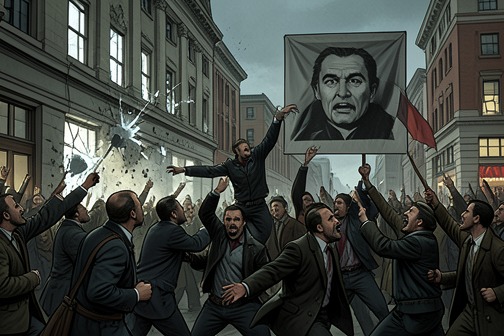
The [National Bolshevik Party Occupation of the Presidential Administration](entity:event-recall-event-fe06c8ad195d) was a direct-action protest that brought forty [National Bolshevik Party](entity:organization-recall-organization-d9e15bd528ae) militants into the offices of [Russia](entity:location-recall-location-e36341713c23)’s presidential administration, where they damaged the premises and shouted “Putin must go!” Its significance in [Emmanuel Carrère](entity:character-recall-character-emmanuel-carr-re-4e52f3cdc3e1)’s account lies not only in the arrests and prison sentences that followed, but in the sharply opposed meanings attached to the action: for some, proof of a fascist movement’s danger; for [Anna Politkovskaya](entity:character-recall-character-anna-politkovskaya-25444347edd7) and [Yelena Bonner](entity:character-recall-character-yelena-bonner-3182875ffebc), evidence of young people willing to resist political cynicism and defend a democratic future.
## The occupation and prosecution
Two years before Carrère encountered [Eduard Limonov](entity:character-recall-character-eduard-limonov-fbb1fb9b4f1c) again, Anna Politkovskaya had covered the trial of forty National Bolshevik Party militants accused of occupying and vandalizing the presidential administration’s offices. The demonstrators’ shouted demand, “Putin must go!”, made the action an explicit challenge to the government. The account supplies no detailed explanation of how the occupation was organized or what prompted its participants to choose the building; its concrete record centers on the action, the slogan, and the state’s prosecution of the forty.
The defendants received lengthy prison sentences. In Carrère’s telling, the severity of the punishment became part of the event’s public meaning: the militants were not simply prosecuted for damaging offices, but became figures in a dispute over whether opposition to the government could be treated as legitimate political action. The trial’s consequences therefore extended beyond the defendants themselves, making their case a test of how the movement and its opponents understood dissent.
## Politkovskaya and the counter-interpretation
Politkovskaya did not present the forty as thugs. She vigorously defended them, describing them as young, courageous people of integrity and as almost the only people capable of inspiring hope for the country’s moral future. Her account, which Carrère finds while reading a collection of her articles, overturns his expectation that the case is self-evident. He had regarded Limonov as a hideous fascist leading a militia of skinheads; Politkovskaya’s praise forced him to confront a radically different assessment of the militants and their political significance.
Yelena Bonner, the widow of [Andrei Sakharov](entity:character-recall-character-andrei-sakharov-c04d8a2087d6) and a widely respected dissident, likewise supported the National Bolshevik Party members. She acknowledged that the party’s name carried unpleasant associations for some people and suggested it might be changed, yet otherwise regarded the militants as admirable. The force of this contrast is not that either woman erased the party’s provocative identity, but that their judgments could not be reconciled with Carrère’s assumption that its members were beyond the bounds of democratic opposition. The occupation thus becomes, in the book, an episode whose meaning changes according to who is looking at it.
## A wider movement and later prosecutions
The 2005 case sits within a broader account of the National Bolshevik Party’s appeal and methods, but it should not be confused with later trials of other militants. Carrère visits Taganskaya District Court on a separate occasion and watches seven party members tried for hooliganism after a clash with pro-government youths. The accused say the other side started the fight; the defense stresses that they are serious students with good grades and have already spent a year in preventive custody. The judge sentences all seven to two years. As police lead them away, they laugh, clench their fists, and shout “Da, smert’!” Their friends watch with envy, seeing the defendants as heroes.
One of the forty from the presidential-administration case is connected to this later scene through the wife of the clandestine head of the [Moscow](entity:location-recall-location-19aceb5ce281) section: she is in prison because she was among the forty. The distinction between the cases matters. The later courtroom does not establish further details about the occupation; instead, it shows how the earlier prosecution became part of a continuing experience of imprisonment, public solidarity, and militant identity. Carrère describes a constituency of thousands, perhaps tens of thousands, drawn to Limonov’s example and to the image of endurance associated with his own imprisonment.
The party’s subsequent organizing gives that constituency a public form. At a convention attended by several hundred delegates, drawn from a movement said to have seven thousand members across Russia, Limonov presents the gathering as proof that years of distributing the party newspaper have produced a community. He also outlines ambitions beyond taking power immediately: the party should mobilize among Russians in former Soviet republics and support separatist republics there. This later program differs from the specific demand voiced during the occupation, but it shows how the party’s opposition developed into a wider, increasingly radical political project.
## Suppression, adaptation, and significance
The state later refused to authorize the National Bolshevik Party under a law banning extremism and fascism, leaving the organization without the right to exist legally. Limonov argues that the party has seven thousand adherents and warns that forcing it underground could push young people toward extremism and terrorism. The ban marks a change in the terrain of opposition: the earlier occupation had brought militants into the presidential administration’s offices; later, the party faced the loss of its legal status and the prospect of organizing in secret.
After the failure of [The Other Russia](entity:organization-recall-organization-e5deb52beabd) movement and the collapse of its electoral prospects, Limonov established [Strategy 31](entity:organization-recall-organization-strategy-31-fab404f336f8), invoking the constitutional right to demonstrate. Its supporters gathered on [Triumfalnaya Square](entity:location-recall-location-c09fdc04741d) on the thirty-first of months that had one, typically numbering about a hundred against roughly five times as many police officers. Dozens were often arrested, and Limonov regularly spent a couple of days in prison. This later protest strategy was not the occupation itself, but it continues the book’s account of opposition meeting an increasingly restrictive state through public action and repeated arrests.
Carrère’s return to the 2005 trial record is therefore also a reassessment of political labels. The occupation remains a disruptive act against the government, followed by lengthy sentences; the evidence does not make it an uncomplicated democratic gesture. But Politkovskaya’s and Bonner’s defenses prevent the event from being reduced to Carrère’s initial image of a fascist militia. Its lasting narrative significance is the unresolved tension between the National Bolshevik Party’s authoritarian and provocative associations and the courage its imprisoned supporters could display in opposing a government they regarded as illegitimate.
Event 8
Collapse of Communism in Europe
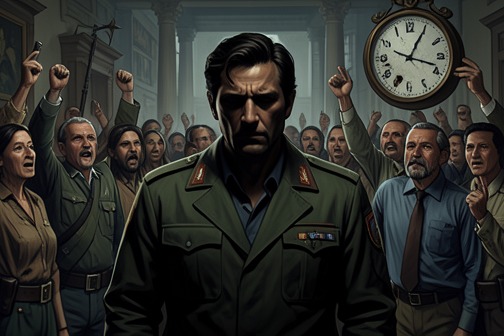
The [Collapse of Communism in Europe](entity:event-recall-event-2608f279054d) is the decisive rupture in the book’s account of [Eduard Limonov](entity:character-recall-character-eduard-limonov-fbb1fb9b4f1c): an event that first seems to separate him from the friends who had admired his irreverence, then places him inside new struggles over Russian power and political legitimacy. The end of the old order does not settle what it meant. Instead, it reveals how nostalgia, nationalism, democratic opposition, and the memory of Soviet life can combine in ways that unsettle the narrator’s assumptions about who belongs on which side.
## From liberation to rupture
Before the collapse, Limonov spoke of the [Soviet Union](entity:location-recall-location-67657886d3d4) under [Leonid Brezhnev](entity:character-recall-character-leonid-brezhnev-2fc7f6c7aa23) with wry nostalgia, presenting it as a vanished world in which resourceful hooligans could thrive. His [Paris](entity:location-recall-location-paris-c02b439ce220) acquaintances took his praise of [Joseph Stalin](entity:character-recall-character-joseph-stalin-b2f2c907a5f9) as provocation, and admired the [Red Army](entity:organization-recall-organization-073952387f8f) officer’s jacket, the arguments, and the adventurous past. They regarded him as their barbarian: an unruly figure whose difference from bourgeois life was part of his appeal.
The collapse changes the tone of that performance. The narrator recalls that Limonov was unhappy while everyone around him celebrated, and that his call for [Mikhail Gorbachev](entity:character-recall-character-7c6bee5bcfc8) to face a firing squad no longer seemed like a joke. The apparent political provocation had become a position with consequences. What had once been safely legible to his friends as theatrical defiance now looked like a real break with their shared expectations of what the end of communism should mean.
## War and a new political identity
After the collapse, Limonov began making long trips to the [Balkans](entity:location-recall-location-5b2c5d5c163a). His acquaintances were horrified to learn that he fought on the Serbian side, and a [BBC](entity:organization-recall-organization-3c76d7ec91ee) documentary showed him bombarding besieged [Sarajevo](entity:location-recall-location-f362c04c2df2) under the eye of [Radovan Karadžić](entity:character-recall-character-8ca2bc660a0e), the Bosnian Serb leader and a known war criminal. In the narrator’s account, this was no longer the picturesque unruliness that had made Limonov attractive in Paris: his politics had entered an actual war.
After returning to [Russia](entity:location-recall-location-e36341713c23), Limonov founded the [National Bolshevik Party](entity:organization-recall-organization-d9e15bd528ae). Its public image made the rupture visible. Reports showed young members with shaved heads, dressed in black, marching in [Moscow](entity:location-recall-location-19aceb5ce281) with a raised-arm gesture associated with Nazism and a clenched-fist gesture associated with communism. Their flags replaced the swastika in a Third Reich imitation with the hammer and sickle, while their slogans invoked Stalin, Beria, and the [Gulag](entity:concept-recall-concept-gulag-41d9bb76f27e). The figure leading them with a megaphone was, for the narrator, almost impossibly the same amusing, seductive friend he remembered from Paris. The change prompted him to look back over their friendship and wonder what chain of circumstances had led Limonov so far from the people who had once admired him.
## A contested place in opposition politics
The narrator’s first judgment seemed straightforward: Limonov was a fascist leading a militia of skinheads. Reading [Anna Politkovskaya](entity:character-recall-character-anna-politkovskaya-25444347edd7)’s account of the trial of forty National Bolshevik militants complicated that conclusion. The activists had occupied and vandalized the presidential administration’s offices while demanding [Vladimir Putin](entity:character-recall-character-vladimir-putin-600db9625a7e)’s departure. Politkovskaya defended them as courageous young people of integrity and among the few who offered hope for Russia’s moral future. [Yelena Bonner](entity:character-recall-character-yelena-bonner-3182875ffebc), widow of [Andrei Sakharov](entity:character-recall-character-andrei-sakharov-c04d8a2087d6), likewise supported the party’s members, while acknowledging that its name carried troubling associations.
This unexpected support did not erase the movement’s symbols or Limonov’s past; it altered the political position from which those things had to be understood. Several months later, Limonov joined a coalition called [The Other Russia](entity:organization-recall-organization-e5deb52beabd) with [Garry Kasparov](entity:character-recall-character-garry-kasparov-4744d0dee2bf) and Mikhail Kasyanov, figures whose political histories seemed incompatible with his own. The narrator saw a change not necessarily in Limonov himself, but in the place he occupied in Russia. That change prompted him to propose Limonov as the subject of a magazine feature, despite his colleague Patrick de Saint-Exupéry’s dismissive description of him as a petty thug.
The contradiction also appears in the 1993 confrontation at the White House. Limonov joined patriots supporting the rebel parliament against Boris Yeltsin. Some among the crowd were fascists, yet they presented themselves as defenders of the constitutional order and accused the democrats of using dictatorship to preserve democracy. Limonov argued to General Rutskoy that the conflict was not a coup but an elected parliament resisting dictatorship, and insisted that the decisive struggle would take place inside the White House. The scene gives political labels no easy stability: people who had recently stood with Yeltsin were now leading a rebellion against him, while Limonov framed his side as the constitutional one.
## Rebuilding a movement after the Soviet Union
Limonov’s party turned its Soviet inheritance into a political constituency. At a convention, several hundred delegates gathered from across Russia, although the party counted seven thousand members in the country. The meeting had been difficult to arrange: venues repeatedly withdrew, and organizers feared a bomb scare, police harassment, or an outright ban. For Limonov, the gathering showed that years spent distributing the party newspaper beyond Moscow had brought real followers together. Many were provincial adolescents whom the narrative depicts as poor and socially exposed; the movement gave them a shared identity, style, and ideal.
Limonov told the delegates that the party was not yet ready to take power. Instead, he proposed turning its attention to Russians living beyond the borders of the former Soviet Union, whom he described as abandoned and dispossessed after its dissolution. He named [Latvia](entity:location-recall-location-2550659298f2), Ukraine, and [Kazakhstan](entity:location-recall-location-5f41d751a306), citing the large Russian populations there, and called for insurgency and separatist republics in the Baltic states and [Central Asia](entity:location-recall-location-801b1b88b04b). A planned canvassing trip to Central Asia drew a surge of volunteers. In this vision, the collapse was not only the end of a state: it was also a grievance and a mandate to contest the new borders it had left behind.
The party’s mass politics developed alongside a widening internal division. [Alexander Dugin](entity:character-recall-character-3d0c85e73dce)’s followers looked down on Limonov’s recruits, whom they regarded as a common crowd of rock fans and fighters rather than the disciplined, historically minded paramilitaries they admired. [Zakhar Prilepin](entity:character-recall-character-334182a15d37) disliked the movement’s fascist references. [Dugin](entity:character-recall-character-dugin-2e48b722d009) eventually left to establish a geostrategic studies center, leaving Limonov’s followers to themselves. The split showed that a shared opposition to the post-Soviet order did not produce a shared account of what should replace it.
## Aftermath: opposition and the struggle over memory
The post-Soviet political landscape also brought a renewed appetite for the Communist Party. Five years after Yeltsin had declared it illegal, polls showed widespread readiness to vote for it, amid anger at democracy, market reforms, and the injustice associated with them. [Gennady Zyuganov](entity:character-recall-character-cb21aa845c13) offered a cautious program focused on corruption, national pride, and Russian Orthodoxy rather than a promise to restore the Gulag or the Berlin Wall. At the same time, oligarchs feared that a Communist victory might undo the loans-for-shares arrangement through which they expected to acquire major state assets. The book presents this electoral contest as a consequence of the collapse that is economic as well as ideological: the new order had not secured popular loyalty simply by displacing the old one.
Later, Limonov opposed Putin in pamphlets, calling him a tyrant, while the narrator judged that description inadequate. Putin’s appeal, as the narrator understands it, rested partly on a refusal to treat decades of Soviet belief and sacrifice as worthless or equivalent to Nazism. Limonov, the narrator suggests, could have pursued a similarly authoritarian course had he reached power; instead, he occupied the incongruous role of opposition defender of democracy and human rights alongside people whose values he had long despised. The collapse therefore ends neither Soviet memory nor the political conflicts built around it. It leaves Limonov in a position shaped by the new order he rejects, while making the narrator reconsider the line between a fascist provocation and a movement that can also be defended as opposition.
Event 9
Limonov's On-Camera Involvement in the Siege of Sarajevo
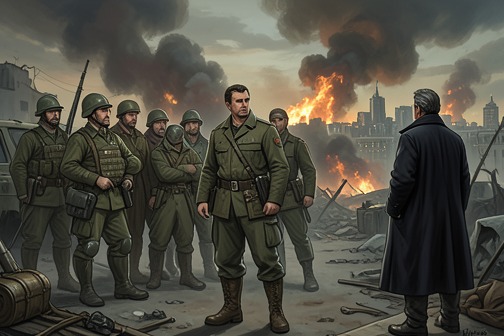
Limonov’s on-camera involvement in the Siege of [Sarajevo](entity:location-recall-location-f362c04c2df2) marks the point at which his post-communist provocations cease to look like performance alone. In a [BBC](entity:organization-recall-organization-3c76d7ec91ee) documentary, Carrère and his circle saw him fighting on the Serbian side and bombarding the besieged city under the benevolent eye of [Radovan Karadžić](entity:character-recall-character-8ca2bc660a0e), leader of the Bosnian Serbs and a known war criminal. The image turned an unsettling political realignment into visible participation in war.
## From Provocation to Political Rupture
Before the collapse of communism, Limonov’s [Paris](entity:location-recall-location-paris-c02b439ce220) acquaintances admired his unconventional behavior and adventurous past. They treated him as their barbarian and thug, a compelling outsider whose taste for provocation could seem part of his charm. That understanding faltered when the political order collapsed: while others welcomed the change, Limonov did not, and his call for [Mikhail Gorbachev](entity:character-recall-character-7c6bee5bcfc8) to face a firing squad no longer seemed like a joke.
His long disappearances to the [Balkans](entity:location-recall-location-5b2c5d5c163a) made the change harder to dismiss as rhetoric. The group learned, to its horror, that he was fighting on the Serbian side. Carrère describes the moral shock through comparisons with siding with the Nazis or the genocidal Hutus: from the Paris circle’s perspective, Limonov had crossed a boundary that his earlier image as an entertaining provocateur had obscured.
## The Sarajevo Footage
The documentary supplied a concrete, public image of that allegiance. Carrère’s circle watched Limonov bombard besieged Sarajevo while Karadžić looked on. The passage does not describe the weapon, the target, or the circumstances of the firing; its emphasis is on what the footage made unmistakable to those watching: Limonov was not merely visiting the Balkans or expressing a political preference but participating in the conflict on the Serbian side.
The camera also fixes the scene within a wider political setting. Karadžić’s presence links Limonov’s actions to the Bosnian Serb leadership, while the besieged city makes the violence more than an abstract emblem of rebellion. For Carrère’s circle, the footage transformed a distant and bewildering change in Limonov’s life into an image they could no longer reconcile with their former friendship.
## Aftermath and Narrative Significance
After these Balkan exploits, Limonov returned to [Russia](entity:location-recall-location-e36341713c23) and created the [National Bolshevik Party](entity:organization-recall-organization-d9e15bd528ae). The sequence places Sarajevo within a larger turn from the Parisian writer and provocateur toward organized political militancy, without claiming that the footage alone caused that later development. The war episode instead serves as the moment when his former acquaintances recognize how far his trajectory has diverged from their own.
Carrère presents the scene through retrospective recollection: the documentary is remembered not simply as evidence of Limonov’s actions but as the shock that reorganizes earlier memories. The friends look back over their time with him and try to imagine the circumstances and personal motives that carried his life so far away from theirs. The footage therefore has a double force in the narrative: it records Limonov’s alignment in the war and exposes the limits of the circle’s previous, affectionate reading of his provocations.
Event 10
Arrest and Trial of Eduard Limonov
The [Arrest and Trial of Eduard Limonov](entity:event-recall-event-b46ac613e47b) is presented as a brief, opaque legal episode with consequences far beyond the courtroom. In 2001, Limonov was arrested, tried, and imprisoned over allegations connected to arms trafficking and an attempted coup in [Kazakhstan](entity:location-recall-location-5f41d751a306), though the narrator describes the reasons as obscure and supplies no detailed account of the evidence, verdict, or sentence. The episode recast him from a controversial political leader into a prisoner whose composure and productivity would become part of his legend. It also exposed a gap between the apparent criminal case and the larger political story: supporters saw a figure who could endure confinement, while the wider account leaves the precise legal basis of the case unresolved.
## Arrest and the Limits of the Account
The arrest enters the narrative not through a courtroom scene but through the news reaching Limonov’s former acquaintances in [Paris](entity:location-recall-location-paris-c02b439ce220). They learned that he had been arrested, tried, and imprisoned in 2001, for reasons they understood only vaguely as involving arms trafficking and an attempted coup in Kazakhstan. The compressed report offers no procedural chronology and does not clarify how the allegations were established. Its reticence is important: the event is a decisive biographical fact, but the narrative does not pretend to supply a complete case record.
The reaction in Paris was not a campaign to secure his release. By then, Limonov had fought on the Serbian side in the [Balkans](entity:location-recall-location-5b2c5d5c163a), appeared in a documentary filming the bombardment of besieged [Sarajevo](entity:location-recall-location-f362c04c2df2), and founded the [National Bolshevik Party](entity:organization-recall-organization-d9e15bd528ae). To his former friends, the arrest did not invite uncomplicated sympathy. Their distance from him makes the news an episode in a political estrangement as well as a prosecution: the man they had once known had become, in their eyes, an alarming public figure.
The later account of prison likewise distinguishes what is known from what is dramatized. Asked how prison had been, Limonov initially answered, “Normalno,” roughly meaning that things were all right, with nothing special to report. Only later did he tell the anecdote about his transfer from [Lefortovo Prison](entity:location-recall-location-0f8bf6b582e5) to the labor camp at [Engels](entity:location-recall-location-fa5f824ffdc7). The narrative therefore withholds the texture of the trial while making the conditions and afterlife of imprisonment vivid.
## Detention and the Prison Legend
The account describes Limonov as first held at Lefortovo, a prison associated in Russian political mythology with the [KGB](entity:organization-recall-organization-kgb-7a6cfca0c71a), and then transferred to a labor camp at Engels on the Volga. The Engels institution had been designed and presented as a modern model prison, but inmates called it the Eurogulag. In Limonov’s telling, its contemporary architecture did not make it more livable than a conventional barbed-wire camp; in some respects, it made life worse.
A sink becomes the object through which the camp’s polished image collides with Limonov’s past. Its smooth steel plate and cast-iron pipe reminded him of the interiors in a Philippe Starck-designed New York hotel where his American publisher had lodged him in the late 1980s. The comparison joined two lives that ordinarily seemed to belong to different people: the writer in a stylish [Manhattan](entity:location-recall-location-5e470c74b89c) hotel and the inmate in a labor camp on the Volga. Limonov took pride in having inhabited both worlds. The episode gave the imprisonment a significance beyond confinement, making the gulf between luxury and forced labor part of the story the book tells about his life.
The prison episode also acquired a public meaning among young National Bolshevik Party followers. The narrative describes thousands, perhaps tens of thousands, of young people drawn to Limonov in a [Russia](entity:location-recall-location-e36341713c23) they regarded as ruled by cynicism. His reputation rested in large part on the image of a prisoner who had not complained or buckled, had written seven or eight books, and had helped his cellmates. To those inmates he could appear both a kingpin and a saint. When he was released, prisoners and guards disputed who would carry his suitcase: a small, concrete gesture that turns his departure into a measure of the authority he had acquired inside.
## Political Context and Competing Meanings
Limonov’s imprisonment came after a period in which his political identity had become difficult for former friends to reconcile with their memories of him. He had returned to Russia after his Balkan activity and created the National Bolshevik Party, whose young supporters marched in [Moscow](entity:location-recall-location-19aceb5ce281) with a combination of raised-arm and clenched-fist salutes. The party’s flag substituted the hammer and sickle for the swastika. For the narrator and his Paris circle, this history made Limonov a figure they considered fascist, not an obvious object of solidarity when he was imprisoned.
The account sets that judgment beside another reading of the party and its militants. [Anna Politkovskaya](entity:character-recall-character-anna-politkovskaya-25444347edd7) defended forty National Bolshevik militants sentenced after occupying and vandalizing the presidential administration’s offices while shouting for [Vladimir Putin](entity:character-recall-character-vladimir-putin-600db9625a7e) to leave. She characterized the young defendants as courageous people of integrity and a rare source of hope for Russia’s moral future. The militants’ case was not Limonov’s trial, but its appearance in the narrative complicates the assumptions through which his arrest is understood: the same movement could be seen by one observer as a fascist militia and by another as an oppositional force willing to risk prison.
That contested position persisted as the party developed. At its convention, several hundred delegates gathered from across Russia, despite the difficulty of finding a venue and fears of police interference. Limonov told them that the party was not ready to take power, but he proposed action on the periphery of Russia, including support for separatist republics in former Soviet territories. He cited Russians living in [Latvia](entity:location-recall-location-2550659298f2), Ukraine, and Kazakhstan and announced a planned tour of [Central Asia](entity:location-recall-location-801b1b88b04b); a hundred hands rose when he asked for volunteers. This later political program helps explain why imprisonment could serve as more than a private ordeal in the book’s portrait: it became part of the image of a leader prepared to confront the state, although the evidence does not establish a direct connection between that program and the charges in his case.
## Consequences and Afterlife
The immediate narrative consequence of the arrest is not a detailed account of the trial’s legal outcome but Limonov’s emergence from prison with renewed symbolic authority. The young militants’ admiration for his endurance contrasts with the friends in Paris who had no desire to sign a petition for his release. Prison thus divides audiences as much as it confines its subject: to one group, it confirms the danger of his politics; to another, it demonstrates a heroic capacity to withstand hardship.
That prison reputation formed part of a larger, unstable opposition career. The National Bolshevik Party was later denied authorization and told it had no right to exist, even though Limonov said it had seven thousand adherents; he warned that banning it would push young people toward clandestine organization and extremism. After the coalition [The Other Russia](entity:organization-recall-organization-e5deb52beabd) failed to establish itself as a durable political vehicle, Limonov created [Strategy 31](entity:organization-recall-organization-strategy-31-fab404f336f8), invoking the constitutional right to demonstrate. Its gatherings on [Triumfalnaya Square](entity:location-recall-location-c09fdc04741d) on the thirty-first of months with that many days were small and heavily policed, and Limonov was regularly detained for a couple of days. These later arrests were not the 2001 case, but they echo its recurring pattern of opposition, state restriction, and confinement.
The event’s decisive significance is therefore not a verdict the account never details. It is the transformation of imprisonment into a political credential and a biographical hinge. Limonov’s route from Lefortovo to the camp at Engels, his writing there, the steel sink that recalled a New York hotel, and the suitcase contested by inmates and guards all feed the legend that his followers sought to emulate. At the same time, the vagueness surrounding the original allegations preserves an unresolved tension: the narrative makes the consequences of the arrest legible while leaving the legal case itself largely in shadow.
Event 11
Battle of Stalingrad
The [Battle of Stalingrad](entity:event-recall-event-2d4f441fa0c0) gives the circumstances of [Eduard Limonov](entity:character-recall-character-eduard-limonov-fbb1fb9b4f1c)’s birth their historical weight: his mother, [Raya Zybin](entity:character-recall-character-raya-zybin-689daa505f9e), was pregnant during the siege, and the account links his arrival to the defeat of the German Sixth Army and the reversal of the battle’s fortunes. The episode also appears through the fate of [Joseph Stalin](entity:character-recall-character-joseph-stalin-b2f2c907a5f9)’s son, captured by the Germans, and Stalin’s refusal to exchange him for Field Marshal Paulus. Together, these details make the battle both a family origin story and a measure of the sacrifices attached to victory.
## Pregnancy and the Turning Point
Raya Zybin’s pregnancy coincided almost day for day with the siege. Eduard was conceived in May 1942, described as a terrible month of bitter defeats, and born on February 2, 1943. The narrative places his birth twenty days before the German Sixth Army capitulated and the tables turned. It does not recount the battle’s military course in detail; instead, it anchors the family chronology to the siege and its approaching outcome.
That timing shaped the meaning attached to the child. Eduard was repeatedly told that he was a child of victory, born into a world that had been spared enslavement by the sacrifice of Russian men and women. The battle thus enters the family story not simply as a date, but as an inherited explanation for the world into which he was born.
## Stalin, Yakov, and the Refused Exchange
The account connects the battle’s military stakes to a personal crisis at its center. German forces had captured Stalin’s son, Lieutenant Yakov Dzhugashvili, while the Russians had captured Field Marshal Paulus at [Stalingrad](entity:location-recall-location-4b711f654663). When the German High Command proposed exchanging the two prisoners, Stalin rejected the offer, saying that he would not exchange field marshals for simple lieutenants.
Yakov later died by throwing himself against the electrified barbed-wire fence of his prison camp. The juxtaposition is stark: a decision made in the language of military rank is followed by the death of Stalin’s son. In the book’s presentation, this episode makes the battle’s human cost inseparable from the choices of political leaders, even when those choices concern their own families.
## Victory and Historical Memory
The battle’s meaning in Eduard’s childhood is presented through a generational contrast. Later generations would call Stalin a tyrant and condemn his reign of terror; for people of Eduard’s generation, however, he remained the leader associated with defeating the Nazis at the most tragic moment in their history. The account explains this attachment through the scale of sacrifice attributed to the victory, while showing how that memory could coexist with later denunciations of Stalin’s rule.
Stalingrad therefore serves as the point where private biography and national memory meet. Eduard’s birth is placed against the battle’s decisive reversal, while the story of Yakov’s capture and death complicates any simple celebration of victory. The event’s significance in the narrative lies in this tension: it is remembered as salvation from defeat, but also as a history measured in lives sacrificed and families divided.
Event 12
German Invasion of the Soviet Union
The [German Invasion of the Soviet Union](entity:event-recall-event-3882b8eb60a7) enters the narrative not as a military chronology but as a remembered rupture in the lives of [Eduard Limonov](entity:character-recall-character-eduard-limonov-fbb1fb9b4f1c)’s parents and their generation. The passage gives only a brief account of the invasion itself; its emphasis falls on the fear that followed and on the memory of [Joseph Stalin](entity:character-recall-character-joseph-stalin-b2f2c907a5f9) speaking to the country over the radio.
## The Invasion in Generational Memory
The book says that Limonov’s parents, like their generation, spent their lives in the shadow of Joseph Stalin. In recalling the German attack in 1941, they remember the days of fear and grief that followed. The event is thus presented through what endured in family and collective memory, rather than through descriptions of military operations or the invasion’s course.
## Stalin’s Radio Address
The recollection also turns to the moment when Joseph Stalin, after overcoming his despair, addressed the people by radio. Instead of calling them comrades, he called them friends. The passage stresses the emotional force of this familiar form of address: words whose warmth had been forgotten offered comfort in a time of terrible trouble. The invasion’s immediate significance in this account lies partly in the crisis against which that address was heard.
## Narrative Significance
The invasion functions as a point of reference in a family history shaped by fear, political authority, and remembered speech. Its presentation is compressed and retrospective: the narrative records how the parents remembered the aftermath, then highlights the words that made Stalin’s broadcast feel consoling. This limited focus does not supply a wider account of the invasion; it shows instead how a national catastrophe survives in the story as a generational memory, carried forward through recollections of both terror and reassurance.
Event 13
Death of Stalin
[Joseph Stalin](entity:character-recall-character-joseph-stalin-b2f2c907a5f9) died on March 5, 1953, when [Eduard Limonov](entity:character-recall-character-eduard-limonov-fbb1fb9b4f1c) was ten. The book presents the death less as a political turning point than as a childhood scene of collective mourning: a sensitive boy weeps with his schoolmates and the country, while the adults around him grieve the leader whose shadow had covered their lives.
## The death in Limonov’s childhood
The account places Stalin’s death within Limonov’s family and school life. His parents, like their entire generation, had spent their lives beneath Stalin’s authority; at ten, Limonov was a well-behaved, book-loving boy who was close to his father and afraid of his mother. When Stalin dies, he joins the public grief rather than standing apart from it. The scene makes the political event legible through a child’s response: Eduard weeps with the rest.
## The remembered voice of authority
The mourning is connected to memories of the German attack on the [Soviet Union](entity:location-recall-location-67657886d3d4) in 1941 and of Stalin speaking on the radio after overcoming his despair. In the passage’s account of that address, he called the people not comrades but “My friends.” The words’ familiar warmth, long absent from public speech, had comforted listeners in a moment of terrible danger. The population’s grief at Stalin’s death is therefore shown alongside the memory of a voice that had once seemed to answer the country’s fear.
## Collective grief and historical memory
The episode records how Stalin’s death was experienced by the generation formed under his rule. Schoolchildren wept because they could not give their lives to prolong his, and Limonov joined them. The scene preserves the emotional force of that mourning without presenting it as a judgment on the full record of Stalin’s rule. Its significance lies in the contrast between the child’s sincere grief and the later reader’s knowledge of the political world that shaped his family: Stalin’s authority was not only a structure of power but part of the intimate vocabulary through which people remembered danger, reassurance, and loss.
Event 14
Secret Speech at the 20th Congress of the CPSU
The [Secret Speech at the 20th Congress of the CPSU](entity:event-recall-event-e56d751aec3a) was [Nikita Khrushchev](entity:character-recall-character-nikita-khrushchev-311cf3b4cb8e)’s 1956 denunciation of Stalin’s cult of personality, delivered at a moment when former prisoners and those who had helped send them away were once again sharing the same society. Though designated secret, the report soon circulated beyond the congress. Its significance lay not only in its criticism of Stalin but in the larger question it raised: what might happen if the [Soviet Union](entity:location-recall-location-67657886d3d4) continued telling the truth about its past?
## Background: A past returning to view
After Stalin’s death, millions of former prisoners were released, and some were rehabilitated. Their return brought survivors into contact with bureaucrats, informers, and others who had expected never to see them again. The encounter did not become the bloodbath it might have been; often, people recognized one another, looked away, and carried on, leaving the history between them unspoken. The Secret Speech belonged to a brief period in which that silence could be broken.
## The report and its implications
In 1956, at the Twentieth Party Congress, Khrushchev delivered a report that deplored Stalin’s cult of personality. It implicitly acknowledged that the country had been governed by murderers for twenty years. Although the report was called secret, it did not stay that way for long. The account presents its effect as more than a change in official language: once the past could be discussed, the truth about the camps and the regime’s violence threatened to unsettle the legitimacy of the whole political order.
## The thaw and the limits of disclosure
The report’s challenge to Stalin was followed by a more public act of disclosure in 1962, when Khrushchev personally authorized publication of [Aleksandr Solzhenitsyn](entity:character-recall-character-aleksandr-solzhenit-89cf357d7965)’s *One Day in the Life of Ivan Denisovich*. The story’s meticulous account of an ordinary day in a camp shocked readers, and the issue of *Novy mir* carrying it was snapped up across [Russia](entity:location-recall-location-e36341713c23). The book gave renewed force to the possibility that one person’s truthful account could not simply be suppressed. In the narrative’s chronology, the Secret Speech and the publication together mark the rising arc of de-Stalinization, while the later book makes visible just how far that opening could reach.
## Political aftermath and historical significance
The authorities understood that continued truth-telling might sweep away not just Stalin but [Vladimir Lenin](entity:character-recall-character-vladimir-lenin-34f94d23ace7), the system itself, and the lies on which it depended. The publication of Solzhenitsyn’s book thus marked both the height and the end of de-Stalinization. After Khrushchev lost power, a generation of apparatchiks that had emerged from the purges established a softer form of Stalinism under [Leonid Brezhnev](entity:character-recall-character-leonid-brezhnev-2fc7f6c7aa23). The report’s historical importance, as presented here, is therefore double: it made a public breach in the official silence, and it exposed the political limits that would soon close around that breach.
Event 15
1962 publication of One Day in the Life of Ivan Denisovich
The 1962 publication of *One Day in the Life of Ivan Denisovich* made a former prisoner’s account of camp life available to readers across the [Soviet Union](entity:location-recall-location-67657886d3d4). Personally authorized by [Nikita Khrushchev](entity:character-recall-character-nikita-khrushchev-311cf3b4cb8e), the book was a rare public breach in the suppression of the country’s recent past: its meticulous attention to an ordinary inmate’s ordinary day made the camp system newly difficult to dismiss as an abstraction. The publication became both the high point of de-Stalinization and, in the account’s telling, a sign of how far that opening could go before it threatened the foundations of the system itself.
## Background: Prisoners Return, Silence Persists
The book appeared after the death of [Joseph Stalin](entity:character-recall-character-joseph-stalin-b2f2c907a5f9), when millions of prisoners were released from the [Gulag](entity:concept-recall-concept-gulag-41d9bb76f27e) and some were rehabilitated. Their return put former prisoners face to face with the informers and officials who had helped send them away. The account describes an uneasy social encounter rather than a reckoning: people recognized what had happened, but generally looked away and resumed their lives. That embarrassed silence formed the setting in which an openly told story about camp life could have exceptional force.
The political opening had already acquired an official signal in 1956, when Khrushchev delivered a report to the Twentieth Party Congress condemning Stalin’s cult of personality. The report did not remain secret for long, and it implicitly acknowledged that the country had been governed by murderers for two decades. Yet acknowledgment from above and knowledge circulating in private were not the same as a widely read account of an inmate’s daily existence. *One Day in the Life of Ivan Denisovich* gave that reality a concrete, sustained form.
## Publication and Reception
Khrushchev personally authorized publication in 1962. The story appeared in issue number 11 of the magazine *Novy mir*. Readers seized the issue across [Russia](entity:location-recall-location-e36341713c23), encountering a prosaic, meticulous narrative about one ordinary day experienced by one ordinary inmate in a camp described as not even particularly harsh. The restraint of that account mattered: it did not need an exceptional ordeal to make imprisonment legible. The routine itself could disclose the system.
The reception was marked by shock and disbelief as well as hope. Readers began to interpret the publication as evidence that a thaw might be underway, and that once one person had been allowed to tell the truth, the authorities might no longer be able to stop others from doing so. The response thus exceeded the fate of a single book. Its appearance suggested that publicly naming a suppressed reality might change what could be said—and what the country could know about itself.
## The Opening and Its Limit
That possibility also revealed the danger the publication posed to the political order. If the truth about the camps and the recent past continued to be told, the reckoning might reach beyond Stalin. It could implicate Lenin, the system built in his name, and the lies on which that system rested. In this account, the book’s importance therefore lies partly in the boundary it exposed: de-Stalinization could condemn Stalin, but a full investigation of the past risked challenging the state’s deeper foundations.
The publication consequently marks both the height and the end of de-Stalinization. After Khrushchev lost power, a generation of Party officials shaped by the purges established what the narrative calls a form of soft Stalinism under [Leonid Brezhnev](entity:character-recall-character-leonid-brezhnev-2fc7f6c7aa23). The resulting order offered stability, entrenched leadership, graft, and limited repression; its members could benefit from the system so long as they adapted to it. The public opening represented by Solzhenitsyn’s book did not develop into an unrestricted account of Soviet history.
## Historical Significance
The book’s significance rests on the conjunction of its modest subject and its extraordinary reach. Rather than describing an exceptional camp or an exceptional prisoner, it recorded an ordinary day in a relatively less harsh camp. That particular scale made the larger reality harder to evade: if even this ordinary routine could be published, the experience of imprisonment could enter public discussion without being reduced to rumor or accusation.
The narrative places the book among the very few works that genuinely altered the course of history, comparing its impact only with that of *The Gulag Archipelago*, published a decade later. Its achievement was also inseparable from its limits. It opened a public breach in enforced silence, but the political response that followed showed why the breach could not remain open indefinitely. In this chronology, publication is at once an act of disclosure and a turning point after which the state’s retreat from de-Stalinization becomes visible.
Event 16
Trial of Joseph Brodsky
The [Trial of Joseph Brodsky](entity:event-recall-event-8380783469a5) transformed a prosecution for “social parasitism” into a dissident legend, as a journalist’s record of the hearing circulated through samizdat and reached an entire generation. The episode exposes both the state’s power to define a writer as a social offender and the difficulty of containing the meaning of his words. It also unsettles [Eduard Limonov](entity:character-recall-character-eduard-limonov-fbb1fb9b4f1c)’s dismissive view of Brodsky: the young poet’s life had been far less sheltered, and his reputation far more commanding, than Limonov wanted to admit.
## Brodsky Before the Trial
In Limonov’s account, Brodsky is introduced as a prodigy from Leningrad, named in the early 1960s by [Anna Akhmatova](entity:character-recall-character-anna-akhmatova-cd3746eefb7e) as the young talent to watch. Limonov’s malicious caricature casts him as the eternal top of the class, hiding behind a teacher’s petticoat. The facts the narrative supplies resist that portrait. Like Limonov, Brodsky was the son of a junior officer; he left school early, worked on a milling machine, dissected bodies in a morgue, and served as a geological assistant in Yakutia.
His youthful adventures were not simply literary or academic. With another young companion, he went to Samarkand and hijacked a plane in an attempt to reach Afghanistan. He was later confined in a psychiatric hospital, where he received painful sulfur injections and underwent ukrutka: wrapped in a sheet, he was plunged into an icy bath and left to dry without being unwrapped. This history gives the later prosecution a context of coercion that extends beyond the courtroom. Before Brodsky was tried as a social parasite, institutions had already subjected him to confinement and treatment described as brutal.
## The Hearing and Its Circulation
At twenty-three, Brodsky was arrested on the charge of “social parasitism.” The prosecution’s contemptuous description of him—as a “Jewish pygmy in corduroys” and a writer whose poems set “gibberish and pornography” against each other—reduced both his stature and his work to targets for ridicule. The narrative observes that such a hearing would ordinarily have passed unnoticed. Its importance came from a journalist who took down the proceedings in shorthand.
That record escaped the courtroom: it circulated as samizdat, carrying the exchange between Brodsky and the judge well beyond the hearing itself. Asked who had enrolled him among the poets, Brodsky answered by turning the question toward a more fundamental claim: who had enrolled him in the human race? His answer, invoking God as a possibility, refused the judge’s implied authority to decide what kind of person or writer he was. The transcript’s passage from an overlooked hearing into dissident circulation is thus part of the event’s meaning: a state proceeding intended to classify an individual became a text readers could share and interpret for themselves.
## [Exile](entity:state-recall-state-exile-6555fd550644) and Literary Reputation
Brodsky was banished to the Far North near Arkhangelsk for five years, where he shoveled manure in a small village. The frozen landscape and his rugged friendship with the villagers fed poems that made their way circuitously back to Leningrad. In dissident circles across the [Soviet Union](entity:location-recall-location-67657886d3d4), those poems became cult objects. The contrast is stark: the authorities sent Brodsky away from the literary public, yet the work produced in exile strengthened his standing among readers.
The narrator places this growing reputation beside Limonov’s competitive frustration. At bookstore 41, Brodsky’s name was on everyone’s lips. Limonov had already resisted the enthusiasm surrounding the publication of One Day in the Life of Ivan Denisovich, but he could separate Solzhenitsyn from himself by an older generation. Brodsky was only three years older. Limonov believed they ought to be competing in the same league, and the public’s response made clear that they were not. The trial therefore enters the book not only as a landmark in Brodsky’s biography but as a measure of the recognition Limonov felt he had not received.
## Significance in Limonov’s Story
The episode complicates Limonov’s early habit of treating the dissident writers of the 1960s as just another set of important people and authorities. His pose of mocking distance groups Brodsky with figures on the other side of a social barrier; the biography it recounts makes that dismissal harder to sustain. Brodsky’s work and the record of his trial reached readers through informal routes, while Limonov watched the poet’s name become a source of collective fascination.
Akhmatova’s response to the biography being made for “our redhead” adds another layer: Brodsky’s life was already being understood as a story shaped by persecution and public attention. In the book’s portrait, the trial crystallizes that transformation. A charge meant to diminish him became the occasion for an answer that traveled farther than the hearing, while the exile that followed supplied poems to the very circles in which his name had become magnetic.
Event 17
Prague Spring reform movement
The [Prague Spring reform movement](entity:event-recall-event-4915439abd44) ended in violent suppression when the [Soviet Union](entity:location-recall-location-67657886d3d4) invaded Czechoslovakia in August 1968. The narrative connects that reversal to a rare act of public defiance in [Moscow](entity:location-recall-location-19aceb5ce281): eight dissidents protested on Red Square, were arrested, and received prison sentences. The fate of [Vadim Delaunay](entity:character-recall-character-vadim-delaunay-2b016bf340b4), who carried the demonstration’s most memorable placard, gives the episode a personal aftermath extending beyond prison and into exile.
## Invasion and Suppression
In August 1968, a few months after the narrator’s lunch with the French cultural attaché, Soviet forces invaded Czechoslovakia and bloodily crushed the [Prague Spring](entity:time-recall-time-prague-spring-e9c4a386a867). The account supplies no detailed chronology of the reform movement or military intervention; its emphasis falls on the invasion’s immediate political meaning and on the dissidents who dared to protest it in the Soviet capital.
## The Red Square Demonstration
Eight people staged the demonstration: Larisa Bogoraz, Pavel Litvinov, Vladimir Dremliuga, Tatiana Baeva, Viktor Fainberg, Konstantin Babitsky, Natalya Gorbanevskaya, and Vadim Delaunay. Gorbanevskaya came pushing her baby in a carriage. Delaunay carried a placard bearing the words FOR YOUR FREEDOM AND OURS, making solidarity with the Czechoslovak cause the demonstration’s explicit message. The narrator stresses the protest’s audacity: it was a small gathering, but one that openly challenged the invasion on Red Square itself.
## Arrests and Aftermath
The demonstrators were arrested as soon as the protest began and sentenced to prison terms of varying lengths. Delaunay received two and a half years. After his release, further entanglements with the [KGB](entity:organization-recall-organization-kgb-7a6cfca0c71a) preceded his emigration to [Paris](entity:location-recall-location-paris-c02b439ce220). The narrator notes that he could have seen Delaunay again there, had he known where he was; Delaunay died in 1983, aged thirty-five. His later life makes the cost of the protest visible beyond the sentences imposed immediately after the arrests: release did not restore the life he had had before, and emigration became part of its aftermath.
Event 18
Soviet Invasion of Czechoslovakia
The [Soviet Invasion of Czechoslovakia](entity:event-recall-event-bf7f637b0404) in August 1968 crushed the [Prague Spring reform movement](entity:event-recall-event-4915439abd44) and provoked an unusually public act of dissent in the Soviet capital: eight people demonstrated on Red Square. In [Emmanuel Carrère](entity:character-recall-character-emmanuel-carr-re-4e52f3cdc3e1)’s retrospective account, the protest is both a response to military repression abroad and a concrete measure of the danger faced by those who challenged it at home. The demonstrators were arrested almost immediately and sentenced to prison; the episode’s personal aftermath follows [Vadim Delaunay](entity:character-recall-character-vadim-delaunay-2b016bf340b4) from prison to emigration and an early death.
## Invasion and protest
A few months after the narrator’s lunch with a French cultural attaché, the [Soviet Union](entity:location-recall-location-67657886d3d4) invaded Czechoslovakia and bloodily crushed the [Prague Spring](entity:time-recall-time-prague-spring-e9c4a386a867). The account turns from that act of state violence to the dissidents who dared to protest it on Red Square. Their demonstration was extravagant not because it involved a large crowd, but because even a small public gathering against the invasion defied the Soviet authorities in a highly visible place.
The eight demonstrators were Larisa Bogoraz, Pavel Litvinov, Vladimir Dremliuga, Tatiana Baeva, Viktor Fainberg, Konstantin Babitsky, Natalya Gorbanevskaya, and Vadim Delaunay. Gorbanevskaya arrived pushing her baby in a carriage, a detail that places an ordinary domestic presence within the scene of political protest. Delaunay carried a placard bearing the words FOR YOUR FREEDOM AND OURS. Its wording made the demonstration more than an objection to Soviet action in Czechoslovakia: it linked the freedom of those resisting intervention abroad to the freedom of those living under Soviet rule.
## Arrests and personal consequences
The authorities arrested the demonstrators as soon as the protest was over. They received prison sentences of varying lengths; Delaunay was sentenced to two and a half years. The rapid movement from a handful of people on the square to criminal punishment makes the state’s response part of the event itself: the protest was brief, but its consequences extended well beyond the moment of arrest.
After his release, Delaunay had further difficulties with the [KGB](entity:organization-recall-organization-kgb-7a6cfca0c71a) and emigrated. He moved to [Paris](entity:location-recall-location-paris-c02b439ce220), where the narrator might have seen him again but did not know he was there. Delaunay died in 1983, aged thirty-five. That compressed sequence—demonstration, imprisonment, renewed pressure, emigration, and death—gives the episode a human chronology beyond the political fact of the invasion.
## The later politics of dissent
The book places this protest alongside later disputes over who could claim the language of courage, democracy, and opposition. In a collection of [Anna Politkovskaya](entity:character-recall-character-anna-politkovskaya-25444347edd7)’s articles, the narrator discovers her defense of forty [National Bolshevik Party](entity:organization-recall-organization-d9e15bd528ae) militants sentenced after occupying and vandalizing the presidential administration’s offices. They had shouted for [Vladimir Putin](entity:character-recall-character-vladimir-putin-600db9625a7e) to go; Politkovskaya described them as courageous people of integrity who could give hope to their country’s moral future. [Yelena Bonner](entity:character-recall-character-yelena-bonner-3182875ffebc), widow of [Andrei Sakharov](entity:character-recall-character-andrei-sakharov-c04d8a2087d6), also supported them, despite reservations about the party’s name. The narrator’s surprise at these endorsements shows how the meaning of dissent could cross boundaries he had assumed were fixed.
A later account of the National Bolshevik movement describes a different repertoire of protest: militants tagged trains, unfurled banners on hard-to-reach monuments, and threw tomatoes at a governor during official events. In the teacher’s view, such actions could be immature yet courageous, because conduct that might bring only a fine in Western Europe could result in prison in [Russia](entity:location-recall-location-e36341713c23). Still later, [Eduard Limonov](entity:character-recall-character-eduard-limonov-fbb1fb9b4f1c)’s [Strategy 31](entity:organization-recall-organization-strategy-31-fab404f336f8) movement invoked the constitutional right to demonstrate, gathering on [Triumfalnaya Square](entity:location-recall-location-c09fdc04741d) on months with thirty-one days; police outnumbered the demonstrators and arrested some of them. These later episodes are not consequences of the 1968 demonstration, but they return the narrative to its central problem: how public protest acquires meaning when the state can make its cost immediate.
## Narrative significance
The Red Square protest is narrated retrospectively, through the fate of one of its participants and through the narrator’s later attempts to understand political opposition. Delaunay’s placard supplies the event with a principle that is both international and personal: freedom cannot be defended as an abstraction while denied to those who speak against their own government. The subsequent prison sentences give that principle a price, while Delaunay’s later emigration shows that release did not necessarily end the pressure exerted on dissenters.
The event also establishes a contrast that recurs in the book’s later political episodes. A small group can make a public claim against a much larger power, but the act does not settle who will later be recognized as a defender of democracy or moral integrity. By naming all eight demonstrators and recording Delaunay’s fate, the narrator preserves the protest as more than a passing image of resistance: it becomes a remembered instance of dissent whose significance is repeatedly reconsidered.
Event 19
1968 Red Square Demonstration
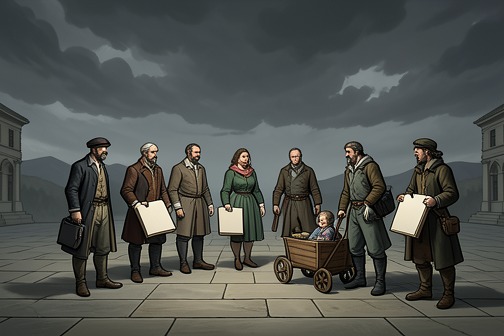
The [1968 Red Square Demonstration](entity:event-recall-event-1968-0903028f87ac) was an act of public dissent against the [Soviet Union](entity:location-recall-location-67657886d3d4)’s invasion of Czechoslovakia and its bloody suppression of the [Prague Spring](entity:time-recall-time-prague-spring-e9c4a386a867). Its eight participants were arrested almost immediately and sentenced to prison. The account gives the protest both a political meaning and a particular human consequence through [Vadim Delaunay](entity:character-recall-character-vadim-delaunay-2b016bf340b4), one of the demonstrators, whose later life the narrator connects to a missed chance to meet again.
## Background and Protest
In August 1968, a few months after the narrator’s lunch with a French cultural attaché, Soviet forces invaded Czechoslovakia and crushed the Prague Spring. Eight dissidents then staged a demonstration on Red Square, an unusually audacious act of protest in the Soviet capital. The account records all eight by name: Larisa Bogoraz, Pavel Litvinov, Vladimir Dremliuga, Tatiana Baeva, Viktor Fainberg, Konstantin Babitsky, Natalya Gorbanevskaya, and Vadim Delaunay. Gorbanevskaya arrived pushing her baby in a carriage, while Delaunay carried a placard bearing the words FOR YOUR FREEDOM AND OURS. The small group made a direct appeal for freedom that joined opposition to the invasion with a claim of solidarity beyond the protesters themselves.
## Arrest and Consequences
The demonstration ended in arrest. The participants received prison sentences of varying lengths; Delaunay was sentenced to two and a half years. After his release, further entanglements with the [KGB](entity:organization-recall-organization-kgb-7a6cfca0c71a) preceded his emigration to [Paris](entity:location-recall-location-paris-c02b439ce220). The rapid sequence—from a public protest to prison and then exile—shows the personal cost attached to this brief act of dissent. The episode does not describe the other demonstrators’ individual sentences, but makes clear that all were condemned.
## Afterlife in the Narrative
Delaunay’s fate carries the event beyond the moment of protest. The narrator recalls having spoken happily with him about Athos, Porthos, and Aramis, and later realizes that he could have seen him again in Paris had he known Delaunay was there. Delaunay died in 1983, aged thirty-five. The recollection thus turns a well-defined act of collective resistance into a story of a particular life: a young dissident survives imprisonment and exile, only for the narrator to understand too late that another meeting had been possible.
Event 20
Publication of The Gulag Archipelago
The publication of The [Gulag](entity:concept-recall-concept-gulag-41d9bb76f27e) Archipelago made testimony about the Gulag into an international political crisis. Built from the accounts of 227 former prisoners and circulated beyond Soviet control, [Aleksandr Solzhenitsyn](entity:character-recall-character-aleksandr-solzhenit-89cf357d7965)’s work exposed not merely a past excess but, as the book’s argument was understood in the narrative, a violence bound to the Soviet system itself. The Soviet leadership’s response revealed how little room remained for direct repression once the world was watching.
## A hidden record reaches the West
For ten years, Solzhenitsyn secretly assembled accounts from 227 former prisoners, writing in tiny script. He buried and microfilmed his manuscripts so they could be sent to the West. The scale and method of this work made the book more than a single author’s testimony: it gathered many survivors’ experiences into a record that Soviet authorities could neither safely contain nor easily dismiss as an isolated accusation.
The Gulag Archipelago was ultimately published in [France](entity:location-recall-location-4f282e1af8a7) and the [United States](entity:location-recall-location-5d55e9152db1). At the beginning of 1974, it was also read aloud on Radio Liberty, carrying its account beyond the printed page and across the [Soviet Union](entity:location-recall-location-67657886d3d4)’s borders. The combination of publication and broadcast made the work’s claims a public international challenge to the state’s authority over its own history.
## The argument at the center of the crisis
The narrative presents the book’s vital truth as the existence of the Gulag both before and after [Joseph Stalin](entity:character-recall-character-joseph-stalin-b2f2c907a5f9). In this interpretation, the camps were not simply a sickness confined to Stalin’s rule, but part of the Soviet system’s essence and purpose. The book’s force therefore lay not only in documenting suffering, but in contesting the comforting boundary between a supposedly aberrant past and the political order that followed it.
That challenge gave the publication a significance disproportionate to the physical book. The [Committee for State Security](entity:organization-recall-organization-80c01782124e)’s director, [Yuri Andropov](entity:character-recall-character-yuri-andropov-05ac85565bde), judged it more dangerous to the regime than the entire American arsenal. Its account threatened the state’s claim to define what had happened, while its reach into France, the United States, and Radio Liberty made the confrontation visible beyond Soviet borders.
## The Politburo weighs its response
Andropov called an urgent meeting of the Politburo. The narrative stages the discussion as a drama among leaders who recognized the danger but differed over how to answer it. [Leonid Brezhnev](entity:character-recall-character-leonid-brezhnev-2fc7f6c7aa23) favored denouncing the work as bourgeois propaganda, yet expected the controversy to subside, much as protests over the invasion of Czechoslovakia had done. His response reflected the hope that public attention would pass without decisive action.
Podgorny, chairman of the Presidium, rejected that passivity. Furious at the system’s inability to use the most extreme remedy, he invoked Chile and argued for killing Solzhenitsyn. He acknowledged that Stalin’s repression had gone too far, but saw the current restraint as an opposite and dangerous excess. Kosygin offered a less openly lethal alternative: sending the writer beyond the Arctic Circle.
Andropov’s intervention narrowed the choices. In his judgment, the moment when Solzhenitsyn could have been killed had passed; the world was watching, making such an act impossible. The leadership therefore settled on expulsion as the only remaining option. Publication had not made Solzhenitsyn safe, but it had changed the political cost of silencing him inside the country.
## Public record and historical significance
The Politburo meeting’s minutes became public in 1992, when Boris Yeltsin declassified the archives. That later disclosure revealed the leadership’s response in its own deliberations: denunciation, killing, internal exile, and ultimately expulsion had been weighed against the international attention the book had drawn.
The episode links the book’s documentary method to its political consequences. Accounts gathered in secrecy and carried abroad returned as a crisis the Soviet leadership could not resolve through its customary control of publication and memory. The decision to expel Solzhenitsyn marked the limits imposed by international scrutiny, while the declassified minutes later exposed how directly the publication had forced the regime to confront the record it sought to contain.
Event 21
Expulsion of Solzhenitsyn from the Soviet Union
The expulsion of [Aleksandr Solzhenitsyn](entity:character-recall-character-aleksandr-solzhenit-89cf357d7965) was the Soviet leadership’s response to a work it could neither contain nor safely suppress: The [Gulag](entity:concept-recall-concept-gulag-41d9bb76f27e) Archipelago. The Politburo considered killing him, exiling him within the country, and denouncing him, but [Yuri Andropov](entity:character-recall-character-yuri-andropov-05ac85565bde) concluded that the moment for those measures had passed. Solzhenitsyn was put on a plane to Frankfurt, and his departure became evidence of the regime’s diminished power to inspire fear.
## The book that precipitated the crisis
Solzhenitsyn’s challenge was not simply that he had written about the Gulag, but that he presented it as central to the Soviet system rather than as a temporary aberration of [Joseph Stalin](entity:character-recall-character-joseph-stalin-b2f2c907a5f9)’s rule. Over ten years, he secretly assembled accounts from 227 former prisoners, writing in tiny script and hiding and microfilming his manuscripts so they could be sent to the West. The resulting The Gulag Archipelago was published in [France](entity:location-recall-location-4f282e1af8a7) and the [United States](entity:location-recall-location-5d55e9152db1), then read on Radio Liberty at the beginning of 1974. Its circulation made the question of how to deal with its author an international crisis.
## The Politburo weighs its options
Yuri Andropov, then director of the [KGB](entity:organization-recall-organization-kgb-7a6cfca0c71a), regarded the book as a greater danger to the regime than the entire American arsenal and convened an urgent Politburo meeting. Its minutes later became public when Boris Yeltsin declassified the archives in 1992. The meeting exposed sharp differences over the response. [Leonid Brezhnev](entity:character-recall-character-leonid-brezhnev-2fc7f6c7aa23) favored denouncing the book as bourgeois propaganda but expected the controversy to die down, as earlier protests over the invasion of Czechoslovakia had. Nikolai Podgorny, chairman of the Presidium, was furious that the system could no longer contemplate a bullet to the back of the head. Alexei Kosygin proposed sending Solzhenitsyn beyond the Arctic Circle instead.
Andropov’s conclusion was that neither option remained viable. The opportunity to kill Solzhenitsyn, he argued, had passed ten years earlier; now the whole world was watching, and the authorities could not lay a hand on him. Expulsion was the only remaining course. The episode thus turned on a reversal: the Soviet leadership retained the machinery of coercion, but international scrutiny limited its freedom to use it against a prominent dissident.
## Departure and its political meaning
Two days after the meeting, Solzhenitsyn was forcibly put on a plane bound for Frankfurt. On arrival, he was greeted by Willy Brandt as if he were a head of state. The contrast between forced removal and this public reception made the expulsion more than a change of residence: it demonstrated that the [Soviet Union](entity:location-recall-location-67657886d3d4) could send an opponent away, but could no longer make his disappearance seem private or unobserved.
The book presents the outcome as a sign that the Soviet system had lost both the will and the power to inspire fear. Rather than persecute unruly figures at home, the authorities increasingly preferred to let them make trouble elsewhere. The account connects this policy to passports issued for emigration to Israel: although they were formally intended for Jews, officials were not exacting about the rule and could treat a known troublemaker as a Jew. That opening would also make [Eduard Limonov](entity:character-recall-character-eduard-limonov-fbb1fb9b4f1c) eligible to leave, linking Solzhenitsyn’s expulsion to the wider practice of exporting dissent beyond Soviet borders.
Event 22
October Revolution of 1917
The [October Revolution of 1917](entity:event-recall-event-e4be4913f923) enters these passages less as a narrated seizure of power than as a historical divide whose meaning keeps changing. Its traces surface in the memories of an émigré newspaper, in arguments about the durability of the [Soviet Union](entity:location-recall-location-67657886d3d4), and in later struggles over who may claim the moral and political inheritance of [Russia](entity:location-recall-location-e36341713c23)’s past.
## A newspaper preserves the Revolution in miniature
NOVOYE RUSSKOYE SLOVO, a Russian-language daily founded in 1910, is presented as an institution whose history brushes against the Revolution without becoming a grand stage for it. Its offices occupy one floor of a run-down building near Broadway; its pages combine delayed translations from New York papers with serial fiction, recipes, and the contributions of obsessive anti-Communists. The contrast is pointed: a newspaper that resembles [Pravda](entity:organization-recall-organization-f9b0da00d859) in format is now a modest workplace among Russian émigrés.
Most of its elderly editors had emigrated just after the Revolution. The oldest could still recall [Leon Trotsky](entity:character-recall-character-3d1a1034486b) visiting the paper before it. In this recollection, the revolutionary figure is approached through the stories of people who knew the newspaper’s daily world, rather than through a formal account of the uprising. The old editor’s anecdotes shrink the distance between world-historical fame and ordinary material life: Trotsky had lived in the Bronx, lectured on world revolution to empty halls, and, in 1917, bought two hundred dollars’ worth of furniture on installment before disappearing from the loan company’s view. The story’s final reversal is its scale: the man who had vanished from a creditor’s reach went on to command the army of the largest country in the world.
## Revolution, empire, and historical hindsight
The Revolution’s long aftermath is also implicit in the account of the Soviet Union as an empire that could not be assumed to endure. The narrator’s mother argued in [Decline of an Empire](entity:object-recall-object-decline-of-an-empire-d98db571590f) that the USSR was not simply Russia but a mosaic of peoples, including numerous Muslim minorities whose demographic weight and dissatisfaction threatened Russian dominance. She judged the state fragile, vulnerable to pressures from its nationalities, and liable to collapse under its own weight. Although events did not unfold exactly as she predicted, the following decade appeared to vindicate her central intuition.
That interpretation itself became part of the struggle over Soviet history. Pravda denounced the book as a pernicious form of anti-Communism, yet a historian associated with the article later asked the author’s mother for a copy, revealing a gap between public denunciation and private curiosity. The Revolution’s legacy is therefore connected not only to the state that followed it but also to the unstable boundaries of what could be acknowledged about that state.
## The contested inheritance of Soviet politics
The passages place later opposition politics within this unsettled historical field, without presenting those movements as a simple continuation of 1917. [Anna Politkovskaya](entity:character-recall-character-anna-politkovskaya-25444347edd7) defended forty [National Bolshevik Party](entity:organization-recall-organization-d9e15bd528ae) militants sentenced after occupying and vandalizing the presidential administration’s offices. She described them as courageous young people capable of restoring hope in the country’s moral future. [Yelena Bonner](entity:character-recall-character-yelena-bonner-3182875ffebc), widow of [Andrei Sakharov](entity:character-recall-character-andrei-sakharov-c04d8a2087d6), also expressed support for the militants, despite the party name’s troubling associations. Their judgments unsettled the narrator’s prior assumption that [Eduard Limonov](entity:character-recall-character-eduard-limonov-fbb1fb9b4f1c) was merely a fascist leading skinheads: the same movement could be regarded by prominent dissidents as part of a struggle for democracy.
The party’s own later rhetoric drew on the dislocations following the end of the Soviet Union. At its convention, Limonov addressed several hundred delegates from a party said to have seven thousand members across Russia. He described Russians in former Soviet republics as abandoned and displaced, citing communities in [Latvia](entity:location-recall-location-2550659298f2), Ukraine, and [Kazakhstan](entity:location-recall-location-5f41d751a306), and proposed encouraging insurgencies and separatist republics in the Baltic states and [Central Asia](entity:location-recall-location-801b1b88b04b). These claims were the party’s political framing of the post-Soviet order, not evidence that the Revolution itself had caused the later conflicts. Their relevance lies in how the old revolutionary and imperial inheritance remained available for competing political uses.
## From historical legacy to state conflict
The later treatment of opposition shows how contested political memory met new institutional limits. Before the presidential election, a law against extremism and fascism gave the authorities latitude to define the terms; after the National Bolshevik Party’s authorization was refused, Limonov warned the minister that an unrecognized party would be driven underground. The party was described as having seven thousand adherents, while the minister’s response raised the possibility of terrorism. The exchange exposes the narrowing space between legal political organization and the state’s security language.
After the coalition [The Other Russia](entity:organization-recall-organization-e5deb52beabd) failed to become a lasting electoral vehicle, Limonov launched [Strategy 31](entity:organization-recall-organization-strategy-31-fab404f336f8), invoking the constitutional right to demonstrate. On qualifying thirty-first days, roughly a hundred demonstrators assembled at [Triumfalnaya Square](entity:location-recall-location-c09fdc04741d), while police outnumbered them about five to one and arrested some of them; Limonov regularly spent a few days in prison. These later episodes do not recount the [October Revolution](entity:time-recall-time-october-revolution-03c6ca2233a1). They show instead how the book’s historical frame extends forward: revolutionary memory persists as an argument about political legitimacy, while the practical contest takes place through parties, public demonstrations, and the state’s power to prohibit or disperse them.
Event 23
Andrei Sakharov Wins the Nobel Peace Prize
[Andrei Sakharov Wins the Nobel Peace Prize](entity:event-recall-event-1be62ee8618c) becomes a turning point not because the book follows the award ceremony, but because the award gives [Eduard Limonov](entity:character-recall-character-eduard-limonov-fbb1fb9b4f1c) a subject on which to make his first consequential polemical intervention. Sakharov’s international stature, and the dissident movement gathered around him, offer Limonov an opening to challenge the moral authority of the émigré and dissident worlds in which he himself is struggling to find a place.
## Sakharov and the Dissident Cause
Sakharov is introduced as a physicist and the father of the Soviet hydrogen bomb who had rallied dissidents for several years and publicly campaigned for the Helsinki Accords and human rights in the [Soviet Union](entity:location-recall-location-67657886d3d4). Accounts of him, as the narrator describes them, present a figure of exceptional intellectual rigor and moral rectitude, almost a saint. The Nobel Peace Prize intensifies that already powerful public image, making Sakharov a prominent symbol of the dissidents’ cause.
The award also provides Limonov with a subject precisely because that image irritates him. The book does not present his response as a considered dispute over Sakharov’s personal integrity: Limonov has no reason to disbelieve what has been reported about him. His target instead is the dissidents’ claim to speak for the country. He argues that they are isolated from ordinary people and represent themselves—and, in Sakharov’s case, the interests of the scientific nomenklatura—rather than the population as a whole.
## Limonov’s Polemic
The award creates an opportunity for Limonov to try polemical writing after other routes have failed to attract notice. The narrator contrasts inventing stories, recounting true ones, and offering opinions on the world as it is: Limonov’s proposed columns about [Kharkov](entity:location-recall-location-6e617dbaa9b3) thugs and the [Moscow](entity:location-recall-location-19aceb5ce281) underground, like his poems, interest no one, while he is depicted as lacking the imagination needed to build a career in fiction. He shuts himself away for two days and writes a furious, witty argument against the dissidents’ authority and the idealized picture of the West.
His argument extends beyond the claim that the dissidents represent a narrow caste. He warns that if they, or politicians committed to their ideas, came to power, the result could be worse than the existing bureaucracy. He describes life in the Soviet Union as gray and boring, but rejects its portrayal as a concentration camp. He also contends that the West is no better and that émigrés encouraged to turn against their country may discover, after leaving, that nobody in America needs them. The attack thus joins a political claim about representation to a personal anxiety: after six months at [Novoye russkoye slovo](entity:organization-recall-organization-novoye-russkoye-7514a6322d9e) and on the margins of the jet set, Limonov is beginning to fear that he, too, has arrived somewhere that has no use for him. He calls the article “Disillusion.”
## Reception and Consequences
The response makes the difference between an argument’s intended audience and its actual reach stark. [The New York Times](entity:organization-recall-organization-a02dba54de1f) and several other prestigious newspapers do not acknowledge receiving the article. It appears more than two months later in an obscure magazine and goes unnoticed by the [New York City](entity:location-recall-location-7a11f2949ca3) intelligentsia it was meant to challenge. Yet it disturbs the small émigré community and the comfortable torpor at Novoye russkoye slovo. Even people who concede that parts of the analysis may be true hesitate to publicize it, fearing that doing so would serve the Communists.
The dispute becomes personal when editor in chief Moishe Borodatikh summons Limonov to his office and points, indignantly, to a Soviet newspaper spread across his desk. [Komsomolskaya Pravda](entity:object-recall-object-komsomolskaya-pravda-50f8420b1d5b) has printed a photomontage: the photograph is old and was taken in Moscow, but the montage places Limonov at the foot of a New York skyscraper. Its caption presents the poet as revealing the truth about dissidents and emigration. Borodatikh tells him that people say he works for the [KGB](entity:organization-recall-organization-kgb-7a6cfca0c71a). Limonov answers with a shrug and leaves without waiting to be dismissed. The Nobel occasion has therefore produced an unexpected result: a polemic ignored by its intended American readership becomes a source of agitation, suspicion, and rupture inside the émigré newspaper world.
Event 24
Sakharov's Internal Exile in Gorky
[Sakharov's Internal Exile in Gorky](entity:event-recall-event-123ec546b1fb) follows a betrayal that turns a moment of public admiration into a prelude to denunciation and fifteen years of exile. The episode matters not only for the punishment that followed, but for Sakharov’s effort to comprehend the betrayal as an intellectual problem rather than answer it with anger.
## The Beach Encounter
In September 1973, [Andrei Sakharov](entity:character-recall-character-andrei-sakharov-c04d8a2087d6) and his wife, [Yelena Bonner](entity:character-recall-character-yelena-bonner-3182875ffebc), were spending a couple of days on the Black Sea. An academic approached them on the beach and praised Sakharov both as a scholar and as a citizen, describing him as a source of pride for his country. Sakharov was moved and thanked him. The encounter seemed to offer a brief, personal affirmation, spoken directly to the man it honored.
## Denunciation and [Exile](entity:state-recall-state-exile-6555fd550644)
Two days later, [Pravda](entity:organization-recall-organization-f9b0da00d859) published a long article denouncing Sakharov, signed by forty academics. Among the signatories was the same man who had praised him on the beach. The article was followed by Sakharov’s exile to Gorky for fifteen years. The reversal was stark: a warm private approach gave way almost immediately to a public act of condemnation, and praise became part of the episode’s contrast rather than protection from its consequences.
## Sakharov’s Response
Yelena Bonner cursed the academic when she learned what he had done. Sakharov, by contrast, was not described as infuriated or indignant. He turned the conduct over in his mind, examining it as a scientist would examine a problem. What troubled him was not simply that the academic had behaved unpleasantly, but that his behavior seemed incomprehensible.
The narrator leaves open whether Sakharov found an explanation, while suggesting that the explanation might lie in Soviet society as a whole. That unresolved question gives the episode its force: the betrayal is presented not merely as an individual act of hypocrisy, but as conduct whose apparent contradiction demanded explanation. Sakharov’s exile is therefore recalled alongside his attempt to understand the world that made such a contradiction possible.
Event 25
Execution of Lavrentiy Beria
The execution of Lavrentiy Beria appears in the book not through an account of its circumstances, but through the act of erasure that followed. In the narrator’s family anecdote, the Soviet encyclopedia was revised so that a condemned former official could disappear from its pages as if he had never existed. The episode makes historical memory itself part of the event’s aftermath: power acts not only on a person’s life, but on whether the past may continue to name him.
## Disgrace and erasure
Beria, identified as the head of the [NKVD](entity:organization-recall-organization-nkvd-67910e9cfa40) under [Joseph Stalin](entity:character-recall-character-joseph-stalin-b2f2c907a5f9), was disgraced and executed. The account supplies no date or details of the execution; its focus is what happened to his public representation afterward. Subscribers to the Great Soviet Encyclopedia were instructed to cut out the article praising him as an ardent friend of the proletariat and insert an article of equal length about the Bering Strait.
The substitution preserves the encyclopedia’s alphabetical order while removing Beria from its account of the world. As the narrator puts the paradox, “Beria, Bering: the alphabetical order was respected, but Beria no longer existed. He never had.” The neatness of the replacement sharpens the violence of the omission: the page remains complete in form, but its history has been made false.
## A remembered example of revision
The narrator traces the story to an anecdote told by his mother. In 1986, before the changes associated with perestroika had begun and before he sensed what was coming, he published a short essay titled “The Bering Strait,” taking its title from that family memory. The essay’s timing makes the anecdote more than an illustration of a past purge: it records how an ordinary act of reading and editing could expose the fragility of official history.
The episode also sits beside another example of retrospective deletion. After [Nikita Khrushchev](entity:character-recall-character-nikita-khrushchev-311cf3b4cb8e) fell, libraries needed to remove *One Day in the Life of Ivan Denisovich* from old copies of *[New World](entity:organization-recall-organization-503307da8dc2)*. The two cases differ in what was removed, but both show authorities attempting to revise the record by altering the material objects through which readers encounter it: encyclopedia entries and bound journal pages.
## The event’s historical meaning
In the narrator’s account, the execution and its textual aftermath belong to a wider system that claimed the power to undo what had happened. The encyclopedia’s replacement does not merely revise Beria’s reputation; it models a politics in which the state can demand that a past fact cease to exist in public memory. The equal-length article and the preserved alphabet make this erasure appear orderly, even routine, while revealing the impossible claim beneath that order: that official power can change the past by changing what remains legible of it.
Event 26
Great Purge in the Soviet Union
The [Great Purge in the Soviet Union](entity:event-recall-event-d6f306e2537c) appears not only as a wave of arbitrary killings and deportations but as an attempt to erase the reality of those crimes. The account links the violence to the habits of silence imposed on families and to the later struggle to recover a shared history: when people could finally write and speak about the past, the official version of Soviet life began to give way.
## Violence and the destruction of memory
The purges of the 1930s are placed within a wider history of state violence that also included collectivization, the deportation and killing of millions of kulaks, and the famine organized by [Joseph Stalin](entity:character-recall-character-joseph-stalin-b2f2c907a5f9) in Ukraine. The account describes the purges as arbitrary and says that millions more were killed or deported. It does not separate the victims into a complete accounting; its emphasis is on the scale of repression and on how little of it could be publicly acknowledged.
The danger of speaking extended into family life. Children who were ten years old in 1937 could know that men had come during the night to take their fathers away and that those fathers never returned. They also learned not to discuss what had happened. Being the child of a person denounced as an enemy of the people was dangerous, so families acted as though the loss had never occurred. Private knowledge survived, but it was forced into silence while public history followed the account Joseph Stalin had prepared.
## From enforced silence to public testimony
The account treats the suppression of memory as part of the suppression of reality itself. Under a system that could demand that people disbelieve what they had witnessed, the past was not simply hidden: citizens were expected to accept an official version in its place. The consequence was a public world in which the absence of victims from the historical record concealed their presence in family memory.
That arrangement began to change during [Mikhail Gorbachev](entity:character-recall-character-7c6bee5bcfc8)’s period of openness. Once people were free to write history as they saw fit, the recovered past became a force that could unsettle the political order. Starting in 1988, books previously available only to an intellectual minority through samizdat or foreign editions appeared publicly. Large print runs sold out; readers queued at dawn and carried the newly available books into the subway, onto buses, and along the street. The reading frenzy made suppressed histories part of ordinary public conversation.
## Naming the victims and revising the record
Under the patronage of [Andrei Sakharov](entity:character-recall-character-andrei-sakharov-c04d8a2087d6), dissidents founded the [Memorial Society](entity:organization-recall-organization-100036600965) to commemorate those killed by repression and those erased from public memory. Its purpose answered the wish expressed by [Anna Akhmatova](entity:character-recall-character-anna-akhmatova-cd3746eefb7e) in *Requiem*: to call the victims by name. At first the group hesitated to use the word millions. Once it did, the scale of the crimes could be spoken aloud as though people had been waiting for permission to acknowledge what they already knew.
The newly public record also changed the terms of political discussion. Comparisons between Hitler and Stalin became commonplace, while accounts of the arrest system and the treatment of the innocent circulated in public debate. A rehabilitation decree covering people persecuted since 1917 was recast not as an act of the state’s generosity but as an admission of complicity by those who had remained silent and looked away. The passage from private grief to public acknowledgment did not undo the purges; it made denial harder to sustain.
## Historical and narrative significance
The Great Purge’s significance in this account lies in the connection between physical violence and the state’s control of historical truth. The terror continued to shape lives after arrests and deportations had ended, because families were compelled to conceal what had happened and official history excluded the victims. Later openness reversed that pressure: reading, naming, and public acknowledgment turned suppressed memories into evidence against the legitimacy of the official past. The recovery of history is therefore presented as more than a change in what could be published. It was a change in what a society could admit had happened.
Event 27
Stalin-era Famine in Ukraine
The [Stalin-era Famine in Ukraine](entity:event-recall-event-27763f1fc1fb) is presented as a catastrophe organized by [Joseph Stalin](entity:character-recall-character-joseph-stalin-b2f2c907a5f9) and then erased from the official account of Soviet history. The book offers no detailed chronology or famine-specific death toll; instead, it places the famine within a wider system of state violence and enforced forgetting, showing how the recovery of historical truth became one of the consequential changes of the Gorbachev years.
## The famine within a suppressed history
The famine appears in a list of events that Soviet society was taught to treat as though they had never happened. The same passage names collectivization and the killing or deportation of millions of kulaks, the purges of the 1930s, and deaths and deportations carried out arbitrarily. The famine is thus not narrated as an isolated disaster: it belongs to a broader history of coercion whose victims and causes were excluded from public memory.
That exclusion reached into family life. Children who were ten in 1937 knew that their fathers had been taken away and never returned, but also knew that speaking about it was dangerous, especially for children of people labeled public enemies. Families learned to behave as if the loss had not occurred; the country learned its history through the official Short Course compiled under Joseph Stalin. The book’s account connects this climate of silence to the famine’s disappearance from the accepted historical record, without supplying a separate account of how the famine unfolded.
## [Glasnost](entity:state-recall-state-glasnost-2fe973354d7c) and the return of history
The book identifies the freedom to write history differently as the extraordinary force that transformed the [Soviet Union](entity:location-recall-location-67657886d3d4) during the six years after [Mikhail Gorbachev](entity:character-recall-character-7c6bee5bcfc8) became Communist Party general secretary. Gorbachev had imagined limited, controllable concessions, but his call to fill in history’s blank pages opened a much wider reckoning. In an address marking the seventieth anniversary of the [October Revolution](entity:time-recall-time-october-revolution-03c6ca2233a1), he acknowledged hundreds of thousands of victims of Stalinism; the book contrasts that figure with a toll running into the tens of millions and describes the speech as a green light for further disclosures.
From 1988, books previously available only to an intellectual elite through samizdat or smuggled foreign editions began appearing publicly. Large print runs sold out, and readers queued at kiosks and read on public transport and in the street. The famine’s return to historical consciousness belongs to this larger upheaval: information that had been kept out of public circulation could now be read, discussed, and related to the lives of earlier generations.
## Naming victims and contesting silence
Under [Andrei Sakharov](entity:character-recall-character-andrei-sakharov-c04d8a2087d6)’s patronage, dissidents founded the Memorial society to name victims of repression who had been killed and then erased from memory. The effort drew on [Anna Akhmatova](entity:character-recall-character-anna-akhmatova-cd3746eefb7e)’s wish to call the dead by name. Memorial initially hesitated to use the word millions; once it did, the book says, people seemed to have been waiting for permission to speak the number aloud. Public debate also began to make comparisons between Joseph Stalin and Hitler commonplace, while the claims of Soviet justice and official innocence were challenged by the history of arbitrary arrest and execution.
The book explains the political force of glasnost through this reversal: the state had tried not merely to conceal crimes but to compel belief that the concealed past had never existed. The famine’s significance in the account therefore includes the struggle over memory. Its recognition depends on breaking the silence that had made private loss dangerous to discuss and public history subject to political revision.
## Memory after the Soviet collapse
The recovery of suppressed history did not settle how later generations would judge the Soviet past. [Zakhar Prilepin](entity:character-recall-character-334182a15d37)’s provincial contemporaries, who were around fifteen when communism collapsed, remembered their Soviet childhood as more intelligible and dignified than their impoverished adolescence and young adulthood. Their nostalgia coexisted with a family memory of parents humiliated and stripped of pride in the post-communist period. The famine is not singled out in this account of nostalgia, but it stands within the larger history that competing memories can obscure or reclaim.
The book later describes [Vladimir Putin](entity:character-recall-character-vladimir-putin-600db9625a7e)’s appeal to a public unwilling to hear that seventy years of life, sacrifice, and belief had been worthless, and his insistence that communism was not the same as Nazism. Set beside the earlier account of glasnost, this politics of memory marks an unresolved tension: suppressed crimes had become speakable, yet the Soviet past could still be defended through memories of childhood, collective purpose, and national dignity. The famine remains consequential in that tension—as a historical reality recovered from silence, and as part of a past whose meaning continues to be contested.
Event 28
Molotov–Ribbentrop Pact and Its Secret Protocols
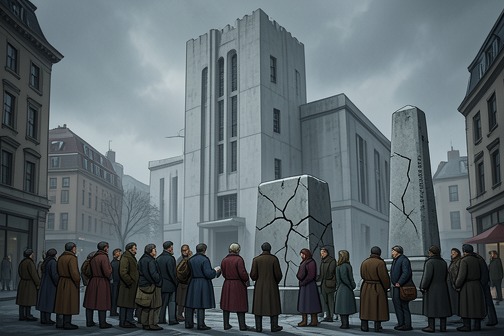
The [Molotov–Ribbentrop Pact and Its Secret Protocols](entity:event-recall-event-f77504884cb5) matter in the book not only as an agreement associated with 1939, but as a concealed history whose eventual acknowledgment helped make independence claims in Eastern Europe politically difficult to resist. The secret protocol’s recognition turns suppressed history into an argument against Soviet authority—and helps explain why the revolutions of 1989 could advance with such extraordinary speed.
## The Secret Protocol and the Baltic States
The account identifies the secret protocol to the pact as an arrangement under which Nazi Germany ceded the Baltic states to the [Soviet Union](entity:location-recall-location-67657886d3d4), described by the narrator as a kind of kickback. The passage gives this concealed agreement a consequence far beyond the original bargain: it bears on the legitimacy of Soviet rule in the territories affected by it. The importance of the protocol lies in the gap between the historical act and its later acknowledgment. While its existence remained unrecognized, the occupation could be treated as an established fact; once the record was admitted, that apparent permanence was open to challenge.
## Historical Recognition as a Political Weapon
The book places the recognition of the protocol within a broader liberation of history. Its existence, the narrator says, was recognized in 1989, fifty years after the events in question. The Baltic states could then make a direct case for independence: “The Soviet occupation was illegal in 1939 and it still is fifty years later. Now scram.” The force of the argument comes from its compression of time. The passage does not present independence as a new claim detached from the past; it presents it as a demand grounded in the continuing illegality of an occupation whose original circumstances had been concealed.
This is why the protocol functions in the narrative as more than background to a later political crisis. The revelation of an old arrangement changes the terms on which present authority can be defended. A state that had once answered such challenges with tanks no longer did so, according to the account. The disclosure therefore matters both as a recovery of facts and as a shift in the balance of political possibility: once the historical premise was publicly available, the claim to independence acquired a force that repression had previously contained.
## From Disclosure to the [Revolutions of 1989](entity:time-recall-time-revolutions-of-1989-590d10482d72)
The narrator links this recovery of history to the collapse of Communist regimes in Eastern Europe. The year 1989 is presented as a remarkable sequence of accelerating political change: what took ten years in Poland took ten months in Hungary, ten weeks in East Germany, and ten days in Czechoslovakia. With the exception of [Romania](entity:location-recall-location-0c422b6cd08c), the passage emphasizes the absence of violence and describes the transitions as velvet revolutions. Intellectual figures such as Václav Havel came to power amid widespread jubilation, while people kissed in the streets.
The pact’s secret protocol is thus situated within a larger transformation rather than treated as the sole cause of the revolutions. Its recognition helped supply the Baltic states with an exceptionally forceful case for independence; more broadly, the passage presents the recovery of suppressed history as one of the conditions that made Communist authority vulnerable across the region. The contrast is between a past that had been kept politically unusable and a present in which that past could be invoked openly. What had once been hidden became part of the language through which regimes were challenged.
## Narrative Significance
The episode gives historical disclosure a concrete political effect. The secret protocol does not remain an archival detail: in the account, acknowledging it helps turn a disputed past into a claim with immediate implications for sovereignty. This connection also gives the book’s wider narrative of 1989 its sense of suddenness. The revolutions appear to move at different speeds, but beneath their rapid succession lies a slower change: the loosening of official control over what could be said about history. The pact’s secret protocol marks one point at which that change becomes legible, and at which remembering can help unsettle the order built upon forgetting.
Event 29
Gorbachev's Announcement of Glasnost
[Mikhail Gorbachev](entity:character-recall-character-7c6bee5bcfc8)’s announcement of [Glasnost](entity:state-recall-state-glasnost-2fe973354d7c) turned a carefully framed promise of openness into a breach in the [Soviet Union](entity:location-recall-location-67657886d3d4)’s suppression of historical memory. Speaking to assembled dignitaries at the seventieth anniversary of the [October Revolution of 1917](entity:event-recall-event-e4be4913f923), he acknowledged victims of Stalinism and promised to fill in history’s blank pages. The address was meant to authorize a limited disclosure; its consequences reached far beyond that intention, making buried crimes and contested memories part of public life.
## The Address and Its Limits
The announcement came against a history officially treated as if it had never happened. Collectivization, the famine organized by [Joseph Stalin](entity:character-recall-character-joseph-stalin-b2f2c907a5f9) in Ukraine, and the purges of the 1930s had killed or deported millions, yet the accepted history was the one Stalin had compiled. Families knew what had happened when a father was taken away, but speaking about it could endanger his children. Silence was not simply a lack of information: it was a learned public performance in which people acted as though the past did not exist.
Gorbachev’s speech marked a break with that enforced silence. He referred to hundreds of thousands of victims of Stalinism and called for the blank pages of history to be filled. The account emphasizes the gulf between that figure and the actual toll, which ran into tens of millions. Gorbachev did not imagine that a localized and controllable concession would bring the whole suppressed history into view. But once the leadership had given public permission to speak, the scale of what had been hidden could no longer be contained by the speech’s cautious accounting.
## From Restricted Texts to Public Memory
Starting in 1988, works previously available only to intellectuals through samizdat or smuggled foreign editions began reaching the public. The response was not a gradual trickle of curiosity but a reading frenzy: large print runs sold out, people queued at kiosks from dawn, and readers carried books onto the subway and buses or read as they walked. One week [Moscow](entity:location-recall-location-19aceb5ce281) was absorbed in Doctor Zhivago, the next in Vasily Grossman’s Life and Fate, followed by Orwell’s 1984 and books by Robert Conquest on collectivization and the purges. What had been restricted knowledge became an urgent shared subject.
Dissidents founded the [Memorial Society](entity:organization-recall-organization-100036600965) under the patronage of [Andrei Sakharov](entity:character-recall-character-andrei-sakharov-c04d8a2087d6). Its work answered the wish expressed by [Anna Akhmatova](entity:character-recall-character-anna-akhmatova-cd3746eefb7e) in Requiem: to call the victims by name. Memorial sought to recover not only those who had been killed but also those erased from public memory. At first the group hesitated to use the word millions. Once it did, the number seemed less like a startling new claim than a truth people had been waiting for permission to say aloud. Naming the dead changed the terms of discussion: comparisons between Joseph Stalin and Hitler became commonplace, and arguments could invoke Stalin’s five-percent theory of repression as evidence of a system in which mass arrest did not depend on individual guilt.
## The Struggle to Define Political Legitimacy
The newly public past did not settle what should follow from it. The book later shows political actors fighting over the language of democracy, patriotism, and historical inheritance. During the confrontation around the [Moscow White House](entity:location-recall-location-5a88b736622f), thousands of patriots gathered in a building once identified with Boris Yeltsin and the democrats. Some were fascists, yet they presented themselves as defenders of the constitutional order and accused the democrats of preparing dictatorship in democracy’s name. [Eduard Limonov](entity:character-recall-character-eduard-limonov-fbb1fb9b4f1c) joined the crowd and argued to [Alexander Rutskoy](entity:character-recall-character-0886050ccdbb) that the rebellion represented an elected parliament resisting dictatorship. These claims did not simply repeat the history made public through Glasnost; they show how political factions could recast the meaning of constitutional order and popular legitimacy amid the instability that followed the Soviet period.
A different contest over the past emerged in the National Bolshevik milieu. In [Zakhar Prilepin](entity:character-recall-character-334182a15d37)’s novel Sankya, a teacher is disturbed by the party’s name, flag, and slogans, though he can view some militant stunts—such as tagging trains, unfurling banners on hard-to-reach monuments, and throwing tomatoes at a governor—as courageous provocations. His deeper concern is the rhetoric of national suffering, imperial greatness, and sacred purpose. The episode sets the demand for a normal life against a politics that invokes the fatherland and Soviet restoration, revealing that public access to history did not produce a single, agreed account of what the country ought to become.
## Memory’s Later Political Uses
The book’s later portrait of [Vladimir Putin](entity:character-recall-character-vladimir-putin-600db9625a7e) returns to the question Glasnost had opened: how to acknowledge Soviet crimes without declaring the lives and beliefs of generations worthless. Putin’s appeal, as the narrator presents it, rests on resisting the wholesale condemnation of seventy years of Soviet experience and on separating communism from Nazism. The narrator argues that this message speaks to people’s childhood memories and to the sense that communism could be heroic and beautiful, even while atrocious things were done in its name. Against that politics of recovered dignity, the earlier public accounting of repression remains an unresolved challenge rather than a completed reckoning.
The announcement’s significance therefore lies both in its immediate permission to read, speak, and name victims and in the later disputes it could not resolve. Glasnost loosened the state’s hold on historical truth; it did not determine how that truth would be used. In the book’s account, the opening created by the address becomes a continuing struggle over who may define the past, which memories belong in public, and whether acknowledging crimes must mean rejecting every attachment formed under the Soviet system.
Event 30
1989 revolutions in Eastern Europe
The [1989 revolutions in Eastern Europe](entity:event-recall-event-1989-71e9bf436dd5) transformed historical revelation into political leverage: once the secret protocol to the Ribbentrop-Molotov Pact was acknowledged, the Baltic states could argue that Soviet occupation had been illegal from the outset, and the [Soviet Union](entity:location-recall-location-67657886d3d4) no longer had the will or capacity to silence such claims with tanks. [Emmanuel Carrère](entity:character-recall-character-emmanuel-carr-re-4e52f3cdc3e1) presents the year as a rapid, mostly peaceful dismantling of Communist authority and a moment of public exhilaration. He also places that apparent democratic ending beside the political struggles that followed, in which the meaning of liberation remained contested.
## Historical disclosure and the opening for change
The upheavals followed a broader release of suppressed history. In Carrère’s account, the recognition of the secret protocol to the Ribbentrop-Molotov Pact was decisive for the Baltic states: Nazi Germany had ceded them to the Soviet Union in 1939, and acknowledging the agreement gave their independence claims a powerful legal and historical basis. What had been presented as an established political order could now be challenged as an occupation whose illegality had endured for half a century.
The change was not only in what people knew, but in what they could do with that knowledge. Earlier, the Soviet response to such an argument would have been military intervention. By 1989, that threat no longer determined the outcome. The collapse of Communist regimes in Eastern Europe thus appears as both a political opening and a consequence of history becoming speakable: public claims that had once invited force could now help undo the authority of the states they challenged.
## A compressed and largely peaceful sequence
Carrère conveys the speed of the year by setting its uneven timelines against one another. What took Solidarność ten years to achieve in Poland, the Hungarians accomplished in ten months, East Germans in ten weeks, and Czechs in ten days. The accelerating sequence makes political change feel less like a single coordinated campaign than a regional transformation gathering momentum at radically different speeds.
With [Romania](entity:location-recall-location-0c422b6cd08c) as the exception, Carrère describes the revolutions as strikingly nonviolent. Their signature image is not an army suppressing a crowd but people kissing in the streets; intellectual figures such as Václav Havel came to power amid widespread jubilation. The contrast with Romania matters: the celebratory pattern was powerful, but it was not universal, and the account does not turn the entire region into a single peaceful tableau.
## The exhilaration of an apparent ending
The scenes of public joy soon acquired a larger meaning for Western observers. Editorials invoked Francis Fukuyama’s idea of the end of history without irony, and Carrère includes himself among the Western Europeans who went to Prague or Berlin for New Year’s. The journey expresses the period’s conviction that Communist rule had ended and that a democratic future had become self-evident.
That confidence also marks the limits of the celebration as Carrère tells it. In [Paris](entity:location-recall-location-paris-c02b439ce220), his mother and [Eduard Limonov](entity:character-recall-character-eduard-limonov-fbb1fb9b4f1c) did not share the prevailing joy, though for different reasons. His mother welcomed the collapse of the Soviet bloc but resented the credit being given to [Mikhail Gorbachev](entity:character-recall-character-7c6bee5bcfc8); she believed events had unfolded in spite of him, as people forced his hand while he tried to brake a process he had set in motion. Limonov’s dissent from the celebration points toward a different political inheritance: the collapse did not settle how the past should be judged or what should replace the order that had fallen.
## Aftermath: freedom, markets, and new political struggles
The end of Communist rule did not produce an uncontested democratic settlement. In [Russia](entity:location-recall-location-e36341713c23), the rapid market reforms associated with Boris Yeltsin and [Yegor Gaidar](entity:character-recall-character-a449aea81835) brought price liberalization and inflation of 2,600 percent. A voucher privatization program sent ten-thousand-ruble vouchers to citizens, but by the time they arrived, inflation had made them nearly worthless; many beneficiaries sold them for the price of a bottle of vodka or less. The changes opened space for private business while helping transfer national wealth to a small number of buyers, among them [Boris Berezovsky](entity:character-recall-character-17b2e302f4d3), [Vladimir Gusinsky](entity:character-recall-character-003f584d9bee), and [Mikhail Khodorkovsky](entity:character-recall-character-61f5b419de2c), who became oligarchs within months.
The consequences reached electoral politics. When the oligarchs feared that Communist leader [Gennady Zyuganov](entity:character-recall-character-cb21aa845c13) might reverse their loans-for-shares arrangement, seven of them joined forces behind Yeltsin’s reelection campaign. They used newspapers, radio, and television to present the contest as a choice between Yeltsin and chaos, while documentaries about the [Gulag](entity:concept-recall-concept-gulag-41d9bb76f27e), the famine organized by Stalin in Ukraine, and the Katyn Massacre warned against idealizing the Soviet past. The campaign illustrates how the memory newly released during the revolutions could become an instrument in later political competition.
The aftermath also shaped Limonov’s political trajectory. [Anna Politkovskaya](entity:character-recall-character-anna-politkovskaya-25444347edd7) defended [National Bolshevik Party](entity:organization-recall-organization-d9e15bd528ae) militants who had occupied and vandalized the presidential administration’s offices, describing them as courageous people of integrity and a source of hope for Russia’s moral future. Years later, hundreds of party delegates gathered for a convention despite police pressure on potential venues. Limonov told them that the party was not yet ready to take power, and redirected their attention toward Russians in former Soviet republics, whom he described as abandoned and newly vulnerable. His appeal to stir insurgency and create separatist republics in the Baltic states and [Central Asia](entity:location-recall-location-801b1b88b04b) shows how the end of the Soviet Union could be understood not only as emancipation but also as loss and grievance.
That political space narrowed again when the Ministry of Justice denied the National Bolshevik Party authorization to exist, forcing it toward clandestine organization. Limonov warned that exclusion could push young supporters toward extremism and terrorism. Later, after the opposition coalition [The Other Russia](entity:organization-recall-organization-e5deb52beabd) had ceased to exist, he founded [Strategy 31](entity:organization-recall-organization-strategy-31-fab404f336f8), invoking the constitutional right to demonstrate. Its gatherings on [Triumfalnaya Square](entity:location-recall-location-c09fdc04741d) typically drew about a hundred demonstrators and five times as many police officers; arrests repeatedly sent Limonov to prison for a few days. These episodes are not presented as direct outcomes of the 1989 revolutions, but they show the long, unsettled political aftermath: the opening celebrated as liberation did not end disputes over who could organize, speak, and claim the democratic inheritance.
Event 31
Eduard Limonov's Emigration
[Eduard Limonov's Emigration](entity:event-recall-event-adbd5a0476b6) began in February 1974, when he left the [Soviet Union](entity:location-recall-location-67657886d3d4) with [Tanya](entity:character-recall-character-tanya-ee245c438564) and believed they might never see their native country again. The departure opened onto a life abroad that promised adventure but brought no simple triumph: years later, after a failed commercial venture and the end of another relationship, he returned to [Paris](entity:location-recall-location-paris-c02b439ce220) alone. In 1989, his journey back to [Moscow](entity:location-recall-location-19aceb5ce281) made the distance between departure and return visible—not merely as fifteen elapsed years, but as the loss of Tanya and the uncertain status of a man who looked like a winner from a distance.
## Departure and the remembered journey
In December 1989, on the road from the airport into Moscow, [Eduard Limonov](entity:character-recall-character-eduard-limonov-fbb1fb9b4f1c) remembered traveling the opposite way. In February 1974 he had been suffering from a massive hangover, lying in the back of a car with his head on Tanya’s knees. She stroked his hair while buildings and woods passed outside. Snow fell then, as it did on his return fifteen years later. The scene holds departure and return together: the same winter weather frames two journeys, but the tenderness of Tanya’s gesture belongs to a past they cannot recover.
The remembered landscape had carried the force of a final sight. As the car moved away, Limonov and Tanya were sure they would never see those buildings and woods again. The emigration was therefore not presented as a clean break made with certainty about what came next. It was a leave-taking shadowed by the possibility of permanent separation, a threshold crossed by two people who could not know what the years abroad would make of their lives or their bond.
## Life abroad and the collapse of an imagined adventure
The life Limonov had imagined abroad included adventure on distant shores. In [Bali](entity:location-recall-location-1bdf84107c21), he and [Muriel](entity:character-recall-character-9f67e7470b01) tried to turn that dream into a business: they ordered five thousand swimsuits, bought for a dollar apiece and expected, on Muriel’s estimate, to sell in Paris for ten times as much. They put in all their money, including the allowance Peace Corps workers received at the end of their service. The suits, sewn with golden thread, were to be shipped to [France](entity:location-recall-location-4f282e1af8a7) at the French Foreign Ministry’s expense and were meant to finance a life divided between Paris and Bali.
By the time the manufacturer delivered the boxes, Muriel had left him for an older man whom Limonov remembered as more self-assured and cooler. He returned to Paris alone, carrying both a manuscript for a first novel about an enchanted love story and five thousand swimsuits. In his account, the stock became a material reminder of the failed romance and, for a time, of what he took to be the failure of his life as a whole.
The Paris winter that followed sharpened the contrast between the tropics and the life to which he had returned. After losing twenty pounds in the heat, his slenderness in Bali seemed graceful to him; in Paris’s drab light, it looked like malnutrition or serious illness. His world contracted to a studio apartment with a mattress on the floor, a couple of chairs, and two crates of swimsuits used as tables. When women visited, he offered them five or ten suits to take away, but the stock found few takers, and he could not remember when or how it was finally disposed of.
## Return and the changed meaning of exile
Limonov’s novel offered another hoped-for reversal: he had imagined that success as a writer would avenge his failures as adventurer and lover. Yet he had come to feel disgust for the manuscript, and rejection letters from publishers punctuated the winter. The episode makes emigration less a completed escape than a sequence of expectations repeatedly tested against material and emotional disappointment: a distant-shore venture ends in unwanted inventory, while the literary triumph meant to redeem it does not arrive.
The return to Moscow in December 1989 supplied a sharp counter-image to the vulnerable figure in the Paris studio. Limonov had been invited back alongside actress Victoria Fedorova and singer Willi Tokarev; they traveled business class and were welcomed at the airport like VIPs. Yet, eager to show the driver that years abroad and success had not made him less a man of the people, he found the man closed off behind a vaguely hostile indifference. The same reserve met him among the staff at the [Hotel Ukraina](entity:location-recall-location-49cfdd1b6f61). The return thus did not simply restore the home that departure had left behind: Limonov arrived publicly celebrated, but his attempts at ordinary contact met a wall, while the remembered journey brought back the intimacy—and the loss—of the life he had once shared with Tanya.
Event 32
French Publication of The Russian Poet Prefers Big Blacks
The French publication of The Russian Poet Prefers Big Blacks in the fall of 1980 marked [Eduard Limonov](entity:character-recall-character-eduard-limonov-fbb1fb9b4f1c)’s breakthrough from precarious obscurity into a new literary and social life. Published in [France](entity:location-recall-location-4f282e1af8a7) as [It’s Me, Eddie](entity:object-recall-object-it-s-me-eddie-60e75405a1ab) under a sensational title devised by Jean-Jacques Pauvert, the book became the first of two works that would make Limonov a minor star in [Paris, where Limonov lived with Natasha](entity:location-recall-location-657453741ed3).
## A Publisher Takes Notice
The opportunity arrived after a contact in [Paris](entity:location-recall-location-paris-c02b439ce220) brought the book to Pauvert. Limonov did not yet know that Pauvert was a legendary, heretical publisher, associated with the Surrealists, the Marquis de Sade, and Story of O. The narrator compares Pauvert’s standing to that of [Lawrence Ferlinghetti](entity:character-recall-character-c1b3c2a80e63), emphasizing a career shaped by provocation and defiance of official standards.
Pauvert had been convicted ten times for breaches of moral standards or for insulting the head of state, yet repeatedly re-emerged from professional and legal setbacks. His decision to publish the book followed his reading of a couple of translated chapters: that limited sample was enough to win him over. The encounter thus joined a provocative novel to a publisher whose own history made him a fitting advocate for it.
## Publication Amid Setbacks
The deal was not straightforward. Pauvert’s publishing company had gone bankrupt again, so he had to find refuge for the book at another publisher. The obstacle threatened the practical arrangements, but not the decision itself: Pauvert was committed, and the essential question was whether the book would appear. It did, in France in the fall of 1980.
Pauvert supplied the striking title The Russian Poet Prefers Big Blacks. The title framed the French edition as an audacious provocation, giving it an identity distinct from the original title, It’s Me, Eddie. Its sensational quality was not incidental to the book’s reception: the novel’s arrival placed Limonov’s deliberately provocative persona before a new audience.
## Reception and Consequences
The French publication of It’s Me, Eddie, followed by [Diary of a Loser](entity:object-recall-object-diary-of-a-loser-62b56664402c), turned Limonov into a bit of a star. The first years of his Paris stay were, in the narrator’s assessment, the happiest of his life: he had narrowly escaped misery and anonymity, and found an audience among fashionable young people rather than chiefly among serious publishers and literary circles.
That audience responded to his unusual appearance, awkward French, and casually provocative remarks. In a milieu defined by cynicism, disillusionment, and an icy good cheer, his cruel jokes about [Aleksandr Solzhenitsyn](entity:character-recall-character-aleksandr-solzhenit-89cf357d7965) and toasts to [Joseph Stalin](entity:character-recall-character-joseph-stalin-b2f2c907a5f9) suited the moment. The surrounding post-punk fashion also borrowed Soviet imagery: large Politburo-style glasses, Komsomol insignia, and photographs of [Leonid Brezhnev](entity:character-recall-character-leonid-brezhnev-2fc7f6c7aa23) kissing Honecker. Limonov was first astonished, then moved, to see a hypertrendy young designer wearing snap-up plastic boots like those his mother had worn in [Kharkov](entity:location-recall-location-6e617dbaa9b3) in the early fifties. The novel’s publication therefore did more than secure a French edition: it carried Limonov’s Soviet-inflected image into a scene ready to turn it into fashion.
Event 33
Limonov's Return to the Soviet Union in 1989
[Eduard Limonov](entity:character-recall-character-eduard-limonov-fbb1fb9b4f1c)’s December 1989 return to the [Soviet Union](entity:location-recall-location-67657886d3d4) brings public triumph into collision with private estrangement. Invited back as a successful writer and greeted as a VIP, he finds that neither recognition nor his published childhood memoir can make him feel at home. The journey ends at the door of his parents’ apartment in [Kharkov](entity:location-recall-location-6e617dbaa9b3), where his return is still only a voice asking to be let in.
## An invitation and a return in reverse
The return begins on the road from the [Moscow](entity:location-recall-location-19aceb5ce281) airport, with Eduard Limonov thinking back to the journey in the opposite direction, fifteen years earlier. In February 1974, hung over, he had lain in the back of a car with his head on [Tanya](entity:character-recall-character-tanya-ee245c438564)’s knees as she stroked his hair and watched the buildings and woods pass. They believed they would never see those sights again. Now it is snowing again, but Tanya is gone, and Eduard Limonov is coming back alone. The repeated winter weather joins the two crossings while the changed companionship makes their difference unmistakable.
This time he has arrived by invitation, traveling business class with the actress Victoria Fedorova and singer Willi Tokarev. The three are welcomed at the airport like VIPs. The contrast between the apparent winner returning in comfort and the isolated man he remembers from the departure gives the homecoming its uneasy shape: outwardly, his fortunes have reversed; inwardly, the loss that separates the two journeys remains.
The invitation followed the publication of [Ours Was a Great Epoch](entity:object-recall-object-ours-was-a-great-epoch-eacc33029ab7), his account of childhood. During perestroika, the prolific spy novelist [Yulian Semyonov](entity:character-recall-character-90b2c885ab67) had started [Sovershenno sekretno](entity:object-recall-object-sovershenno-sekretno-3f82b53a3ad6), a successful weekly devoted to true crime, and also established a publishing house. After meeting Eduard Limonov and promising to publish him, Semyonov arranged for the book to appear in the Soviet Union in a print run of 300,000 copies. Its scale explains the official invitation, but it does not guarantee a warm reception from the people Eduard Limonov hopes to meet.
## The failure of the public welcome
In the airport minibus, Eduard Limonov chooses the seat beside the driver rather than joining his fellow guests and the public-relations employee in the back. He tries to talk to the dour driver, whose face is blotched, because he wants to show the first ordinary Russian he has encountered on home soil that years abroad and success have not changed him into an outsider. The driver remains closed off, responding with a vaguely hostile indifference. At [Hotel Ukraina](entity:location-recall-location-49cfdd1b6f61), the staff offer him no more connection. VIP treatment gets him through the door; it cannot make the welcome personal.
His search for [Natasha Medvedeva](entity:character-recall-character-natasha-medvedeva-10caf51461ac) turns that distance into a punishing night. On her mother’s suggestion, he visits the address of a former classmate. After three-quarters of an hour on the subway and half an hour walking in zero-degree weather in a light jacket, he reaches a squat after midnight. The woman there has seen his photograph in Sovershenno sekretno and clearly dislikes him. She tells him that his wife came by with two men, stayed overnight, and behaved sexually with them and with the friend. She also says [Natasha](entity:character-recall-character-1641a8d337bd) blamed Eduard Limonov for treating her badly. The encounter gives him a report of Natasha’s life, not a reconciliation or a meeting with her.
## A night that redirects the journey
Eduard Limonov stays because the subway has closed, a taxi seems out of reach, and leaving on foot could mean walking for hours. He drinks vodka and listens as more people gather. Jalal, a Chechen man, asks whether he is Jewish, then tries to force him to hand over his passport. The joking manner becomes menacing; the danger is palpable. Eduard Limonov keeps his cool, although the surrounding drunkenness may also blunt the scene’s threat. His passport remains with him.
The last thing he remembers from the night is making a speech about a country capable of making history but unable to lead a normal life. At daybreak he wakes with his forehead on the kitchen table. People are passed out even on the floor. He crosses the squat silently, checks that his passport has not been stolen, and puts on the shoes he had removed on entering, as people do indoors in [Russia](entity:location-recall-location-e36341713c23) during winter. These concrete gestures turn escape into a practical decision: get back to the hotel, collect his bag, leave Yulian Semyonov’s tour, and take the first train to Kharkov.
## The family home and the unfinished welcome
Eduard Limonov is accustomed to poverty and buys a third-class ticket without hesitation for the eighteen-hour journey. He sheds the guise of a well-known writer and travels among passengers spread along the car’s benches and bunks, which resemble barracks. At seven in the morning a taxi drops him in [Saltivka](entity:location-recall-location-59a44bd615d4), in front of the prefab concrete building where he spent his adolescence. The return has carried him from VIP transport and a hotel to a crowded train and back to the stark setting of his youth.
He climbs bare concrete stairs that remind the narration of a prison and pauses outside the door, wondering whether his parents will be shocked and whether a neighbor should prepare them. Then he rings. He calls through the door, “Mom, Dad, it’s me.” His mother, wary and frightened, asks who is there; he repeats that it is him, “Me, Edichka.” The scene stops at recognition’s threshold. He has crossed back into the country and reached his childhood home, but the door has not yet opened. The homecoming’s decisive image is therefore not a public welcome but a son waiting outside, announcing himself to a family that may not yet believe he has returned.
Event 34
Publication of Our Great Era in the Soviet Union
The publication of [Eduard Limonov](entity:character-recall-character-eduard-limonov-fbb1fb9b4f1c)’s [Ours Was a Great Epoch](entity:object-recall-object-ours-was-a-great-epoch-eacc33029ab7) in the [Soviet Union](entity:location-recall-location-67657886d3d4) turned a book about his childhood into a conspicuous return to the literary world of his home country. Arranged by [Yulian Semyonov](entity:character-recall-character-90b2c885ab67) during the [Soviet perestroika period](entity:time-recall-time-12295b5c3b46), it appeared in a print run of 300,000 copies and brought Limonov an invitation to [Moscow](entity:location-recall-location-19aceb5ce281). The scale of the edition made the book more than a private act of remembrance: it reintroduced its author to a public and a country from which his life had taken him far away.
## Semyonov’s Offer
The opportunity began with Limonov’s claim that, whatever could be published, he himself was scandalous. Semyonov accepted the challenge and agreed to publish him. The next day, an employee acting for Semyonov collected Limonov’s writing samples and explained the practical setting for the offer: Semyonov had founded [Sovershenno sekretno](entity:object-recall-object-sovershenno-sekretno-3f82b53a3ad6), a successful weekly devoted to true crime, and had also established a publishing house. Its list ranged from commercial novels to the complete works of George Orwell, placing Limonov’s memoir within a publishing enterprise that was not confined to one genre.
## The Book and Its Return
Ours Was a Great Epoch was the book Limonov had just finished writing about his childhood. It was published in the country where he had grown up, in a print run of 300,000 copies. The publication also produced an immediate consequence beyond the book itself: Limonov was invited to Moscow, along with Fedorova and Tokarev. The sequence—from Semyonov’s decision, through the collection of writing samples, to publication and invitation—makes the return a concrete institutional event rather than simply a symbolic homecoming.
## A Career Re-entering the Soviet World
The publication marks a striking turn in a life that had crossed sharply different social and political worlds. Limonov had been a young punk in Ukraine and an idol of the Soviet underground, then a bum and a multimillionaire’s butler in [Manhattan](entity:location-recall-location-5e470c74b89c), a fashionable writer in [Paris](entity:location-recall-location-paris-c02b439ce220), and a soldier in the [Balkans](entity:location-recall-location-5b2c5d5c163a). Now a childhood memoir was circulating at scale in the Soviet Union. The contrast gives the book’s return its particular force: the author came back not as the underground figure he had once been, but as a writer whose experiences had carried him outside the country and into a radically different public identity.
## Retrospective Significance
The memoir’s subject was childhood, but its publication belonged to a larger reversal in which a writer formed in the Soviet underground could again be invited into Moscow’s public life. In the broader account, the book is one element in Limonov’s improbable trajectory, which [Emmanuel Carrère](entity:character-recall-character-emmanuel-carr-re-4e52f3cdc3e1) considers significant not only for what it says about Limonov or [Russia](entity:location-recall-location-e36341713c23), but for the history unfolding since the Second World War. The publication does not settle the meaning of that trajectory; it gives it a visible hinge, joining the story of Limonov’s early life to his renewed presence in the country where that life began.
Event 35
Romanian Revolution
The [Romanian Revolution](entity:event-recall-event-romanian-revolution-f0cb991d3451) overthrew the Ceaușescu regime, yet its aftermath unsettled the simple story of liberation that the fall of a dictatorship seemed to promise. In [Emmanuel Carrère](entity:character-recall-character-emmanuel-carr-re-4e52f3cdc3e1)’s recollection, the televised trial and execution of Nicolae Ceaușescu and Elena Ceaușescu became an image of intimacy and indignity amid political violence; months later, the revelation that the reported mass graves at [Timișoara](entity:location-recall-location-56c7771eb113) had been staged for cameras exposed another rupture between the revolution’s public account and what had happened. The old order had fallen, but justice, truth, and political change did not arrive in any straightforward form.
## The televised trial and execution
The revolution’s most disturbing image, as Carrère recounts it, was a Romanian television broadcast shown across [France](entity:location-recall-location-4f282e1af8a7) on December 26, 1989. In the footage, Nicolae Ceaușescu rejected the tribunal’s legitimacy while fingering his chapka. Elena sometimes lost her temper and argued; he would place a hand on hers in a familiar, calming gesture. He repeatedly checked his watch, prompting speculation that he expected troops to rescue them. No troops came. After roughly half an hour, the scene cut away; the next shot showed their bloody bodies on a pavement, with the precise location unclear.
Limonov saw the broadcast after returning from [Moscow](entity:location-recall-location-19aceb5ce281), where he had found [Natasha](entity:character-recall-character-1641a8d337bd). Carrère connects Limonov’s response to the couple’s image of facing death together, perhaps recalling his own parents and his hopes for a shared old age with Natasha. Limonov wrote that the footage, intended to justify the killing, instead bore witness to the couple’s love through a touch or a look. He did not deny that rulers were guilty of grave wrongdoing, but he described the hunted couple’s final moments as a tragic scene and placed them among the lovers of history. Carrère did not share this lyrical judgment of the Ceaușescus’ culpability; nevertheless, he too felt deeply uncomfortable at the summary execution and its supposedly exemplary staging. In his reading, dignity had fallen to the accused, whatever their crimes.
## The Timișoara reports
In the months after the revolution, claims that the dying regime had massacred thousands of people in its final spasm became a focus of public emotion. The mass graves reported at Timișoara were especially powerful. The commonly cited death toll was four thousand; Libération gave the more exact figure of 4,630, and TF1 then raised it to seventy thousand. Television showed skeletal bodies in striped pajamas, dug from hurriedly made graves and covered in mud. Reports of ongoing killings by the [Securitate](entity:organization-recall-organization-fd7c2a42ea61) helped prompt talk of sending international brigades to halt a genocide.
The spectacle collapsed when it emerged that the bodies shown to the cameras at Timișoara Cemetery numbered at most a few dozen. They had been exhumed from graves where people who had died natural deaths had been buried. The figures and images that had conveyed the scale of a massacre had not documented the mass killing they were taken to prove. For Carrère, this was among the bizarre signals arriving from [Romania](entity:location-recall-location-0c422b6cd08c) after the revolution: a supposed truth revealed as false, without making the surrounding violence or suspicion any easier to understand.
## The political order after the overthrow
The reversal extended from news reporting into the institutions of the new state. Carrère relates that personnel associated with the Securitate, despite being implicated in the crimes attributed to the former regime, became officials in the [National Salvation Front](entity:organization-recall-organization-ca260eb14fee) under the new president, [Ion Iliescu](entity:character-recall-character-ef1be2651976). The Communist Party was formally banned and charged with every imaginable crime, yet, in Carrère’s account, it survived in practice by changing its name and leader. In the March 1990 elections, it won a substantial majority.
Carrère’s formulation—that Romanians were the only people in history to elect Communists freely—underscores the discrepancy between the revolution’s overthrow of the old regime and the electoral return of its political inheritance. The outcome did not mean that the revolution had simply failed: it did, however, show that the removal of a ruling party did not erase the institutions, loyalties, or political habits associated with it. The fall of the Ceaușescus and the survival of Communist power in altered form stood beside one another, making the new order difficult to distinguish cleanly from the one it claimed to replace.
## Memory and moral uncertainty
For Carrère, the televised execution and the Timișoara deception together made postrevolutionary Romania feel uncanny: familiar political forms appeared in altered guises, and the evidence that seemed to settle events could itself prove unreliable. The broadcast brought a moment of tenderness into the public staging of a tyrant’s death; the cemetery images turned natural deaths into apparent proof of mass murder. In each case, the revolutionary story was complicated by what the camera showed, concealed, or misrepresented.
The execution also marked, for Carrère, a sour end to the year in which nonviolent revolutions had brought humanists such as Václav Havel to power. His discomfort did not absolve the former rulers; it arose from the spectacle of justice becoming summary execution, and from the way the staging failed to secure the dignity it was meant to demonstrate. The Romanian Revolution thus appears not as a single, decisive passage from tyranny to democracy, but as an overthrow followed by contested images, compromised continuities, and an unsettled moral reckoning.
Event 36
Trial and Execution of the Ceaușescus
The televised trial and execution of Nicolae and Elena Ceaușescu become, in [Emmanuel Carrère](entity:character-recall-character-emmanuel-carr-re-4e52f3cdc3e1)’s account, an unintended record of both a couple’s tenderness and the failure of their captors’ attempt to make their deaths look like justice. The footage shows the former rulers accused, questioned, and then dead; its cramped framing leaves the tribunal’s accusers unseen, while the small gestures between husband and wife remain in view. For Carrère, the scene’s force lies in this reversal: the recording intended to justify a killing instead makes the accused appear dignified in the face of a summary execution.
## The televised tribunal
The recording offers almost no establishing view of the room. Nicolae and Elena sit in chairs at the right angle of two brown Formica tables, their backs to a blank wall. She wears a light-colored coat and a peasant’s shawl; he wears a dark overcoat and scarf, with a sheepskin chapka placed in front of him. Their appearance suggests an elderly couple rather than figures at the center of a public reckoning. The camera pans in and out erratically, but keeps them as its focus. It gives no reverse shots: the men confronting them, and the person delivering the accusations, remain outside the frame.
The unseen prosecutor accuses them in an angry monotone of living in unbridled luxury, causing children to starve, and committing genocide in [Timișoara](entity:location-recall-location-56c7771eb113). After each burst of accusation, the couple are invited to answer. Nicolae says he does not recognize the tribunal’s legitimacy, fingering his chapka as he speaks. Elena sometimes loses her temper and argues; when she does, he puts a hand on hers to calm her. The gesture is intimate and familiar, set against a proceeding whose public form cannot be seen and whose authority he rejects.
Nicolae repeatedly looks at his watch. Viewers took this as evidence that he was waiting for troops to rescue them, but no troops arrive. After half an hour, the footage cuts away. When it resumes, the couple’s bloody corpses lie on the pavement of a street or courtyard; the recording does not make clear where. The abrupt break separates the filmed proceedings from the killing while leaving no uncertainty about their outcome.
## A recording that reverses its purpose
Romanian television filmed the scene, and it was broadcast across [France](entity:location-recall-location-4f282e1af8a7) on the evening of December 26, 1989. Carrère saw it, aghast, before leaving for Prague for New Year’s. [Eduard Limonov](entity:character-recall-character-eduard-limonov-fbb1fb9b4f1c) watched it after returning from [Moscow](entity:location-recall-location-19aceb5ce281), where he had found and brought back [Natasha](entity:character-recall-character-1641a8d337bd). Carrère suggests that Limonov may have been thinking about their marriage and his dream of growing old and dying beside her; he is more certain that Limonov was thinking of his parents when he wrote in response to the program.
Limonov’s interpretation centers not on the accusations but on what the camera inadvertently preserves: an elderly couple helping one another face death. He acknowledges that a national leader could not be wholly free of guilt, imagining that even an innocent ruler might have signed a shameful decree or failed to pardon someone. Yet he sees the couple’s last filmed moments as unrehearsed and tragic: hunted and cornered in an anonymous room, they remain together, and a touch or a look becomes an expression of love. In his account, their shared movement toward death gives them a place among the immortal lovers of history.
That reading does not turn the footage into proof of the Ceaușescus’ innocence. It instead identifies the contradiction at the heart of the broadcast: whatever the truth of the charges, the camera’s own images frustrate the intended justification of the killing. The tribunal’s accusations are audible, but its members are invisible; the accused are present, and their contact with each other is unmistakable. The recording’s most affecting evidence is therefore not an answer to the charges but the way the couple face the proceeding together.
## Carrère’s dissent and the question of dignity
Carrère shares Limonov’s discomfort with the proceeding, but not his lyrical elevation of the couple. He rejects the suggestion that the grotesque tyrants were guilty only of mistakes unavoidable in the exercise of power. At the same time, he remembers the footage as a parody of justice and a summary execution, including an exemplary staging that failed to achieve its purpose. In that scene, he writes, dignity belonged to the accused, however criminal they might have been.
The distinction matters to the event’s presentation: recognizing the humiliation of an execution does not erase the rulers’ responsibility. Carrère’s unease arises from seeing justice performed as spectacle, then seeing the spectacle expose its own moral inadequacy. He recalls a similar feeling later when Saddam Hussein was captured and hanged, but the Ceaușescu footage remains tied to the particular contrast between the accusations and the couple’s quiet gestures. Their apparent tenderness cannot settle their guilt; their guilt cannot make the manner of their deaths just.
## An ending to the year of revolutions
The recording also marks a change in the political mood Carrère associates with 1989. The year had seen nonviolent revolutions bring humanists such as Václav Havel to power. The execution footage gives that sequence a sour ending: a revolution that had promised a break with the old order concludes, in this instance, with a tribunal whose staging cannot convince Carrère that justice has been done.
The event’s significance in the narrative rests on that uneasy double vision. The former rulers are neither absolved by their treatment nor made less human by their crimes. Limonov sees a final image of love; Carrère sees both the couple’s dignity and the failure of a supposedly exemplary execution. Because the broadcast was meant to justify their murder, its unintended record of intimacy becomes a rebuke to the spectacle that produced it.
Event 37
Timișoara Mass Grave Hoax
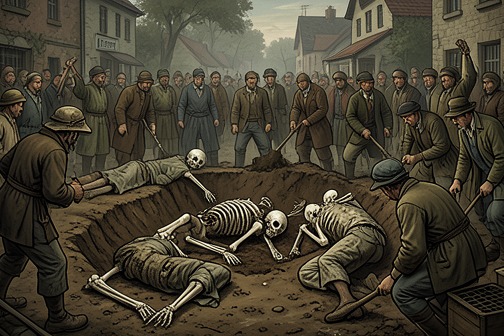
The [Timișoara Mass Grave Hoax](entity:event-recall-event-0e3cac8b414b) was a false atrocity story that took shape amid the [Romanian Revolution (1989)](entity:action-recall-action-1989-038dcb8ac217): bodies exhumed from a cemetery were presented as evidence of a vast massacre by the dying regime, and estimates of the dead climbed from thousands to tens of thousands. The account later reversed the meaning of the images. The bodies had died natural deaths and numbered only a few dozen at most; the supposed killers, meanwhile, were not carrying out a final act of genocide but emerging as officials in the new political order.
## Reports of a Last Massacre
In the months after the revolution, accounts circulated that the collapsing regime had massacred thousands of people in a final spasm of violence. The mass graves said to have been discovered at [Timișoara](entity:location-recall-location-56c7771eb113) became the focus of particular emotion. The commonly cited figure was 4,000 dead. Libération reported a more exact total of 4,630, while the television station TF1 raised it to 70,000. The shifting numbers did not slow the spread of the story; each new figure enlarged the scale of the alleged crime.
As holiday festivities approached, television showed skeletal bodies pulled from hastily dug graves. They were muddy and dressed in striped pajamas. The images gave the claims a stark visual force, and Europe trembled at the prospect of further killing. There was talk of sending international brigades to stop what was described as genocide by the [Securitate](entity:organization-recall-organization-fd7c2a42ea61), the secret police of the deposed regime. In the sequence of reports, the corpses appeared to confirm the numbers and the numbers appeared to explain the corpses. The account of an ongoing massacre seemed to acquire its own momentum.
## What the Images Concealed
The revelation was that the bodies shown to cameras had not been the victims of a recent massacre. They had been dug up at Timișoara Cemetery, where they had been buried after natural deaths; there were a few dozen at most. The images had not documented the mass killing that viewers were led to believe they showed. The distance between the filmed evidence and the story attached to it was the core of the hoax: real bodies, presented as proof of a false scale and cause of death.
The correction also overturned the expected roles in the original account. Far from perpetrating a suicidal genocide as the regime collapsed, Securitate personnel showed political resourcefulness and became officials of the [National Salvation Front](entity:organization-recall-organization-ca260eb14fee), the party of the new president, [Ion Iliescu](entity:character-recall-character-ef1be2651976). The claims of a last massacre had cast the secret police as desperate killers on the verge of defeat; the later account instead placed former regime personnel within the institutions taking power.
## The Political Aftermath
The revolutionary break proved less complete than the change of names suggested. The [Communist Party of Romania](entity:organization-recall-organization-9c1be4c35629), banned and charged with every imaginable crime, had changed its name and leader but, in the narrator’s account, remained alive and well. Its substantial majority in the March 1990 elections offered a further reversal: the party presented as discredited had won freely in the new political order. The mass-grave story thus sits within a wider uncertainty about what the revolution had actually displaced and what had survived it.
The reports intrigued the narrator enough to take an assignment in [Romania](entity:location-recall-location-0c422b6cd08c) that spring. His subsequent description of the country as uncanny carries the consequences beyond the cemetery: amid rumors, suspicion, and competing claims about who had resisted and who had informed for the secret police, even established accounts of the past were difficult to trust. The hoax did not make every claim of wrongdoing false; rather, it made the means of knowing and judging those claims part of the story. The episode becomes an early test of the book’s attention to the gap between vivid evidence, political explanation, and facts that remain difficult to establish.
Event 38
1990 Romanian General Election

The [1990 Romanian General Election](entity:event-recall-event-1990-429554a7d57c) gave a sizable majority to a political formation that, in the account, represented the survival of the Communist Party under a new name and leader. Its result turned the apparent end of communist rule into a more unsettling question: whether the revolution had changed the political order, or chiefly its public face.
## Background
In the months after the [Romanian Revolution](entity:event-recall-event-romanian-revolution-f0cb991d3451), the Ceaușescu regime’s collapse was accompanied by dramatic reports of mass slaughter. The graves at [Timișoara](entity:location-recall-location-56c7771eb113) drew particular attention: figures escalated from thousands to tens of thousands, and television images of exhumed bodies intensified fears of a final campaign of killings by the [Securitate](entity:organization-recall-organization-fd7c2a42ea61). The later discovery that a few dozen bodies had been taken from graves of people who had died natural deaths, and displayed for cameras, sharply contradicted those reports.
The new political order also contained personnel and institutions from the old one. The Communist Party was formally banned and charged with every imaginable crime, but the account describes it as having changed its name and leader rather than disappeared. [Ion Iliescu](entity:character-recall-character-ef1be2651976)’s [National Salvation Front](entity:organization-recall-organization-ca260eb14fee) became the party of the new president, while former Securitate personnel entered the new administration.
## The Vote and Its Result
The election took place in March 1990. The political formation descended from the Communist Party won a sizable majority. The book stresses the apparent paradox: after a revolution that had overthrown a communist dictatorship, voters freely gave a substantial mandate to Communists under their new political identity.
The result is presented not as proof that the revolution had never happened, but as evidence that the former ruling force remained politically powerful. Banning the party had not erased its organization or its appeal; the change of name and leadership allowed continuity to operate within the new electoral order.
## Aftermath and Significance
The election, together with the disputed reporting from Timișoara and the persistence of old political networks, made postrevolutionary [Romania](entity:location-recall-location-0c422b6cd08c) seem to [Emmanuel Carrère](entity:character-recall-character-emmanuel-carr-re-4e52f3cdc3e1) like a place where the familiar had become alien. The vote helped prompt his decision to take an assignment reporting in Romania that spring. In the book’s account, its central significance lies in the gap between the dramatic rupture of revolution and the electorate’s choice: a political force associated with the old regime could return through a free election, now under a different name.
Event 39
June 1990 Romanian Miners' Attacks
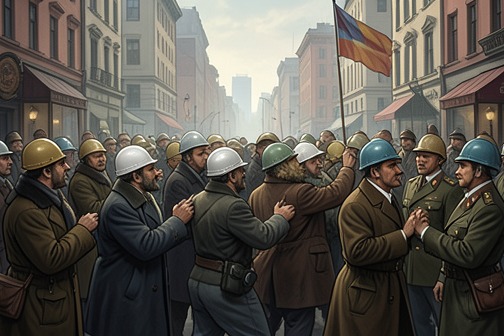
The [June 1990 Romanian Miners' Attacks](entity:event-recall-event-1990-6-f58193cebea1) were a two-day assault on [Bucharest](entity:location-recall-location-8f691c147fd0) in which the [National Salvation Front](entity:organization-recall-organization-ca260eb14fee) mobilized 20,000 miners under the stated pretext of defending democracy. The miners beat people suspected of belonging to the opposition and then attacked indiscriminately; President [Ion Iliescu](entity:character-recall-character-ef1be2651976) congratulated them as they left. [Emmanuel Carrère](entity:character-recall-character-emmanuel-carr-re-4e52f3cdc3e1) recounts the episode as both an organized political action and a bewildering spectacle in a country where claims, rumors, and public reality had become difficult to disentangle.
## Background and political climate
In the months after the revolution that overthrew Nicolae Ceaușescu and Elena Ceaușescu, [Romania](entity:location-recall-location-0c422b6cd08c) was already caught between competing claims about who had resisted the old regime and who held power in the new one. Reports of mass graves at [Timișoara](entity:location-recall-location-56c7771eb113) had stirred intense emotion. The death toll was successively given as four thousand, 4,630, and then seventy thousand on television. Carrère says the bodies shown in the broadcasts numbered at most a few dozen and had been buried after natural deaths. Meanwhile, former members of the [Securitate](entity:organization-recall-organization-fd7c2a42ea61), rather than carrying out the genocide attributed to them, had become officials in the National Salvation Front, led by the new president, Ion Iliescu. The Communist Party had been banned but, in Carrère’s account, survived under a new name and leader; it won a sizable majority in the March 1990 elections.
The disorientation was not only political. Carrère describes post-revolutionary Romania as an uncanny place, shadowed by rumors of secret-police passageways and disappearances, and saturated with suspicion, hatred, and slander. In Bucharest, tens of thousands of stray dogs competed for scraps with tens of thousands of children living on the streets. An old Romanian exile, returned after thirty years in [France](entity:location-recall-location-4f282e1af8a7), told Carrère that the bitterness and fear he saw in people’s faces made them seem like strangers. Against this background, the government’s appeal to workers to defend democracy against a neofascist plot sounded to Carrère like another claim in a landscape where the distinction between public justification and concealed purpose had grown unstable.
## Mobilization and attacks
The violence was not an impromptu gathering. The National Salvation Front chartered buses and trains to bring 20,000 miners to Bucharest on June 14, 1990. They had been galvanized by what Carrère calls frenetic brainwashing and were armed with iron bars. Their arrival turned an official call to defend democracy into a campaign of street intimidation.
For two days, the miners attacked people they suspected of belonging to the opposition. Since few people fit that description, the assaults widened to include almost anyone. Carrère presents the shift from targeted beatings to indiscriminate violence as the spectacle’s bluntest demonstration of force: the attackers were showing that they were not kidding around. When the violence ended, Iliescu congratulated the miners as they began to leave. The visible conclusion of the mobilization thus came with approval from the president whose appeal had summoned them.
## Carrère's position in Bucharest
Carrère was finishing a reporting assignment in the Carpathian Mountains when the miners arrived. He made it back to Bucharest only as the spectacle was ending. Journalists then crowded into the Hotel Intercontinental, where he stayed for three days, delaying his own departure in the hope that something else would happen. He watched crowds gather and disperse, listened to rumors accumulating in the hotel, and weighed the risk of leaving and missing events against the risk of staying without a good reason to remain.
During those days he spoke with an American journalist whose face had been badly beaten. The two shared an interest in paranoid science fiction, and their conversations turned to stories about the breakdown of reality and the minds that try to interpret it. Their discussion of Philip K. Dick’s *The Penultimate Truth* gave Carrère a frame for what they had seen: in the novel, people live underground believing television reports of a war still raging above them, until a rumor suggests that the fighting ended long ago and powerful people have kept the masses below ground for their own benefit. Carrère connected the novel’s image of manipulated knowledge to the hatred he and the American journalist saw in the miners’ eyes as they descended on Bucharest to “save democracy.”
## Meaning and aftermath
The miners’ attacks sharpened a central contradiction in Carrère’s account of revolutionary Romania. The National Salvation Front invoked democracy against an alleged neofascist conspiracy, while organizing the transport of a vast, armed force that terrorized the capital and received the president’s congratulations. The assault was therefore more than street violence: it made the power behind the new government visible, even as official language presented that power as protection.
At the Hotel Intercontinental, Carrère and the American journalist made an impious wish: that the hatred would one day turn against those who had stirred it. Carrère returned from Romania disturbed. The episode remained with him as an instance of public life becoming almost impossible to read: accusations of hidden plots, memories of the old security apparatus, official claims about democracy, and violence in the streets all pressed against one another without settling into a reassuring account of what was true.
Event 40
January Events in Lithuania
The [January Events in Lithuania](entity:event-recall-event-4587ab26b59d) marked a sharp loss of political credibility for [Mikhail Gorbachev](entity:character-recall-character-7c6bee5bcfc8). In January 1991, Russian tanks entered [Vilnius](entity:location-recall-location-f55f31042248) as the world watched the First Gulf War; after meeting major resistance, they withdrew, leaving around fifteen dead. The episode discredited Gorbachev in the eyes of democrats and made his appeals to a humane form of socialism harder to believe.
## Background and Course
The timing gave the military action a particular political charge: the invasion of Vilnius took place while international attention was absorbed by television coverage of the First Gulf War. The account does not detail the operation’s orders or objectives, but emphasizes the sequence that followed: substantial resistance, the tanks’ retreat, and the deaths of around fifteen people.
The episode became known as Black Sunday. Its significance lay not only in the failed intervention but in what the intervention suggested about authority in the Soviet political system. Gorbachev later claimed that he had not been informed. The explanation shifted responsibility for both the intervention and its failure, but left observers weighing whether he had lied or was genuinely out of the loop.
## Political Fallout
For democrats, Black Sunday discredited Gorbachev. After the tanks entered Vilnius and withdrew, talk of socialism with a human face could no longer be heard as a sufficient answer to the violence. The event deepened the conflict between Gorbachev’s public political language and the actions carried out by military forces.
The episode also belongs to a broader pattern of military activity occurring beyond Gorbachev’s apparent control. The army increased troop movements and border clashes without informing him, sometimes during international summits, where such actions could embarrass him before Western leaders. Yet the provocations seemed to have the opposite effect on his public presentation: photographs showed him smiling all the more.
## A Crisis of Authority
Black Sunday foreshadows the larger political danger described in the surrounding account: Gorbachev’s inability or unwillingness to recognize how rapidly his authority was eroding. Boris Yeltsin had been elected president of [Russia](entity:location-recall-location-e36341713c23) by direct suffrage, but Gorbachev treated him with disdain as a so-called democrat; that dismissal only enhanced Yeltsin’s stature. The Lithuanian episode sharpened the contrast between Gorbachev’s claims to command and the growing evidence that events could move without his knowledge or consent.
His closest political associates also warned of the danger. [Eduard Shevardnadze](entity:character-recall-character-bb6bee8eee83) publicly declared that a dictatorship was in the offing, while [Alexander Yakovlev](entity:character-recall-character-28640526dff7) tried to alert Gorbachev to increasingly overt sedition in the Politburo. Gorbachev brushed off Yakovlev’s concerns. In this account, Black Sunday is thus both a specific military retreat and an early measure of a much wider crisis: the loss of democratic trust, the weakening of political authority, and the failure to confront the forces acting in the state’s name.
Event 41
Croatian War
The [Croatian War](entity:event-recall-event-fab5a802aa00) is presented not as a conflict with an immediately clear division between right and wrong, but as a struggle in which national self-determination, the memory of fascist violence, and the fears of minorities collide. Its fall into the narrative is marked by [Vukovar](entity:location-recall-location-36d49389a148): the city’s destruction ends the narrator’s distant, unsettled observation and draws [Eduard Limonov](entity:character-recall-character-eduard-limonov-fbb1fb9b4f1c) toward the front, where the visible machinery of war fascinates him more than the political contradictions surrounding it.
## Competing claims and inherited violence
The narrator first encounters the conflict from afar, while writing a biography of Philip K. Dick and following events in the [Former Yugoslavia](entity:location-recall-location-58305b38bfc4) without taking a firm position. In the earliest framing, when Serbs and Croats are the principal parties, their fighting can seem like an ancient feud: villagers reach for rifles after drinking and kill one another over histories and grievances difficult for outsiders to comprehend. One such dispute concerns a field regarded by Serbs as sacred because it was the site of their bitterest historical defeat. From a distance, the war also appears to signal that the exhilaration of 1989 has faded.
Many of the narrator’s friends support Croatian independence on the principle of national self-determination: a people that wants to leave should not be forcibly kept within a state. Those who oppose this argument raise two objections. If the principle applies without qualification, they argue, it must also apply to Corsicans, Basques, Flemish separatists, and supporters of Italy’s Northern League, potentially making separation endless. They also invoke the history of the Second World War: [France](entity:location-recall-location-4f282e1af8a7) had traditionally been a friend to the Serbs, who resisted Nazi Germany, while the Croats had supported the Nazis with particular zeal. The account of Ante Pavelić in Malaparte’s Kaputt gives this history its most grisly emblem. Asked whether a basket contained Dalmatian oysters, Pavelić reportedly said it held forty pounds of Serbs’ eyes, sent by his [Ustaše](entity:organization-recall-organization-af19b66afff4) loyalists; the Serbian side, in turn, was associated with the [Chetniks](entity:organization-recall-organization-f84a5a9ee7cd).
The argument that seems most persuasive to the narrator concerns the Serbs living within [Croatia](entity:location-recall-location-75da79a63ef8). A population long dominant in the Former Yugoslavia would become a minority in an independent Croatia, and its fears were sharpened by the first actions of the government under [Franjo Tuđman](entity:character-recall-character-c33e3a01fd02). The government banned signs in Cyrillic, dismissed Serbs from the civil service, and replaced the Yugoslav federation’s red-starred flag with a red-and-white checkerboard. The new flag had been created in 1941 by the Germans, and for people who had lived through the Second World War it carried associations comparable to those of the swastika. In those first months, the account insists, the conflict could not simply be sorted into good and bad camps. Propaganda was present, but it was not irrational to imagine the Serbs of Croatia as a people exposed to persecution. The spectacular destruction of Vukovar begins to alter that uncertain picture.
## Limonov is drawn toward Vukovar
In November 1991, Limonov is invited to [Belgrade](entity:location-recall-location-6393b96ea7c0) for the launch of one of his books. During a signing, uniformed men ask what he knows about the Serbian Republic of Slavonia. He knows little. They explain that it is a Serbian enclave at the eastern edge of Croatia: unwilling to accept Croatian secession, its inhabitants have seceded themselves, provoking Croatian opposition and war. Vukovar, a key city in the fighting, has just fallen. The men ask whether he wants to see it.
Limonov has other plans and is more interested in events in his own country than in disputes between Balkan peasants. Yet he thinks he will soon be fifty and has never been to war, an experience he believes a man must have sooner or later. He accepts. His excitement is so great that he does not sleep that night. At dawn, two officers collect him from his hotel and take him along the highway linking Belgrade with Zagreb. Since hostilities began, the road has seen no private vehicles, and the journey proceeds through roadblocks and checkpoints. Soldiers inspect identification papers while others keep rifles trained on travelers. The route to Vukovar is therefore not a clean passage from civilian life into war: armed scrutiny and suspicion are already part of the journey.
## A divided identity at the checkpoints
Limonov’s identity complicates the officers’ assumptions. As a Russian, he is presumed to be Orthodox and pro-Serbian; his French passport, however, suggests that he is Catholic and perhaps pro-Croatian. The passport makes him legible to the soldiers through a competing national and religious alignment, despite the simplicity of their initial expectation. The tension eases after he makes forceful criticisms of Tuđman and [Hans-Dietrich Genscher](entity:character-recall-character-38a10fb93860), the German foreign minister who encouraged European colleagues to recognize Croatia’s independence. In Belgrade, Genscher is regarded as a theorist of a Fourth Reich. The officers and Limonov exchange threats about hanging one with the other’s intestines, drink together to seal the understanding, and continue on their way.
The episode offers a small, concrete instance of how the conflict’s political divisions are enforced and negotiated. Limonov is questioned not only about what he knows, but about what his passport appears to say he believes. His verbal attack on figures regarded as hostile to [Serbia](entity:location-recall-location-b1e98ddb0dab) reassures his escorts sufficiently for the journey to resume. Yet that accommodation does not resolve the larger issue of who is actually conducting the war.
## The army behind the Serbian cause
One detail in the account the officers give Limonov undermines their comparison between the Serbs of Croatia and Jews facing persecution during the Second World War. The soldiers supporting the Serbian cause wear the uniform of the Yugoslav People’s Army, an institution that still exists and is theoretically unable to participate in the conflict. In practice, because the army is majority Serb, it has conscientiously shelled Vukovar and Croatian positions around it. The officers’ account of Serbian vulnerability thus sits beside evidence of an organized military force actively attacking the city. The analogy with Jews who had no Wehrmacht to defend them cannot withstand that contrast.
Limonov is indifferent to the contradiction. What attracts him are the soldiers, tanks, sandbags, gray-green uniforms against the snow, and the mortar fire. The narrative’s emphasis shifts accordingly: it has moved from the narrator’s careful weighing of historical claims to Limonov’s appetite for the physical presence of war. His trip does not settle the political argument or turn him into a reliable judge of its factions. Instead, Vukovar draws him into a scene where the discrepancy between an explanatory story and the forces on the ground is unmistakable, yet less compelling to him than the spectacle of armed conflict itself.
Event 42
Battle of Vukovar
The [Battle of Vukovar](entity:event-recall-event-40b0ffe44851) is presented through [Eduard Limonov](entity:character-recall-character-eduard-limonov-fbb1fb9b4f1c)’s journey to the city after Serbian troops had taken it, not through an account of the fighting itself. The visit brings him face to face with the destruction left by the battle and with the conflict’s competing claims about victimhood. He recognizes that civilians and fighters have suffered on both sides, yet refuses neutrality and chooses the Serbian side—a decision that exposes how readily the reality of war becomes entangled with his own longing for danger and military brotherhood.
## Background and invitation
In November 1991, Limonov was in [Belgrade](entity:location-recall-location-6393b96ea7c0) for the launch of one of his books when uniformed men approached him at a signing. They asked what he knew about the Serbian Republic of Slavonia, described to him as an enclave of Serbs in the easternmost part of [Croatia](entity:location-recall-location-75da79a63ef8). Opposed to Croatia’s secession, its Serbs had declared a secession of their own; the Croats objected, and the dispute had become a war. [Vukovar](entity:location-recall-location-36d49389a148), a key city in that conflict, had just fallen. The men invited Limonov to see it for himself.
He initially had other plans. Events in his own country interested him more than what he considered disputes between Balkan peasants. But he thought he would soon be fifty and had never experienced war, an experience he believed a man ought to have sooner or later. He accepted the invitation and was so excited that he did not sleep that night. The trip therefore began not with a political commitment to the conflict but with an appetite for the experience of war itself.
At dawn, two officers collected him from his hotel and drove him along the highway between Belgrade and Zagreb. Since hostilities began, the road had seen no private vehicles, and checkpoints and roadblocks interrupted the journey. Soldiers checked travelers’ identification while others kept rifles trained on them. Limonov’s identity complicated the assumptions made about him: as a Russian, he was presumed Orthodox and pro-Serbian, but his French passport suggested to the officers that he might be Catholic and pro-Croatian. He eased their suspicion with pointed remarks against [Franjo Tuđman](entity:character-recall-character-c33e3a01fd02) and [Hans-Dietrich Genscher](entity:character-recall-character-38a10fb93860), whom the officers associated with European recognition of Croatian independence. After a drink, they continued toward Vukovar.
## The fall and its aftermath
A contradiction in the officers’ account complicates the journey. The soldiers supporting the Serbian cause wore the uniform of the Yugoslav People’s Army, an institution that in theory could not take part in the conflict. In practice, because it was majority Serb, it had shelled Vukovar and Croatian positions around it. The officer accompanying Limonov nevertheless developed a comparison between the Serbs’ situation and the Jews’ fate during the Second World War. The comparison faltered against the evidence of the army’s role, but Limonov was not interested in testing it. Tanks, rifles, sandbags, gray-green uniforms against snow, distant mortar fire, and villages still smoking held his attention instead.
Vukovar had been taken two days before his arrival. Those around Limonov called the capture a liberation, without irony; the word did not make him question what had happened. The once-pretty Habsburg city looked to him like a smaller Berlin after the [Red Army](entity:organization-recall-organization-073952387f8f)’s advance: devastated rather than restored. On his return to Belgrade, a writer would ask what hotel he had stayed in. Limonov did not explain that there were no hotels left in Vukovar. Few houses still stood, none was habitable, and the city had become a wasteland of rubble, twisted metal, and glass that bulldozers were beginning to clear.
The destruction shaped even the smallest movements through the city. Mines made it dangerous to step off the path, and there were no birds in the sky. Most corpses had already been removed, but Limonov was taken to a body-identification center. There he saw tortured, purple and charred bodies, slit throats, and bags of human remains unloaded from trucks. When he asked who the dead men were, the officer guiding him answered that they were Serbs. To the officer, the victims of war were Serbs by definition and Croats their torturers. The narrative sets that certainty against the location: the center stood on the outskirts of a Croatian city annihilated by Serbian, or more precisely federal, artillery, with a quarter of its population missing. It does not establish the identity of the bodies Limonov saw; the guide’s answer is itself part of the competing account of the battle.
## Allegiance and the experience of war
Limonov did not conclude that one side held a monopoly on suffering or courage. He believed there were innocent victims, valorous warriors, and unjustly displaced people on both sides. But for him, refusing to choose was not an acceptable response: he regarded neutrality as cowardice and felt that fate had placed him with the Serbs. His allegiance thus coexisted with an awareness that the Serbian account could not explain away the devastation surrounding him.
The visit fulfilled the desire that had taken him onto the road. Around the evening fires and in the crowded camp, he felt at home among unshaven men warming swollen, black-fingernailed hands. The camp’s charcoal stoves, prune schnapps, and the smell of feet made war into a physical world of hardship and belonging. As a child, he had dreamed of this kind of military encampment and brotherhood; now he felt that what fate had denied him had suddenly been placed within reach. He judged that two hours of war taught more about life and people than four decades of peace. Although he called war dirty and senseless, he also believed that its intense appeal explained why people returned to it. Vukovar’s destruction and Limonov’s exhilaration occupy the same episode, an uneasy contrast the account refuses to resolve.
## Later political significance
The battle also supplied an analogy in Limonov’s later political rhetoric. Addressing his [National Bolshevik Party](entity:organization-recall-organization-d9e15bd528ae), he compared Serbs in the former Yugoslavia with Russians living in former Soviet republics: peoples who had once exercised power, he argued, but who now faced victimization, ostracism, or toleration in territories they believed they had helped build. He pointed to Russian communities in [Latvia](entity:location-recall-location-2550659298f2), Ukraine, and [Kazakhstan](entity:location-recall-location-5f41d751a306) and advocated stirring insurgency and creating separatist republics. The analogy does not erase the differences between those situations; it shows how the experience of Vukovar could be carried forward as a political frame for interpreting abandonment and lost power. The episode’s lasting significance lies in this double vision: Limonov encountered a city whose destruction challenged a simple story of Serbian victimhood, yet he emerged with a Serbian allegiance and a model of war that would inform his later political imagination.
Event 43
Bosnian War
The [Bosnian War](entity:event-recall-event-c9dc2c4eb59f) enters the narrative as both a conflict over territory and a struggle over how the conflict should be understood. Through the siege of [Sarajevo](entity:location-recall-location-f362c04c2df2), the testimony of journalists, and a documentary scene in which [Eduard Limonov](entity:character-recall-character-eduard-limonov-fbb1fb9b4f1c) fires toward the city, [Emmanuel Carrère](entity:character-recall-character-emmanuel-carr-re-4e52f3cdc3e1) follows the pull between moral commitment and political doubt. His account resists the comfort of a simple story, but it also resists using complexity to erase the difference between besieged people and those besieging them.
## The war and its competing explanations
In the spring of 1992, fighting between Serbs and Croats gave way to war in Bosnia and Herzegovina. In the circles Carrère describes, the moral map initially seemed clear: [Slobodan Milošević](entity:character-recall-character-aadf83022df1) and [Radovan Karadžić](entity:character-recall-character-8ca2bc660a0e) stood on the Serbian side of the aggression, while [Alija Izetbegović](entity:character-recall-character-cea5bdd7ae8f) and the Bosnian Muslims appeared as its victims. Sarajevo became a symbol of a harmonious, multiethnic Europe under attack. Its inhabitants were often represented in [France](entity:location-recall-location-4f282e1af8a7) through an idealized image: educated, cosmopolitan, and surrounded by books and classical music. The city’s symbolic status helped mobilize concern, but it also made it easier for observers to turn a complicated war into a story that confirmed their own hopes about Europe.
That interpretation brought some of Carrère’s acquaintances to the besieged city. They made repeated journeys to Sarajevo, slept in bombarded buildings without the possibility of bathing, crossed shattered streets under sniper fire, and lived with the possibility that any day might be their last. The danger itself could heighten the experience: visitors drank with the knowledge that they might not return and sometimes fell in love amid the destruction. Their involvement was not merely an abstract expression of solidarity; it placed them physically inside a city under attack.
Carrère did not go. Fear played a part: when he was invited, he learned that [Jean Hatzfeld](entity:character-recall-character-347025097522) had lost a leg after being hit by Kalashnikov fire. But he also distrusted sacred political missions, particularly those that attracted people in his own social circle. He wondered whether values regarded as eternal and universal by his own class might later appear grotesque or wrong. That suspicion made him receptive to arguments that the conflict was less morally legible than it seemed. Serbs, those arguments held, had their own history of Ottoman rule; Izetbegović was said to be a fundamentalist surrounded by mujahideen; and some photographs of Serbian victims, it was claimed, were misidentified as victims of the Serbs. Carrère acknowledges how readily he listened and nodded along to these explanations.
## Sarajevo, the front lines, and the choice of witness
The warning that things were more complicated than they seemed could challenge a self-satisfied account of the war, but it could also serve as an excuse for delay and diplomatic evasion. Carrère sets this danger against the counterargument made by a prominent defender of the besieged city: the facts, in this view, were not made less grave by adding qualifications. The distinction matters in the account. To notice complexity is not necessarily to conclude that every side is equally responsible; to hesitate over judgment can itself become a way of avoiding a choice.
That choice was also geographical. After the first days of the siege, when a person could still drive from one side to the other at the risk of being shot, observers had to decide whether to follow events from inside Sarajevo or from the positions surrounding it. Jean Hatzfeld and [Jean Rolin](entity:character-recall-character-44344cf2c45f), despite their reluctance to gather followers around a noble cause, naturally took the side of the weaker party. Their principle was to go where shells were falling, not where they were fired from. It did not require treating the besieged as faultless or the besiegers as uniformly monstrous. It did require recognizing the unequal positions from which each group acted.
Hatzfeld’s later investigation made that commitment harder, not simpler. He had initially believed Serbian snipers had ambushed him because he was a journalist. Returning to Sarajevo after a year in hospital, he investigated how he had been wounded and concluded that the shots that cost him his leg had in fact been fired by Bosnian militiamen. The discovery overturned his first account of his own injury, but did not make him retreat to the claim that one side was simply as bad as the other. Carrère treats the willingness to foreground evidence against one’s initial belief as a form of honesty distinct from indiscriminate equivalence.
The positions could also shift. Rolin later felt an undeniable satisfaction when Serbs, for once, were on the receiving end of violence. That response did not last; the wheel turned again, and observers could find themselves criticizing the [International Criminal Tribunal for the former Yugoslavia](entity:organization-recall-organization-4b6824cc8969) for prosecuting Serbian war criminals while Croatian and Bosnian counterparts faced leniency from their own courts. Carrère connects this instability to the recurring reversal of victim and perpetrator: the person or group that suffers at one moment may inflict suffering at another. Remaining attentive to victims therefore requires vigilance, not a permanent identification with whichever side once occupied that role.
## Filming the Bosnian Serb side
In 1992, [Pawel Pawlikowski](entity:character-recall-character-a435bc465375) was disturbed by the prevailing rhetoric in London and [Paris](entity:location-recall-location-paris-c02b439ce220) that cast the Serbs as heirs to the Nazis. He knew journalists, writers, and filmmakers who had made their base in besieged Sarajevo, and decided to travel to the other side to learn what people there thought. His documentary, *Serbian Epics*, records material that the familiar account risked leaving out without requiring the viewer to mistake Serbian nationalist self-presentation for neutral truth.
Pawlikowski filmed musicians playing hurdy-gurdies outside soldiers’ tents and singing old-sounding chants about defeat on earth, victory in heaven, and burning Turkish houses. He followed the songs into weddings and children’s ditties, including songs sung by children carrying Kalashnikovs. The heroes invoked in these performances were not only figures from the distant past: their names were replaced by those of contemporary leaders, including Radovan Karadžić and the Serbian military leader Ratko Mladić. The documentary also shows a council of war in which the two men bend over maps, mark borders, and consider which populations and territories might be conceded. Their small meeting at [Pale near Sarajevo](entity:location-recall-location-9d4abd42d4be) echoes the diplomatic negotiations taking place elsewhere, but makes the directness of their decisions visible.
Pawlikowski also filmed Pale, a ski resort built for the 1980 Sarajevo Olympics that served as the capital of the Bosnian Serb Republic. The contrast between its winter-sports infrastructure and its wartime political role gives the place a disquieting double character. At the officers’ mess, Pawlikowski noticed Limonov: a large pair of glasses, a crew cut, a People’s Army overcoat over a leather jacket, and a pistol that seemed more like part of a disguise than a natural accessory. Limonov appeared friendly with a group of [Chetniks](entity:organization-recall-organization-f84a5a9ee7cd) without belonging to them. When he introduced himself to French television workers as a writer interested in the world’s hot spots, he also identified himself as a soldier rather than a journalist. His appearance and self-description placed him at the unstable boundary between observer, partisan, and combatant.
## Limonov at the siege
The documentary’s most consequential scene takes place on the heights above Sarajevo, where Serb batteries bombard a city situated in a basin. Mortar fire continues in the background as Limonov and Karadžić speak among soldiers. Karadžić presents the Serbian position as an effort to recover territory that had belonged to Serbs since time immemorial, not as an act of aggression. Limonov listens respectfully, then declares admiration for the Serbs’ resistance to fifteen countries acting together against them. Their exchange is shaped by the camera’s presence, but the scene also shows Limonov publicly aligning himself with the Bosnian Serb cause.
The conversation turns from military claims to poetry. Karadžić recites an ode he had written twenty years earlier, describing Sarajevo engulfed in flames. The moment gives the later destruction a disturbing literary prehistory: the city appears not just as a battlefield but as an image already present in a poem. When Karadžić leaves to take a telephone call, Limonov watches a soldier grease a machine gun. The soldier offers him a chance to try it. Limonov takes his position behind the weapon, follows the soldier’s instructions, and empties a magazine toward the besieged city. The documentary’s sequence moves from political admiration to physical participation; the gunfire makes the distance between Limonov’s public language and the besieged population unmistakably concrete.
## Aftermath and the problem of moral balance
The war’s later recollection cannot be reduced to a single reversal in which the former victim becomes the aggressor, or the reverse. Carrère’s examples instead show why the roles must be reconsidered as circumstances change. Hatzfeld’s injury, the positions from which observers watched the siege, and the later suffering of defeated Serbs in enclaves in Kosovo all complicate the history of victimhood. They do not cancel the asymmetry of a besieged city under bombardment, nor do they make every account equally reliable. The ethical task is to remain open to facts that unsettle one’s side while still judging who is stronger, who is weaker, and where the violence is being inflicted.
The Bosnian War also became a political reference beyond Bosnia. At a later [National Bolshevik Party](entity:organization-recall-organization-d9e15bd528ae) convention, Limonov compared Russians left outside [Russia](entity:location-recall-location-e36341713c23) after the [Soviet Union](entity:location-recall-location-67657886d3d4)’s collapse to Serbs in the former Yugoslavia: peoples who, in his account, had once exercised power and were now victimized or excluded. That analogy carried the conflict’s language of dispossession into his own political project. Across these scenes, the war is therefore not only a past military struggle but a test of how political movements use suffering, how witnesses revise their judgments, and whether acknowledging complexity can coexist with taking a side.
Event 44
Sarajevo’s wartime siege and bombardment
The Siege of [Sarajevo](entity:location-recall-location-f362c04c2df2) is presented as both a prolonged assault on a besieged city and a test of how observers choose their side. In [Emmanuel Carrère](entity:character-recall-character-emmanuel-carr-re-4e52f3cdc3e1)’s retrospective account, its significance lies not only in the bombardment but in the changing judgments it provokes: visitors drawn by solidarity and danger, witnesses willing to correct their first impressions, and images that make [Eduard Limonov](entity:character-recall-character-eduard-limonov-fbb1fb9b4f1c) look at once less culpable than rumor suggested and more ridiculous than his admirers might have wished.
## A siege and its observers
When fighting between Serbs and Croats came to a provisional halt and shifted to Bosnia in the spring of 1992, the political picture seemed clear to the circles Carrère knew. [Slobodan Milošević](entity:character-recall-character-aadf83022df1) and [Radovan Karadžić](entity:character-recall-character-8ca2bc660a0e) appeared to embody the aggressor’s side; [Alija Izetbegović](entity:character-recall-character-cea5bdd7ae8f) and the Bosnian Muslims appeared to be suffering a heinous attack. In [France](entity:location-recall-location-4f282e1af8a7), Sarajevo became a symbol of the multiethnic Europe people wanted to defend. Its Bosnian Muslim residents were often idealized as the embodiment of that cause.
That idealizing view helped propel people Carrère knew into regular trips to the besieged city. They slept in bombarded buildings without the possibility of bathing, crossed shattered streets under sniper fire, and lived with the possibility that any day might be their last. The danger could lend itself to exhilaration and romance; some visitors fell in love. Carrère acknowledges that he declined the opportunity partly out of fear. He had also learned that [Jean Hatzfeld](entity:character-recall-character-347025097522) had just lost a leg after being hit by Kalashnikov fire, and he distrusted the pull of supposedly sacred political missions, especially when they appealed to his own social circle.
## Choosing where to stand
Carrère’s hesitation develops into a wider question about political certainty. He considers how easily a person might be drawn, in another time or circumstance, toward terrible causes, and whether values regarded as universal might later look grotesque or wrong. He does not treat those doubts as proof that the besieged and besiegers were morally equivalent. Instead, he examines the danger of explanations that make every conflict so complicated that no one has to choose a side.
Hatzfeld’s reporting becomes a test of that distinction. His first instinct was to believe Serbian snipers had ambushed him because they meant to kill a journalist. After spending a year in hospital, he returned to Sarajevo to investigate and concluded that, by chance, the shots that cost him his leg had come from Bosnian militiamen. The correction matters: Hatzfeld puts a fact against his own initial understanding rather than concealing it. Yet it does not make the choice of where to observe the siege meaningless. Carrère’s account argues that when one side is weaker and the other stronger, a witness can acknowledge that the weaker side is not angelic and the stronger side not demonic while still going where the shells fall, rather than where they are fired from.
That position requires continual adjustment. Carrère notes that [Jean Rolin](entity:character-recall-character-44344cf2c45f) could feel satisfaction when Serbs, for once, were the ones under attack; the feeling did not last as the balance shifted again. The sequence leads to a broader warning about the reversal of victim and perpetrator: those who suffer may become perpetrators, and perpetrators may later become victims. The challenge is not to claim permanent innocence for one camp, but to keep moving one’s attention toward those who are suffering now.
## The film from the heights
Paweł Pawlikowski, a Polish-born British filmmaker, approached the war from the other side of the dominant rhetoric in London and [Paris](entity:location-recall-location-paris-c02b439ce220), which portrayed the Serbs as heirs to the Nazis. In 1992 he went to see what people there thought and filmed the material that became Serbian Epics. The documentary follows Serbian nationalist imagery into everyday settings: musicians play hurdy-gurdies outside soldiers’ tents, songs celebrate defeat on earth and victory in heaven, and children sing while carrying Kalashnikovs. The names of heroic ancestors give way to contemporary figures, including Karadžić and Ratko Mladić.
Pawlikowski also filmed a council of war in which Karadžić and Mladić lean over maps, marking borders and populations and weighing what could be conceded. The scene gives the leaders’ decisions a physical form: lines on a map stand for people and territory being bargained over. At Pale, the ski resort that served as the capital of the Bosnian Serb Republic, Pawlikowski noticed Limonov among officers and [Chetniks](entity:organization-recall-organization-f84a5a9ee7cd). Limonov’s People’s Army overcoat, leather jacket, crew cut, glasses, and 7.65 pistol made him seem like an outsider adopting a disguise. Pawlikowski asked him to interview Karadžić for the film.
The resulting scene takes place on the heights from which Serb batteries bombard Sarajevo. The city lies below in a basin, and the rumble of mortar fire is nearly constant. Karadžić, tall and imposing in a large overcoat, explains that his people are not aggressors but seek to reclaim territory they regard as theirs. Limonov nods respectfully and praises the Serbs’ resistance to the countries aligned against them. When Karadžić recites an ode about Sarajevo in flames, a pause gives the exchange an ominous quality. A telephone call from Karadžić’s wife interrupts it.
While soldiers remain nearby, one plays with a small dog and another greases a machine gun. The soldier offers Limonov a turn. Limonov takes his position behind the weapon, follows the instructions, and fires a magazine toward the besieged city. The filmed gesture is startling partly because the soldier’s encouragement and the laughter around him make Limonov look like a child eager to perform for adults. The camera records a real act, but the act alone cannot establish that he hit anyone.
## What the images prove—and cannot prove
The film’s reception sharpened the scene into a more definite accusation. In France, a rumor spread that Limonov had been shown shooting people in Sarajevo’s streets. When asked about it fifteen years later, he denied aiming at people: he had fired in the city’s direction, he said, but at nothing in particular or at the sky. A wide shot supports part of that distinction. The machine-gun scene occurs on heights some distance from the city, where mortars were firing, not down among the positions from which snipers picked people off in the streets.
But the edit complicates the viewer’s judgment. The footage of Limonov with the machine gun is followed by a much closer view of the city, presented like a reverse angle. That change in perspective can make the shots appear more directly connected to the streets below than the opening wide shot warrants. The images cannot settle whether Limonov would have been troubled by shooting at people, or whether he did so in other circumstances. They establish that he fired toward the besieged city; they do not establish that he shot its inhabitants.
The uncertainty did not prevent the footage from changing his public image. People Limonov knew in Paris stopped seeing him as a charming adventurer and began to regard him as something like a war criminal. Carrère, who had not seen the film when French television broadcast it, eventually obtained a DVD from Pawlikowski. Serbian Epics so disturbed him that he stopped work on the book for more than a year. His strongest reaction was not that the documentary proved Limonov had committed a crime; Carrère explicitly distinguishes the filmed evidence from that claim. It was that Limonov looked absurd: a little boy playing at toughness.
## The siege as a problem of judgment
The episode’s force comes from the gap between the reality of bombardment and the instability of the stories told about it. Sarajevo’s position in a basin, the near-constant mortar fire, and the danger faced by people crossing its streets are concrete conditions; the film’s edited sequence, by contrast, can invite a viewer to infer more than its images demonstrate. Carrère makes that gap visible rather than closing it with a verdict.
The siege therefore becomes a setting in which sympathy, evidence, and political allegiance remain in tension. Hatzfeld’s investigation corrects his own assumption about who fired the shots that wounded him without erasing the difference between besieging and besieged. Limonov’s filmed burst of gunfire reveals his proximity to the Serbian position and his willingness to participate in its performance, but it does not show him killing anyone. In Carrère’s account, the essential act of witnessing is neither to hide inconvenient facts nor to use complexity as an excuse for indifference.
Event 45
1991 Soviet August coup attempt
The [1991 Soviet August coup attempt](entity:event-recall-event-1991-f03b2846b255) began while [Mikhail Gorbachev](entity:character-recall-character-7c6bee5bcfc8) was vacationing in [Crimea](entity:location-recall-location-14f700c5d2bf) and ended four days later with the conspirators defeated, the public still free, and the Communist Party of [Russia](entity:location-recall-location-e36341713c23) facing suspension. The episode is presented as both a genuine democratic crisis, whose outcome depended on the army, and a farce: the plotters’ own panic and ineptitude turned an attempt to restore control into a spectacle of collapsing authority.
## Seizure of power and the conspirators
The coup began when Gorbachev’s telephone was cut, his villa isolated, and the surrounding area cordoned off. A group of generals—Kryuchkov, Yazov, Pugo, and Yanayev—declared a state of emergency. They put Vice President Yanayev, described as the weakest of their number, in charge. An old-style attempt to clamp down on the press accompanied the seizure of power, but the new leader projected no confidence: he shut himself in his office and had to be forcibly removed before he would give a televised press conference. On screen, his hands trembled and his expression seemed lost even as he was presented as triumphant.
The account stresses the disparity between the coup’s coercive instruments and the men attempting to wield them. In retrospect, the conspirators emerge not as disciplined masters of power but as mediocre men who drank themselves into a state of panic. They sensed that the operation was going wrong, yet the order had been given and tanks were already entering [Moscow](entity:location-recall-location-19aceb5ce281). Their imagined response was not a dramatic last stand but retreat to bed, aspirin, and a jar of pickles. This comic image does not make the danger unreal: it shows how an attempt to impose emergency rule could be both grave in its stakes and absurd in the conduct of its authors.
## The threatened return of repression
At the time, democratic supporters did not know that the plotters would prove so inept. After a second thaw, they feared that political freedom was freezing over again and wondered whether they had been foolish to stay rather than flee while they could. The coup might have succeeded. Its fate depended on the army, and particularly on the young conscripts ordered to march on Moscow. They feared being made to repeat what their fathers had done in Prague in 1968. The account therefore presents their obedience to Boris Yeltsin’s appeal—to remain on the side of the law and the state—as an act requiring courage, not as an automatic consequence of the coup’s weakness.
Yeltsin organized resistance from the seat of parliament in Moscow, known as the [Moscow White House](entity:location-recall-location-5a88b736622f). The building became a focal point for the country’s fight for democracy and a stage on which political legitimacy was made visible. The photograph of Yeltsin standing on a tank outside it condensed that struggle into a single image. [Mstislav Rostropovich](entity:character-recall-character-ae4735591808) rushed to guard the door of Yeltsin’s office; Muscovites came to defend the building, raised barricades, and put their bodies between the threatened freedom and the forces sent against it. As the tanks backed away, girls kissed soldiers and slipped flowers into the barrels of their rifles. The fourth day brought an immense release of tension: the feared return of repression had not happened, and people would continue to live in freedom.
## Collapse and public reckoning
The plotters’ failure was not merely a military or administrative reversal; it destroyed the authority they had tried to perform. Their presentation of Yanayev as a triumphant leader could not conceal his visible fear, while the tanks and emergency measures failed to produce the obedience on which the takeover depended. The account’s insistence on the coup’s farcical quality turns humiliation into part of its political consequence: the heirs of decades of oppression did not depart in a grand, tragic finale, but as buffoons who no longer seemed frightening.
Gorbachev returned from Crimea conspicuously tanned and unaware of what had happened. The affair registered for him and his family partly through the fact that they had been cut off from the world in a villa likened to one fit for an oil sheikh. Three of the putschists later committed suicide. [Eduard Limonov](entity:character-recall-character-eduard-limonov-fbb1fb9b4f1c) remained to mourn them, a detail that identifies his loyalty to the defeated even when their choices were open to condemnation. The coup’s aftermath thus also reveals a distinction in Limonov’s conduct: he honors the vanquished rather than treating defeat as proof that they deserve to be forgotten.
On August 23, the confrontation moved into a parliamentary session broadcast around the world. Yeltsin made Gorbachev read, in an unsteady voice, the minutes of the council meeting at which the ministers Gorbachev had appointed had resolved to betray him. Yeltsin then announced that there was a decree to sign: the suspension of the Communist Party of Russia’s activities. The staged pause and Gorbachev’s bewildered response made the act theatrical, but the decree was consequential. The party that had been central to the political order was now being formally suspended in public, by a leader whose authority had risen through resistance to the coup.
## Memory and significance
Two decades later, young people in the cities remembered August 1991 as one of the most intense moments of their lives. Their recollections followed the coup’s abrupt reversal: first the terror that the [Soviet Union](entity:location-recall-location-67657886d3d4) was returning, then the exhilaration of watching it collapse into ridicule. The episode’s emotional force lay in both fear and relief, not in a simple assumption that freedom had always been secure. Its ending mattered because the feared nightmare had nearly become real and because crowds, conscripts, and political leaders helped prevent it.
The account sets the coup’s imagery alongside revolutionary acts of resistance, but its defining contrast is between the solemn danger of renewed oppression and the conspirators’ shabby, increasingly ridiculous performance. The plotters had emergency powers and tanks; the resistance had a parliament building, a photograph of Yeltsin on a tank, barricades, and flowers placed in rifle barrels. Their failure made the last heirs of seventy years of oppression appear less like masters of history than figures already losing control of it. Yet the narrative preserves the uncertainty that people experienced at the time: the coup could have succeeded, and its defeat was not inevitable.
Event 46
Belavezha Accords
The [Belavezha Accords](entity:event-recall-event-14fe4c5f4600) mark the dissolution of the [Soviet Union](entity:location-recall-location-67657886d3d4) in a scene presented less as a carefully prepared constitutional settlement than as a secret, improvised decision by three republic leaders. At a hunting lodge in [Belovezhskaya Forest](entity:location-recall-location-e08f5e76f3db), Boris Yeltsin, [Leonid Kravchuk](entity:character-recall-character-69bcc9dd1da1), and [Stanislav Shushkevich](entity:character-recall-character-2e57508ebb7d) invoked their republics’ role in creating the Union to claim the right to dissolve it. The abruptness of the decision, and the way [Mikhail Gorbachev](entity:character-recall-character-7c6bee5bcfc8) was informed only afterward, give the event its defining political and dramatic force.
## From public collapse to a secret meeting
The account places the meeting after a visible sequence of symbols giving way. The [Felix Dzerzhinsky Statue in Lubyanka Square](entity:object-recall-object-a5e3966433df), outside the headquarters of the [Committee for State Security](entity:organization-recall-organization-80c01782124e), is toppled; the red flag is replaced by the tricolor of the 1917 provisional government. A few months later, the decisive gathering takes place in secret at a hunting lodge in Belovezhskaya Forest. Yeltsin leaves [Moscow](entity:location-recall-location-19aceb5ce281) without telling Gorbachev what he intends to do.
The three participants are the presidents of [Russia](entity:location-recall-location-e36341713c23), Ukraine, and Belarus. Their discussion, as recounted here, is not underpinned by a worked-out institutional plan: none of them has the slightest idea what a federation or confederation might look like. Instead, they return to a single historical argument. Their three republics created the Soviet Union in 1922, they say, and therefore have the right to dissolve it. The account stresses the gap between the scale of the decision and the scant preparation behind it.
## The decision and its announcement
The meeting is rendered as a drinking binge as much as a political conference. The presidents drink heavily in the sauna while repeating their justification. Yeltsin becomes so drunk that Kravchuk and Shushkevich have to carry him to bed. Before he loses consciousness, however, he calls George Bush, senior, to ensure the American president is the first to hear the news: “George, the guys and I have worked something out. The Soviet Union no longer exists.”
That call gives the decision an audience abroad before Gorbachev, still the Soviet president, has been told. The asymmetry is pointed: the man presiding over the Union is excluded from the meeting that announces its end, while Yeltsin makes a point of notifying the American president. The accord’s portrayal thus turns a political transfer of power into a sequence of personal choices, messages, and omissions.
## Gorbachev learns what has happened
The task of informing Gorbachev falls not to Yeltsin, the most powerful of the three, but to Shushkevich, described as the least important member of the troika. Shushkevich tells him that the Soviet Union no longer exists. Gorbachev’s reported response is: “But then what will become of me?” The question makes the collapse of the state personal: alongside the fate of the Union is the immediate fate of the leader it has displaced.
The account then contrasts Gorbachev’s alarm with the relative leniency of his subsequent circumstances. He is granted a dacha and a foundation and is able to give highly paid lectures for the rest of his life. Set against the account’s reference to Russian history since the Middle Ages, this is presented as an exceptionally gentle fate for a deposed ruler.
## Political afterlife
The dissolution also becomes a point of reference in later political arguments about the republics and the people left outside Russia. At a [National Bolshevik Party](entity:organization-recall-organization-d9e15bd528ae) convention, [Eduard Limonov](entity:character-recall-character-eduard-limonov-fbb1fb9b4f1c) describes the former Soviet republics as territories abandoned by Gorbachev and argues that the breakup left 25 million Russians without their former place in the Union. He cites 900,000 Russians in [Latvia](entity:location-recall-location-2550659298f2), 11 million in Ukraine, and 5 million in [Kazakhstan](entity:location-recall-location-5f41d751a306), presenting their situation as the basis for a new political struggle on the Union’s periphery.
Those claims belong to Limonov’s later rhetoric, not to the negotiations at the hunting lodge. Their place in the account nevertheless shows how the dissolution acquired competing meanings: for the three presidents, a decision justified by the founding republics’ authority; for Limonov, a rupture that abandoned Russians beyond the new borders. The scene of the three leaders drinking and deciding without a replacement plan stands in sharp contrast to the far-reaching consequences that later political movements would attach to their act.
Event 47
1993 Russian Constitutional Crisis
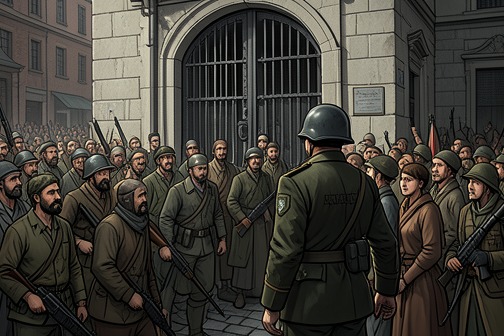
The [1993 Russian Constitutional Crisis](entity:event-recall-event-1993-f9dd7d11b323) turned a constitutional confrontation between Boris Yeltsin and his opponents into a siege, street battle, and bloody defeat for the insurgents. In the account, [Eduard Limonov](entity:character-recall-character-eduard-limonov-fbb1fb9b4f1c)’s participation makes the crisis more than a contest over institutions: he enters the White House’s orbit as a committed patriot, misses much of the siege after leaving, and then is wounded in the assault on Ostankino. Its aftermath leaves both the political balance and the moral meaning of the conflict unsettled.
## Background and Competing Claims
The crisis took shape amid rapid economic and political change. Yeltsin’s government had liberalized prices, provoking inflation of 2,600 percent. A voucher scheme intended to turn citizens into investors had been undermined by the loss of the vouchers’ value; many beneficiaries sold them for little more than the equivalent of a bottle of vodka. Meanwhile, the new political order did not command settled public allegiance. The confrontation would be presented as a defense of democracy by Yeltsin’s supporters and as resistance to executive seizure of power by his opponents.
In September 1993, Yeltsin announced that he was dissolving the Duma and calling new elections. The narrator treats dissolution as a familiar political gamble, but stresses the uncertainty over whether Yeltsin would accept the result if elections failed to produce a more compliant parliament. [Viktor Alksnis](entity:character-recall-character-d0e34b735be9), known as the Black Colonel, called Limonov to say that the situation was heating up and that patriots were gathering at the White House. Limonov finished his bowl of broth, left his lodging, and went there.
The building had changed meaning since the confrontation two years earlier: it had once stood internationally as a symbol of Yeltsin’s victory and the democrats’ cause. Now several thousand patriots gathered outside it. The narrator does not present this camp as politically uniform: some of its members were fascists, but others could not be reduced to that label. Their claim to be defending constitutional order against democrats prepared to impose a dictatorship was confused and compromised, yet the account refuses to dismiss it as wholly baseless.
The two central parliamentary opponents had themselves recently stood on Yeltsin’s side. [Ruslan Khasbulatov](entity:character-recall-character-22b77d9047a8), president of the Duma, and General [Alexander Rutskoy](entity:character-recall-character-0886050ccdbb), vice president of the Russian Republic, now led the rebellion against him. Rutskoy had also turned against [Yegor Gaidar](entity:character-recall-character-a449aea81835), mocking the prime minister over a photograph of him playing golf in pink shorts. The reversal of former allies sharpened the crisis: the dispute was not a simple division between people who had always belonged to opposing camps.
## The White House Occupied
That evening, an extraordinary session of the dissolved parliament declared its dissolution unconstitutional, deposed Yeltsin, named Rutskoy president in his place, and occupied the White House. The assembly claimed to act in the people’s name and said it would leave only if forced out at bayonet point. Limonov joined the supporters inside. Through the night he moved from meeting to meeting amid cigarette smoke while the occupants argued, shouted, drank, drafted communiqués, and discussed forming a government. Limonov was impatient with the talk of distributing ministries; he wanted preparations made for the siege he expected.
The following day, Limonov left to shower and change at a friend’s home and visit [Alexander Dugin](entity:character-recall-character-3d0c85e73dce), whom he urged to join the patriots. [Dugin](entity:character-recall-character-dugin-2e48b722d009) stayed behind to watch events on television. When Limonov returned, Yeltsin had cut electricity and telephone service to the White House and deployed OMON riot police. The siege had begun, and Limonov could not get back inside. All night he tried to slip between military trucks and soldiers carrying machine guns, comparing his position to that of a French partisan during the Nazi occupation. Government loudspeakers called on the insurgents to surrender; from outside, the building’s candlelit windows showed flickering lights and moving shadows.
The siege lasted ten days. Those trapped inside had no electricity, telephones, water, or heat; the cafeteria’s food and drink ran out. They burned office furniture for warmth and sang Orthodox hymns and songs of the [Great Patriotic War](entity:time-recall-time-great-patriotic-war-d80065f4e220). The people crowded into the building included Cossacks, old Stalinists, young neo-Nazis, parliamentary legalists, and priests. Offices became makeshift confessionals and baptisteries, and the little water left was blessed. Icons and images of the Virgin stood alongside portraits of Lenin and Nicholas II; red flags appeared beside swastika armbands. The scene’s clashing symbols and factions made the occupied building a miniature of the crisis’s political disorder.
Contact with the outside depended on an English journalist’s bulky radio telephone; mobile phones did not yet exist. Rumors ranged from the fantastic claim that the American Congress had arrested Bill Clinton to the increasingly credible fear that the army would attack. The occupants expected a bloodbath if they did not capitulate, but rejected capitulation as tension mounted. Rutskoy and Khasbulatov spoke of mass suicide, and nobody slept. Limonov, meanwhile, was outside and distraught at missing the siege, certain that the people inside would pay dearly for their resistance. The television coverage presented the insurgents as fascists and madmen and showed Yeltsin’s supporters, including a concert by [Mstislav Rostropovich](entity:character-recall-character-ae4735591808), while offering no images from inside the White House.
## Street Fighting at Ostankino
On October 3, Limonov did take part in a huge demonstration outside the White House. Several hundred thousand people waved red flags in support of the insurgents. He had come with [Taras Rabko](entity:character-recall-character-3db05e9122ea), a Ukrainian student and, after Limonov and Dugin, the third member of the [National Bolshevik Party](entity:organization-recall-organization-d9e15bd528ae). The crowd shouted support for the [Soviet Union](entity:location-recall-location-67657886d3d4) and accused Yeltsin of fascism. Some also shouted antisemitic and racist slogans. Limonov disapproved, judging them both stupid and likely to be the only element Western media would report.
The demonstrators provoked OMON, whose forces opened fire, seized people, and beat them. Young people who recognized Limonov surrounded him and shielded him with their bodies. Rutskoy appeared on a White House balcony and urged the crowd to march on the Kremlin, arrest Yeltsin, and take Ostankino, the television tower whose control could, the account notes, change the struggle for the news. Armed men boarded buses and cars for the tower. Limonov and Rabko joined them; as they crossed an otherwise deserted city, occasional bystanders raised a V sign. On the bus, Limonov told an Irish journalist that the struggle was not over and that his side was beginning to hold its head high.
At Ostankino, several hundred insurgents had grown to several thousand, but only about one in ten carried a weapon, and OMON was waiting. The police opened fire and charged with batons. Limonov was slightly to one side when the assault began and threw himself to the ground. A body fell on top of him: the Irish journalist, who was dead, blood at his mouth. Limonov checked him and briefly wondered whether anyone would one day see the footage the journalist had just filmed.
Gunfire continued around them. Limonov got up, felt a bullet strike his shoulder, and was led by Rabko to trees in the park. Rabko tore his shirt to dress the wound. It bled heavily but was not deep. The fighting carried on nearby before the area quieted. When OMON searched the park and forced demonstrators into vans, Limonov and Rabko escaped capture. With the exits watched, they spent the night freezing in bushes. Limonov told himself that next time he would lead, rather than leave events to the generals who had dismissed him as an intellectual.
## Defeat and Its Immediate Aftermath
At dawn, Limonov and Rabko left the park and reached a metro station, where they learned that tanks surrounded the White House. Only hours earlier, they had thought victory possible; now it was clear that the insurgents had lost. The attack on the building brought renewed patriotic songs and Orthodox litanies. Rutskoy again spoke of suicide, invoking Hitler in his bunker, but surrendered in the afternoon. The narrator says that the delay cost 150 lives. OMON entered the White House and pursued those inside through corridors, offices, and toilets, beating them and, in some cases, killing them.
The official register recorded hundreds dead and thousands injured, including not only insurgents but passersby, older people, and children who had gathered to watch. Fearing arrests in nationalist refuges, Limonov and Rabko went into hiding. They took a train to [Tver](entity:location-recall-location-f66c6c3b09e6), where Rabko’s mother lived, and spent two weeks shut up in her small apartment watching television.
The imposed account of the crisis began to crack. The narrator describes a reversal in which the comparison with the [Paris](entity:location-recall-location-paris-c02b439ce220) Commune placed the fascists in the role of the Communards and the democrats in the role of the Versaillais. Political labels no longer seemed to settle who was progressive or reactionary, or who was right. Andrei Sinyavsky, a dissident and committed democrat, expressed the disorientation in an interview: “The terrible thing now,” he said, “is that the truth seems to be on the side of people I’ve always thought of as my enemies.” The crisis had not merely defeated one side; it had made the customary moral alignment harder to sustain.
## Political Legacy
The crisis became a point of reference in Limonov’s later political organizing. At a National Bolshevik Party convention, he recalled his futile attempt to persuade Rutskoy during the siege and argued that the moment for taking power had not yet arrived. The party had grown to seven thousand members, with several hundred delegates attending the convention, but Limonov told them not to mistake enthusiasm for readiness to rule. The experience of 1993 thus remained a lesson in timing as well as a memory of defeat.
He redirected the party’s ambitions toward Russians living in former Soviet republics, whom he described as abandoned after the Soviet Union’s collapse. He named the Baltic states and [Central Asia](entity:location-recall-location-801b1b88b04b) as targets for organizing and advocated encouraging insurgencies and separatist republics. This later strategy does not erase the White House’s defeat; it shows how Limonov converted the crisis into a continuing opposition project. Years afterward, the Ministry of Justice denied the National Bolshevik Party authorization to exist, forcing it toward clandestine organization. The crisis’s aftermath, in the book’s broader political arc, therefore extends from the collapse of the 1993 insurgency to the state’s later suppression of the movement that Limonov built.
Event 48
1993 Russian Legislative Election
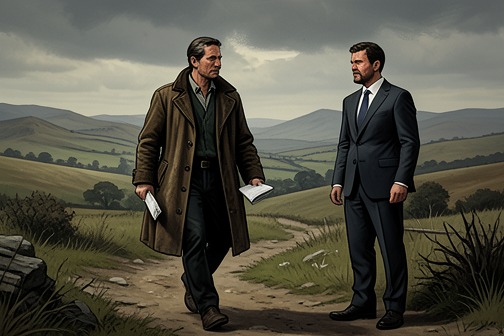
The [1993 Russian Legislative Election](entity:event-recall-event-1993-32623e011c65) is a turning point in [Eduard Limonov](entity:character-recall-character-eduard-limonov-fbb1fb9b4f1c)’s political trajectory: it gives him a chance to enter parliament, but also exposes the cost of his preference for leading a small party over joining a larger one. The campaign unfolds after the Duma has been dissolved and bloodily suppressed, amid the social damage of economic reform and a political climate in which the meaning of democracy has become uncertain. Limonov campaigns across the [Tver](entity:location-recall-location-f66c6c3b09e6) region with [Taras Rabko](entity:character-recall-character-3db05e9122ea), but loses while [Vladimir Zhirinovsky](entity:character-recall-character-c961e077a963) wins a quarter of the vote. Limonov’s defeat is not simply imposed by the electorate: he declines an alliance that might have made him a member of parliament.
## Background: A Country in Upheaval
The election becomes necessary after the Duma is dissolved and the confrontation is bathed in blood. In the aftermath, the claim that democracy has been saved does not settle the matter: the book describes a public atmosphere in which people no longer use the word without quotation marks, and familiar divisions between progressive and reactionary, democratic and fascist, have become unstable. The election is thus presented not as a routine transfer of power but as a contest over what political legitimacy means after violence.
Economic reform gives that contest a material setting. The price liberalization associated with Boris Yeltsin and [Yegor Gaidar](entity:character-recall-character-a449aea81835) produces inflation of 2,600 percent. Vouchers intended to represent each citizen’s share of national wealth were mailed on September 1, 1992, to every Russian citizen over one year old; by the time they arrived, inflation had made them nearly worthless. Many recipients sold them for roughly the value of a bottle and a half of vodka. In the Tver region, Limonov encounters towns and villages devastated by shock therapy, a landscape far removed from the prosperous, American-style middle-class family shown in Gaidar’s campaign advertising.
## Limonov’s Campaign in the Tver Region
A law student, Rabko helps Limonov register as a candidate. The Yeltsin years are described as chaotic but open enough that anyone can run for office and express an opinion. [Alexander Dugin](entity:character-recall-character-3d0c85e73dce) has promised to help, but remains in his heated [Moscow](entity:location-recall-location-19aceb5ce281) office; the party’s campaign staff is therefore just Limonov and the loyal Rabko. Through December they travel around the district in an old car with Moldavian plates, lent by an officer they know. When its owner wants it back, they continue by bus and third-class train.
The district contains 700,000 voters. Limonov holds small meetings, gathering groups of fifteen to twenty people, mostly poor and elderly retirees. In the struggling settlements of Rzhev, Staritsa, Demidovo, and others, Rabko approaches passersby to bring them to the rallies. Listeners hear Limonov’s Russian nationalist platform, but many end by asking which candidate he supports: Yeltsin or Zhirinovsky. Their question registers the narrow terms in which national politics is being understood, and the difficulty Limonov faces in making independence itself sound like a persuasive choice.
The campaign also meets a public habituated to voting for the party in power. Limonov objects to Gaidar’s television advertisement, which depicts a prosperous suburban family going to vote and a child joking that the family dog cannot vote too. He regards this imagined middle-class world as an insult to most Russians. His listeners agree with the criticism, but the book notes that agreement does not necessarily translate into votes against the governing party.
## Rival Appeals and the Result
A few voters support Zhirinovsky, whose campaign offers a more spectacular nationalist response to the people swindled by reform. In a documentary made for the [BBC](entity:organization-recall-organization-3c76d7ec91ee) by [Pawel Pawlikowski](entity:character-recall-character-a435bc465375), the candidate promises free vodka, the reconquest of the empire, support for the Serbs, bombings of Germany, Japan, and the [United States](entity:location-recall-location-5d55e9152db1), the reopening of the [Gulag](entity:concept-recall-concept-gulag-41d9bb76f27e), and imprisonment for the new Russians and supposed traitors. The book observes that this rhetoric is not far removed from Limonov’s own political stock-in-trade, but Limonov struggles to explain what his independent candidacy offers instead.
Yeltsin and Gaidar win the election, while Zhirinovsky receives a quarter of the vote. That result makes Limonov’s alternative especially stark: had he run alongside Zhirinovsky, he would have become a member of parliament. Zhirinovsky was willing to include him, but Limonov refuses. The narrator presents the decision as consistent with Limonov’s familiar preference: he would rather head a party of three than stand beneath a leader with millions of supporters.
## Defeat and Political Meaning
The certainty of the outcome is such that Limonov does not wait for the results to be officially announced. He returns to [Paris](entity:location-recall-location-paris-c02b439ce220) furious and humiliated. The campaign has taken him through a neglected provincial hinterland and brought him into contact with voters whose hardship makes the costs of reform tangible, yet it does not produce a parliamentary foothold. Its failure exposes the tension between political reach and personal command: Limonov can imagine a route into parliament, but not at the price of subordinating himself to another figure.
The election also prefigures the political world that will shape Limonov’s later activity. The book places his candidacy in the brief period when electoral participation and open political expression remain possible, even amid disorder, and sets its defeat against the broader instability of post-Soviet politics. For Limonov, the result is both a humiliation and a revealing choice: he leaves without a seat, having refused the alliance that could have delivered one.
Event 49
First Chechen War
The [First Chechen War](entity:event-recall-event-3c6f3b184cbe) emerges as both a military catastrophe and a political gamble: a campaign whose leaders hoped it would strengthen Boris Yeltsin, but whose destruction and human cost made the promise of a swift victory ring hollow. The account places the war amid a crisis of democratic legitimacy and offers a second, explicitly attributed explanation for why influential military figures may have wanted the conflict: a major war could conceal the scale of corruption in the armed forces.
## Background and political stakes
By the time the war entered the presidential-election crisis of 1996, the disastrous effects of shock therapy and the first wave of privatizations had plunged [Russia](entity:location-recall-location-e36341713c23) into chaos. Many people regarded the changes since 1989 as a historic calamity. Yeltsin, once the bearer of great hopes, appeared to have lost control; isolated in the Kremlin with his family and security chief, [Alexander Korzhakov](entity:character-recall-character-b5b2c9454d93), he endured serious depressive episodes and drank heavily. His public drunkenness embarrassed Russians at international gatherings. The account presents these swings between despair and drunken euphoria as a political circumstance in which military hard-liners could find an opening.
[Chechnya](entity:location-recall-location-63a9bb7e3d65) had been independent since 1991 and was governed by a former Soviet apparatchik who had converted to Islam. The account describes it as a haven for organized crime, drug trafficking, and counterfeiting, but also notes that Russia continued to benefit from the situation and had little obvious economic reason to intervene. That distinction matters: the campaign is not explained simply as an effort to suppress crime. The military high command had another interest in a major conflict, according to a theory advanced by [Paul Klebnikov](entity:character-recall-character-c3e4ceeb458d) before his murder.
Klebnikov, whom the narrator describes as no believer in conspiracy theories, suspected that generals needed a war to hide extensive corruption. They had allegedly sold large quantities of weapons and ammunition, especially tanks, on the black market. A major conflict, in his account, would allow that matériel to be recorded officially as destroyed. The book does not establish this as the decisive cause; it preserves it as Klebnikov’s explanation and explicitly leaves open how much weight it should carry.
## The assault and its scale
Whatever the generals’ motives, the Russian army did not spare the city. At the height of the siege of [Sarajevo](entity:location-recall-location-f362c04c2df2), the account gives a figure of 3,500 detonations a day. At the beginning of the siege of [Grozny](entity:location-recall-location-b957dbe8e1cc) in December 1994, it gives 4,000 an hour. The comparison compresses the difference into a brutal measure of intensity: the bombardment of Grozny surpassed even the already staggering pace described for Sarajevo. The city was laid waste as completely as [Vukovar](entity:location-recall-location-36d49389a148) had been.
The account sets that destruction against the Chechens’ resistance. They fought a merciless guerrilla war, attacking Russian soldiers in their tanks and carrying out bloody terrorist actions on Russian territory. The campaign therefore did not remain the victorious lightning strike its young conscripts had been promised. Instead, the army became bogged down in a conflict compared to the Soviet war in Afghanistan, a comparison that makes the war’s failure of expectation central to its human cost.
## Conscripts and the legacy of dirty wars
Forty thousand young conscripts were drawn into the conflict. Among them was [Zakhar Prilepin](entity:character-recall-character-334182a15d37), who would later become a writer. They had been promised a rapid victory and a triumphant return; many instead found themselves trapped in a war as horrible as Afghanistan had been for their fathers and older brothers. The book’s account refuses to treat the conscripts as an abstract military number: it emphasizes that they returned, if they returned at all, crippled, humiliated, and suffering from hallucinations.
The chronology sharpens the sense of repetition. [Mikhail Gorbachev](entity:character-recall-character-7c6bee5bcfc8) withdrew Soviet troops from Afghanistan in 1988; only six years of peace separated that war from the Chechen conflict. The two wars are presented as dirty wars that sent young Russians home bearing lasting physical and psychological damage. The interval is short enough to make the second campaign feel less like a new beginning than a renewed exposure of a generation to violence.
## Electoral calculation and political consequence
The conflict was also bound up with Yeltsin’s deteriorating political position. With the 1996 election approaching, Korzhakov and the military hawks persuaded him that a small, decisive war against Chechnya could undermine the nationalists and revive his waning popularity. The plan depended on a sharp contrast between the promised quick victory and the campaign that followed: Grozny was devastated, guerrilla resistance continued, and conscripts became bogged down in another prolonged war.
As the election approached, Yeltsin was more hated than his predecessor, and he seriously considered canceling the vote. The account thus places the war beside a broader crisis in which the democratic experiment had lost public support and the Communist Party appeared capable of winning massive backing. It does not present the war as the sole cause of that crisis, nor does it settle the outcome of Klebnikov’s theory about military corruption. Instead, it shows the campaign at the intersection of presidential insecurity, electoral calculation, military interests, and the lives of young soldiers. Its decisive significance lies in that collision: a war intended to produce political advantage became an immense act of destruction and another source of the crippled, humiliated survivors whom the book associates with Russia’s dirty wars.
Event 50
Battle of Grozny
The [Battle of Grozny](entity:event-recall-event-5f1934117c29) opens in the account as an assault whose scale is measured against the siege of [Sarajevo](entity:location-recall-location-f362c04c2df2): where Sarajevo endured 3,500 detonations per day at the height of its siege, [Grozny](entity:location-recall-location-b957dbe8e1cc) faced 4,000 per hour at the beginning of the siege in December 1994. The city was laid waste as completely as [Vukovar](entity:location-recall-location-36d49389a148). The contrast in tempo makes the bombardment’s intensity stark, while the comparison places Grozny within a wider pattern of urban destruction in the wars accompanying the breakup of Yugoslavia and the [Soviet Union](entity:location-recall-location-67657886d3d4).
## Bombardment and Urban Destruction
The Russian army did not hold back. The account gives the bombardment’s peak rate in a compressed numerical comparison: thousands of detonations over a day in Sarajevo, against thousands in a single hour in Grozny. It does not detail individual strikes or provide a casualty count; instead, the city’s devastation is conveyed through the comparison with Vukovar, another city described as laid waste.
## Chechen Resistance
The Chechens answered the assault with a guerrilla war marked by both ferocity and cruelty. They burned Russian soldiers inside their tanks and carried out bloody terrorist actions on Russian territory. The resistance therefore extended beyond the devastated city: the battle’s violence was not confined to the siege lines, but also appeared in attacks within [Russia](entity:location-recall-location-e36341713c23).
## Conscripts and the Failed Promise of a Swift Victory
The fighting trapped 40,000 young conscripts in a war they had been told would be a victorious lightning strike followed by a triumphant return. Among them was [Zakhar Prilepin](entity:character-recall-character-334182a15d37). Instead of the quick campaign they expected, the conscripts found themselves bogged down in a conflict compared to the war in Afghanistan, which had afflicted their fathers and older brothers. The promised victory thus gave way to an experience of prolonged combat and uncertainty over who would return.
## The Aftermath in Historical Perspective
The account sets the battle against the short interval between two wars that sent young Russians home, if they came home at all, crippled, humiliated, and suffering hallucinations. After [Mikhail Gorbachev](entity:character-recall-character-7c6bee5bcfc8) withdrew Soviet troops from Afghanistan in 1988, only six years of peace separated that war from the beginning of the siege of Grozny. The battle consequently appears not as an isolated campaign, but as the renewal of a cycle in which one generation’s war was followed, after a brief respite, by another.
Event 51
1996 Russian Presidential Election
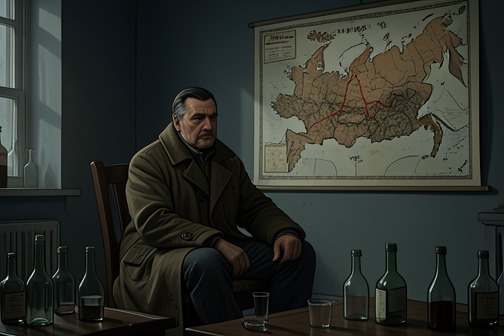
The [1996 Russian Presidential Election](entity:event-recall-event-1996-2020d6fd48d2) was fought over more than the presidency: it tested whether the public’s anger at the upheavals of the post-Soviet years would bring the Communists back to power, and whether the new oligarchs could turn their wealth into political influence. Boris Yeltsin won a runoff described as largely rigged, but the campaign exposed the collision of economic collapse, media power, historical memory, and [Eduard Limonov](entity:character-recall-character-eduard-limonov-fbb1fb9b4f1c)’s deliberately paradoxical politics.
## Crisis and the Communist challenge
The election approached after the shock therapy reforms and first privatizations had plunged [Russia](entity:location-recall-location-e36341713c23) into chaos. For many people, the years since 1989 seemed a historic calamity, and Yeltsin—once the focus of high hopes—appeared to have lost control. He was secluded in the Kremlin with his family and security chief, [Alexander Korzhakov](entity:character-recall-character-b5b2c9454d93), and coped with severe black moods by drinking heavily. His public drunkenness, including an embarrassing appearance at Berlin’s solemn commemoration of the 1945 victory, further weakened his standing. The account also links the prospect of a new war in [Chechnya](entity:location-recall-location-63a9bb7e3d65) to the political calculations of military hardliners: a conflict, they hoped, might damage the nationalists and revive Yeltsin’s popularity, while concealing corruption in the military command.
The alternative that alarmed the establishment was not merely a protest candidate but the Communist Party. Five years earlier, Yeltsin had declared it illegal; now polls suggested that voters angered by democracy, the market, and the injustice accompanying them were ready to support it in large numbers. Its leader, [Gennady Zyuganov](entity:character-recall-character-cb21aa845c13), presented a cautious program centered on fighting corruption, restoring national pride, and affirming Russian Orthodoxy. Rather than promising a return to the [Gulag](entity:concept-recall-concept-gulag-41d9bb76f27e) or the Berlin Wall, he pledged to narrow the gap between rich and poor. That offer drew force from the hardships of ordinary people, even as its label carried the weight of the Soviet past.
## Oligarchs, privatization, and the campaign
The oligarchs had reason to fear a change of government. The earlier voucher privatization scheme had been badly undermined by inflation: after prices were liberalized, inflation reached 2,600 percent, and the vouchers mailed on September 1, 1992, to Russian citizens over one year old were nearly worthless by the time they arrived. Some recipients could exchange a voucher for little more than a bottle of vodka. The account identifies [Boris Berezovsky](entity:character-recall-character-17b2e302f4d3), [Vladimir Gusinsky](entity:character-recall-character-003f584d9bee), and [Mikhail Khodorkovsky](entity:character-recall-character-61f5b419de2c) among the businessmen who bought up vouchers and became multibillionaires within months, in a country where rules, banking, and taxation had yet to catch up with private business.
Their immediate stake was the loans-for-shares scheme. Banks lent money to the cash-strapped state, taking shares in valuable, still-unprivatized industries such as natural gas and petroleum as collateral. If the state failed to repay the loans after a year, the lenders could take the shares; the deadline fell after the election. A Communist victory might undo the arrangement. After a warning from George Soros at the Davos World Economic Forum made the danger feel immediate, Berezovsky called six other powerful oligarchs and urged them to unite behind Yeltsin. Their rivalries, including violent competition between the entourages of Berezovsky and Gusinsky, gave way temporarily to a common electoral purpose.
The seven oligarchs poured money and media influence into Yeltsin’s campaign. Newspapers, radio, and television repeatedly framed the choice as either Yeltsin or chaos, or a leap backward. Relentless broadcasts of documentaries about the Gulag, Stalin’s famine in Ukraine, and the Katyn Massacre reinforced the warning against a Communist return. The campaign thus made historical memory part of electoral persuasion: the suffering of the Soviet past was used to discredit the alternative, while the disastrous consequences of the new economic order helped make that alternative attractive.
## Limonov and the choice between camps
The campaign left Limonov’s young National Bolsheviks with a political dilemma. They were disgusted by propaganda that rejected what they had been taught to love and placed their parents’ ideals alongside Nazism. Yet Limonov found neither Yeltsin nor Zyuganov a satisfactory choice. He briefly joined the marginal Stalin Bloc, only to be displaced as its candidate by Yevgeny Dzhugashvili, Stalin’s grandson, whose mustache and pipe recalled the dictator. In the runoff, however, Limonov told his followers to vote for Yeltsin. His reasoning was that the more chaos there was, the better the prospects for revolution.
The decision startled supporters and later fed rumors that Limonov was a paid Kremlin agent. He drew a different lesson: political paradoxes were dangerous because the masses would not understand them. The episode captures the gap between his revolutionary ambitions and the practical effect of his interventions. Rather than offering a stable electoral program, he treated the ballot as one move in a larger contest over disorder and political possibility.
## Victory and the violence that followed
Between the two rounds, Yeltsin suffered a heart attack, which was concealed from the public as far as possible. The runoff ultimately declared him the winner, in an outcome the narrative calls largely rigged. His victory secured the oligarchs’ immediate political objective and left Limonov convinced that the election’s aftermath, rather than its formal result, might open further possibilities for upheaval.
Soon after the election, Limonov was walking home alone when three men attacked him on a deserted street. They knocked him down and kicked his ribs and face. He spent eight days in hospital and nearly lost an eye. The account does not establish who ordered the assault. Limonov’s suspicions focused particularly on General Alexander Lebed, who had finished third in the election, but the possibility that Lebed or someone around him had retaliated for attacks in [Limonka](entity:organization-recall-organization-f8642338f33b) remains a suspicion, not a demonstrated explanation. Afterwards, Limonov no longer went out without three tough-looking National Bolsheviks beside him. The election’s conclusion, in this account, is therefore not simply Yeltsin’s victory: it is the visible continuation of political competition through money, propaganda, unresolved suspicion, and personal violence.
Event 52
1998 Russian Financial Crisis

The [1998 Russian Financial Crisis](entity:event-recall-event-1998-889098f269f1) is presented as a devastating reversal for ordinary Russians amid the conspicuous enrichment of the oligarchs. The book does not supply a technical account of the crash; instead, it registers its social force through the savings it erased, the people who did not protest, and the opulent world they watched from the margins. Its surrounding narrative traces the unequal economic and political order that had taken shape during Boris Yeltsin’s reforms and second term.
## Background: Shock Therapy and Privatization
The crisis follows an abrupt attempt to create a market economy in a country that had never had anything remotely like one. Aware of his limited economic knowledge, Boris Yeltsin appointed [Yegor Gaidar](entity:character-recall-character-a449aea81835), a young economist descended from the Communist nomenklatura and a fervent believer in liberalism. Yeltsin and Gaidar sought to move quickly, hoping to push reform through before reactionary forces could block it. They called the program shock therapy.
Price liberalization produced inflation of 2,600 percent. On September 1, 1992, every Russian citizen over one year old was sent a voucher valued at ten thousand rubles, intended to give each person a share in national wealth and encourage investment in businesses and private property. By the time the vouchers arrived, inflation had made them nearly worthless: at most, they could buy a bottle of vodka. Many recipients sold them to buyers offering roughly the value of a bottle and a half. The episode supplies an earlier measure of how formal economic participation could translate, for ordinary people, into little more than a quickly spent token.
## From Vouchers to Oligarchic Wealth
Among the buyers who accumulated these vouchers were [Boris Berezovsky](entity:character-recall-character-17b2e302f4d3), [Vladimir Gusinsky](entity:character-recall-character-003f584d9bee), and [Mikhail Khodorkovsky](entity:character-recall-character-61f5b419de2c), whom the book uses as representative figures for the oligarchs. The transition from an economy in which private business had been forbidden to one suddenly operating without established rules, laws, a banking system, or taxation gave energetic entrepreneurs room to build enormous fortunes. The narrative describes them as having been told, almost overnight, that they could pursue the business they had been barred from practicing.
A further transfer of economic power came through the loans-for-shares scheme. The oligarchs’ banks lent money to a cash-strapped state, with shares in major natural-resource companies pledged as collateral. If the state failed to repay the loans within a year, the lenders could take the shares. Because the deadline fell after the presidential election, the arrangement also gave the oligarchs a direct stake in who remained in power. They feared that [Gennady Zyuganov](entity:character-recall-character-cb21aa845c13), the Communist candidate, might repudiate the agreement. At the 1995 Davos World Economic Forum, the attention Zyuganov received from journalists and political advisers alarmed Berezovsky. He then called six other powerful oligarchs, proposing that they set aside their conflicts and use their combined financial and media power to secure Yeltsin’s reelection.
## The Crash and Its Unequal Burden
The book places the 1998 crash within the second Yeltsin term, which it dates from 1996 to 2000. Foreign businessmen, journalists, and adventurers later remembered those years as exhilarating: [Moscow](entity:location-recall-location-19aceb5ce281) seemed to offer nights of extravagance and a center-stage role in the world. That experience belonged chiefly to those able to afford it. The crisis erased the meager savings of people who had already lost them once in the decade, yet they did not take to the streets. The account shows them stunned and still, seated in shabby coffee shops before televisions that displayed the rich-city world from which they were excluded.
The contrast is rendered through precise images of consumption. On television, a young woman could casually use a gold card to pay for sushi costing what a teacher earned in a year; wealthy young men traveled with entourages of bodyguards and flew privately to Courchevel, where they filled Jacuzzis with Veuve Clicquot. While these scenes made elite abundance visible, the crisis’s victims remained largely unseen and politically quiet. The juxtaposition makes the crash more than a financial setback in the narrative: it exposes the distance between the people absorbing repeated losses and those whose wealth was expanding.
## Political Consequences and Significance
The loans-for-shares bargain illustrates how economic resources became political leverage. Khodorkovsky, for example, paid $168 million for Yukos, an oil company bringing in three billion dollars a year. The fortunes built around raw materials, the account argues, generated little public wealth and disappeared into opaque offshore networks, including those in Liechtenstein and the Cayman Islands. The crash thus unfolds against a social order in which the gains of privatization were concentrated while ordinary households remained vulnerable to the next shock.
As Yeltsin’s second term approached its end, the oligarchs again looked for a successor who would cooperate with them. Berezovsky proposed [Vladimir Putin](entity:character-recall-character-vladimir-putin-600db9625a7e), then a little-known former intelligence officer who had quietly headed the [Federal Security Service](entity:organization-recall-organization-d88330d0701a) for the previous year. The account presents this search as a continuation of the oligarchs’ effort to protect their interests, not as a consequence of the 1998 crash alone. In the event’s broader significance, the crisis marks the human cost of a market transformation whose most visible rewards belonged to a small circle, while its repeated losses settled on people with little means to resist.
Event 53
1999 Russian Apartment Bombings
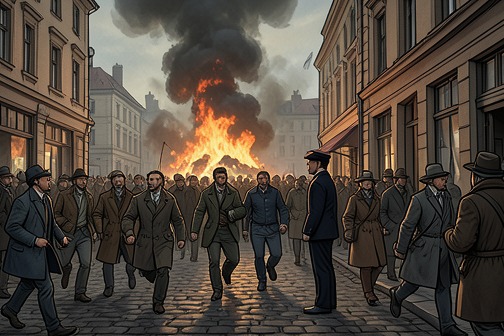
The [1999 Russian Apartment Bombings](entity:event-recall-event-1999-14c7381806cc), a series of attacks on apartment buildings in the suburbs of [Moscow](entity:location-recall-location-19aceb5ce281) in the fall of 1999, killed more than three hundred civilians. In the book’s account, the bombings became both the pretext for a new war in [Chechnya](entity:location-recall-location-63a9bb7e3d65) and the setting for a lasting, unresolved suspicion: that the attacks attributed to Chechen terrorists had in fact been carried out by the [Federal Security Service](entity:organization-recall-organization-d88330d0701a), possibly with [Vladimir Putin](entity:character-recall-character-vladimir-putin-600db9625a7e)’s endorsement.
## Political setting and the attacks
Six months before the presidential election, Boris Yeltsin designated Putin as his heir apparent. The book presents the election as already appearing almost a formality, then links the bombings to the effort to make the new leader look like a savior: once again, it suggests, a war in Chechnya offered a useful pretext. The account describes the attacks as having been blamed on Chechen terrorists without a shred of proof, while distinguishing that official attribution from the competing theory about responsibility.
The theory that the Federal Security Service had carried out the bombings was publicly expressed by General Alexander Lebed, journalist Artyom Borovik, former Federal Security Service officer Alexander Litvinenko, and [Paul Klebnikov](entity:character-recall-character-c3e4ceeb458d), the narrator’s cousin. The book notes that all four later died violent deaths: Lebed and Borovik in suspicious accidents, Litvinenko by polonium poisoning, and Klebnikov, a journalist, by gunfire from a Kalashnikov. Their deaths are recounted alongside the theory, but do not establish that it was true.
## Suspicion and public response
The account characterizes the theory as both paranoid and not entirely implausible, and says it remained widespread among the Russian population. Its emphasis is not only on the allegation but on the apparent coexistence of suspicion and political support: people were not particularly bothered by the possibility, the narrator writes, and voted overwhelmingly for Putin several times while believing—or at least believing him capable of being guilty—of such a crime. The bombings thus remain politically consequential in the narrative even as their responsibility remains contested.
## Putin’s rhetoric and the later echo
A few months after his promotion, Putin declared his intention to “waste the terrorists in their shithouses.” The book treats the phrase as setting the tone for his presidency. Among the National Bolsheviks, it immediately became an inside joke, recast as a threat exchanged over vodka. The joke turns presidential language into everyday banter, even as the account stresses that [Eduard Limonov](entity:character-recall-character-eduard-limonov-fbb1fb9b4f1c) and his associates had no idea what awaited them.
The suspicion surrounding the bombings returns during the Moscow theater hostage crisis in October 2002. Watching news coverage from his cell in [Saratov](entity:location-recall-location-f449ad81f1f4), Limonov recalled persistent rumors that the [1999 attacks](entity:time-recall-time-1999-7b15d73492a6) had been committed not by Chechens but by the Federal Security Service with the president’s endorsement. The later recollection connects the bombings to Limonov’s growing condemnation of Putin: in the book’s account, this was the first time he used the word fascist negatively.
Event 54
Second Chechen War
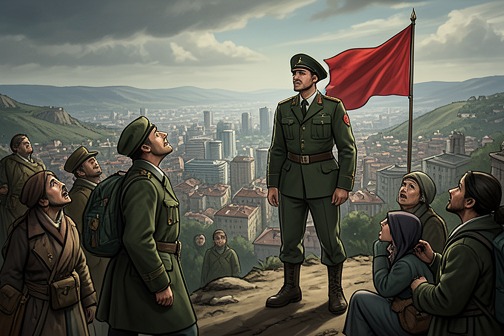
The [Second Chechen War](entity:event-recall-event-5a6d81728bca) is presented chiefly through the political circumstances surrounding its launch, rather than through scenes of combat. In the account, the 1999 apartment bombings in the suburbs of [Moscow](entity:location-recall-location-19aceb5ce281)—more than three hundred civilians killed—provide the pretext for a new war in [Chechnya](entity:location-recall-location-63a9bb7e3d65) and help make [Vladimir Putin](entity:character-recall-character-vladimir-putin-600db9625a7e), then Boris Yeltsin’s designated successor, appear as a national savior. The narrative’s emphasis falls on the gap between the official attribution of the attacks and the doubts that persisted around it, as well as on the political uses of war rhetoric.
## Political Setting and the Bombings
Six months before the presidential election, Yeltsin designated Vladimir Putin as his heir apparent. The election consequently seemed almost a formality, and the narrative describes a war as a means of presenting the new leader as a savior. The stated pretext was a series of bombings in Moscow’s suburbs in the fall of 1999. They killed more than three hundred civilians and were blamed on Chechen terrorists, although, as the account stresses, no proof was presented.
The passage does not recount military operations or identify particular battles. Instead, it locates the war’s significance in the sequence that brought Putin to power: succession, attacks on civilians, attribution to an enemy, and the prospect of a leader able to promise decisive retaliation. The war is thus introduced not as a battlefield chronicle but as a political event whose public meaning was bound up with the circumstances of its beginning.
## The Unresolved Allegation
Against the official attribution, the narrator describes an alternative theory: that the [Federal Security Service](entity:organization-recall-organization-d88330d0701a) had committed the bombings. The account names four people who publicly expressed the theory: Alexander Lebed, journalist Artyom Borovik, former Federal Security Service officer Alexander Litvinenko, and [Paul Klebnikov](entity:character-recall-character-c3e4ceeb458d), the narrator’s cousin. Their later deaths are recounted with markedly different circumstances: Lebed and Borovik died in what the narrator calls suspicious accidents, Litvinenko was poisoned with polonium, and Klebnikov was shot with a Kalashnikov.
The passage does not establish the theory as fact. It calls it both paranoid and not entirely implausible, and notes that it remained widespread among the Russian population. Its pointed observation is that belief in the allegation did not prevent many people from voting overwhelmingly for Putin in successive elections. In the narrative’s account, suspicion and political support coexist: voters could believe, or at least consider possible, that a leader was implicated in a grave crime and still back him.
## War Rhetoric and Political Consequences
A few months after his promotion, Putin’s public manner had changed. He announced his intention to waste the terrorists in their shithouses, a brutal formulation that the narrative presents as setting the tone for his presidency. Among Limonov’s [National Bolshevik Party](entity:organization-recall-organization-d9e15bd528ae) followers, the phrase became an inside joke, adapted to everyday banter over vodka. Its reuse turns a presidential threat into a private party catchphrase, without making the underlying violence disappear.
The war’s political atmosphere appears alongside the authorities’ treatment of organized opposition, though the narrative does not claim that the war caused the party’s suppression. Before the presidential election, the Ministry of Justice passed a law against extremism and fascism whose definitions it reserved the right to determine, then told the National Bolshevik Party that the measure concerned it. Limonov met the minister in a suit and tie to argue that his party was neither extremist nor fascist. After the authorization deadline passed, the party was refused permission to exist legally. At a second meeting, Limonov pointed out that his organization had seven thousand adherents, unlike the many registered parties he described as phantom organizations, and warned that driving young people underground could push them toward extremism and terrorism.
## The Event in the Wider Narrative
The account’s treatment of the Second Chechen War is deliberately bounded: it gives the reader the civilian cost of the bombings, the official accusation, the contested alternative, and the rhetoric that followed, but supplies no battlefield narrative with which to resolve the allegations. That omission makes the uncertainty itself part of the event’s political afterlife. The question is not merely what the state said had happened, but how suspicion of a different explanation could become widespread without dislodging support for the leader who emerged from the crisis.
The war also marks the setting in which Limonov’s movement and the new presidency came into contact. The National Bolshevik Party’s joke about Putin’s threat, followed by the denial of its legal status, places the movement’s oppositional life beside the expanding authority of the state. The narrative therefore presents the war as both a conflict invoked in the making of a presidential image and a turning point in a political climate where forceful state language and narrowing space for opposition developed side by side.
Event 55
Transnistria War
The [Transnistria War](entity:event-recall-event-transnistria-war-3d551830117e) enters the narrative through a terse geographical recollection: [Eduard Limonov](entity:character-recall-character-eduard-limonov-fbb1fb9b4f1c) remembers the Black Sea during the war. The book supplies no further account of the conflict or his actions there, so its significance here lies in the way the war becomes one marker in a life recalled through places and water.
## The War as a Place in Memory
The reference occurs in The Book of Water, a memoir assembled from recollections of seas, rivers, lakes, ponds, and pools. Its chapters move between places and periods without following a chronological or geographical itinerary. In that sequence, the Black Sea during the Transnistria War is named alongside the Seine, the East River, the Kuban River, and the torrents of the [Altai](entity:location-recall-location-altai-70f2300fda8c). The brief mention establishes an association between the war and a body of water, but does not describe a battle or specify what Limonov experienced there.
## Place in The Book of Water
The book comprises around forty short chapters, precise in their recollection but apparently disorderly in sequence. Their underlying arrangement is connected to the women in Limonov’s life, including Anna, [Tanya](entity:character-recall-character-tanya-ee245c438564), and [Natasha](entity:character-recall-character-1641a8d337bd). The war reference therefore sits within a personal, associative structure rather than an account organized around military events. The surrounding recollections range from watching Natasha swim to walking along the Seine and fishing in the Altai; the Black Sea recollection is one element in this broader map of remembered places.
## Scope of the Account
The narrative provides no date, combatants, cause, course, or outcome for the Transnistria War. Nor does the passage establish that Limonov fought in it: it says only that he remembered the Black Sea during the war. The event’s limited treatment matters for understanding the source. The war is invoked as a temporal and geographical coordinate in Limonov’s recollections, not presented as a developed episode whose military or political history the book explains.
Event 56
September 11, 2001 attacks
The [September 11, 2001 attacks](entity:event-recall-event-9-11-3534f829cd59) are recalled not through a description of the attacks themselves but through their immediate effect on the public image of [Eduard Limonov](entity:character-recall-character-eduard-limonov-fbb1fb9b4f1c) and the [National Bolshevik Party](entity:organization-recall-organization-d9e15bd528ae). While Limonov is in prison, the attacks supply a new frame for presenting the party: a television film portrays it as an extension of Al-Qaeda, turning a remote encampment in the [Altai](entity:location-recall-location-altai-70f2300fda8c) into an imagined training ground for fanatics.
## Occurrence and Context
The narrative places the attacks during Limonov’s imprisonment and connects them to the moment he arrives in [Saratov](entity:location-recall-location-f449ad81f1f4). It offers no account of the attacks’ course or casualties. Instead, the event serves as the historical circumstance against which a new, more menacing portrayal of his political movement becomes legible.
## The Television Reframing
As Limonov reaches Saratov, [Channel One Russia](entity:organization-recall-organization-bf2c55f6e5eb) airs a film called The Ghost Hunt. The film presents the National Bolshevik Party as a branch of Al-Qaeda and depicts a hut in the Altai as a secret camp training hundreds of fanatical fighters. The book contrasts that image with the reality of Limonov’s small group and its limited presence there; the imagined camp, it notes, was closer to his own dream than to what existed.
## Consequences in Prison
The film’s account circulates inside the prison: every inmate has seen it, and Limonov becomes known as bin Laden. The nickname carries two opposing consequences. It flatters him by casting him as the protagonist of a spectacular threat, but it also makes him more dangerous to be around. In this episode, the attacks matter to the narrative chiefly as the backdrop to a transformation in political meaning: a television story converts Limonov’s ambitions and a modest encampment into evidence of an international terrorist menace.
Event 57
Eduard Limonov's arrest and trial
[Eduard Limonov](entity:character-recall-character-eduard-limonov-fbb1fb9b4f1c)’s arrest and trial expose the gulf between the modest reality of his group’s encampment in the [Altai](entity:location-recall-location-altai-70f2300fda8c) and the state’s portrayal of it as a grave security threat. The raid leads from a snowbound cabin to Lefortovo’s isolation, a high-profile trial in [Saratov](entity:location-recall-location-f449ad81f1f4), and a four-year sentence served in part at [Penal Colony 13 at Engels](entity:location-recall-location-13-125ed8c83413). Across those settings, the case becomes both a struggle over political legitimacy and a close account of how Limonov meets confinement through discipline, observation, and adaptation.
## Political Context and the Raid
The arrest came against a background in which political identities and claims to democratic legitimacy had become fiercely contested. During the earlier confrontation at the White House, Limonov had joined the patriots assembled in support of rebel legislators. He argued that the conflict was not a coup but an elected parliament resisting dictatorship, and presented Western support for Boris Yeltsin as evidence that [Russia](entity:location-recall-location-e36341713c23)’s opponents abroad wanted the country weakened. The episode illustrates how language about democracy, patriotism, and constitutional order could be claimed by opposing sides.
The later prosecution would likewise turn on how the state defined Limonov and his movement. The account describes a camp in the Altai where a special-forces unit arrived at dawn. Around thirty masked men, armed and accompanied by barking German shepherds, pulled the sleepers from their bags and made them kneel in the lingering snow. Limonov had lost his glasses and was barefoot in wool underwear; as the group’s leader, he was allowed to dress first. One of the soldiers told him that he admired his books and was proud to be arresting him, then the questioning began with the demand, “Where are the weapons?”
The search was meticulous, using dogs and metal detectors. It found two hunting rifles but no other weapons. The arresting force’s scale and theatrical efficiency stood in stark contrast to the sparse evidence described at the camp. Six other National Bolsheviks were loaded roughly into an army truck, while Limonov travelled with Colonel Kuznetsov in a sedan stocked with vodka and snacks. Their drive to the [Federal Security Service](entity:organization-recall-organization-d88330d0701a) base at Gorno-Altaysk took eight hours, and a special plane awaited the prisoners there. Kuznetsov called the journey “VIP treatment” and drank to the operation’s success. During the drive he disclosed that he had worked on the movement’s file for years, had acted against its members at a filmmaker’s request, and had arranged the arrest of activists travelling to [Riga](entity:location-recall-location-d65ca907e874) two months earlier. Limonov challenged the earlier arrest as a setup, saying those activists had carried no drugs.
## Lefortovo: Isolation and Self-Discipline
Limonov was detained at Lefortovo, a prison associated with the Soviet and Russian state’s most prominent political prisoners and high-level security suspects. At first he did not know precisely what he and his companions were accused of. He had not seen a lawyer, could receive no visitors, and had no way to learn when the trial would begin or whether people outside knew where he was. The uncertainty extended beyond the charges to the possibility that his arrest might pass without public notice.
The prison’s conditions differed from those of many Russian institutions: the cells were clean, white, and not overcrowded, and inmates were not subjected to the beatings or sexual violence described elsewhere. Its pressure came instead through strict isolation and control of time. Prisoners could watch television for much of the day, a routine that the narrative describes as leading from fuzzy-headed dependence into apathy and depression. Exercise took place in tiny fenced-off spaces on the roof, where loud music made conversation impossible. It was optional, and many inmates chose to remain in bed rather than go outside.
Limonov insisted on exercising every day. Even in winter, when it was dark and temperatures reached minus twenty-five, he demanded his allotted time outdoors. For half an hour he ran on his small patch of concrete, doing push-ups and sit-ups and boxing the icy air. The guards resented having to leave their warm room for a single prisoner, but they were also impressed by his persistence. His politeness and education earned him the nickname “Professor.” The contrast is central to the account of his imprisonment: the institution sought to narrow movement and contact, while he made a repeated physical routine into a form of resistance to passivity.
## Charges and Trial in Saratov
After fifteen months in Lefortovo, Limonov was transferred under police escort in a government Antonov aircraft to Saratov, on the Volga. The jurisdiction was chosen because it was the Russian region closest to [Kazakhstan](entity:location-recall-location-5f41d751a306), where prosecutors said the alleged crimes had been committed. In Saratov, prisoners had to state not only their names and patronymics but also the criminal-code articles under which they were held. Limonov learned to recite his identifying details and four charges: terrorism, organizing or participating in an illegal armed group, unlawful firearms dealings, and incitement to extremist activity.
At the first hearing, the investigating judge recited the charges and the severe sentences they carried. Limonov faced a double bind: he took a certain pride in being accused of major crimes, yet needed to defeat the case if he was to avoid a long term as a terrorist. The account emphasizes the disparity between the prosecution’s claim and the circumstances it describes: half a dozen men in a log cabin, roughing it about sixty miles from the Kazakh border, with no arms beyond a couple of hunting rifles. In the author’s framing, the group had little apparent capacity to destabilize Kazakhstan, much less to initiate a nuclear war. But the judge appeared unwilling to engage with Limonov’s arguments and adhered to the Federal Security Service’s account, which portrayed him and his six associates as a serious threat to national security.
The case was also shaped by television. As Limonov arrived in Saratov, [Channel One Russia](entity:organization-recall-organization-bf2c55f6e5eb) broadcast a film called The Ghost Hunt. It presented the [National Bolshevik Party](entity:organization-recall-organization-d9e15bd528ae) as an Al-Qaeda branch and the Altai hut as a secret training camp for hundreds of fanatical fighters. The narrative distinguishes this sensational image from the camp that had actually been raided, while noting that Limonov had himself dreamed of building a force on that scale. Prisoners had all seen the broadcast; they called him “bin Laden,” a nickname that flattered him but also made the prosecution’s portrayal harder to dismiss as harmless spectacle.
## Conviction and Penal Colony 13
Saratov brought a different hardship from Lefortovo. Its cells, designed for four, could hold seven or eight inmates. When Limonov entered his cell, every bed was taken, so he rolled out his mattress on the floor without complaint. That response helped unsettle expectations formed by his reputation as an intellectual, political prisoner, and celebrity. He shared food from packages, did chores without fuss, and learned the unwritten rules of the cell. He refused cards and chess because he considered them a waste of time, choosing instead to read and write, but he also helped fellow prisoners with letters and crosswords. Within a week, the other inmates had concluded that he was a good man to live with.
The sentence was less severe than the prosecution had sought. After the prosecutor Verbin called for fourteen years, the judge imposed four; Limonov had already served half, leaving two years. The account calls the reduction a remarkable reprieve, particularly because he had been preparing for twelve years. It did not remove the threat of arbitrary punishment. At Penal Colony 13 at Engels, an officer could reportedly send an inmate to solitary for a week on a pretext; one story circulated there concerned a prisoner whose release was delayed by a year after a drunken junior officer objected to his shave. Limonov therefore tried to make himself inconspicuous and avoid provoking staff who might resent his fame.
[Engels](entity:location-recall-location-fa5f824ffdc7) was presented to human-rights advocates as evidence of improving Russian prison conditions, with brightly coloured walls, rosebushes, and designer-style sinks. Yet it had a reputation so poor among Russian prisoners that some injured themselves to avoid being sent there. Limonov’s response was not to mistake the appearance of the colony for freedom. At sixty, he was exempt from forced labour, but barred during the day from returning to his books and notepads. Instead, he cleaned toilets, a task allotted an hour that he deliberately stretched across four by doing it thoroughly and refusing to daydream. The arrest and trial thus end not with release from state control but with a changed arena: after isolation and overcrowded cells, the work camp imposes its own repetitive schedule, and Limonov meets it by turning even compulsory cleaning into a test of attention and self-command.
Event 58
Holodomor
The [Holodomor](entity:event-recall-event-4d5d87507145) is invoked through a brief but devastating contrast between staged appearances and famine reality. In 1932, H. G. Wells judged how people were eating from an excellent meal served to him in Kiev, while the famine beyond that meal was so severe that peasants resorted to killing their own children. The episode gives the book’s later description of a showcase prison a historical precedent: an observer can mistake the carefully presented for the truth of a whole society.
## The famine behind the meal
The passage places Wells’s visit at the height of a famine, and measures its severity in the starkest terms: peasants resorted to killing their own children. Against that reality, the excellent meal served to Wells becomes more than a detail of hospitality. It is the narrow evidence from which he draws a sweeping conclusion about how Ukrainians ate.
## The polished display and the hidden reality
The comparison is made while describing [Penal Colony 13 at Engels](entity:location-recall-location-13-125ed8c83413), a work camp presented to human rights advocates as evidence that prison conditions in [Russia](entity:location-recall-location-e36341713c23) are improving. Its brightly colored walls, rosebushes, and pseudo Philippe Starck sinks make a persuasive display. The account sets that display beside Wells’s meal in Kiev: in both cases, a visible pocket of comfort risks being mistaken for the condition of people beyond it.
## Narrative significance
The Holodomor reference sharpens the book’s warning about appearances without claiming that the two situations are identical. A meal and a showcase prison can both be real, yet still conceal the wider circumstances they are taken to represent. The comparison turns the prison’s cosmetic improvement into a question of what an official tour allows its visitor to see—and what it leaves outside the frame.
Event 59
Kosovo's independence
Kosovo’s independence is presented as the occasion for [Vladimir Putin](entity:character-recall-character-vladimir-putin-600db9625a7e) to issue a pointed warning to Europe: recognition of Kosovo, he says, could be answered with support for the independence of South Ossetia and Abkhazia, military action in Georgia, and a cutoff of gas supplies. The passage records a threat, not the subsequent execution of those measures; its significance lies in how recognition becomes the stated trigger for a broader confrontation over political recognition and Russian power.
## Recognition as provocation
The account frames Europe’s recognition of Kosovo’s independence as something that provokes Putin. It does not describe the recognition process or explain Kosovo’s history. Instead, it concentrates on Putin’s response, making the event matter here through the consequences he says Europe should anticipate. Kosovo thus enters the narrative as the precedent invoked in a warning directed at Europe.
## The warning and its stakes
Putin’s reply links three forms of retaliation: South Ossetia and Abkhazia, he says, will also be independent; [Russia](entity:location-recall-location-e36341713c23) will send tanks to Georgia; and Russia will cut off its gas if Europe is not polite in its dealings with the country. The sequence moves from a challenge to Europe’s recognition policy, through a territorial and military threat, to the use of energy supply as pressure. These are presented as conditional assertions, not as events that the passage says have already taken place.
## Narrative significance
The episode compresses a dispute over recognition into a declaration of leverage. In the narrator’s framing, Putin answers Europe’s action by asserting that Russia can apply the same principle elsewhere and can attach military and economic consequences to the argument. The passage therefore gives Kosovo’s independence a specific role in the book: it is the occasion on which Putin makes his warning explicit, rather than a separately narrated account of Kosovo’s political history.
Event 60
2008 Russian presidential election
The [2008 Russian presidential election](entity:event-recall-event-2008-65a1ff968bcc) becomes, in [Emmanuel Carrère](entity:character-recall-character-emmanuel-carr-re-4e52f3cdc3e1)’s account, a test of whether a constitutional transfer of office can also transfer power. [Vladimir Putin](entity:character-recall-character-vladimir-putin-600db9625a7e) did not run for a third consecutive term; instead, [Dmitry Medvedev](entity:character-recall-character-dmitry-medvedev-fd134e6e5519) became president while Putin took the prime minister’s office. The arrangement preserved the appearance of succession while leaving Putin close at hand, and its later resolution sharpened the contrast between Limonov’s political ambitions and the system he opposed.
## Background: Limonov’s political opening
Before the election, Limonov’s standing had changed. Carrère recalls discovering that [Anna Politkovskaya](entity:character-recall-character-anna-politkovskaya-25444347edd7) had defended [National Bolshevik Party](entity:organization-recall-organization-d9e15bd528ae) militants sentenced after occupying and vandalizing the presidential administration’s offices. She portrayed the young defendants as courageous people who could offer hope for the country’s moral future. [Yelena Bonner](entity:character-recall-character-yelena-bonner-3182875ffebc), widow of [Andrei Sakharov](entity:character-recall-character-andrei-sakharov-c04d8a2087d6), also supported the party members, despite the troubling associations of their name. These unexpected endorsements unsettled Carrère’s prior view of Limonov as simply a fascist leader of skinheads and suggested that the position he occupied in [Russia](entity:location-recall-location-e36341713c23) had shifted.
That altered standing helped make Limonov a figure in a broader opposition project. Several months later, Carrère learned that [The Other Russia](entity:organization-recall-organization-e5deb52beabd) was forming under the leadership of [Garry Kasparov](entity:character-recall-character-garry-kasparov-4744d0dee2bf), Mikhail Kasyanov, and Limonov: a chess champion, a former prime minister under Putin, and a writer Carrère thought respectable company would shun. Their alliance made Limonov more socially acceptable as a politician, even as Carrère remained uncertain about what the change meant. The election would test whether that new visibility could become an effective challenge to power.
## The party and its followers
The political force behind Limonov was not only a coalition of prominent figures but a movement built around his personal authority. Young National Bolsheviks regarded him as a living legend, in large part because of his conduct in prison: he had endured Lefortovo and a harsh labor camp without complaint, written seven or eight books, and helped his cellmates. On his release, inmates and guards disputed who should carry his suitcase. In the book, this prison reputation becomes a source of political allegiance as well as literary legend.
The movement’s appeal took organizational form. Branches appeared in cities including Krasnoyarsk, Ufa, and [Nizhny Novgorod](entity:location-recall-location-5f6818c48b0d). At a party convention, several hundred delegates arrived from across Russia, although the party counted about seven thousand members in total. Finding a venue was difficult: places that initially agreed to host the gathering later withdrew, apparently after police intervention. The convention nevertheless opened, and Limonov addressed the gathered supporters as people who had become a real community through years of distributing the party paper.
Limonov presented the movement as a force for the country’s future but argued that the moment to take power had not arrived. He proposed instead to act on Russia’s periphery, especially in the Baltic countries and [Central Asia](entity:location-recall-location-801b1b88b04b), where he said Russians had been abandoned after the [Soviet Union](entity:location-recall-location-67657886d3d4)’s dissolution. He pointed to the Russian populations in [Latvia](entity:location-recall-location-2550659298f2), Ukraine, and [Kazakhstan](entity:location-recall-location-5f41d751a306) and advocated encouraging insurgency and separatist republics. This program reveals the distance between the party’s ambitious political imagination and the immediate electoral contest: its leader was building a movement and identifying other fronts, not simply presenting a conventional route to government.
## The 2008 arrangement
Carrère recounts the election retrospectively, returning to a forecast made by a British journalist at a Limonov–Kasparov press conference. Putin respected the constitution’s limit on three consecutive presidential terms and did not run again in 2008. Instead, Medvedev became president and Putin became prime minister. Carrère likens the arrangement to a driving-school car with two steering positions: Medvedev occupies the learner’s seat, while Putin sits beside him as the experienced instructor, able to let him drive while remaining on hand if something goes wrong.
The analogy makes the constitutional transfer legible while stressing its imbalance. Medvedev held the presidency and was allowed to govern, but Putin’s continuing presence as prime minister cast him as the senior partner. The arrangement left two questions open in Carrère’s account: whether Putin would return to the presidency when the constitution allowed it in 2012, and whether Medvedev, having acquired power, might resist or even displace his mentor. The election therefore appears not as a settled succession but as an interval whose political meaning would only become clear later.
## Opposition after the election
The same political moment exposed the limits of Limonov’s alliance. In the later account, Carrère says that Kasparov did not attempt to run after being harassed, and that The Other Russia ceased to exist after what Carrère calls its failure in the presidential elections. Limonov did not abandon opposition politics, but the coalition that had brought him alongside Kasparov and Kasyanov no longer provided a continuing vehicle. The election’s significance for Limonov lies partly in this contrast: increased legitimacy and public visibility had not yielded a durable political organization or a path into office.
Limonov instead created [Strategy 31](entity:organization-recall-organization-strategy-31-fab404f336f8), named for Article 31 of the constitution, which guarantees the right to demonstrate. On the thirty-first of months with thirty-one days, supporters gathered at [Triumfalnaya Square](entity:location-recall-location-c09fdc04741d). Carrère describes the usual imbalance as roughly a hundred demonstrators facing five times as many police officers, with a few dozen protesters arrested; Limonov consequently spent regular short periods in prison. These demonstrations kept opposition visible, but their scale and repeated arrests differed sharply from the prospect of taking power that the earlier alliance had seemed to open.
## The answer in 2012
Carrère’s account closes the question raised by the 2008 arrangement through a later look back. The 2012 election answered the first question clearly: Putin returned to the presidency. It answered the second just as clearly in the negative: Medvedev did not confront or defeat his mentor. Carrère describes Russia as resigned to eight more years under Putin. The transfer of office had thus proved temporary in precisely the way the driving-school image anticipated: the learner had driven, but the experienced driver took the wheel again.
For Limonov, the outcome completed a political reversal. Carrère suggests that Limonov may have believed he could be swept to power by a velvet revolution, while the election and its aftermath left him in the incongruous position of an opposition figure beside people whose democratic and human-rights values he did not share. The 2008 election matters, then, both as a carefully staged succession at the top of the state and as the point at which Limonov’s newly respectable opposition role failed to become a credible route to power.
Event 61
Dissolution of the Soviet Union
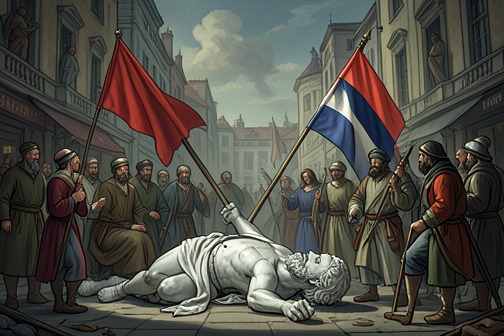
The [Dissolution of the Soviet Union](entity:event-recall-event-211e47345236) is recounted as both a historic rupture and an improvised act of political decision: in secret, Boris Yeltsin, [Leonid Kravchuk](entity:character-recall-character-69bcc9dd1da1), and [Stanislav Shushkevich](entity:character-recall-character-2e57508ebb7d) announced that the state was over, without a plan for what should replace it. The episode’s almost farcical informality—vodka, a sauna, an intoxicated president, and a late-night telephone call—stands against the scale of what it ended. Its aftermath is measured not only in the fate of [Mikhail Gorbachev](entity:character-recall-character-7c6bee5bcfc8), but in the conflicting hopes and disillusionments that shaped post-Soviet [Russia](entity:location-recall-location-e36341713c23).
## The symbolic unmaking of the old order
The narrative places the dissolution amid a sequence of visible reversals. The statue of Felix Dzerzhinsky, founder of the Soviet security police, is toppled in the square in front of the [Lubyanka](entity:location-recall-location-a93fab96898b), the institution’s headquarters. The red flag gives way to the tricolor of the 1917 provisional government. These are more than changes of monument and banner: they make the collapse legible in public space, as the symbols of Soviet authority are displaced by emblems from an earlier, unfinished political history.
The account then shifts from the public spectacle to a decision made out of sight. A few months after the statue falls, Yeltsin leaves [Moscow](entity:location-recall-location-19aceb5ce281) without telling Gorbachev what he intends to do. At a hunting lodge in [Belovezhskaya Forest](entity:location-recall-location-e08f5e76f3db), he meets Kravchuk and Shushkevich. The contrast is sharp: the end of a union is decided not in a carefully prepared constitutional forum, but at a private gathering whose participants, the narrative emphasizes, have not worked out what a federation or confederation would mean.
## The lodge meeting and the declaration
The three leaders justify their action by returning to the union’s origin. They repeat that their three republics created the [Soviet Union](entity:location-recall-location-67657886d3d4) in 1922 and therefore have the right to dissolve it. The narrative presents this as the rationale they use among themselves, not as the culmination of a considered blueprint. The meeting is held in utmost secrecy, and its informality is underscored by the huge quantities of vodka consumed in the sauna. No detailed replacement structure is ready; the decision precedes the institutional arrangements that might have given it shape.
Yeltsin becomes so drunk that Kravchuk and Shushkevich have to carry him to bed. Before losing consciousness, he calls George Bush Sr. so that the American president will be the first to hear the news. Yeltsin announces, “George, the guys and I have worked something out. The Soviet Union no longer exists.” The casual phrase “worked something out” compresses an event of immense consequence into the language of an improvised arrangement. The telephone call also turns the lodge decision outward: before Gorbachev is informed, the leader of the [United States](entity:location-recall-location-5d55e9152db1) has been told that the Soviet Union is finished.
The task of telling Gorbachev falls to Shushkevich, whom the narrator describes as the least important member of the trio. Gorbachev, aghast, asks, “But then what will become of me?” The question reduces the dissolution to its personal consequence for the man displaced by it, while exposing how little provision the conspirators have made for the departing president—or, as the narrative suggests, for the political order beyond him.
## Gorbachev’s fate and competing judgments
The answer to Gorbachev’s question is unexpectedly mild. He is to receive a dacha, a foundation, and permission to earn exceptionally high fees lecturing for the rest of his life. The narrator contrasts this comfortable retirement with the historical fate of deposed rulers in Russia, calling it exceptionally lenient by comparison. The dissolution thus removes Gorbachev from power without bringing the personal retribution that the country’s history might lead one to expect.
The book also sets the French public’s sentimental attachment to Gorbachev against the interpretation of the narrator’s mother, who was living in [France](entity:location-recall-location-4f282e1af8a7) but shared what he describes as the view of the immense majority of Russians. To her, Gorbachev was an apparatchik overwhelmed by forces he had unwillingly unleashed; Yeltsin embodied his people’s wish for freedom. Yeltsin had broken with the Communist system that had formed him, followed [Andrei Sakharov](entity:character-recall-character-andrei-sakharov-c04d8a2087d6)’s coffin beside [Yelena Bonner](entity:character-recall-character-yelena-bonner-3182875ffebc), become Russia’s first elected president, and defended the White House. He had outlawed the Communist Party and liquidated the union that had imprisoned its constituent nations. Within two years, the narrator says, he had become a major historical figure.
That account does not settle what the dissolution would achieve. The narrator frames the next question as whether Yeltsin could turn his momentum into democracy, a market economy, and a new society in a country long marked by backwardness and misfortune. The question preserves a distinction between ending the Soviet state and creating a viable successor. The lodge meeting supplies the first decision; it cannot, by itself, answer what kind of country will follow.
## The post-Soviet inheritance
The book’s later scenes show the collapse’s inheritance not as a single political consensus but as rival responses to a disoriented society. Among the young, anger at the cynicism that has become a kind of religion in Russia draws thousands, perhaps tens of thousands, toward [Eduard Limonov](entity:character-recall-character-eduard-limonov-fbb1fb9b4f1c). His admirers are much younger than he is, but see in his adventurous life and prison endurance a legend they can emulate. Their devotion belongs to a world in which the old order has disappeared but has not been replaced by a shared account of justice, dignity, or purpose.
That discontent takes organizational form in the [National Bolshevik Party](entity:organization-recall-organization-d9e15bd528ae). Branches appear in Krasnoyarsk, Ufa, and [Nizhny Novgorod](entity:location-recall-location-5f6818c48b0d); when Limonov visits one city, party members meet him at the station, arrange accommodation, and spend whole nights listening to him. [Zakhar Prilepin](entity:character-recall-character-334182a15d37) admires Limonov’s force and alertness, yet does not feel entirely at ease in his presence. Among the other members, by contrast, Prilepin finds loyalty, solidarity, and a willingness to go to prison for their ideas. Their moral code, the narrative says, stands diametrically opposed to the corrupt and disoriented world that succeeded the Soviet Union.
The party’s convention gives this dispersed following a public gathering. Although the organization has seven thousand members across Russia, only several hundred reach the meeting; some sleep at a bunker, others at a workers’ hostel. Finding a venue is difficult because owners withdraw their offers, apparently after police intervention. Delegates fear a bomb scare, harassment, or an outright ban, but the convention opens. Limonov sees the result of three years spent carrying copies of the party paper to train stations: people have arrived, and he recognizes them as brothers. The scene shows one response to the dissolution’s unsettled aftermath—a political community assembled around a leader and a counter-code of loyalty, defiance, and shared risk.
That opposition, too, later meets its limits. After [Garry Kasparov](entity:character-recall-character-garry-kasparov-4744d0dee2bf) does not run for president and the movement [The Other Russia](entity:organization-recall-organization-e5deb52beabd) fails in the elections, Limonov creates [Strategy 31](entity:organization-recall-organization-strategy-31-fab404f336f8), named for the constitutional right to demonstrate. Its supporters gather on [Triumfalnaya Square](entity:location-recall-location-c09fdc04741d) on the thirty-first of months that have one; typically about a hundred demonstrators face five times as many police, and dozens are arrested. Limonov repeatedly spends a couple of days in prison. The sequence does not make these later movements a simple consequence of the dissolution, but it places them within the political landscape the collapse left behind: a state ended in one hurried meeting, while the argument over freedom, power, and the shape of Russia continued in streets, organizations, and prisons.
Event 62
Kursk submarine disaster
The [Kursk submarine disaster](entity:event-recall-event-8fe68e85543c) is recalled as a measure of the distance between the deaths of ordinary people and the news [Vladimir Putin](entity:character-recall-character-vladimir-putin-600db9625a7e) chose to give the public. The passage supplies few details about the disaster itself; its force comes from the contrast between the crew’s prolonged death at the bottom of the Barents Sea and the presidential announcement about a thriving litter of puppies.
## The Disaster in the Narrative
The crew of the submarine Kursk died over the course of eight days on the bottom of the Barents Sea. The account offers no further explanation of the disaster’s cause or the circumstances inside the submarine. Instead, the duration and location establish the scale of the catastrophe in a single stark image: men dying beneath the sea while the event becomes part of a wider portrait of political indifference.
## Putin’s Public News
Carrère places the crew’s deaths alongside two other tragedies: Russian special forces gassed 150 hostages at [Dubrovka Theater](entity:location-recall-location-de5974f15050), and 350 children were massacred at the school in [Beslan](entity:location-recall-location-99942ae07ed6). Against this sequence, Putin gives the people news of his dog and her newborn puppies. The litter is doing well and drinking its mother’s milk; the announcement directs attention toward domestic reassurance while mass death goes unaddressed in the comparison.
## Narrative Significance
The disaster functions not as a separately reconstructed episode but as evidence in Carrère’s contrast between [Eduard Limonov](entity:character-recall-character-eduard-limonov-fbb1fb9b4f1c) and Putin. Both men are presented as cold and untroubled by the sanctity of human life, but Putin is the one who has succeeded and holds power. The Kursk crew’s deaths make that distinction concrete: the passage sets a prolonged catastrophe beside a cheerful report about puppies, exposing the unsettling gap between what has happened and what the public is invited to hear.