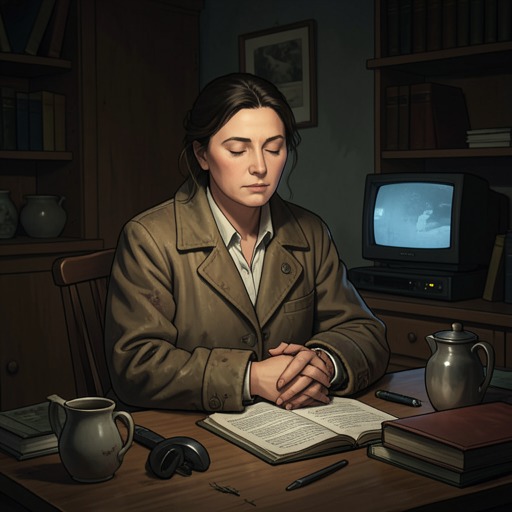
“Love in practice is a harsh and dreadful thing compared to love in dreams”
Longing“Love in practice is a harsh and dreadful thing compared to love in dreams” names the demanding center of Dorothy Day’s spirituality: love becomes real through care for people in need, including when that care is exhausting or difficult. The expression joins an inner religious life to public action, presenting hospitality not as an idealized feeling but as a daily commitment to people in whom Day believed Christ was present.
Meaning in Day’s spirituality
Day’s mysticism differed from accounts centered on visions, lights, or a felt union with God. She prayed regularly, attended Mass daily, and read theologians, but her primary way of encountering God was through other people. She drew this understanding from the Gospel’s account of the last judgment: Christ identifies himself with those who are hungry, thirsty, strangers, unclothed, sick, or imprisoned. Day took that teaching literally as a guide to action: what a person does for another person, she believed, is done to Christ. In this sense, the expression describes a recognition that has to be enacted, not merely contemplated.
The recognition could be obscured by the circumstances of those seeking help. People arriving at the Catholic Worker house might be alcoholic, mentally ill, or addicted to drugs; some were hostile and sometimes violent. Day acknowledged the difficulty of seeing Christ in people who demanded attention or behaved in ways others found unlovely. The disparity between the ideal of love and the strain of responding to actual need gives the expression its force: practical love can be harsh precisely because it takes place amid suffering, conflict, and human complexity.
Hospitality and social action
Day’s commitment took institutional form in the Catholic Worker movement, which she began with Peter Maurin. Their newspaper, The Catholic Worker, first appeared on May 1, 1933, with 2,500 copies sold at Union Square for a penny each. It addressed unemployment, trade unions, cooperatives, the exploitation of Black Americans, child labor, and a local strike. The paper was not intended merely to report events; it also offered commentary on them. Day and Maurin avoided political partisanship and did not endorse a political party, seeking social change through a pacifist approach rather than violence or force.
Their other major effort was to establish a House of Hospitality where poor people could find food and shelter. The work had no guarantee of ease or sufficiency: there was often not enough money to meet expenses or feed everyone, and volunteers sometimes had to break up fights. Day herself chose poverty and sometimes had to leave when the pressure became too much, but she returned. Houses later opened in other American cities, extending hospitality beyond the original setting. The expression thus speaks to both an individual discipline and a shared practice organized around material needs.
Day did not regard immediate care as a substitute for challenging injustice. In 1960, she addressed the criticism that serving poor people was merely a temporary remedy for a deeper social illness. Her answer held relief and structural change together: the wounded had to be cared for even as people worked against the forces that produced suffering. This balance is central to the expression’s practical meaning. Love responds to the person in front of it, while remaining attentive to the wider conditions that make such help necessary.
A wider discipline of spiritual practice
The book places Day’s form of mysticism alongside other accounts in which spiritual life is sustained by ordinary practices. On a visit to Gethsemani, a monk advised a student seeking a deeper prayer life to pray the Psalms; the author made that counsel a steady practice. The book likewise presents prayer, meditation, study, silence, and worship not as spectacular achievements but as habits whose cumulative effect can shape a life. These examples do not equate private prayer with Day’s service to the poor. They show a broader emphasis on spirituality as something practiced over time, in ordinary life, rather than reserved for exceptional experiences.
Day’s daily Mass and prayer belonged to that interior life, but hospitality was where her understanding of divine presence became most concrete. She believed Christ could be encountered in the guest who needed food or shelter, even when no visible sign made that presence easy to recognize. Her expression therefore marks a tension between inward devotion and demanding action without treating them as rivals: prayer sustained a vision of the person in need, and service gave that vision practical consequence.
Legacy and final image
Day’s work continued despite suspicion from Church officials about her pacifism, social-justice commitments, and criticisms of capitalism. She died at eighty-three on November 29, 1980, after years of congestive heart failure that eventually confined her to her room. At her funeral, her grandchildren carried the pine box in which she would be buried. As the procession stopped for a cardinal to bless the body, a mentally ill man pushed through the crowd and stared at the coffin; no one stopped him. The scene recalls the people among whom Day had sought Christ, making the expression’s demanding claim present even at her funeral.
The book presents Day’s life as a journey from rejecting religion in college to devoted Catholic faith and sustained work among the poor. Its final account of her mysticism does not make hardship into a consoling abstraction: love can place a person amid terrible human suffering. Day’s expression endures as a concise account of that cost and conviction—that finding Christ in other people means accepting the demands of care, not merely cherishing the dream of love.