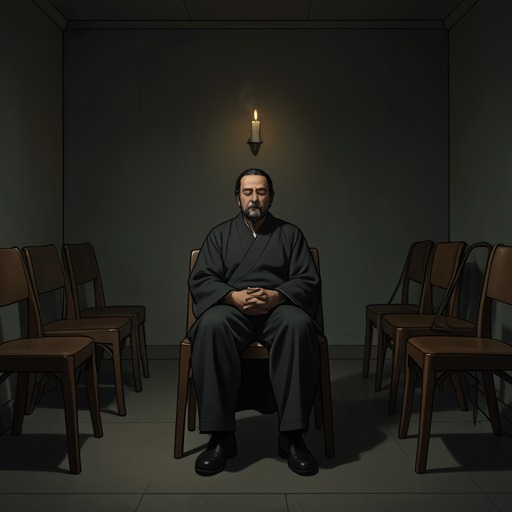
The birth of the Word in the soul
LongingThe birth of the Word in the soul is Meister Eckhart’s account of an inward Christmas: Christ is born not only in the world but in the deepest ground of a receptive human soul. Across four sermons, Eckhart describes that ground as the place where images, sensory knowledge, and self-directed effort fall silent, allowing God to act. The teaching makes inward stillness—not visions or the accumulation of religious ideas—the condition for receiving divine presence.
A Christmas Sermon on Inward Birth
Eckhart developed the teaching in Sermon 101, apparently preached during the Christmas season early in the fourteenth century and forming the first of four related sermons. A trained scholastic theologian concerned with the relation between faith and reason, he shaped the sermon as a sequence of questions and answers. As the series proceeds, reason becomes less prominent: the form itself moves toward the stillness the teaching requires.
The first sermon draws on a passage from the Wisdom of Solomon in which the all-powerful Word leaps from heaven in the silence of night. The familiar Christmas image of Christ born in a silent night becomes, in Eckhart’s interpretation, a way to describe Christ’s birth within the soul. This is not simply a metaphor for remembering the Nativity. It names an inward event available to a good and perfected person who walks in God’s ways; an undisciplined person, by contrast, would neither know of this birth nor experience it.
The Ground and the Work of Receptivity
Asked where God speaks the Word, Eckhart locates the birth in the soul’s purest part, its ground. The person prepared for it lives nobly, gathers the self inward, and does not turn outward through the five senses in pursuit of created things. This is not a claim that bodily perception is itself the birth, but a distinction between sensory attention to many things and the inward receptivity in which the Word may be received.
Eckhart’s answer to whether a seeker should form images of God is no. The soul should become free of thoughts, words, deeds, and images, maintaining a receptive attitude instead of trying to represent or summon God. This is the apophatic path: approaching God by releasing images and concepts rather than relying on created things as a route to knowledge. The ground is more secret still than ordinary thought. No creature can enter it, and it has no activity or understanding of its own; when the soul is free of images, God can unite with it and do the divine work there.
The contrast is not between having a childish image of God and replacing it with a more sophisticated one. Eckhart’s point is that even a more abstract conception may remain an image that locates God somewhere beyond the self. The soul’s task is to let go of such representations and remain in silence, where the Word can be born. His discipline is therefore chiefly an inward self-denial: rather than fasting, losing sleep, or punishing the body, the seeker relinquishes images, sensory claims to knowledge, and attitudes that obstruct awareness of God. This unknowing is not mere ignorance; it is a way of ceasing to mistake limited ideas for God.
Four Sermons, One Continuing Birth
The second sermon takes up the question of where the child born king of the Jews is found. Eckhart answers that the child is in the ground, the soul’s essence. Sin can absorb the soul’s powers and prevent reception of the Divine, while knowledge can also become an obstacle when it occupies the space that must be made empty. In this account, forgetting matters more than knowing: the Word is heard in silence and stillness, through passivity and reception.
The third sermon turns to the Gospel account of Jesus Christ at twelve years old in the temple. Mary and Joseph search anxiously before finding him, and his reply directs attention to his Father’s house. Eckhart draws from their search an inward instruction: a person preparing for Christ’s eternal birth in the soul must leave the crowd and return to the ground, becoming passive and receptive. The movement away from the crowd is not an escape into a different outward place so much as a return to the hidden inward place where the birth occurs.
The final sermon asks whether this eternal birth happens continuously or only after great effort. Eckhart answers by distinguishing three modes of the intellect. The active intellect uses reason to bring people toward God; the passive intellect receives God’s action, allowing God to enter the ground; and the potential intellect prepares the soul for a mystical encounter that may or may not happen. The distinctions preserve a role for reason while refusing to make reason the agent of the divine birth: it can lead and prepare, but the decisive work depends on reception.
Experience, Transformation, and the Limits of Effort
In discussing ecstasy or rapture, Eckhart treats it as a possible characteristic of mystical experience, but one that cannot last. Its strain on the body makes it brief; he cites the Transfiguration of Jesus and Paul’s mystical experience as brief events. Yet he is wary of making ecstasy the goal. The object of spiritual seeking is God, not an experience of unusual intensity. The birth of the Word therefore differs from a program for producing visions: even preparation cannot compel the encounter.
Eckhart also describes six stages of growth in the inner person, drawing on Augustine. The movement begins with living by the example of good and holy people despite one’s own imperfection. It continues as the person turns toward God and seeks divine wisdom, then withdraws from the mother and leaves behind fear and care, with love and zeal displacing the desire to do wrong. Increasingly rooted in love, the person learns to endure opposition, temptation, and sorrow; then comes peace and silent repose in God’s gifts and wisdom. In the sixth stage, freedom from images accompanies transformation, oblivion of time, and becoming God’s child. The destination is eternal life, in which the image of God appears and shines.
The wider account of Christian mysticism in the book helps clarify the stakes of this teaching without reducing it to a single formula. Mystical experience may involve visions or voices, as in the case of Hildegard of Bingen, but it may also lack sensory content: Bernard of Clairvaux reported no sensory experience in his encounter with God, and Thomas Merton described a conviction of God’s presence without a sensory experience. In this broader account, mysticism is associated with direct awareness of divine presence, while William James’s marks of mystical experience include ineffability, a form of knowledge beyond ordinary reasoning, transience, and passivity. Eckhart’s emphasis on silence and reception resonates especially with the limits of language and the inability to manufacture the encounter; his account also insists that spiritual seeking aims at God rather than at extraordinary phenomena.
The Ground as the Teaching’s Center
The ground is the organizing idea that joins the sermons’ questions about the child, silence, knowledge, and effort. Eckhart presents it as the soul’s innermost depth, untouched by anything other than God; some interpreters describe it as a spark or divine flame. The birth takes place there not because the soul contains a picture of God, but because it becomes free enough for God to act without images or creatures intervening.
This makes the teaching both intimate and demanding. The answer to where the child is found is not a distant location but the depths of the soul, yet reaching that inward place requires relinquishing the very thoughts and images by which people commonly try to grasp religious truth. Eckhart’s account does not promise that disciplined stillness will force a mystical encounter. It describes the soul’s preparation and the possibility of divine action, while leaving the birth itself a gift. Its decisive claim is that the deepest meeting with God occurs not through possessing an adequate idea of God, but through the receptive ground in which the Word may be born.