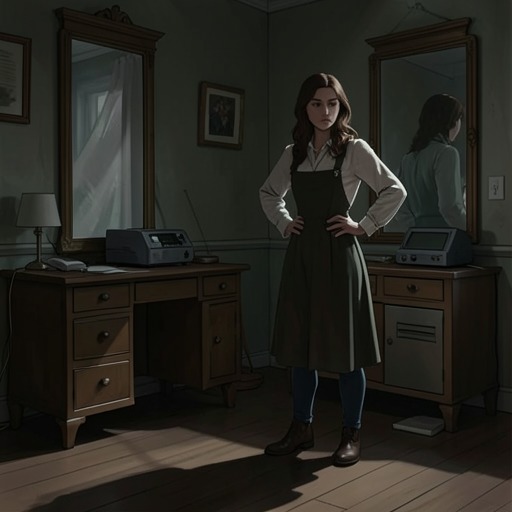
Parents discovered Tisch was admitted and forcibly arranged Ever to Taiwan
Loveboat, TaipeiThe episode in which Ever’s parents discover her New York University Tisch School of the Arts admission makes a hidden artistic ambition the subject of an immediate family confrontation. Her mother’s destruction of the admission letter and the parents’ already-purchased ticket to Taiwan transform a dispute about Ever’s future into an abrupt departure, setting the coercive circumstances for her summer away from home.
Discovery and Public Confrontation
The confrontation breaks into a moment between Ever, Megan, and Dan. Ever has just dared herself to hug Dan as if he were simply another friend when her mother calls out to her. Her mother rushes from the car, while her father follows, lowering his Cleveland Indians cap and limping from an old workplace injury. The arrival turns a private, emotionally complicated exchange into a scene with an audience.
Ever’s mother presses a creased sheet of cream stationery into her face: the letter from Tisch, marked with its purple flame insignia. She demands to know what else Ever has been hiding. The question makes clear that the admission is not merely unexpected news; it is evidence, in her mother’s eyes, of a secret plan.
The argument quickly connects dance to Ever’s medical applications. Her mother asks whether Tisch explains why Ever got into only one medical school. Ever denies it, recalling how seriously she worked on her applications and interviews. Her parents had already blamed her biology grades for her limited medical-school acceptances, even though Northwestern’s program ranked above Brown’s. The admission therefore lands inside a conflict that was already organized around academic achievement and the family’s expectation that Ever pursue medicine.
The Letter Is Destroyed
Ever’s mother explains that a woman called asking whether Ever would accept the offer. The call led her to search Ever’s room and find the letter. She shakes the paper and argues that there is no future in dancing, invoking Agatha, an older woman from church who comes for free senior lunches and speaks about her past with the Cleveland Ballet. The example turns Ever’s possible career into a warning about aging and financial insecurity, and her mother extends that fear to the family’s own future.
Ever tries to diminish the admission, saying she applied on a whim and did not get in at first. Her mother responds by crumpling the letter into a ball and throwing it into a dumpster. The discarded paper is not replaceable in the moment: Ever sees her mother’s throw as a shot that could have gone pro and cries that the letter belongs to her.
Ever lunges for the dumpster and grips its rusty edge. Her blisters burst as she tries to haul herself up, but the wall is too high and the garbage too deep for her to retrieve the letter. Her mother grabs the back of her leotard, pulls her away, and clangs the lid shut. The physical struggle gives the conflict a stark material form: Ever reaches for the document that represents a possible choice, while her mother forcibly closes off access to it.
The Taiwan Plan
After the letter is thrown away, Ever’s mother reveals another decision already made. She has brought a folded paper and tells Ever that she and her father think it is time for Ever to learn her culture. They have enrolled her in a program in Taiwan. Ever’s response is disbelief; the announcement comes not as an invitation to weigh options but as a plan presented after arrangements are in motion.
Ever associates the mention of Mandarin with the Chinese school she left in second grade. Those Saturday classes involved a thirty-minute drive to affordable lessons in Cleveland, copying characters into charts, and reciting poems she did not understand. After a teacher criticized her fluency, the shame became too much for her and her parents. She has no time, she protests, to study Mandarin this summer. The announcement thus touches an earlier experience of cultural learning marked by difficulty and embarrassment, rather than a simple absence of opportunity.
Her father presents the Taiwan program as a good opportunity to learn traditional characters. But the practical details make the pressure unmistakable: the program lasts eight weeks and starts that Sunday. Ever had thought the trip might be only a week; the revelation that it begins almost immediately leaves little room to consider or refuse it.
Sacrifice, Compliance, and Departure
Ever’s mother insists that the trip is not a punishment and cites Aunty Lilian’s assurance that young people enjoy the program. She also points to the ticket’s expense and lack of a refund. When Ever asks whether her parents have bought it already, her mother reveals what she sacrificed to pay: she sold her black pearl necklace.
The necklace carries a history that sharpens the emotional bind. It was a gift from her mother’s father, who died when she was fifteen. Ever remembers her mother bringing it out on his death anniversary and polishing the pearls with red silk; she has also heard the story of how Gong-Gong brought it back from a failed business trip to Hong Kong. By naming the sale, the mother makes the cost of the decision personal and inherited. Ever’s resistance now meets not only parental authority and a nonrefundable ticket, but also a sacrifice tied to her mother’s memory of her own father.
Ever cannot meet Megan’s eyes. She says she will need to find her passport and walks to the car, describing the feeling as leaving her heart in the dumpster. That image joins the two imposed losses of the scene: the admission letter she cannot retrieve and the future she had begun to imagine through dance. Her departure is not presented as agreement with her parents’ judgment. It is the immediate consequence of a plan already paid for, scheduled, and backed by the emotional weight of her mother’s sacrifice.
Turning Point and Significance
The episode shifts Ever’s conflict over medicine and dance from private uncertainty into open confrontation. Her parents learn about the Tisch offer through an outside caller; the letter becomes proof of an undisclosed possibility, and the decision to send Ever to Taiwan becomes their answer to it. The discovery, the destruction of the document, and the imminent trip form a chain of actions that narrows Ever’s choices before she can pursue the offer.
The scene also makes cultural education part of the family dispute without reducing it to a neutral itinerary. Ever’s parents frame Taiwan as a chance to learn her culture and traditional characters, while Ever’s memories of Chinese school include shame and incomprehension. The eight-week program therefore arrives as both an asserted opportunity and a directive imposed in the wake of her parents’ discovery of her dance ambitions. Its immediate consequence is her departure for Taiwan; its emotional starting point is a letter thrown away and a choice she has not been allowed to make on her own.