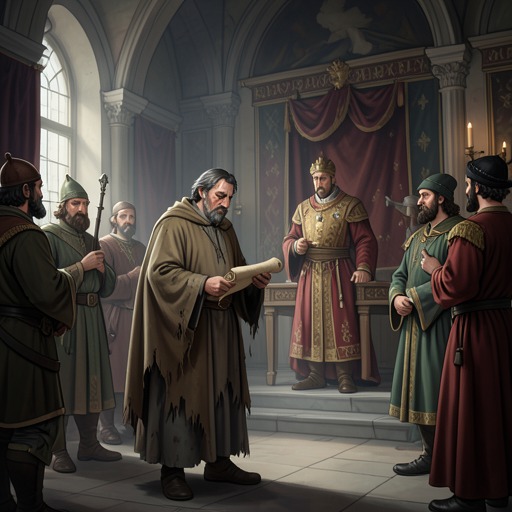
“It will be easy for me to compass this”
Mabinogion“It will be easy for me to compass this” is Culhwch’s answer to the seemingly impossible conditions Yspaddaden Penkawr sets before allowing him to marry his daughter. Repeated as each new obstacle is named, the phrase gives the exchange its rhythm and its governing contrast: Yspaddaden insists that the task cannot be done, while Culhwch refuses to treat difficulty as a reason to retreat. The refrain expresses resolve, but its repetition also makes clear how much remains to be accomplished; confidence is not the same as completion.
The Refrain and Its Setting
The phrase occurs in a negotiation that begins with an agreement about justice. Yspaddaden asks whether Culhwch seeks his daughter and requires a pledge that he will be treated fairly. Culhwch gives it willingly and invites Yspaddaden to name his terms. Only then does the father begin laying out the conditions. The refrain is therefore not an unprompted boast: it is Culhwch’s repeated response within a bargain whose terms the other party controls.
Yspaddaden’s demands arrive in a recognizable verbal pattern. He presents an obstacle, often explains why it cannot be met by ordinary means, and adds that the relevant person will not cooperate of their own free will and cannot be compelled. Culhwch answers with the same assurance, sometimes in the fuller form, “It will be easy for me to compass this, although thou mayest think that it will not be easy.” At other points he uses the shorter “It will be easy for me to compass this.” The wording varies, but the posture does not: each response meets a fresh impossibility without bargaining down the goal.
The repeated placement matters as much as the words themselves. Yspaddaden’s speeches keep reopening the question of whether the marriage can happen; Culhwch’s refrain closes each exchange only long enough for another condition to begin. It works like a hinge between challenge and escalation. The listener learns to expect the answer, even as the next demand makes the previous one look modest.
From Impossible Labor to Wedding Provision
The first condition turns the landscape itself into a deadline. Yspaddaden points to a vast hill and requires it to be uprooted, its roots burned for manure, and the land ploughed and sown so that grain ripens within a single day. That harvest must then provide food and drink for Culhwch and the daughter’s wedding. The scale of the work and the compressed timetable make the demand fantastical; Culhwch’s assurance does not specify how the task will be achieved, only that he will meet it.
Yspaddaden immediately narrows the challenge from land to expertise. The ground is too wild for any husbandman except Amaethon son of Don, who will not come willingly and cannot be forced. To plough it, Culhwch must also obtain paired oxen: the two dun oxen of Gwlwlyd, a yellow and a brindled bull, and two horned oxen positioned on opposite sides of a peaked mountain. Those last animals are identified as Nynniaw and Peibaw, whom God turned into oxen for their sins. The sequence makes the refrain answer not merely to physical labor but to the problem of assembling rare skill, animals, and supernatural circumstances.
The wedding provisions extend that logic. Yspaddaden requires flax that has failed to sprout from nine bushels sown in a red field, so that it can be grown on the new land and woven into a white wimple for his daughter. He asks for honey nine times sweeter than honey from a virgin swarm, without scum or bees, to make bragget; for Llwyr’s uniquely valuable vessel to hold the drink; and for Gwyddneu Garanhir’s basket, which can provide each of thrice nine men with the meat he desires. A horn for serving liquor and Teirtu’s self-playing harp add drink and music to the feast. The refrain thus spans a chain of tasks in which even ordinary wedding customs depend on extraordinary objects and powers.
The cauldron of Diwrnach Wyddel, steward to Odgar son of Aedd, king of Ireland, is required to boil the wedding meat. This demand also foreshadows a different kind of obstacle: the cauldron is not simply a convenient household object but a possession tied to a powerful keeper. In the refrain’s accumulating pattern, the feast is never just a feast. Each course, vessel, and instrument becomes another test of whether Culhwch can turn an imposed condition into a possible undertaking.
Grooming Becomes a Further Quest
The demands then shift from preparing the wedding to preparing Yspaddaden himself. He says that he must wash his head and shave his beard, but insists on using the tusk of Yskithyrwyn Benbaedd, which must be pulled alive from the boar’s head. Only Odgar son of Aedd can extract it. Yspaddaden adds that he will trust no one to keep the tusk except Gado of North Britain, ruler of its sixty Cantrevs, who will not willingly leave his kingdom. A personal grooming requirement has expanded into a sequence involving a dangerous animal, a king with the necessary power, and a custodian who must be persuaded or brought along.
The preparation grows stranger still when Yspaddaden says his hair must be spread out for shaving. For this he requires warm blood from a jet-black sorceress, daughter of a pure-white sorceress, at Pen Nant Govid on the confines of Hell. The blood must be carried in bottles belonging to Gwyddolwyn Gorr, because those bottles preserve a liquid’s heat on a journey from east to west. Fresh milk for the gathering creates a separate demand: it must be kept in the bottles of Rhinnon Rhin Barnawd, which prevent liquor from turning sour. Culhwch’s formula remains unchanged as the required materials move from livestock and produce into sorcery, heat-preserving containers, and supernatural preservation.
Yspaddaden next asks for the comb and scissors between the ears of Twrch Trwyth, the son of Prince Tared, because no other implements can manage his hair. But the grooming tools cannot be obtained in isolation: the boar cannot be hunted without a particular whelp, leash, collar, and chain. Each item points outward to another keeper or specialist, making the list recursive. What first sounds like a single demand for a comb becomes an expedition whose necessary equipment has its own conditions of possession and use.
The Boar Hunt and Its Dependencies
Twrch Trwyth’s hunt produces the longest and most densely connected sequence of conditions. Drudwyn, the whelp of Greid son of Eri, is needed to hunt the boar. The dog requires the leash of Cwrs Cant Ewin, held by a collar belonging to Canhastyr Canllaw, which must be fastened with the chain of Kilydd Canhastyr. Yet even this equipment is insufficient without a huntsman capable of working the dog: that role belongs to Mabon son of Modron, who was taken from his mother when three nights old and whose whereabouts and survival are unknown.
The search for Mabon adds a kinship clue to the practical list. Yspaddaden says he cannot be found unless Culhwch finds Eidoel, his blood kinsman and cousin. A swift horse, Gwynn Mygdwn, is then required to carry Mabon to the hunt. The account’s repeated assurance confronts a problem with no simple object to seize: before the hunt can begin, the missing huntsman must be located through a relative, and then provided with a mount.
Further specialists and animals are added. Garselit the Gwyddelian, chief huntsman of Ireland, is indispensable; so are two swift hounds, Aned and Aethlem, said never to have been released upon an animal without killing it. The leash for the two cubs must be made from the living beard of Dissull Varvawc, plucked with wooden tweezers, since a leash made after his death would be brittle. The only huntsman said to be able to hold those cubs is Kynedyr Wyllt, described as nine times wilder than the wildest mountain beast. The conditions thus distinguish sharply between owning equipment and being able to use it: the living source, the correct material, and the uniquely qualified handler all matter.
The hunt also requires Gwynn ap Nudd, whom God has placed over the brood of devils in Annwn to prevent them from destroying the present race. Yspaddaden claims that Gwynn cannot be spared from this charge, then identifies the only horse capable of carrying him: Du, the horse of Mor of Oerveddawg. Gilennhin, king of France, must also come, although leaving his kingdom for Culhwch would be improper. The son of Alun Dyved is needed for his skill in releasing dogs. These requirements bring supernatural authority, kingship, transport, and practical hunting craft into one undertaking, each with its own stated limit on availability.
Finally, Yspaddaden insists on Arthur and his companions, although he says Arthur will not come for Culhwch and cannot be compelled. He names Bwlch, Kyfwlch, and Sefwlch, grandsons of Cleddyf Difwlch, and gives an elaborate account of their retinue: three shields, three spears, three swords, three dogs, and three horses, alongside their wives, grandchildren, daughters, and handmaids. The three men are to sound the horn while the others shout, creating a commotion so vast that all will think the sky is falling to earth. The demand’s comic abundance is also structural: by the end, the refrain has had to absorb not just another individual or tool but an entire company and a spectacle of collective noise.
What the Assurance Does—and Does Not—Promise
After the boar-hunt requirements, Yspaddaden adds the sword of Gwrnach the Giant, the only weapon with which the giant can be slain. He will give it neither for payment nor as a gift, and cannot be compelled. Yspaddaden then gathers the whole negotiation into a warning: Culhwch will meet difficulties and sleepless nights, and if he does not obtain the requested things, he will not obtain the daughter. The refrain has carried the exchange through an enormous catalogue, but the father still reserves the power to make failure consequential.
Culhwch’s final answer changes the emphasis without abandoning the confidence established by the refrain. He invokes horses and chivalry, names Arthur as his lord and kinsman, and declares that Arthur will obtain the required things. He concludes that he will gain Yspaddaden’s daughter and that Yspaddaden will lose his life. The earlier phrase is therefore more than a claim that the tasks are easy in themselves: it sustains Culhwch’s commitment through a sequence designed to make success appear impossible, while the final declaration reveals the force and stakes behind that persistence.
The refrain does not explain the means by which every condition will be met, nor does its recurrence prove that Yspaddaden’s judgments are mistaken. Its function in this scene is to hold open the possibility of action. Each repetition counters the claim that an unwilling keeper, an absent kinsman, an impossible deadline, or a unique object must end the courtship. As a result, the phrase becomes the verbal signature of the quest’s governing tension: the obstacles keep multiplying, but Culhwch’s answer remains constant.