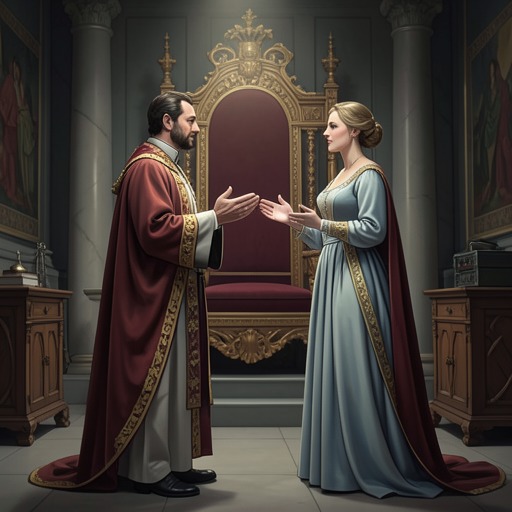
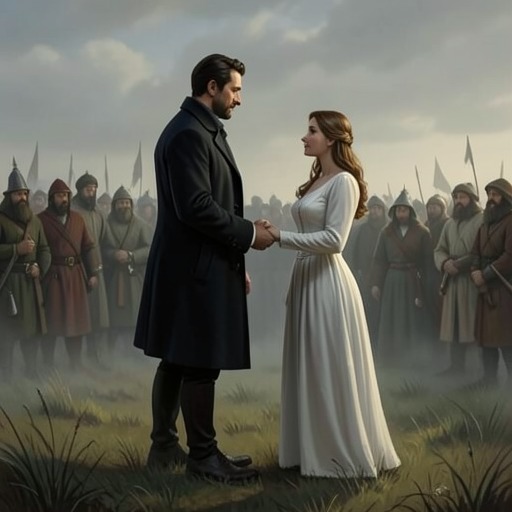
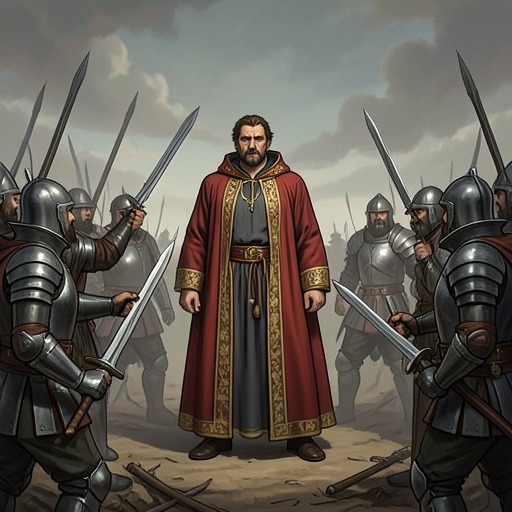
Event 1
The Irish War Sparked by Branwen
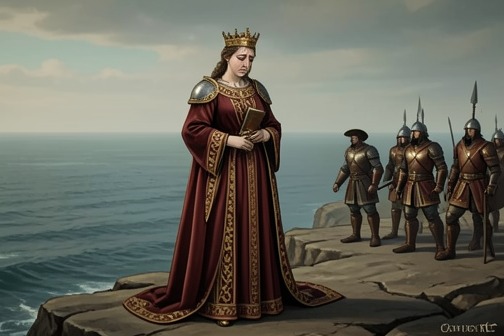
[The Irish War Sparked by Branwen](entity:event-recall-event-3d0a3379733e) grows from the mistreatment of a queen into a disastrous conflict between Ireland and Britain. [Branwen](entity:character-recall-character-branwen-5bfd0ef7b66c)’s secret message brings [Bendigeid Fran](entity:character-recall-character-bendigeid-fran-06c13c169669) across the sea to answer her appeal, but a negotiated peace cannot withstand [Evnissyen](entity:character-recall-character-evnissyen-535dfab53673)’s killing of [Gwern](entity:character-recall-character-gwern-60dff1a51dd7), Branwen’s son. The war ends not in a clear victory but in near-total loss: Branwen dies on the journey home, and only seven of Bendigeid Fran’s men escape the battle.
## From Royal Welcome to Captivity
After Branwen married [Matholwch](entity:character-recall-character-matholwch-e4e65d4dc96f) and travelled with him to Ireland, she was initially received with great honour. During that first year she gave visiting nobles and ladies valuable gifts, enjoyed their friendship, and gave birth to a son, Gwern, who was sent away to be foster-nursed among Ireland’s leading men. This beginning makes the later reversal especially stark: Branwen had been welcomed as a queen and the mother of an heir, yet neither status protected her when political resentment gathered around Matholwch.
In the second year, Matholwch’s foster-brothers and close associates reproached him over the insult he had received in Britain and the payment made for his horses. Their demand for vengeance was enforced against Branwen: she was removed from Matholwch’s chamber, made to cook for the court, and subjected to a daily assault by the butcher. The punishment targeted her for a grievance associated with her husband, turning a diplomatic affront into private and sustained abuse. Matholwch’s men then restricted travel between Ireland and Britain, seeking to prevent news of Branwen’s treatment from reaching her family. The restrictions lasted three years.
## The Message and the Crossing
Unable to communicate openly, Branwen secretly raised a starling in the cover of a kneading trough and taught it to carry her message. She tied a letter describing her suffering to the bird’s wing and sent it towards Britain. The starling reached Bendigeid Fran at [Caer Seiont](entity:location-recall-location-d026e57e5682) in [Arvon](entity:location-recall-location-d396a8de06b4), where he was conferring with others, and its domestic training drew attention to the letter. The war thus begins not with a public declaration but with a private appeal that breaks through the barriers Matholwch’s advisers had imposed.
After reading the letter, Bendigeid Fran summoned the island’s leaders. He assembled a host and explained the grief his sister was enduring; those gathered resolved to sail to Ireland, leaving Caradawc and other appointed leaders to govern in his absence. When Bendigeid Fran’s force approached the Irish shore, the scale of the arrival was first reported through uncanny images: Matholwch’s swineherds described what looked like a moving forest and mountain on the sea. Branwen understood the signs as the fleet’s masts and her brother himself, too large for any ship to contain. The description makes the approaching army seem almost inseparable from the landscape, while Branwen recognizes immediately that it has come in response to her appeal.
Matholwch’s forces withdrew across the [Linon River](entity:location-recall-location-1f023067aee0) and destroyed its bridge, hoping the water would hold Bendigeid Fran back. When his chieftains pointed out that there was no bridge, Bendigeid Fran lay across the river so his host could cross over him. Hurdles were set upon his body, making him the bridge. The episode turns a practical obstacle into a public image of leadership: the king physically places himself between his people and the barrier. His act also became the source of a saying that continued to be used as a proverb.
## Negotiation and the Broken Peace
Matholwch first offered to give the kingship of Ireland to Gwern, his son by Branwen, and to maintain Matholwch wherever Bendigeid Fran wished. Bendigeid Fran rejected the offer because it did not give him the kingdom itself. After their messengers returned without securing agreement, Matholwch’s advisers proposed a larger settlement: build a house that could hold both armies, submit the kingdom to Bendigeid Fran’s will, and do him homage. They reasoned that the honour of providing a house for a king who had never before been housed in one might persuade him to make peace.
Bendigeid Fran accepted after taking counsel, at Branwen’s urging and to prevent the country’s destruction. The house was built to accommodate the opposing hosts, but the Irish concealed armed men in leathern bags hung from brackets on its hundred pillars. Evnissyen discovered the deception and killed the concealed men, exposing the peace gathering as a setting prepared for renewed violence. Even so, the two forces entered the house from opposite sides, sat together, and reached an agreement that conferred sovereignty on Gwern. The boy was passed affectionately from Bendigeid Fran to [Manawyddan](entity:character-recall-character-manawyddan-7a6c02bb6e50) and then welcomed by Evnissyen. That brief display of kinship precedes the decisive rupture: Evnissyen privately resolved to commit an act of slaughter and threw Gwern into the fire. Branwen tried to leap after her son, but Bendigeid Fran restrained her as the gathering dissolved into tumult and the men reached for their weapons.
## The Battle and Its Cost
The Irish used the cauldron of renovation to return their dead to combat. Those revived could fight as before, though they could no longer speak. Seeing that the dead from Bendigeid Fran’s host were not being restored, Evnissyen recognized the danger into which he had helped bring his people. He entered the cauldron among the Irish dead, and his action broke it; he died in the process. His intervention gave Bendigeid Fran’s men a chance to achieve what success they could, but it did not deliver a decisive victory. Only seven of the host survived, and Bendigeid Fran was wounded in the foot by a poisoned dart.
Among the survivors were [Pryderi](entity:character-recall-character-pryderi-98fb0e3080ef) and Manawyddan. Bendigeid Fran ordered the survivors to cut off his head and carry it to the [White Mount](entity:location-recall-location-2fbeff58a397) in [London](entity:location-recall-location-1bfd335cdd1b), facing [France](entity:location-recall-location-4f282e1af8a7), where it was to be buried. He foretold a long journey and prescribed two extraordinary rests: seven years feasting in [Harlech](entity:location-recall-location-1904bfbb250a), accompanied by the birds of [Rhiannon](entity:character-recall-character-rhiannon-9f2cd49bf2db), and then eighty years at [Gwales](entity:location-recall-location-5a9e14ce6754) with his head uncorrupted. They were not to open the door that faced [Cornwall](entity:location-recall-location-cornwall-5562c2fa740e); once opened, they must leave and continue to London. The journey’s ritual instructions extend the consequences of the war beyond the battlefield, making the dead king’s head a continuing presence among the few who remain.
Branwen accompanied the seven survivors as they landed at Aber Alaw in [Talebolyon](entity:location-recall-location-8bfe7913092a). Looking back towards Ireland and Britain, she lamented that both islands had been destroyed because of her, then died. Her burial was made on the banks of the [Alaw River](entity:location-recall-location-30bca974b024). The survivors later learned that [Caswallawn](entity:character-recall-character-caswallawn-9d3c17db56a9) had taken Britain’s kingship and that Caradawc and most of the leaders left behind had also died. The war therefore brings down not just a royal household in Ireland but the order Bendigeid Fran had entrusted to those governing in his absence. Its final measure is the widening circle of loss: Branwen’s appeal brings her brother’s army, the attempt to restore her honour becomes a conflict that destroys both sides, and the few who survive must carry the memory of that destruction onwards.
Event 2
The Long Feast of Bran’s Head
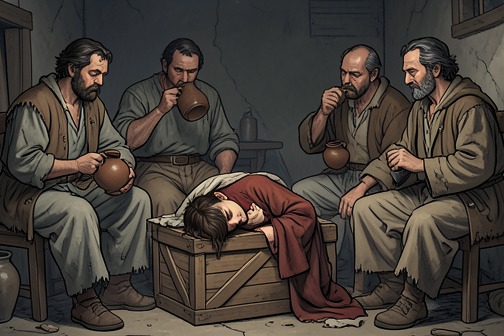
[The Long Feast of Bran’s Head](entity:event-recall-event-ba0d6478a636) is the postwar journey and prolonged sojourn of the survivors who carry [Bran’s head](entity:object-recall-object-8793f3aa6646) toward [London](entity:location-recall-location-1bfd335cdd1b). What begins as [Bendigeid Fran](entity:character-recall-character-bendigeid-fran-06c13c169669)’s final command becomes a passage through suspended time: seven years of feasting at [Harlech](entity:location-recall-location-1904bfbb250a) and eighty years at [Gwales](entity:location-recall-location-5a9e14ce6754), where grief and awareness of time are held at bay until a forbidden door is opened. The episode gives the head a continuing place among the living, while making remembrance the condition that ends their enchanted stay.
## After the War and the Command
The feast follows a disastrous conflict in which the men of the Island of the Mighty gain some advantage but do not win. Only seven of their company escape, and Bendigeid Fran has been wounded by a poisoned dart. The survivors are [Pryderi](entity:character-recall-character-pryderi-98fb0e3080ef), [Manawyddan](entity:character-recall-character-manawyddan-7a6c02bb6e50), Gluneu Eil Taran, Taliesin, Ynawc, Grudyen son of Muryel, and Heilyn son of Gwynn Hen. The smallness of this remnant sets the scale of the journey: they carry forward not a victorious army but the last companions of their lord.
Bendigeid Fran orders the seven to cut off his head and take it to the [White Mount](entity:location-recall-location-2fbeff58a397) in London, where it is to be buried facing [France](entity:location-recall-location-4f282e1af8a7). His instructions also prescribe the route’s long pauses. At Harlech they are to feast for seven years, accompanied by the birds of [Rhiannon](entity:character-recall-character-rhiannon-9f2cd49bf2db); at Gwales in [Penvro](entity:location-recall-location-73b1fee8a304) they may remain for eighty years, provided they do not open the door facing Aber Henvelen and [Cornwall](entity:location-recall-location-cornwall-5562c2fa740e). Once that door is opened, they must leave for London without delay. The command makes the journey at once practical and extraordinary: a burial destination is fixed, but the way there is measured in periods of waiting whose limits depend on obedience to a prohibition.
[Branwen](entity:character-recall-character-branwen-5bfd0ef7b66c) travels with the company as its eighth member. At Aber Alaw in [Talebolyon](entity:location-recall-location-8bfe7913092a), she looks back toward Ireland and the Island of the Mighty and grieves that both have been destroyed because of her; she dies there, and the survivors bury her beside the Alaw. The company then continues with the head. Her loss precedes the first feast, so the extended interval of joy that follows does not erase the cost of the war that sent them on the road.
## Seven Years at Harlech
At Harlech, the survivors provide food and drink and settle to eat. Three birds come and sing to them. Their song surpasses every song they have heard, and the birds seem distant over the sea while appearing distinctly present to the listeners. The company remains at this repast for seven years, fulfilling the first part of Bendigeid Fran’s instructions. The feast is not merely a brief rest along the way: it becomes an entire stretch of their journey, governed by the singing that accompanies it.
The movement onward comes only when the seventh year has ended. The survivors leave Harlech carrying the head and travel to Gwales in Penvro. In this way, the narrative marks the transition not by ordinary daily events but by the completion of the prescribed term. The singing and the feast hold the company in place; the passage of seven years releases them to continue.
## The Long Stay at Gwales
At Gwales, they find a fine place overlooking the ocean and enter a spacious hall. Two doors stand open, but the third—the door facing Cornwall—is closed. Manawyddan points out that this is the door they must not open. That night the company feasts and rejoices. They remember neither the food set before them nor what they have heard, and they are unaware of sorrow. For eighty years, they remain in this joyful state, neither conscious of how much time has passed nor wearied by their stay.
Bran’s head remains with them without becoming corrupted, and its presence is no more burdensome than if Bendigeid Fran were there in person. The head thus continues to serve as the company’s lordly companion even after his death, linking the hall’s unusual stillness to the command that brought them there. The account names the episode the entertaining of the noble head; it also distinguishes this prolonged entertainment from the earlier entertaining of Branwen and [Matholwch](entity:character-recall-character-matholwch-e4e65d4dc96f) in Ireland. The repeated language of entertainment turns a royal feast into a memorial interval, while the head’s preservation gives that interval its defining marvel.
## The Forbidden Door and the End of the Feast
The eighty-year stay ends when Heilyn son of Gwynn, unable to resist testing the prohibition, opens the door and looks toward Cornwall and Aber Henvelen. The act breaks the company’s unawareness. They become conscious again of every hardship they have endured, of the friends and companions they have lost, and of the misery that has befallen them; above all, they remember the fate of their lord. The joy of Gwales had not repaired or removed those losses. It had kept them outside the company’s awareness, and the opened door makes their grief present again.
Unable to rest after this return of memory, the survivors set out for London with the head. They bury it at the White Mount, completing the task Bendigeid Fran had assigned them. The burial is described as the third goodly concealment, and its later disinterment as the third ill-fated disclosure. The narrative further states that no invasion from across the sea came to the island while the head remained concealed. The feast therefore ends not in a return to ordinary life at Gwales, but in the fulfillment of a burial duty whose concealment is connected to the island’s security. Its governing contrast is between two forms of keeping: at Gwales, the companions keep the head with them and forget their grief; at London, they place it in concealment, and the journey’s obligation is complete.
Event 3
Blodeuwedd Is Created from Flowers and Wed to Lleu
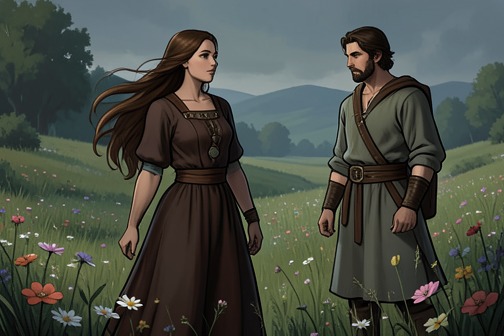
[Blodeuwedd](entity:character-recall-character-blodeuwedd-206d049551ba) Is Created from Flowers and Wed to [Llew Llaw Gyffes](entity:character-recall-character-llew-llaw-gyffes-2213b372d52c) is the magical answer to [Arianrod](entity:character-recall-character-arianrod-292f26eee013)’s attempt to deny him a wife: [Math son of Mathonwy](entity:character-recall-character-math-son-of-mathonw-da01273903e6) and [Gwydion](entity:character-recall-character-gwydion-c3225039959a) make a bride from blossoms, then establish the couple through marriage, land, and a court of their own. The episode turns a curse into a new household and gives Llew a place to rule.
## The Curse and Its Answer
After Gwydion obtains arms for the youth by staging a false invasion, Arianrod lays a destiny upon him: he will never have a wife from the race inhabiting the earth. Gwydion rejects the restriction, insisting that the youth will have a wife notwithstanding. The challenge is met not by undoing Arianrod’s words but by finding a way around their stated condition.
Gwydion and Math son of Mathonwy decide to form a wife for Llew Llaw Gyffes by charms and illusion. Their response makes the conflict over his future concrete: where Arianrod has tried to close off marriage, the two men create a bride whose origin lies outside ordinary human birth.
## The Making of Blodeuwedd
They gather blossoms of the oak, broom, and meadowsweet and shape them into a maiden described as exceptionally fair and graceful. Math son of Mathonwy and Gwydion then have her baptized and name her Blodeuwedd. Her name and origin are bound to the flowers from which she is made, marking her as the result of deliberate enchantment rather than descent from an earthly family.
The creation answers the curse by changing the terms of the problem. Arianrod’s declaration concerned a wife of the race already inhabiting the earth; Blodeuwedd is instead fashioned by magic. The narrative thus moves directly from a spoken restriction to an embodied solution, with the newly made maiden serving as the means by which Llew can marry.
## Marriage and Endowment
Blodeuwedd becomes Llew Llaw Gyffes’s bride, and a feast is held. The marriage is followed by a question of material provision: Gwydion observes that a man cannot readily maintain himself without possessions, and Math son of Mathonwy grants Llew the Cantrev of Dinodig. The account identifies the district as the territory then called [Eivionydd](entity:location-recall-location-c16fd3e65a89) and [Ardudwy](entity:location-recall-location-3705028f6303).
Llew and Blodeuwedd settle at [Mur y Castell](entity:location-recall-location-faaf050949ba), on the border of Ardudwy, where Llew has a palace and reigns. The narrative records that the people love both him and his rule. The grant therefore gives the marriage a public and political setting: Llew is not only provided with a wife but established in a territory where he can hold authority.
## The Household Established
The episode’s resolution combines three acts—magical creation, marriage, and territorial endowment—into a single foundation for Llew’s adult life. The bride’s unusual origin overcomes the limit Arianrod has imposed, while the land and palace supply the couple with a recognized place in the social and political order. The account closes this stage with Llew and Blodeuwedd settled at Mur y Castell and his governance described as well regarded.
Event 4
Lleu’s Betrayal, Restoration, and Slaying of Gronw
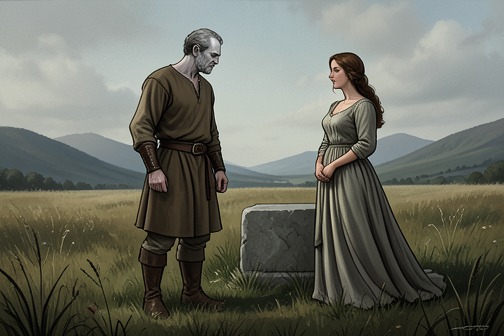
[Llew Llaw Gyffes](entity:character-recall-character-llew-llaw-gyffes-2213b372d52c)’s betrayal, restoration, and slaying of [Gronw Pebyr](entity:character-recall-character-gronw-pebyr-8709995be380) turn a secret entrusted within a marriage into a sequence of downfall, recovery, and retribution. [Blodeuwedd](entity:character-recall-character-blodeuwedd-206d049551ba) and Gronw use Llew’s own account of how he might be killed to arrange the attack; his uncle [Gwydion](entity:character-recall-character-gwydion-c3225039959a) finds him changed into an eagle and restores him, and Llew ultimately reclaims his lands and kills Gronw. The episode’s reversals are bound to precise conditions: the making of a spear, the position of a foot on a buck and the edge of a bath, and, in the final encounter, a stone slab that cannot stop Llew’s dart.
## The Secret of Llew’s Death
After Gronw has spent successive nights with Blodeuwedd, the two discuss how they might remain together. Gronw proposes that she learn from Llew, under the appearance of concern, how he could meet his death. When Llew returns home, Blodeuwedd keeps silent at first, then presents herself as sorrowful at the thought of losing him. Her professed solicitude gives her a way to ask for the knowledge that Gronw needs.
Llew explains that he cannot easily be killed. The spear used against him must take a year to make, and work on it can be done only during Sunday sacrifices. He also says that he cannot be slain inside a house or outside one, on horseback or on foot. The apparent impossibility has a narrow exception: he must be in a bath beside a river, under a tightly thatched roof, with one foot on a buck and the other on the edge of the cauldron. Blodeuwedd presents her request as a wish to understand how such a position could be possible; Llew shows her, not knowing that she means to make the conditions actionable.
She sends word to Gronw, who makes the spear and has it ready a year later. She then arranges the scene at the bath and has goats gathered across the river from [Bryn Kyvergyr](entity:location-recall-location-ba9735e092d3), where Gronw is to lie in ambush. The long making of the weapon and the careful assembly of the setting transform Llew’s supposedly protective explanation into a plan. His confidence in Blodeuwedd makes the disclosure possible; the attack depends on reproducing his description exactly.
## The Attack and Gwydion’s Search
Blodeuwedd takes Llew to inspect the prepared bath. He enters, anoints himself, and, at her prompting, asks for one of the animals she calls bucks to be brought. He then steps out and places one foot on the bath’s edge and the other on the buck’s back. From the hill at Bryn Kyvergyr, Gronw rises, kneels, and throws his poisoned spear. It strikes Llew in the side; the shaft comes out, but the dart’s head remains. Llew flies away as an eagle, cries out, and disappears from sight.
Gronw and Blodeuwedd go to the palace together, and Gronw takes possession of [Ardudwy](entity:location-recall-location-3705028f6303). After overcoming the land, he rules both Ardudwy and [Penllyn](entity:location-recall-location-2f9115bff793). News of Llew’s disappearance reaches [Math son of Mathonwy](entity:character-recall-character-math-son-of-mathonw-da01273903e6) and Gwydion. Gwydion refuses to rest until he has found news of his nephew, and searches across [Gwynedd](entity:location-recall-location-a48814fb085e) and [Powys](entity:location-recall-location-bc8d52a4ba96) before reaching a house in [Arvon](entity:location-recall-location-d396a8de06b4).
There, Gwydion learns that a sow leaves its sty each day and that no one knows where it goes. He asks to be present when the sty is opened. The sow runs against the course of a river to [Nant y Llew](entity:location-recall-location-c969271d6a0e) and feeds beneath a tree on putrid flesh and vermin. Looking up, Gwydion sees an eagle in the tree; when it shakes itself, the same matter falls from it for the sow to eat. From the eagle’s wounds, Gwydion recognizes Llew. The search reveals a disturbing reversal: the ruler’s nephew survives, but in a changed form, dependent on the sow’s visits for sustenance.
## Restoration and the Fate of Blodeuwedd
Gwydion calls to the eagle in song, and it comes down from the tree to his knee. He strikes it with his magic wand, restoring Llew to his own form. The transformation has left Llew emaciated, little more than skin and bone. Gwydion takes him to [Caer Dathyl](entity:location-recall-location-0ca9f1d18865), where physicians from Gwynedd treat him; by the end of the year, Llew is completely healed.
Once recovered, Llew tells Math that he wants retribution from the person who caused his suffering and says that the sooner he regains what is his, the better. The people of Gwynedd are gathered and march to Ardudwy. When Blodeuwedd hears that Gwydion is coming, she flees to the mountain with her maidens. They cross the [Cynvael River](entity:location-recall-location-861eea57717e) and head for a court on the mountain, but fear drives them onward facing backward; they fall into the lake. All drown except Blodeuwedd, whom Gwydion catches.
Gwydion does not kill her. Instead, he condemns her to become an owl, never again to show her face in daylight and destined to be attacked and chased by other birds. She retains the name Blodeuwedd, which the tale identifies as the name for an owl in its own time. Her punishment makes the consequences of her betrayal permanent: she survives, but under a form and name that preserve the memory of the wrong done to Llew.
## Llew’s Return and Gronw’s Death
Gronw withdraws to Penllyn and sends an embassy asking whether Llew will accept land, territory, gold, or silver in compensation. Llew refuses each offer. The least he will accept, he says, is that Gronw stand where Llew stood when he was struck, while Llew takes aim from the place Gronw occupied. He demands not a negotiated payment but a return to the place and terms of the attack.
Gronw asks his warriors, household, and foster-brothers whether any will take the blow in his place. None agrees. The tale links their refusal to their enduring description as the third disloyal tribe. Gronw therefore goes to the bank of the Cynvael River and takes the position from which he attacked Llew. Llew stands in Gronw’s former place. Gronw asks to put a slab from the riverbank between himself and the dart, appealing to the fact that his deed was accomplished through a woman’s wiles. Llew permits him to use it.
The protection fails: Llew throws the dart, which pierces the slab and passes through Gronw’s back, killing him. The slab remains on the bank in Ardudwy, pierced through, and is called [Llech Gronw](entity:object-recall-object-llech-gronw-66cf4d304911). Its surviving hole gives the encounter a lasting physical marker, while the reversal of positions completes the repayment Llew demanded. He takes possession of the land a second time, governs prosperously, and, as the story relates, becomes lord over Gwynedd. The ending restores his rule but does not erase the consequences of the conspiracy: Blodeuwedd remains an owl, Gronw is dead, and the pierced slab preserves the place where Llew’s recovery became vengeance.
Event 5
Maxen Wledig’s Dream and Expedition
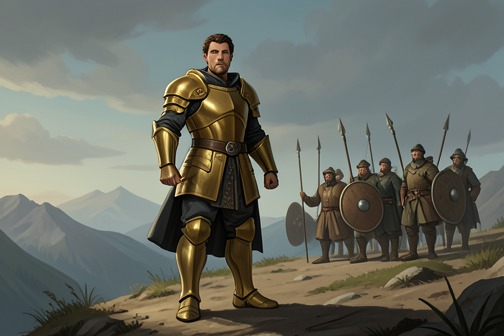
[Maxen Wledig’s Dream and Expedition](entity:event-recall-event-db39bd2e02df) turns a private vision into a chain of public consequences: an emperor’s longing leads him to Britain, marriage binds his rule to [Helen Luyddawc](entity:character-recall-character-helen-luyddawc-d207c9b4b37c)’s homeland, and a seven-year absence from [Rome](entity:location-recall-location-f3877a21016f) ends in a military struggle for his throne. The dream first supplies a geography to be pursued; the journey then makes that geography political, joining Maxen’s imperial ambitions to the fortunes of Helen’s family and the [Island of Britain](entity:location-recall-location-9fd9af301a64).
## The Dream and Its Geography
Maxen, emperor of Rome, sets out to hunt with a retinue that includes thirty-two crowned kings who are his vassals. The account presents the hunt as a way for him to place himself on equal terms with those rulers, rather than simply as sport. At midday, under a fierce sun, he falls asleep while his attendants shield him with spears and shields and place a gold-enamelled shield beneath his head.
In the dream, Maxen travels up a river valley to a mountain so high it seems to touch the sky. Beyond it lie exceptionally fair, level lands, crossed by mighty rivers descending towards the sea. Following the rivers, he reaches the mouth of the largest and sees a great city, a vast castle with towers of many colours, and a harbour filled with ships. One ship surpasses the others in size and beauty: its visible planks are alternately gilded and silvered. A bridge made from a whale’s bone links it to land. Maxen boards, and the vessel carries him over the sea to an island whose rugged valleys, cliffs, and precipices seem unlike any country he has seen.
The dream’s sequence continues across water and land to another river-mouth castle. Inside, Maxen sees a splendid hall furnished with gold and silver, where two auburn-haired youths play chess. An old, powerful-looking man sits nearby in an ivory chair, carving chessmen with a steel file; before him are a gold chessboard and a gold rod. The maiden sits in a chair of red gold, dressed in white silk and gold tissue and wearing a jeweled frontlet. Her beauty arrests the dream’s movement: she rises, Maxen embraces her, and they sit together in her chair. The noise of the hunting dogs, shields, spears, and horses wakes him just as he holds her close.
The awakening makes the vision an immediate crisis. Maxen returns towards Rome in such grief that his household cannot draw him into its meals or entertainments. For a week he withdraws from wine, mead, songs, and tales, sleeping whenever he can because the maiden appears to him only in dreams. When the king of the Romans tells him that people resent receiving neither messages nor answers from their absent-minded ruler, Maxen summons Rome’s wise men and tells them why he is sorrowful.
## The Search, Recognition, and Marriage
The wise men advise a three-year search, sending messengers through the three parts of the world so that the prospect of news may sustain Maxen. After a year, the first messengers return knowing no more than when they left. A Roman king then proposes a more exact test: Maxen should hunt along the route he remembers from the dream. At the riverbank, the emperor recognizes the place where he had begun his dream-journey and recalls travelling west towards the source.
Thirteen messengers follow the remembered route. They wear one sleeve over the front of each cap as a sign of their embassy, intended to protect them even in hostile lands. Over the high mountain they find broad plains and large rivers; at the rivers’ mouths they identify the great city, its many-coloured towers, and the enormous fleet, including the remarkable ship. After crossing the sea, they traverse the Island of Britain, pass [Snowdon](entity:location-recall-location-075eac64d118), and see [Anglesey](entity:location-recall-location-eae9e178e77c) and [Arvon](entity:location-recall-location-d396a8de06b4). At [Aber Sain](entity:location-recall-location-274588a7d2aa) they find the open castle and hall. Inside stand the same two youths at chess, the old man carving chessmen beside a pillar, and the maiden in her golden chair. The dream has become a place the messengers can enter and verify.
The messengers kneel and address the maiden as the empress of Rome. She challenges the apparent presumption of their greeting, and they explain that Maxen has seen her in his sleep and is consumed by love for her. They offer her the choice of going with them to become empress or having the emperor come to marry her. She will neither deny their account nor accept it too readily: if Maxen loves her, she says, he must come himself. The messengers return at speed, replacing exhausted horses along the way, and offer to guide him because they know the woman’s name, kindred, and lineage.
Maxen sets out with his army. He conquers the Island of Britain from Beli son of Manogan and his sons, driving them to the sea, and continues to Arvon. Recognizing the castle at Aber Sain from the dream, he enters the hall and finds the youths, the old chess-carver, and the maiden exactly as he remembers them. The youths are [Kynan](entity:character-recall-character-kynan-c94a2cd5ef00) and [Adeon](entity:character-recall-character-adeon-737bb1560f9e), the old man is Eudav, and the woman is Helen Luyddawc. Maxen embraces Helen; that night she becomes his bride. The pursuit of an imagined beloved thus ends not in Helen’s removal to Rome but in the emperor’s arrival in her country.
## Helen’s Settlement and the Seven-Year Rule
The morning after the wedding, Helen asks for her maiden portion. She requests the Island of Britain, from the Channel to the Irish Sea, together with the three adjacent islands, to be held under her as empress of Rome. She also asks for three chief castles at places of her choosing. The highest is to stand at Arvon. Earth is brought from Rome so that the emperor may sleep, sit, and walk on ground considered more healthful for him; the other two castles are established at [Caerlleon upon Usk](entity:location-recall-location-caerlleon-upon-usk-6701ef046cac) and [Caermarthen](entity:location-recall-location-856d3a07af85).
The narrative connects Helen’s authority to the shaping of the island itself. While hunting near Caermarthen, Maxen reaches the summit of [Brevi Vawr](entity:location-recall-location-18e6022094b4), where he pitches his tent; the camping place is known as [Cadeir Maxen](entity:location-recall-location-ff65e0512e1c). Helen then has high roads made between her castles throughout the Island of Britain. These roads bear her name, Helen Luyddawc, because she is sprung from a native of the island and, the account says, its men would not have built such great roads for anyone else. The marriage therefore produces more than a change of household: it places territory under Helen’s authority and gives her an enduring association with the island’s routes and strongholds.
Maxen remains in Britain for seven years. The Roman custom described in the tale makes that duration decisive: an emperor who stays abroad longer than seven years is expected to lose his position and never return. The Romans appoint a new emperor, who sends Maxen a threatening letter whose wording is pointedly incomplete. Maxen answers in kind with a letter that also leaves its threat unfinished. The exchange gives way to action: Maxen must attempt to recover in person the authority that his prolonged absence has put at risk.
## The Campaign for Rome and Its Aftermath
Maxen marches with his army towards Rome, conquering [France](entity:location-recall-location-4f282e1af8a7), [Burgundy](entity:location-recall-location-b77e5ac6363d), and the lands along the way before encamping outside the city. The siege lasts a year without bringing him closer to taking Rome. The turn comes with the arrival of Helen’s brothers from the Island of Britain. Their force is small, but the account describes its warriors as better than twice their number among the Romans, and its standards as exceptionally handsome and well appointed. Helen recognizes those standards; Kynan and Adeon meet Maxen, who welcomes and embraces them.
Kynan sees that the siege has become a contest of method as much as strength. He and Adeon measure the city wall at night and send carpenters to the wood to make ladders, one for every four men in their company. They exploit a pause that has settled into the fighting: each day at midday, both sides stop while the emperors eat. The Britons eat in the morning and drink until invigorated; while the two emperors are at their meal, they bring their ladders to the walls and enter the city. The new emperor has no time to arm himself before he and many others are killed. The Britons spend three days and nights subduing the defenders and taking the castle, while another part of their force prevents Maxen’s army from entering until the city has been brought under their control.
When Maxen wonders why Helen’s brothers have not conquered the city for him, Helen directs him to ask them for it. They answer that the city belongs to neither a conqueror nor a giver: only the men of the Island of Britain could take it and grant it. Rome’s gates then open, Maxen takes the throne, and the Romans submit. He offers Kynan and Adeon his host to conquer whichever regions they desire. They go on to capture lands, castles, and cities; the account says they kill the men and spare the women, continuing their conquests until the young men who had accompanied them have grown grey-haired. At last, Adeon chooses to return to the land from which he came with many of his followers, while Kynan remains abroad with the rest. The tale closes not with a simple restoration of Maxen’s former life, but with Rome regained through British arms and the brothers divided between return and continued settlement.
Event 6
Culhwch’s Quest for Olwen
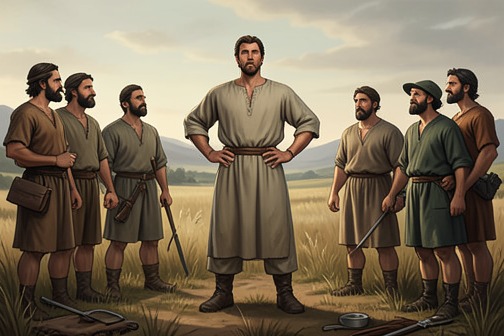
[Culhwch’s Quest for Olwen](entity:event-recall-event-culhwch-s-quest-for-olw-8d70b4043f97) turns a marriage proposal into a test of whether an imposing father’s conditions can be met. [Yspaddaden Penkawr](entity:character-recall-character-yspaddaden-penkawr-da558c38386f) will give [Olwen](entity:character-recall-character-olwen-f6d08f8ce3be) to [Culhwch](entity:character-recall-character-culhwch-36de095768db) only after the marvels he names have been accomplished. Culhwch accepts the terms, and [Arthur](entity:character-recall-character-arthur-2e33b65bbe57)’s aid makes the quest possible; its conclusion fulfills the marriage agreement but also brings about Yspaddaden’s death and the seizure of his stronghold.
## Terms and Stakes
Yspaddaden first requires Culhwch to pledge that he will be treated justly, then invites him to name what he wants. Culhwch promises to accept the conditions, and Yspaddaden sets out a task on a vast scale: a great hill must be uprooted, its roots burned for manure, and the land ploughed and sown, with the grain ripened all in a single day. The wheat must then provide food and drink for the wedding. The demand makes the wedding itself the measure of completion: the work is not simply to prepare land, but to produce what the marriage feast requires within an impossible-sounding deadline.
Yspaddaden immediately adds an obstacle to even this challenge. In his account, no ordinary husbandman can prepare the wild land; only Amaethon son of Don can do it. Amaethon will not come willingly, Yspaddaden says, and Culhwch will not be able to compel him. The task therefore combines extraordinary labor with a problem of obtaining the necessary person’s cooperation. Culhwch answers that the work will be easy for him to compass, refusing to let the scale of the demand end the negotiation.
The hill is one condition within a wider set of marvels, not the entire quest. Yspaddaden warns that Culhwch will face difficulties and sleepless nights, and makes Olwen’s marriage depend on his obtaining everything he names. At the same time, he says Culhwch will not be charged for Olwen’s food or clothing while the search continues. The condition gives the quest a defined endpoint—completion of the marvels—while allowing the pursuit to take as long as it requires. Culhwch, for his part, declares that Arthur will obtain the horses and company he needs. His appeal to Arthur invokes both kinship and a practical source of aid.
## The Quest and Arthur’s Aid
The surviving account presents the quest through its demands and its final return rather than recounting every task in sequence. At the end, Culhwch and [Goreu](entity:character-recall-character-goreu-7f80451dd398), [Custennin](entity:character-recall-character-custennin-4cc5b6d0e880)’s son, bring the marvels to Yspaddaden’s court, accompanied by those who wish Yspaddaden ill. The completion is therefore not represented as Culhwch’s solitary achievement: the party arrives together, and Arthur’s contribution is explicitly acknowledged in the settlement. The story makes the scale of the undertaking legible through the number and difficulty of the conditions, even where the episode’s concluding account does not rehearse each one.
Kaw of North Britain then shaves Yspaddaden’s beard. This act marks the change from conditional promise to fulfilled obligation: Yspaddaden acknowledges that Olwen is now Culhwch’s, though he says Culhwch owes the result to Arthur, not to any goodwill on his own part. He also makes clear that he would never have given his daughter freely and that her marriage means his own death. The quest’s success thus resolves the betrothal bargain but does not reconcile the people bound by it.
## Death and Settlement
After conceding that Olwen is to be Culhwch’s wife, Yspaddaden is seized by Goreu and killed. Goreu places his head on a stake at the citadel, and the company takes possession of the castle and its treasures. The sequence converts the completion of the marriage tasks into a transfer of power and property: the father who set the conditions no longer controls the household or its wealth. The outcome is not merely permission for a wedding, but the end of Yspaddaden’s authority over Olwen and his stronghold.
That violent settlement is anticipated by Yspaddaden’s own terms. He has linked the successful quest to his loss of life, and on the final day he treats Culhwch’s claim as one that must be honored. Yet the recognition remains hostile: Yspaddaden grants that his daughter is Culhwch’s while insisting that Arthur, rather than he, has made the result possible. The party’s victory therefore rests on both the completion of the agreed marvels and the removal of the father who had set them as barriers.
## Marriage and Narrative Significance
That night Olwen becomes Culhwch’s bride, and she remains his wife for the rest of her life. The permanence of the marriage gives the quest a settled conclusion: the promised union is not left pending after the father’s death. Arthur’s hosts then disperse to their own countries, closing the collective undertaking and returning its participants to their separate homes.
The episode joins a marriage plot to a sequence of public, practical, and extraordinary obligations. Its conditions concern more than Culhwch’s desire for Olwen: the hill must be transformed into productive land, the wedding provisions made, and the whole set of marvels brought before Yspaddaden. The final account accordingly distributes credit and consequence across the company. Culhwch gains his bride, Arthur is named as the one who accomplished the marvels, Goreu carries out the fatal settlement, and the party takes the castle and its treasures. The wedding is both the reward for the quest and the turning point at which Yspaddaden’s household passes into other hands.
Event 7
The Battle of Camlan
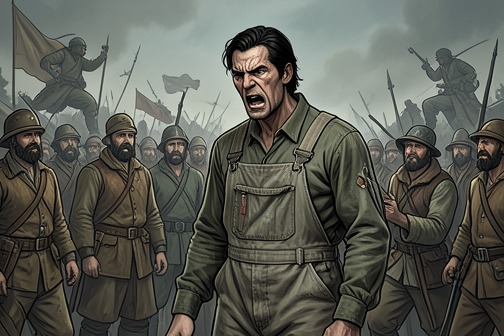
[The Battle of Camlan](entity:event-recall-event-85c64493c3a4) is presented through [Iddawc Cordd Prydain](entity:character-recall-character-iddawc-cordd-prydai-f04277bcbfd9)’s confession that he helped bring it about. Though sent by [Arthur](entity:character-recall-character-arthur-2e33b65bbe57) to seek peace with Medrawd, he deliberately turned a conciliatory embassy into a provocation; the battle’s remembered cause is therefore not only the feud between the two leaders, but the messenger’s distortion of the words meant to avert it.
## The Failed Embassy
Iddawc tells [Rhonabwy](entity:character-recall-character-rhonabwy-88d6acfc4821) that he served as a messenger between Arthur and Medrawd, Arthur’s nephew. Arthur sent him to reason with Medrawd, reminding him that Arthur was both his foster-father and his uncle, and to seek peace so that the sons of the kings and nobles of the [Island of Britain](entity:location-recall-location-9fd9af301a64) would not be slain. Arthur entrusted Iddawc with the fairest words he could devise for that purpose.
Iddawc was then a reckless youth, driven, by his own account, by a desire for battle. Instead of conveying Arthur’s appeal faithfully, he gave Medrawd the harshest words he could devise. The mission’s intended work was reconciliation; Iddawc turned it into an occasion for insult, stirring anger where he had been charged to seek peace.
## The Road to Camlan
Iddawc explicitly connects his intervention to the battle: he says that the strife he kindled and the wrath he stirred led to the Battle of Camlan. His recollection gives the conflict a sharply personal point of origin. Arthur and Medrawd stand at the center of the threatened rupture, but the account singles out the intermediary who carried words between them and made those words more hostile.
The episode’s force lies in the distance between the message entrusted to Iddawc and the message he chose to deliver. Peace was not merely left unachieved: the envoy charged with pursuing it actively worsened the breach. The account thus remembers the battle through a failure of mediation, making speech itself part of the chain of events that brought the conflict on.
## Departure and Penance
Iddawc says that he left three nights before the end of the battle and went to Llech Las in North Britain to do penance. He remained there for seven years before gaining pardon. His departure means that his recollection does not recount the battle’s final course; it records instead his responsibility for helping to cause it and the penitential withdrawal that followed.
The seven-year penance gives the confession a long aftermath, but the account does not specify its practices or describe the battle’s outcome. It does establish Iddawc’s own judgment of his part: he identifies his reckless intervention as the source of his lasting culpability, then marks the passage from that culpability to pardon through years of penance.
Event 8
Peredur’s Failure at the Castle of the Lame King
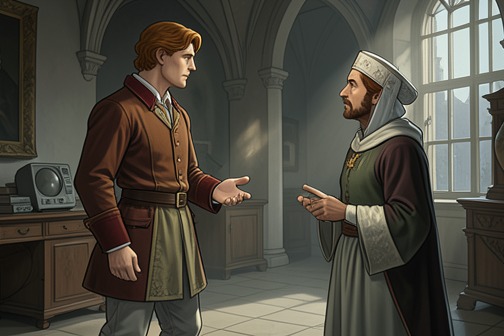
[Peredur](entity:character-recall-character-peredur-f0f4e8e82164)’s failure to question the marvels at the Castle of the [Lame King](entity:character-recall-character-lame-king-078abb50f8c8) becomes, in a later accusation at [Arthur](entity:character-recall-character-arthur-2e33b65bbe57)’s court, the missed opportunity on which a kingdom’s health and peace depend. The maiden’s charge turns a moment of silence into a cause with far-reaching consequences, and Peredur responds by resolving to discover what the signs meant.
## The Omission at the Castle
At Arthur’s principal palace at [Caerlleon upon Usk](entity:location-recall-location-caerlleon-upon-usk-6701ef046cac), a maiden addresses the gathered court and singles out Peredur. She recalls that, when he was at the Castle of the Lame King, he saw a youth carrying a spear that streamed with blood, along with other wonders. Peredur did not ask what these sights meant or what had caused them. The episode is therefore defined not by an action he took, but by the question he failed to ask.
## The Accusation and Its Stakes
The maiden declares that inquiry would have restored the king to health and brought peace to his dominions. Because Peredur remained silent, she predicts that the king will instead face battles and conflicts, with knights perishing, wives widowed, and maidens left without portions. Her accusation makes the consequences of the omission collective: the failure concerns not only the king or Peredur, but the people whose lives will be shaped by the realm’s continuing disorder. These outcomes are presented as the maiden’s explanation and forecast, not as events already shown to have occurred.
## Peredur’s Response
After the maiden leaves, [Gwalchmai](entity:character-recall-character-gwalchmai-42fa519e4b02) resolves to seek the imprisoned maiden whose release, he has been told, would bring the highest fame. Peredur makes a distinct commitment: he will not rest until he knows the story and meaning of the spear the maiden described. The challenge thus redirects his attention from the wonders he once passed over to the need to understand them. His response begins an inquiry, but the account here does not say that he reaches the Castle of the Lame King again or that the king is restored.
## Narrative Significance
The episode presents interpretation as a responsibility with practical consequences. The wonders at the castle were not merely spectacle: according to the maiden, asking about them could have changed the king’s condition and the fortunes of his domain. Her rebuke also gives Peredur’s earlier silence a new significance after the fact, making the missed question legible as a turning point only when its consequences are explained. His vow marks a change in purpose, from witnessing marvels without understanding them to seeking their meaning.
Event 9
Peredur Slays the Addanc
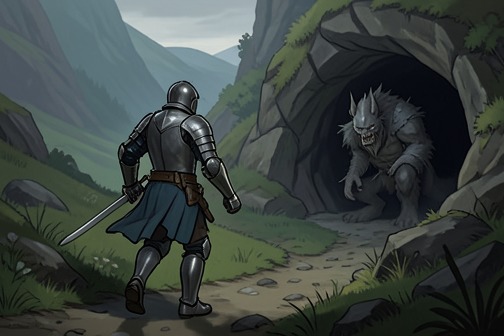
[Peredur Slays the Addanc](entity:event-recall-event-peredur-slays-the-addan-248970b7c691) is a brief monster-slaying episode in which [Peredur](entity:character-recall-character-peredur-f0f4e8e82164) deliberately takes the most dangerous of three roads and kills the creature foretold as his quarry. The victory fulfills a prediction, but Peredur’s response to the reward offered afterward keeps the episode from becoming simply a tale of combat: he has come to face the monster, not to secure a marriage or a kingdom.
## The Road to the Cave
The encounter follows Peredur’s arrival at a valley where a youth describes three roads: one to his palace, one to a nearby town where food and drink can be bought, and a narrower track toward the [Addanc](entity:character-recall-character-addanc-ae27868d973b)’s cave. The youth also offers Peredur the choice of visiting the palace or staying to watch a deer hunt. Peredur declines these safer and more hospitable possibilities and chooses the cave road.
That choice makes the approach part of the trial. The cave is not an accidental obstacle on his route: Peredur is told where the Addanc dwells, and he expressly asks permission to take that path. His movement away from the palace, the town, and the hunt gives the combat a clear direction before the monster appears.
## The Killing and the Prediction
Peredur enters the cave carrying a stone in his left hand and a lance in his right. He sees the Addanc inside, pierces it with the lance, and cuts off its head. The action is swift and direct; the account gives no prolonged struggle or further explanation of the creature’s powers. The decisive details are Peredur’s preparation, his entry into the cave, and the killing blow.
As Peredur comes out, three companions are waiting at the entrance. They greet him and tell him that a prediction had named him as the one who would slay the monster. Their presence turns the killing into the fulfillment of an expectation already attached to Peredur, rather than an achievement whose significance is established only by the force of the blow.
## Reward and Refusal
Peredur gives the severed head to the three young men. They offer him his choice of any one of their three sisters in marriage, together with half their kingdom. The scale of the reward makes the contrast with his stated purpose conspicuous: he answers that he did not come to court a bride. He adds, however, that if he were to take a wife, he would prefer their sister to all others. The episode therefore ends with an offer neither simply accepted nor wholly dismissed; Peredur distinguishes his reason for coming from the possibility of choosing a bride, while leaving that possibility open.
Event 10
The Serpent at the Mound of Mourning
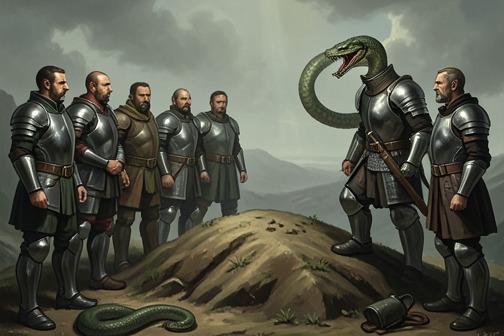
[The Serpent at the Mound of Mourning](entity:event-recall-event-the-serpent-at-the-moun-a021f47806db) turns a contest over a guarded marvel into a demonstration of [Peredur](entity:character-recall-character-peredur-f0f4e8e82164)’s authority. Faced with three hundred tent owners who expect to fight among themselves for the stone after the serpent dies, he first compels their submission and then kills the serpent alone. The outcome is not merely possession of the prize: Peredur pays the assembled men for their expenses, makes them his vassals, and gives the stone to his companion [Etlym Gleddyv Coch](entity:character-recall-character-etlym-gleddyv-coch-e684e34aa78d).
## The Challenge at the Mound
The day after reaching the court of the Countess, Peredur set out for the [Mound of Mourning](entity:location-recall-location-mound-of-mourning-c18fa6370855). Etlym, now the Countess’s bridegroom, chose to accompany him. When they came within sight of the mound and its tents, Peredur sent Etlym ahead to demand that the gathered men do homage to him. Etlym identified Peredur as his lord, but the men rejected the demand: they were kings, earls, and barons, and considered the request arrogant. They would rather fight than submit.
Peredur gave them a choice between homage and battle. Their refusal transformed the approach to the mound into a contest for political as well as martial authority: before facing the serpent, Peredur had to establish that the armed company would recognize his standing. The challenge was large in scale, with the owners of three hundred tents arrayed against him.
## Three Days of Submission
Peredur met the challenge over three successive days. On the first day he overthrew the owners of a hundred tents; on the second, another hundred. Faced with the prospect of continuing the fight, the remaining hundred took counsel on the third day and chose to do homage. The movement from open resistance to submission is measured in hundreds, making the change in allegiance the immediate consequence of Peredur’s repeated victories.
Only after they had yielded did Peredur ask why so many people had gathered there. They explained that they were guarding the serpent until it died. They expected that, once it was dead, they would fight one another for the stone, which would belong to whoever emerged victorious. Thus the conflict among the tent owners had been anticipated even before the creature’s death; Peredur’s victory over them settled that rivalry before it could begin.
## Peredur and the Serpent
The guards offered to go with Peredur to encounter the serpent, but he refused. He reasoned that if the creature were slain with their help, he would gain no more fame from the deed than any one of them. His decision makes the slaying a solitary feat, distinct from the collective submission he has already secured. He went to the serpent’s place, killed it, and returned to the assembled men.
The account gives no further description of the serpent or of the manner of its death. Its importance in the episode lies in the contest it organizes: the men have gathered to watch for its death and then contest the stone, while Peredur breaks that expected sequence by defeating the guards, killing the creature himself, and controlling what happens to the prize.
## The Stone and the Aftermath
After returning, Peredur asked the guards to reckon what they had spent while waiting at the mound and promised to repay them in full. He paid each according to the amount claimed. In return, he required only that they acknowledge themselves as his vassals. The settlement gives the episode a second resolution beyond victory in combat: Peredur converts defeated opponents into subjects and answers their material claims with payment rather than taking the stone without regard for their costs.
Peredur then told Etlym to return to the woman he loved and said that he would reward him for having served as his attendant. He gave Etlym the stone. Etlym accepted the gift with a wish that Heaven repay and prosper Peredur, then returned to the Countess. The stone therefore passes not to the strongest of the waiting guards, as their intended contest had stipulated, but from Peredur to the companion who had carried his demand of homage. The episode closes with Peredur moving onward and Etlym returning to his beloved, separating the two companions after the shared venture.
Event 11
Peredur’s Tournament for the Empress of Cristinobyl
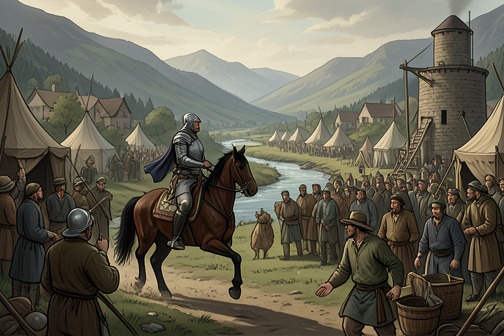
[Peredur’s Tournament for the Empress of Cristinobyl](entity:event-recall-event-peredur-s-tournament-fo-3ee058d308fc) turns an extravagant gathering into a test of valor, courtesy, and remembered obligation. [Peredur](entity:character-recall-character-peredur-f0f4e8e82164) arrives as a spectator, drawn first to a maiden in a satin garment; only after the miller’s sharp challenge does he enter the contests. His victories bring material reward to the household that sheltered him, while his later acceptance of the Empress’s three successive challenges fulfills a pledge tied to his earlier encounter with the [Addanc](entity:character-recall-character-addanc-ae27868d973b). The episode ends not with a departure or a brief triumph, but with fourteen years of the Empress’s hospitality.
## The Gathering and Its Stakes
Peredur rides into a broad valley crossed by a river and marked by tents of many colors. He is struck by the number of water-mills and windmills as well as by the scale of the encampment. A tall, auburn-haired man dressed as a workman identifies himself as chief miller of the mills and welcomes Peredur to his pleasant house. The miller’s home gives the knight a place to stay amid a gathering whose size has required an unusual practical response: the mills were built because food could not otherwise be brought in for the thousands assembled.
The gathering is for the [Empress of Cristinobyl the Great](entity:character-recall-character-empress-of-cristino-288e66150ded). The miller explains that she will accept no one except the most valiant man, and that wealth is no qualification. The tournament is therefore both a public contest and a means of determining who may win her favor. Its scale makes the standard seem daunting: the crowd is counted in thousands, while the mills stand as visible evidence of the provisions needed to sustain it.
Peredur asks the miller for a loan so that he can buy meat and liquor for himself and the household, promising to repay him before he leaves. The miller lends the money, though his wife is angry when Peredur borrows again after the first day. Their strained hospitality forms a small but consequential counterpoint to the grand contest: Peredur is living on credit while surrounded by a spectacle of plenty, and the miller’s household must wait to see whether his promise will be kept.
## From Spectator to Competitor
On the first day, Peredur equips himself and his horse, but does not enter the tournament. In another tent, he sees a beautiful maiden leaning from a window, dressed in satin, and becomes deeply attached to her. He remains fixed on her from morning through the afternoon until the tournament ends. He returns to the miller’s house, removes his armor, and borrows more money. The next day he repeats the same pattern: he goes out prepared, watches the maiden instead of competing, and returns to borrow again.
On the third day, the miller strikes him between the neck and shoulder with the edge of an axe and gives him a blunt choice: turn his head away or go to the tournament. Peredur smiles at him and enters the contest. The change is immediate. He overthrows every man who meets him that day and continues until all have been defeated. Those he vanquishes are sent to the Empress’s prison; their horses and arms go to the miller’s wife as payment for the household’s loans. Thus the victories answer two claims at once: they establish Peredur’s prowess before the Empress and settle his debt to the people who have lodged and fed him.
The Empress sends for the victorious Knight of the Mill. Peredur refuses the first and second messages. On the third attempt, she sends a hundred knights to bring him against his will; Peredur fights them, has them bound, and throws them into the mill-dyke. The Empress then consults a wise man of her counsel. Rather than sending another force, he approaches Peredur and asks him to visit for the sake of the lady he loves. Peredur goes with the wise man and the miller, sits in the tent’s outer chamber, and receives the Empress beside him. Their conversation is slight, and he soon takes his leave. The first summons has brought him to her tent, but not yet into a sustained exchange.
## The Goblets and the Pledge
The next day Peredur visits the Empress again. In the tent, where the chambers are equally decorated and the company does not know where he will choose to sit, he takes a seat beside her and speaks courteously. Three men then enter in succession, each bearing wine and making the same demand: the vessel is to be given only to someone willing to fight for it. The first brings a goblet; the second presents a goblet fashioned from a wild beast’s claw; the third carries a bowl. Each time the Empress looks to Peredur, he asks her to give the vessel to him, drinks the wine, and passes it to the miller’s wife.
These repeated challenges bring the miller’s household back into the center of the scene. The wife who resented Peredur’s borrowing now receives the vessels he claims, while his earlier victories have already repaid her with the horses and arms of defeated competitors. The episode links public prowess to concrete obligations: what Peredur wins does not remain solely a mark of his personal standing but becomes recompense for the hospitality extended to him.
That night Peredur returns to his lodging. The following day he arms himself and rides to the meadow, where he slays the three men who brought the wine. He then returns to the tent. The Empress reminds him of the faith he pledged when she gave him the stone and he killed the Addanc. Peredur acknowledges that he remembers. The tournament’s confrontations therefore reach beyond the immediate contest: the Empress’s earlier gift and Peredur’s promise give his actions a history, and his answer confirms that he recognizes the obligation.
## The Long Stay
After Peredur remembers his pledge, the Empress entertains him for fourteen years. The account gives no further detail about those years, and it does not describe the tournament as ending in a marriage. Its stated outcome is the length of the Empress’s hospitality. That duration gives the episode a larger scope than the sequence of contests might suggest: the arrival, loans, victories, wine challenges, and remembered promise lead into a prolonged stay rather than a quick reward or immediate return.
The tournament’s movement is built from contrasts. Peredur begins by watching while others compete, then acts decisively when pressed to choose. He first avoids the Empress’s summons, yet later sits beside her and responds to the challenges made in her presence. His debts to the miller’s household are repaid through the spoils of victory, while his obligation to the Empress is recalled through the stone and his pledge. By the end, competitive success has become both service to those who aided him and a bond that keeps him at the Empress’s court for many years.
Event 12
Peredur’s Quest for the Castle of Wonders
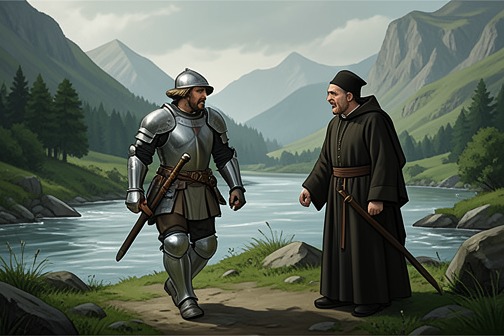
[Peredur’s Quest for the Castle of Wonders](entity:event-recall-event-peredur-s-quest-for-the-ad6a76a8e870) turns a search for a named destination into a sequence of trials that gradually discloses the purpose behind them. The route leads through unfamiliar country and a royal court before [Peredur](entity:character-recall-character-peredur-f0f4e8e82164) reaches a lake-bound castle where apparently living chessmen, a destructive black man, and a monstrous stag stand between him and the truth about his family.
## The Search Begins
Peredur has been wandering across the island seeking news of the black maiden, without success. In an unknown land, in a river valley, he meets a horseman dressed as a priest and asks for a blessing. The priest rebukes him for travelling in armour on [Good Friday](entity:time-recall-time-good-friday-34392fdf0994). Peredur explains that he did not know the date: it is a year since he left his country. He dismounts and leads his horse, changing his conduct in response to the warning.
After crossing a wood, Peredur comes upon an inhabited but unfortified castle and again encounters the priest. This time the priest blesses him and offers him lodging. When Peredur tries to depart the following day, the priest tells him that no one may travel that day and asks him to stay two more days, promising help in finding his destination. On the fourth day, he gives Peredur directions: cross a mountain to a river valley, where a King’s palace stands. The King had stayed there during [Easter](entity:time-recall-time-easter-4ee721615d13), and the priest says that Peredur may learn of the [Castle of Wonders](entity:location-recall-location-castle-of-wonders-455185b8690d) there.
At the river, Peredur meets the King and a hunting party. The King offers him a choice: join the hunt, or go to the palace, where the King’s daughter will provide food and drink until he returns. A yellow page accompanies Peredur to the palace. The daughter welcomes him and seats him beside her at the meal; she laughs loudly at what he says. The page interprets her response as evidence that she is in love with Peredur, or will soon be, and advises the King to have him seized until the matter is clarified. The King’s men arrest Peredur and put him in prison, temporarily interrupting the search just as he approaches the court that can guide him onward.
## The King’s Reward and the Chessboard
The King’s daughter provides Peredur with horse and arms so that he can watch the conflict between her father and a powerful Earl who possesses two earldoms. Peredur enters the fighting in a scarlet robe over his armour and with a yellow shield, then returns to prison after each day’s combat without revealing who he is. For three days he defeats the Earl’s men; on the fourth he kills the Earl. The daughter identifies the victorious knight to her father, and the King, now secure in the two earldoms, offers Peredur his daughter in marriage, half his kingdom, and the earldoms. Peredur declines the offer because he has not come to seek a bride: he is still pursuing news of the Castle of Wonders. The daughter says she loves him and arranges a guide and provisions, directing him to a castle in the middle of a lake. Its name is known, she explains, but its wonders are not.
Peredur finds the castle’s gate and hall open. Inside, chessmen play a game by themselves. When the side he favours loses, he becomes angry, gathers the pieces into his lap, and throws the chessboard into the lake. The black maiden appears and tells him that he has deprived the Empress of a board she would not have surrendered for all her empire. To recover it, Peredur must go to the [Castle of Ysbidinongyl](entity:location-recall-location-castle-of-ysbidinong-32b5052380ba) and defeat a black man who lays waste the Empress’s lands; the maiden warns that he may not return alive. Peredur goes, fights the black man, and grants his request for mercy on condition that he restore the chessboard to its former place. When the maiden says the board has not been restored, she orders Peredur to return and kill him. Peredur does so. The trial turns his impulsive destruction of the chessboard into an obligation to confront the force harming the Empress’s dominions.
## The Stag, the Cromlech, and the Turn Toward Revenge
The black maiden next bars Peredur from seeing the Empress until he confronts a monster in the forest. She describes a stag swift as a bird, with a single spear-length horn, that ruins the forest’s best trees, kills the animals it encounters, and drains the fish-pond each night, leaving the fish exposed. Since no mortal has entered the forest for more than a year, she gives Peredur a little dog belonging to the Empress to rouse the beast and lead it towards him. The stag charges; Peredur lets it pass and cuts off its head. A mounted lady arrives, takes the dog in the flap of her cap, and reproaches him for killing the finest jewel in her dominions. Peredur explains that he was asked to do so, then seeks a way to win her friendship. She sends him to a grove on a mountain, where he must challenge a man beneath a cromlech three times.
A black man rises from beneath the cromlech on a bony horse; both rider and horse wear oversized, rusty armour. Peredur repeatedly casts him down, but the man springs back into the saddle each time. When Peredur dismounts and draws his sword, the black man vanishes with both horses, leaving Peredur unable to find him again. The encounter does not resolve the challenge or explain the strange trials. Instead, Peredur crosses the mountain and reaches a castle in a river valley, where an open hall contains the lame, grey-headed man and [Gwalchmai](entity:character-recall-character-gwalchmai-42fa519e4b02). Peredur finds his horse in the same stall as Gwalchmai’s, and they are glad to see him. The arrival brings the wandering quest back into contact with [Arthur](entity:character-recall-character-arthur-2e33b65bbe57)’s company, just before the meaning of the black maiden’s appearances and the earlier marvels is disclosed.
## Recognition and Revenge
The lame, grey-headed man and Gwalchmai’s welcome marks a return to Arthur’s company, but the encounter’s purpose becomes clear when a yellow-haired youth kneels before Peredur and asks for his friendship. He reveals that he had appeared as the black maiden and had also brought to Arthur’s Court the bloody head on a salver and the lance streaming with blood. The head belonged to Peredur’s cousin, killed by the [Sorceresses of Gloucester](entity:character-recall-character-sorceresses-of-glou-d4c9f816abb6); they had also lamed Peredur’s uncle. The youth identifies himself as that cousin and discloses the prophecy that Peredur would avenge these deeds. The apparently disconnected marvels of the quest now converge on a family grievance and a foretold reckoning.
Peredur and Gwalchmai take counsel and send to Arthur and his household, asking them to come against the sorceresses. In the ensuing fight, one sorceress kills an Arthurian man before Peredur, and he orders her to stop; when she kills another, he warns her again. Only after a third death does he draw his sword and strike her helmet. She calls on the other sorceresses to flee, identifying Peredur as the man who had learned chivalry among them and was destined to kill them. Arthur’s company joins the assault, and the Sorceresses of Gloucester are all slain. The Castle of Wonders adventure thus ends not with Peredur claiming the Empress’s chessboard or meeting her, but with the revelation that his sequence of trials has led to the vengeance foretold for his family.
Event 13
The Slaying of the Sorceresses of Gloucester
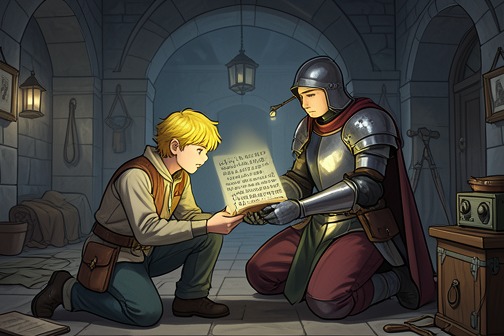
[The Slaying of the Sorceresses of Gloucester](entity:event-recall-event-the-slaying-of-the-sorc-4008195668a3) is the revenge episode in which [Peredur](entity:character-recall-character-peredur-f0f4e8e82164) learns that the [Sorceresses of Gloucester](entity:character-recall-character-sorceresses-of-glou-d4c9f816abb6) killed his cousin and lamed his uncle. A yellow-haired youth identifies himself as Peredur’s cousin and connects that family history to several earlier marvels; the revelation turns Peredur’s scattered adventures into a foretold reckoning.
## Revelation and Prophecy
At the castle, the youth kneels before Peredur and asks for his friendship. He explains that he had appeared in several forms and episodes: as the black maiden at [Arthur](entity:character-recall-character-arthur-2e33b65bbe57)’s Court, in connection with the chessboard Peredur overturned, and alongside the black man of Ysbidinongyl, the stag, and the black man beneath the cromlech. He also identifies himself as the source of the bloody head on the salver and the lance streaming with blood. The head belonged to Peredur’s cousin, he reveals, and the sorceresses had killed him and lamed Peredur’s uncle. The youth then discloses that a prophecy assigns Peredur the task of avenging these wrongs, giving the earlier wonders a common cause and a clear destination.
## The Reckoning
Peredur and [Gwalchmai](entity:character-recall-character-gwalchmai-42fa519e4b02) took counsel and sent to Arthur and his household, asking them to come against the Sorceresses of Gloucester. During the fighting, one sorceress slew a man before Peredur. He bade her stop, but when she slew a second man after his warning, he again intervened without drawing his sword. Only after she killed a third man before him did Peredur strike, splitting her helmet. The three deaths and his repeated warnings mark the point at which he moves from witness to active avenger.
The sorceress called to the others to flee, identifying Peredur as the man who had learned chivalry among them and was destined to destroy them. Arthur and his household then attacked and slew every one of the sorceresses. The episode thus fulfills the prophecy through a collective victory: Peredur initiates the decisive action, while the assembled company completes the reckoning.
## Closure and Narrative Function
The closing notice, “And thus is it related concerning the [Castle of Wonders](entity:location-recall-location-castle-of-wonders-455185b8690d),” marks the slaying as the resolution of the preceding marvel-filled sequence rather than the beginning of a new adventure. The narrative then opens a separate tale about [Geraint](entity:character-recall-character-geraint-c8a758f86d59), returning to Arthur’s court at [Caerlleon upon Usk](entity:location-recall-location-caerlleon-upon-usk-6701ef046cac). This sharp transition gives the revenge episode a bounded shape: the revelations and family reckoning bring the Castle of Wonders story to its close, while the larger collection moves on to another branch of Arthurian narrative.
## Recognition at the Castle
The reckoning emerges from a chain of encounters that brings Peredur back into company: after the black man beneath the cromlech disappears with both horses, Peredur reaches a castle where Gwalchmai and a lame, grey-headed man are waiting. Peredur’s horse is there too, in the same stall as Gwalchmai’s. In this setting, the yellow-haired youth’s approach and request for friendship connect the recovered horse and the earlier marvels to the family history that gives the episode its purpose.
Event 14
Geraint’s Sparrow-Hawk Tournament
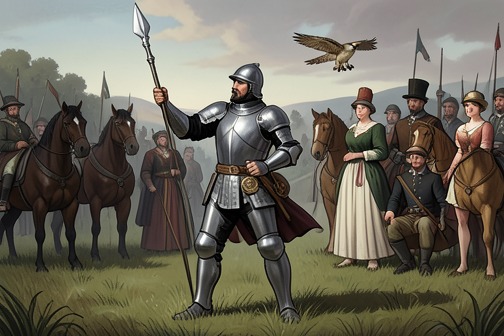
[Geraint’s Sparrow-Hawk Tournament](entity:event-recall-event-geraint-s-sparrow-hawk-80135ab3078c) turns a contest for a prized bird into a public reckoning over courtesy, status, and restitution. [Geraint](entity:character-recall-character-geraint-c8a758f86d59) arrives without a lady of his own, but challenges [Edeyrn](entity:character-recall-character-edeyrn-ccc887f39354) on behalf of [Enid](entity:character-recall-character-enid-6800f27ce0d7), the daughter of the dispossessed Earl [Ynywl](entity:character-recall-character-ynywl-eadb8bdda9ce). His victory answers an earlier insult to [Gwenhwyvar](entity:character-recall-character-gwenhwyvar-31ec144fcc56)’s maiden as well as the affront directed at Geraint, and its consequences extend beyond the tournament: Edeyrn is sent to [Arthur](entity:character-recall-character-arthur-2e33b65bbe57)’s court to make amends, Ynywl recovers his lost holdings, and Enid becomes Geraint’s bride.
## The prize and the grievance
The contest is held in a meadow in a town later identified as [Cardiff](entity:location-recall-location-cardiff-0a50facd7b25). Two forks support a silver rod, and a Sparrow-Hawk is placed upon it as the prize. The assembled participants come with horses and arms, each accompanied by the lady he loves best; without her presence, a man cannot joust for the bird. The rule makes the tournament both a test of prowess and a public declaration of attachment.
Edeyrn has won the Sparrow-Hawk in each of the two previous years. If he secures it a third time, the prize will thereafter be sent to him every year, and he will no longer need to attend the contest; he will be known as the Knight of the Sparrow-Hawk. Geraint’s challenge therefore intervenes at the decisive point in a contest that is about to become Edeyrn’s lasting distinction.
The challenge has a grievance behind it. Edeyrn and his dwarf have insulted Geraint and the maiden serving Gwenhwyvar. Geraint recounts the affront to Ynywl, whose household gives him shelter. He lacks a lady to accompany him under the tournament’s rule, so he asks permission to challenge for Ynywl’s daughter, Enid. He promises that, should he survive, he will love her for the rest of his life; should he not, she will remain as she was. Ynywl agrees and arranges for Geraint to have arms, a horse, and support at the contest. Geraint chooses to keep his own horse and use Ynywl’s arms.
## Geraint challenges Edeyrn
At daybreak, Geraint and Ynywl’s family reach the meadow as Edeyrn calls upon his beloved to take the Sparrow-Hawk. Geraint interrupts, asserting that Enid is fairer, nobler, and more entitled to the prize. Edeyrn demands that he prove the claim by fighting. Geraint enters the contest in heavy, rusty, ill-fitting armor, a sharp contrast to the honor and standing that the tournament is meant to display.
The knights break successive sets of lances. Edeyrn appears to have the advantage, and his supporters rejoice, while Ynywl, his wife, and Enid fear for Geraint. Ynywl supplies more lances as they break, then offers Geraint the lance he had held on the day he was made a knight, a weapon he says he has never broken. The dwarf brings Edeyrn another lance in turn. Geraint refuses to be discouraged by Edeyrn’s apparent mastery and continues the contest.
The fighting shifts from lances to swords. When Geraint finally gains the advantage, Edeyrn asks for mercy. Geraint grants it on a specific condition: Edeyrn must go directly to Gwenhwyvar and make satisfaction for the insult his dwarf offered her maiden. Geraint says that, for the insult to himself, he is content with what he has already done in the contest. Edeyrn accepts the condition and identifies himself as Edeyrn, son of Nudd; Geraint in turn names himself as Geraint, son of [Erbin](entity:character-recall-character-erbin-06507e0ef911). The encounter thus makes the opponent’s identity explicit and converts victory into an obligation to repair the wrong.
## Redress and restoration
Edeyrn rides to Arthur’s court with his beloved and the dwarf. Gwenhwyvar hears that he comes in a battered state and then receives him at the gate. Edeyrn explains that Geraint compelled him to come, but acknowledges that the fault was his own. He also recounts that Geraint challenged for Enid, accompanied by Ynywl, Ynywl’s wife, and their daughter, who were plainly living in straitened circumstances. Gwenhwyvar grants mercy; Arthur orders that Edeyrn receive medical care and that, if he lives, the court determine what satisfaction is due. The tournament’s outcome is therefore not treated as a private victory alone: the insult to the queen’s household is brought before the king and court.
Geraint declines the young Earl’s invitation to remain at his castle after the contest. He returns instead to Ynywl’s lodging, and the young Earl offers him ointment and hospitality. When the Earl invites Geraint to a meal, Geraint first asks for Ynywl, his wife, and Enid, then makes clear that he will not leave Ynywl in poverty. The dispute arose because Ynywl’s nephew, now the young Earl, had taken Ynywl’s possessions and refused to return them when asked. Geraint requires their restoration, including what Ynywl should have received from the time of his loss, and asks those who owe Ynywl homage to perform it. The young Earl agrees, and Ynywl regains his castle, town, possessions, and even the smallest jewel. The resolution gives material consequence to Geraint’s defense of Enid: her father’s household is restored rather than merely honored in words.
## Marriage and public recognition
Ynywl offers Enid to Geraint, but Geraint says she should go with him to Arthur’s court, where [Arthur and Gwenhwyvar](entity:relation-recall-relation-arthur-and-gwenhwyva-9605130a47c3) can decide how she is to be received. When they arrive, Arthur gives Enid to Geraint, and the customary bond between them is made. Gwenhwyvar’s finest apparel is given to Enid, transforming the poor clothing in which she first appeared into court dress. She and Geraint are lodged in the chamber where Arthur and Gwenhwyvar sleep, and from that point Enid is his bride.
The court’s welcome extends the tournament’s judgment beyond the field. Gwenhwyvar proposes that the stag’s head, held back until Geraint returned, be awarded to Enid; the court and Arthur applaud the choice. The distinction increases Enid’s reputation and brings her more friends. Geraint, for his part, continues to love the stag, tournaments, and hard encounters, and he wins in them over the following three years, until his fame has spread throughout the kingdom.
## Significance
The contest joins several kinds of obligation in a single public event. Its rules require a knight to appear with the lady he loves, but Geraint’s challenge is also grounded in a demand for redress: he uses Enid’s claim to confront Edeyrn over the treatment of Gwenhwyvar’s maiden. The outcome accordingly moves through distinct forms of recognition—Edeyrn’s defeat, his admission of responsibility, the court’s response, Ynywl’s restored property, and Enid’s formal welcome as Geraint’s bride.
Geraint’s victory does not leave the conflict at the level of force. He distinguishes between his own affront, for which he considers the contest sufficient, and the wrong done to Gwenhwyvar’s maiden, which must be answered at court. He likewise turns his standing as victor into leverage for Ynywl, insisting on the return of property and homage. The tournament thus serves as a test of arms and a means of setting relationships and obligations right; the Sparrow-Hawk is the prize, but the event’s broader resolution lies in the restoration of honor, land, and place within the court.
Event 15
Geraint and Enid’s Journey of Trials
[Geraint and Enid’s Journey of Trials](entity:event-recall-event-geraint-and-enid-s-jour-55422bd8ce73) turns a marriage strained by suspicion into a test of fidelity, judgment, and public responsibility. [Geraint](entity:character-recall-character-geraint-c8a758f86d59) sets out believing that [Enid](entity:character-recall-character-enid-6800f27ce0d7)’s sorrow means she wants another man; on the road, her repeated warnings and continued loyalty contradict that belief, while each new challenge measures his strength and her devotion. The journey’s decisive change comes when Geraint recognizes that Enid was right, and its conclusion reunites their private bond with Geraint’s public reputation as a ruler.
## The cause of the journey
After Geraint had secured the boundaries of his dominions and won renown in tournaments, prosperity drew him away from the duties and company that had once occupied him. He remained at home, increasingly shut away with Enid, and neglected his nobles, hunting, and other amusements. The people of the court murmured about his withdrawal. When [Erbin](entity:character-recall-character-erbin-06507e0ef911) asked Enid whether she had caused it, she denied responsibility and grieved over the situation, uncertain how to raise the matter with her husband.
One summer morning, Enid watched Geraint sleeping and lamented that his arms and breast had lost the glory of their former warlike fame. Her tears and words woke him. Instead of understanding her concern as grief for his diminished reputation, Geraint suspected that she was thinking of another man and wanted different company. He ordered her to dress in her worst riding clothes, prepare her horse, and accompany him on a quest of uncertain length. He told her to ride well ahead, not to turn back, and not to speak unless he addressed her. He also warned her that she would not return until she had learned whether he had truly lost his strength. His suspicion thus turns a concern about his public conduct into a private ordeal imposed on them both.
## Warnings and the road’s tests
Geraint chose not the frequented road but a rough route through places beset by thieves, robbers, and dangerous animals. When four armed horsemen emerged from a forest and discussed taking the couple’s horses, armor, and Enid, she broke her silence to warn Geraint. He rebuked her for speaking, then defeated all four attackers. He took their equipment and horses and ordered Enid to drive the animals ahead of her, repeating his demand for silence.
The pattern recurred as they travelled. Three horsemen approached, seeking to seize the accumulated horses and armor, and Enid again warned Geraint; the account then describes five more armed riders making a similar plan. She warned him of that group too, despite knowing that each warning would provoke his anger. Geraint overcame the five, adding their equipment and horses to the train in Enid’s care. His instruction remained unchanged, but the practical burden of carrying out his victories fell increasingly on her. When night caught them in a deep, vast wood, he stopped for rest and told Enid to watch the horses while he slept in his armor.
Later, an earl offered Enid his earldom if she would leave Geraint. She refused, saying that Geraint was the first man to whom she had pledged her faith. She did not tell Geraint of the conversation at once, fearing it would anger or distress him. At midnight, however, she quietly assembled his armor and woke him to disclose the earl’s intention. Geraint took her warning, gave their host eleven horses and eleven suits of armor, and left by a different route. When the [Earl Dwrm](entity:character-recall-character-earl-dwrm-a2186aaf12e2) arrived with eighty knights, Enid saw the pursuing force and warned Geraint yet again. He confronted the attackers, defeated them and the earl, and spared the earl when he asked for mercy.
## Recognition and renewed danger
The journey later brought [Geraint and Enid](entity:relation-recall-relation-geraint-and-enid-eeb324132f5f) to [Arthur](entity:character-recall-character-arthur-2e33b65bbe57)’s company. Geraint was wounded, and Arthur kept him under medical care for nearly a month before permitting him to resume the road. Enid continued to ride ahead as before. When Geraint investigated a woman’s cries, he found a knight dead and a young woman mourning him. She explained that three giants had killed her husband. Geraint pursued them, overcame them, and returned gravely wounded; on reaching Enid, he fell from his horse as if dead.
The Earl of Limours came upon the two women and offered Enid an earldom and himself, whether Geraint lived or died. Enid refused to change her clothes, eat, or drink while Geraint remained on the bier. When the earl forced the matter and struck her, she cried out. Geraint revived at the sound, rose, and killed the earl. The moment overturns the power dynamic that had governed their journey: Enid’s steadfast refusal to abandon him becomes the means by which Geraint returns, and he recognizes that she had been right. He also grieves that she has been so altered by hardship and accepts her knowledge of where his horse is. They leave together.
## The enchanted games and the return
As they rode on, a pursuing force approached, but it was [Gwiffert Petit](entity:character-recall-character-gwiffert-petit-05fdb05f9414), coming to assist Geraint. Gwiffert offered medical help at a nearby palace. Geraint recovered there, and his armor was repaired; the party stayed for a fortnight and a month. Enid then travelled with them more gladly than before. The respite did not end Geraint’s appetite for adventure: when a traveller warned them that a road led through a hedge of mist to [Earl Owain](entity:character-recall-character-earl-owain-5bca5e442b8d)’s enchanted games, Geraint chose that way.
The hedge was so high that its top could not be seen, and nearly every stake bore a man’s head. Earl Owain allowed no companion to enter with Geraint. Undeterred, Geraint rode alone into the mist and came to an orchard, where a red-satin tent stood beneath an apple tree. Inside, he sat in an empty golden chair despite a maiden’s warning that its owner would resent it. The arriving knight challenged him, and Geraint defeated him after a fierce contest. Rather than claim wealth or another reward, Geraint demanded that the games, the hedge of mist, and the enchantment end. He sounded the hunting horn as instructed; at its first blast the mist vanished, and the assembled hosts were reconciled.
Geraint and Enid then parted from Earl Owain and returned toward Geraint’s dominions. The story closes not with another private test but with the restoration of their standing: Geraint reigns prosperously, and his warlike fame and honor endure alongside Enid’s. The journey’s sequence of mistaken suspicion, repeated warnings, separation, and recognition makes Enid’s constancy visible through action, while Geraint’s final choice to end the enchantment rather than simply win its contest gives his strength a public consequence.
Event 16
Geraint Breaks Earl Owain’s Enchanted Games
[Geraint Breaks Earl Owain’s Enchanted Games](entity:event-recall-event-geraint-breaks-earl-owa-8f7ae41c8f3d) is the episode in which [Geraint](entity:character-recall-character-geraint-c8a758f86d59) turns a deadly, isolating spectacle into a public reconciliation. Though warned that no one who enters the [Hedge of Mist](entity:object-recall-object-50665bb8698f) returns, he chooses the challenge, defeats its guardian in combat, and requires the enchantment itself to be undone. The victory matters not only because Geraint survives: it ends the games, lifts the barrier, and allows those separated by the Earl’s rule to come together again.
## Causes and Approach
Geraint reaches [Earl Owain](entity:character-recall-character-earl-owain-5bca5e442b8d)’s territory after a period of recovery. The Little King, [Gwiffert Petit](entity:character-recall-character-gwiffert-petit-05fdb05f9414), had brought him to shelter when Geraint was wounded, and at the Baron’s palace physicians restored him while his armour was repaired. Once well, Geraint declines the Little King’s invitation to rest at his own court. He chooses instead to make one more day’s journey before turning back, and [Enid](entity:character-recall-character-enid-6800f27ce0d7) travels more gladly than she had at any earlier point on the road.
At a fork, a traveller warns the company away from the lower road. A Hedge of Mist lies below, he explains, concealing enchanted games from which no entrant has returned. The Earl who owns the town permits people of gentle birth to lodge there only if they stay at his court. Geraint hears both the danger and the restriction, then chooses the lower road. At the town, he and his companions take lodging before a young messenger directs them to the Earl’s hall, where they are welcomed and seated according to rank.
The games initially seem to create a conflict even before Geraint enters them. Remembering the warning, he does not eat. Earl Owain understands that Geraint may be reluctant to risk the challenge and says that he need not go; indeed, the Earl offers to prevent anyone else of Geraint’s rank from being made to go as well. Geraint answers through his choice rather than hesitation: he wants to enter and asks to be shown the way. His participation is not forced by the Earl’s rule or by a failure to understand the danger. He knowingly elects to face it.
## The Hedge and the Challenge
The assembled company escorts Geraint to the boundary. The Hedge of Mist is extraordinarily high, and its stakes are marked with human heads, save for two. The display makes the warning visible: the games have taken lives, and their cost is not hidden behind the mist. When the Little King asks whether anyone may enter with Geraint, Earl Owain says no. He cannot identify a safe entrance, leaving Geraint to choose his own way through.
Geraint rides into the mist alone and emerges in a large orchard. There he finds an open space and a tent of red satin, its entrance open and an apple tree standing before it. A great hunting-horn hangs from one of the tree’s branches. Inside the tent, a maiden sits in a golden chair, opposite an empty chair. Geraint takes the empty seat despite her warning that it belongs to a man who has never allowed anyone else to sit there. The choice brings the concealed challenge into the open: a mounted knight arrives amid a great tumult and demands satisfaction for the affront.
## Combat and the End of the Enchantment
The knight meets Geraint in battle, and neither yields quickly. They break one set of lances, then a second and a third, exchanging repeated, fierce blows. Geraint eventually drives his horse forward and strikes the centre of his opponent’s shield. The shield splits; Geraint’s lance penetrates the armour, breaks the girths, and throws the knight over his horse’s crupper to the ground. The defeat transforms the encounter: the fallen challenger asks for mercy and offers Geraint whatever he desires.
Geraint’s demand reaches beyond personal satisfaction. He requires that the games cease and that the Hedge of Mist, magic, and enchantment be removed. The defeated knight agrees, but explains that the mist will disappear only when the horn is blown by the knight who vanquished him. The horn on the apple tree is therefore more than a feature of the strange setting: it provides the specific means by which Geraint’s victory can become a change in the whole territory.
While Geraint has been fighting, Enid has remained apart, anxious for him. He goes to the tree and sounds the horn. At its first blast the mist vanishes. The hosts then come together and are reconciled with one another. The resolution joins a private victory to a communal consequence: Geraint has defeated the knight, but the decisive outcome is the removal of the barrier and the restoration of contact among those the enchantment had kept apart.
## Return and Significance
Earl Owain invites Geraint and the Little King to remain for the night. They separate the following morning, and Geraint returns toward his own dominions. From then on, he reigns prosperously, while his warlike fame and splendour endure in honour to both him and Enid. The ending places the episode within their larger journey: after danger and injury, the couple leave not merely healed and moving homeward, but with public renown affirmed.
The sequence turns on a series of deliberate thresholds. Geraint chooses the dangerous road after hearing the warning; accepts the challenge after being offered a way to avoid it; enters alone when no companion is permitted; and, once victorious, uses his demand to dismantle the conditions that made the games deadly. The heads on the hedge register the past cost, while the horn’s first blast marks the change from separation to reconciliation. The episode’s resolution is therefore not simply that Geraint wins a contest: he makes the victory release others from the enchantment and restores a shared world beyond the mist.