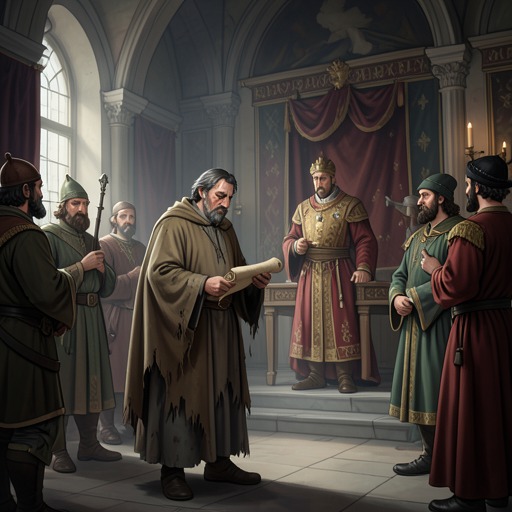
Culhwch asks Arthur for help in winning Olwen's hand
MabinogionCulhwch asks Arthur for help in winning Olwen’s hand, converting a prophecy heard at home into a public obligation at Arthur’s court. The request binds kinship, royal generosity, and the prowess of Arthur’s warriors to a quest for Olwen, daughter of Yspaddaden Penkawr. It also sets the terms of the adventure: Arthur promises assistance, but finding Olwen remains uncertain, and the first search returns no news of her.
Prophecy and the making of the request
Culhwch’s approach to Arthur begins with a complicated change in his household. His mother, Goleuddydd, had charged her husband not to take another wife until a briar with two blossoms grew upon her grave. The king promised to keep the grave clear, but after seven years his attendant neglected the duty. The king then saw the briar and, following a counsellor’s advice, killed King Doged, took Doged’s wife and daughter, and conquered his lands. The new queen had been carried away by violence, a circumstance that shadows the household in which Culhwch’s destiny is disclosed.
The queen sought news of her husband’s children from an old woman in the town. At first she was told that he had none; then the old woman revealed a prediction that the queen would bear him an heir, and that he already had a son. The queen returned home pleased and asked her consort why he had concealed his children. He admitted the concealment and sent for Culhwch, bringing the young man to court. This discovery matters to the request that follows: Culhwch is not an unknown petitioner but the king’s son, and his relationship to Arthur will make the appeal a family claim as well as a courtly one.
The queen urged Culhwch to marry and offered her own daughter, but he said that he was not yet of an age to wed. She then declared that he would not find a suitable wife until he obtained Olwen, daughter of Yspaddaden Penkawr. Though he had never seen Olwen, Culhwch blushed, and love for her took hold of him at the news. When his father asked what had happened, Culhwch explained the condition the queen had named. His father answered that the task would be easy for him because Arthur was his cousin, and advised him to go to Arthur, have his hair cut, and ask a boon.
The petition at Arthur’s court
Culhwch arrived at Arthur’s court mounted on a richly equipped horse. His greeting extended from the ruler to the lowest-ranked person present, treating the whole court as included in his formal courtesy. Arthur welcomed him with the privileges of a king’s guest: a place between two warriors, minstrels, and a promise that Culhwch would receive the first share of the gifts Arthur distributed to visitors. Culhwch declined to make hospitality his purpose. He said that he had come to ask a boon, and made Arthur’s reputation part of the stakes: if granted, the favor would be repaid with praise; if refused, Culhwch would carry Arthur’s discredit wherever his renown had reached.
Arthur responded with a sweeping promise. Culhwch could name what he wanted within the reach of the world’s bounds, with specific exceptions: Arthur’s ship, mantle, sword Caledvwlch, lance Rhongomyant, shield Wynebgwrthucher, dagger Carnwenhau, and wife Gwenhwyvar. Culhwch’s first request was modest in form: he asked Arthur to bless his hair. Arthur took a golden comb and silver-looped scissors and combed it. Only then did Arthur ask who the young man was, explaining that he felt drawn to him and recognized that they were of the same blood.
Culhwch named himself as the son of Kilydd and Goleuddydd. Arthur confirmed that he was Culhwch’s cousin and renewed his promise. Culhwch then named his real boon: that Arthur obtain Olwen for him. He also asked the warriors of the court to undertake the task. The haircut thus marks the passage from welcome to petition, while the confirmed kinship gives the request a personal bond that Arthur’s freely pledged favor turns into an obligation.
A search delayed and a pledge renewed
Arthur admitted that he had never heard of Olwen or her kindred, but agreed to send messengers throughout his dominions. Culhwch allowed him from that night until the end of the year to find her. The messengers returned after the year without learning any more about Olwen than they had known at the outset. The delay reveals that Arthur’s authority and network do not make the task immediately solvable; the promised boon is real, but the person sought remains beyond the court’s knowledge.
Culhwch protested that everyone else had received a boon while his own remained unfulfilled, and threatened to leave carrying away Arthur’s honour. Kai rebuked him for reproaching Arthur, then pledged that the company would not part until it had either proved that Olwen did not exist in the world or obtained her. The response changes the request from a favor that Arthur might pursue through messengers into an expedition undertaken by the court’s warriors. Their declared alternatives—establishing that the maiden could not be found or securing her—make the search itself the test of their commitment.
The company committed to the quest
Arthur assigned companions whose distinct abilities answer different demands of travel and encounter. Kai brings unusual endurance and physical powers: he can remain underwater or awake for nine days and nights, can grow as tall as the highest tree, and carries such heat that rain leaves what he holds dry around his hand while his warmth can serve his cold companions as fire. His sword’s wounds cannot be healed by a physician. These attributes present him as more than a courtly escort; his pledge to stay until the quest is resolved rests on a reputation for surviving conditions that would defeat ordinary travellers.
Bedwyr is named as another dependable fighter. He never shrinks from an undertaking Kai joins, is exceptionally swift, and, despite having one hand, is said to shed blood on the battlefield with unmatched speed; his lance can inflict a wound equal to those of nine opposing lances. Kynddelig Kyvarwydd is sent as guide, with the capacity to guide the company in unfamiliar lands as well as in his own. Gwrhyr Gwalstawt Ieithoedd is included because he knows all languages, a practical gift for an expedition that may cross into unknown country and meet unfamiliar peoples.
Gwalchmai is chosen for his record of completing the adventure he sets out to seek, as well as his distinction as a footman and knight. His family connection also places him within Arthur’s kin: he is Arthur’s nephew, the son of Arthur’s sister. Menw is added for protection in savage country; he can cast a charm and illusion so that the company remains unseen while still able to see others. Together, these assignments turn Arthur’s verbal promise into a deliberately composed party: strength, guidance, communication, proven questing, and concealment all have a place in the undertaking.
The episode ends not with Olwen found or the marriage secured, but with the search made collective and enforceable. Culhwch’s destiny supplies its immediate cause; Arthur’s kinship and pledge authorize it; the year of fruitless inquiry establishes its difficulty; and the warriors’ commitment provides the means to continue beyond the court’s first failed effort.