The Disappearance and Recovery of Pwyll and Rhiannon’s Son
MabinogionThe disappearance and recovery of Pwyll and Rhiannon’s son turns a missing heir into a public accusation against his mother, then resolves the mystery through a second, parallel disappearance: the annual loss of a foal. The child’s return to Narberth exposes the women’s false account, ends Rhiannon’s seven-year penance, and restores the family while joining the boy to the household that raised him.
Background and Disappearance
In the third year of Pwyll and Rhiannon’s rule, the nobles of Dyved grew concerned that the couple had no heir. Meeting Pwyll at Preseleu, they urged him to take another wife, arguing that he could not remain with them forever without a successor. Pwyll asked them to wait one more year, and they agreed. Before that year ended, Rhiannon gave birth to a son at Narberth.
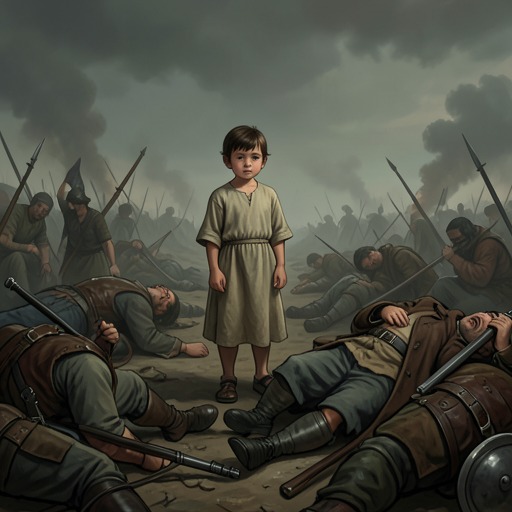
Six women were assigned to watch the mother and newborn through the night. They stayed awake for part of it, but all fell asleep before midnight. When they woke toward daybreak, the child was gone. Afraid that they would be punished for losing him, the women devised a false explanation: they killed some puppies, put their blood on Rhiannon, laid the bones beside her, and claimed that she had devoured her son. The story gave them a way to shift responsibility for the disappearance onto the sleeping mother.
Rhiannon woke and asked where her son was. The women answered that she had attacked them and killed the child. She denied the accusation and urged them to tell the truth, but neither her appeals nor her insistence that they would not be punished changed their story. The child’s absence was therefore compounded by a claim that made his mother appear responsible for it.
Rhiannon’s Penance
News of the accusation spread through the land. The nobles came to Pwyll and asked him to put Rhiannon away because of the supposed crime. Pwyll refused: her earlier lack of children could no longer be a reason to reject her, and he would not abandon her on the basis of the accusation. He instead said that, if she had done wrong, she should perform penance.
Rhiannon consulted teachers and wise men. Preferring penance to a contest with the women who accused her, she accepted the sentence imposed on her: for seven years she was to remain at the palace of Narberth, sitting each day beside a horse-block outside the gate. She had to tell her story to visitors who might not already know it and offer, if they would allow her, to carry them on her back into the palace. Few accepted. Her sentence made the false story a repeated public burden: each visitor could encounter the accused mother before learning that the missing child had not been found.
Teirnyon Finds the Child
The recovery begins with Teirnyon Twryv Vliant, lord of Gwent Is Coed. A mare belonging to his household foaled on every first of May, but its colt always disappeared. Determined to discover what happened, Teirnyon kept watch when the mare was brought into a house. That night she gave birth to a large, beautiful colt. A claw reached through the window and seized it. Teirnyon struck at the intruding creature with his sword, disrupting the theft and leaving the colt with him.
Teirnyon went outside in pursuit of the noise, but darkness hid its source. When he returned to the house, he found an infant at the door, wrapped in a satin mantle. The boy was unusually strong for his age. Teirnyon took him to his wife, who had never had a child, and she agreed to raise him. They had him baptized and named him Gwri Wallt Euryn because the hair on his head was as yellow as gold.
The boy grew with remarkable speed. By the end of his first year he could walk firmly and was larger than a big three-year-old; in his second year he was as large as a six-year-old. Before he was four, he was persuading the grooms to let him take horses to water. Teirnyon’s wife then asked about the colt he had saved on the night the boy appeared. Since the colt and infant had arrived in the same encounter, she proposed giving the horse to the boy. Teirnyon agreed, and the horse was cared for so it could be broken in when the child was ready to ride.
Recognition and Return to Narberth
When Teirnyon heard reports of Rhiannon’s punishment, he made careful inquiries among those who came to his court. The account troubled him, and he looked closely at the boy. Teirnyon had once been one of Pwyll’s followers and knew what Pwyll looked like; the resemblance between the boy and Pwyll convinced him that the child was Pwyll’s son. He concluded that it was wrong to keep raising the boy as his own while Rhiannon suffered for his disappearance.
Teirnyon discussed returning the child with his wife, who agreed. She saw three possible benefits: gratitude and gifts for helping bring Rhiannon’s punishment to an end, gratitude from Pwyll for nursing and restoring his son, and the possibility that the boy, if he proved noble in character, would remain their foster-son and help them in turn. Their decision joined care for the child to a willingness to release him to his birth family.
The next day Teirnyon set out with two knights, and the boy rode the colt he had been given. Near the palace at Narberth they saw Rhiannon sitting beside the horse-block. She offered to carry each of them into the palace as her penance for supposedly killing her son. Teirnyon refused, and the boy refused as well. Their refusal brought her no immediate explanation, but it placed the child she believed lost directly before her.
Recognition, Naming, and Fosterage
A feast was prepared at the palace, where Pwyll was present. Teirnyon sat between Pwyll and Rhiannon, with the boy among the company. After the meal, Teirnyon recounted the mare’s foaling, the infant’s discovery, and how he and his wife had raised the child. He identified the boy as Rhiannon’s son and declared that the person who had accused her had wronged her. Those present agreed that the boy looked like Pwyll. Rhiannon said that, if Teirnyon’s account was true, her trouble had ended.
Pendaran Dyved proposed naming the child Pryderi, as Pwyll’s son. Rhiannon indicated that the name Gwri Wallt Euryn, given by Teirnyon’s household, might suit him better. Pwyll proposed that the boy take his name from the word his mother had spoken when she received the joyful news of him. The family accepted Pryderi as his name, restoring him publicly not only as Pwyll’s son but also as the child whose return answered Rhiannon’s long ordeal.
Pwyll thanked Teirnyon for raising the boy and promised to support Teirnyon and his possessions for as long as he could; when Pryderi was able, Pwyll said, the son would be better placed to maintain them. Pwyll arranged for Pendaran Dyved to raise Pryderi from then on, with Teirnyon and Pendaran both recognized as foster-fathers. Teirnyon returned to his own country with love and gladness. Although offered fine jewels, horses, and dogs, he accepted none of them. The ending therefore restores the child without erasing the care that sustained him: Pryderi returns to his parents, while his upbringing remains part of the bond between the two households.