Geraint’s Sparrow-Hawk Tournament
MabinogionGeraint’s Sparrow-Hawk Tournament turns a contest for a prized bird into a public reckoning over courtesy, status, and restitution. Geraint arrives without a lady of his own, but challenges Edeyrn on behalf of Enid, the daughter of the dispossessed Earl Ynywl. His victory answers an earlier insult to Gwenhwyvar’s maiden as well as the affront directed at Geraint, and its consequences extend beyond the tournament: Edeyrn is sent to Arthur’s court to make amends, Ynywl recovers his lost holdings, and Enid becomes Geraint’s bride.
The prize and the grievance
The contest is held in a meadow in a town later identified as Cardiff. Two forks support a silver rod, and a Sparrow-Hawk is placed upon it as the prize. The assembled participants come with horses and arms, each accompanied by the lady he loves best; without her presence, a man cannot joust for the bird. The rule makes the tournament both a test of prowess and a public declaration of attachment.
Edeyrn has won the Sparrow-Hawk in each of the two previous years. If he secures it a third time, the prize will thereafter be sent to him every year, and he will no longer need to attend the contest; he will be known as the Knight of the Sparrow-Hawk. Geraint’s challenge therefore intervenes at the decisive point in a contest that is about to become Edeyrn’s lasting distinction.
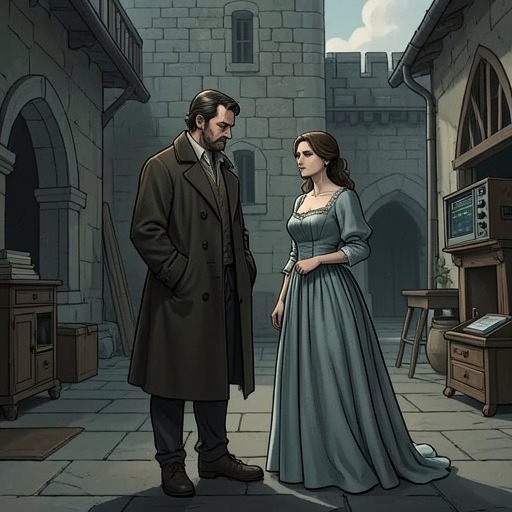
The challenge has a grievance behind it. Edeyrn and his dwarf have insulted Geraint and the maiden serving Gwenhwyvar. Geraint recounts the affront to Ynywl, whose household gives him shelter. He lacks a lady to accompany him under the tournament’s rule, so he asks permission to challenge for Ynywl’s daughter, Enid. He promises that, should he survive, he will love her for the rest of his life; should he not, she will remain as she was. Ynywl agrees and arranges for Geraint to have arms, a horse, and support at the contest. Geraint chooses to keep his own horse and use Ynywl’s arms.
Geraint challenges Edeyrn
At daybreak, Geraint and Ynywl’s family reach the meadow as Edeyrn calls upon his beloved to take the Sparrow-Hawk. Geraint interrupts, asserting that Enid is fairer, nobler, and more entitled to the prize. Edeyrn demands that he prove the claim by fighting. Geraint enters the contest in heavy, rusty, ill-fitting armor, a sharp contrast to the honor and standing that the tournament is meant to display.
The knights break successive sets of lances. Edeyrn appears to have the advantage, and his supporters rejoice, while Ynywl, his wife, and Enid fear for Geraint. Ynywl supplies more lances as they break, then offers Geraint the lance he had held on the day he was made a knight, a weapon he says he has never broken. The dwarf brings Edeyrn another lance in turn. Geraint refuses to be discouraged by Edeyrn’s apparent mastery and continues the contest.
The fighting shifts from lances to swords. When Geraint finally gains the advantage, Edeyrn asks for mercy. Geraint grants it on a specific condition: Edeyrn must go directly to Gwenhwyvar and make satisfaction for the insult his dwarf offered her maiden. Geraint says that, for the insult to himself, he is content with what he has already done in the contest. Edeyrn accepts the condition and identifies himself as Edeyrn, son of Nudd; Geraint in turn names himself as Geraint, son of Erbin. The encounter thus makes the opponent’s identity explicit and converts victory into an obligation to repair the wrong.
Redress and restoration
Edeyrn rides to Arthur’s court with his beloved and the dwarf. Gwenhwyvar hears that he comes in a battered state and then receives him at the gate. Edeyrn explains that Geraint compelled him to come, but acknowledges that the fault was his own. He also recounts that Geraint challenged for Enid, accompanied by Ynywl, Ynywl’s wife, and their daughter, who were plainly living in straitened circumstances. Gwenhwyvar grants mercy; Arthur orders that Edeyrn receive medical care and that, if he lives, the court determine what satisfaction is due. The tournament’s outcome is therefore not treated as a private victory alone: the insult to the queen’s household is brought before the king and court.
Geraint declines the young Earl’s invitation to remain at his castle after the contest. He returns instead to Ynywl’s lodging, and the young Earl offers him ointment and hospitality. When the Earl invites Geraint to a meal, Geraint first asks for Ynywl, his wife, and Enid, then makes clear that he will not leave Ynywl in poverty. The dispute arose because Ynywl’s nephew, now the young Earl, had taken Ynywl’s possessions and refused to return them when asked. Geraint requires their restoration, including what Ynywl should have received from the time of his loss, and asks those who owe Ynywl homage to perform it. The young Earl agrees, and Ynywl regains his castle, town, possessions, and even the smallest jewel. The resolution gives material consequence to Geraint’s defense of Enid: her father’s household is restored rather than merely honored in words.
Marriage and public recognition
Ynywl offers Enid to Geraint, but Geraint says she should go with him to Arthur’s court, where Arthur and Gwenhwyvar can decide how she is to be received. When they arrive, Arthur gives Enid to Geraint, and the customary bond between them is made. Gwenhwyvar’s finest apparel is given to Enid, transforming the poor clothing in which she first appeared into court dress. She and Geraint are lodged in the chamber where Arthur and Gwenhwyvar sleep, and from that point Enid is his bride.
The court’s welcome extends the tournament’s judgment beyond the field. Gwenhwyvar proposes that the stag’s head, held back until Geraint returned, be awarded to Enid; the court and Arthur applaud the choice. The distinction increases Enid’s reputation and brings her more friends. Geraint, for his part, continues to love the stag, tournaments, and hard encounters, and he wins in them over the following three years, until his fame has spread throughout the kingdom.
Significance
The contest joins several kinds of obligation in a single public event. Its rules require a knight to appear with the lady he loves, but Geraint’s challenge is also grounded in a demand for redress: he uses Enid’s claim to confront Edeyrn over the treatment of Gwenhwyvar’s maiden. The outcome accordingly moves through distinct forms of recognition—Edeyrn’s defeat, his admission of responsibility, the court’s response, Ynywl’s restored property, and Enid’s formal welcome as Geraint’s bride.
Geraint’s victory does not leave the conflict at the level of force. He distinguishes between his own affront, for which he considers the contest sufficient, and the wrong done to Gwenhwyvar’s maiden, which must be answered at court. He likewise turns his standing as victor into leverage for Ynywl, insisting on the return of property and homage. The tournament thus serves as a test of arms and a means of setting relationships and obligations right; the Sparrow-Hawk is the prize, but the event’s broader resolution lies in the restoration of honor, land, and place within the court.