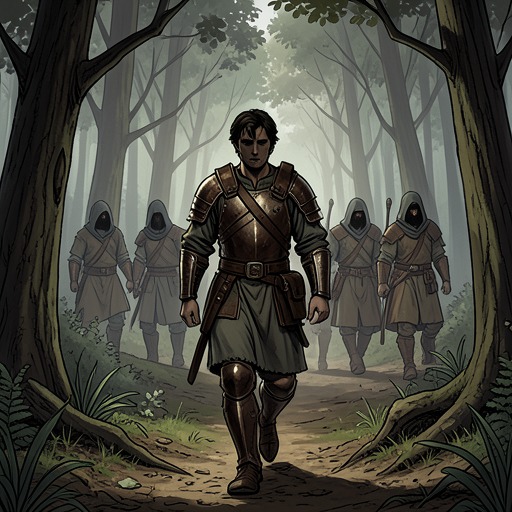
Owain's defeat of the Black Savage
MabinogionOwain son of Urien’s defeat of the Black Oppressor turns a predatory court into a promised place of refuge. The victory is more than a personal triumph: it exposes the murders and dispossession concealed behind the castle’s hospitality, compels its master to change his purpose, and sets a group of bereaved women on the road back to Arthur’s Court with their property restored.
The Court and Its Captives
The episode begins after Owain has fought his way to the Black Oppressor’s court, with the lion accompanying him. In the hall he finds four-and-twenty ladies, distinguished by their noble birth but dressed in garments worth scarcely four-and-twenty pence. Their appearance makes the violence of the place visible: these are daughters of Earls, yet they have been stripped of the wealth and clothing that marked their station.
The ladies explain that they had arrived with husbands whom they loved and were initially welcomed with honour and rejoicing. While they were in a stupor, however, the demon who owned the castle killed their husbands and took their horses, raiment, gold, and silver. The men’s corpses remain in the house, alongside the bodies of many others. The hall’s apparent welcome has thus proved a trap: hospitality precedes incapacitation, murder, and theft.
Their account also gives the encounter stakes beyond Owain’s own safety. The women grieve for their husbands, but they fear that Owain will suffer the same fate. Their warning places their knowledge of the court’s history against the Black Oppressor’s friendly manner when he next appears. The threat is not merely a possibility they imagine; it is the established pattern behind the household’s ruin.
The Challenge and Surrender
After hearing the women’s account, Owain leaves the castle grieving. He meets a knight who greets him cheerfully, as though they were brothers. The contrast between that apparent friendliness and the women’s testimony sharpens the confrontation. Owain makes clear that he has not come seeking the knight’s friendship; the Black Oppressor answers that friendship will not be found. They charge one another and fight furiously.
Owain overcomes him and binds his hands behind his back. Defeated, the Black Oppressor asks that his life be spared. He says that Owain’s arrival and victory had been foretold, identifies himself as a robber, and acknowledges that his house has been a house of spoil. His plea offers not just submission but a different future for the place: if spared, he will become the keeper of a hospice and maintain the house for the weak and the strong for the good of Owain’s soul.
Owain accepts the proposal and stays there that night. The change is expressed as a condition the defeated knight undertakes to fulfil, rather than as an account of the hospice already operating. Even so, the promise reverses the use of the castle as he describes it: a place organized around robbery is pledged to the care of people of differing strengths. Mercy makes that proposed change possible, while the captives’ testimony has made the need for it unmistakable.
Restitution and Return
The following day, Owain takes the four-and-twenty ladies with him to Arthur’s Court, along with their horses, clothing, and whatever goods and jewels they possess. Their return is therefore not simply an escape from the castle. The narrative specifies the recovery of the very categories of property the Black Oppressor had taken, reversing the theft as far as the surviving possessions allow. The husbands cannot be restored: their deaths remain the permanent cost of the court’s violence.
At Arthur’s Court, the ladies are free to choose whether to stay or depart. Some remain; others leave. This detail gives the rescued women distinct outcomes instead of treating them as a single captive group whose story ends upon arrival. Owain’s arrival also renews the joy Arthur feels at seeing him after his earlier loss, now increased by the return of the ladies and their possessions.
Place in Owain’s Story
The defeat belongs to a wider sequence of action in which the lion remains Owain’s companion. Earlier, when two young men pressed him and Luned was in danger of being burned, Owain tried to keep the lion behind a stone-blocked door; the lion broke through the wall, killed the attackers, and helped save her. At the Black Oppressor’s court, the account again presents the lion as accompanying Owain through danger, though it places the decisive combat with Owain himself. This distinction keeps the victory his while retaining the animal as a continuing ally.
The episode closes its immediate chain of rescue by bringing Owain and the ladies back to Arthur’s Court, but it also establishes the Black Oppressor’s promised reform as a consequence of defeat rather than further killing. Owain remains there greatly beloved and heads his household until he later departs with his followers, including the army of three hundred ravens left to him by Kenverchyn. The narrative says he is victorious wherever he goes with them. Against that larger pattern of victories, this encounter is notable for its paired outcome: the robber is spared on condition of service, and the women leave with recovered goods, even as the dead husbands cannot return.