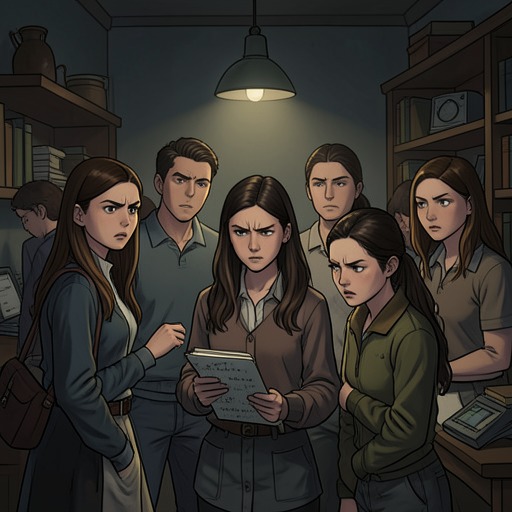
before the story begins
A Zoologist’s Daughter
Katie Hullen grew up in [Africa](entity:location-recall-location-8e502ee2b82b). Her parents are animal researchers who study animals and local residents at field research sites, while also educating her at home. She felt her education was natural and complete, even though she never attended an American school
the first morning of school
Cady’s First Day
Kitty's parents were anxious and prepared lunch for her, rehearsed what she should say when she was scared, and took her photo before she entered the school. Their worries showed that all three felt they weren't ready for this new life. When Kitty crossed the street, a passing school bus startled
the first day at lunch
The Cafeteria’s Territories
At lunch, Kitty saw the cafeteria as a habitat divided into territories by different groups. She tried to approach several tables, but felt more out of place because of a joke with sexual implication, a cold rejection, and an awkward greeting in Swahili to a group of black girls. Finding no place
the second day of school
The Back-Building Ruse
The next morning, Katie sat beside Janice Ian and Damien. They were the first students to warmly welcome her. They said they would take her to the health class in the so-called upper floor of the school, but instead led her outside to the playground, because that building had been burned down many
the second day of school
A Map of the Plastics
Jennifer and Damien pointed out that [Regina George](entity:character-recall-character-regina-george-f71dc6f33140) is the queen bee of the school, and Greta Venus and [Karen Smith](entity:character-recall-character-karen-smith-91c2af6f1309) are her close followers. They said Regina is good at manipulating people, very dangerous, but Katie, watching from the other end of the playground, only saw a group of particularly bright students
the second day of school
Regina’s Lunch Invitation
At lunch, [Jason Mandrino](entity:character-recall-character-jason-mandrino-10a40bc7a00f) harassed Katie with a crude questionnaire, but Regina intervened and sent him away. Then she invited Katie to have lunch with the Plastic Sisters, asking about her background; upon hearing that she had been homeschooled, Regina showed both surprised and fascinated expressions. Regina praised Katie
after the second day’s lunch
Janis’s Spy Assignment
Regina invited Katie for lunch. Jennifer was thrilled and urged her to report everything the plastic sisters said. Katie pointed out that espionage isn't a scientific experiment, but she agreed, partly because Jennifer was her closest friend at school, and partly because Regina's charm was beginning to attract her. This arrangement
the first week of school
The Rules of Belonging
Gretchen explained the rules of the Plastic Sisters: you can't wear certain clothes or hairstyles repeatedly, you can only wear jeans on Fridays, and violating the rules might mean losing your lunch table seat. She presented these rules as a way to show friendship and mutual understanding, making it seem like conformity
the first week of school
A Crush on Aaron
Katie immediately fell in love with Alan Searles in calculus class and actively handed him a pencil; whenever he looked at her, she would forget where she was. She wanted to talk to him after class, but was interrupted by Kevin Garnier. Kevin invited her to join the math competition team
the first weeks of school
The Mall Invitation
Katie watched Alan practice soccer; when he noticed her, she waved at him. Then Regina parked her convertible next to her and invited her to shop with the Plastic Sisters. Although Katie had promised Janis to keep in touch with them to gather information, she found it hard to resist the allure of
the first mall outing
Regina’s Cruel Phone Call
When Regina saw Jason and Taylor Wieder together, she took Grace's phone and posed as a staff member of a family planning clinic, falsely claiming there were urgent test results waiting for Taylor. When Taylor was called away by his mother, several girls laughed; however, Katie was sickened by the cruel
during the first weeks of school
The Burn Book
At Regina's house, Katie witnessed a luxurious world, vastly different from the cramped research trailer where she and her parents had lived. [Mrs. George](entity:character-recall-character-mrs-george-d3abe1ed28eb) welcomed her with a deliberately warm enthusiasm, calling herself "the fashionable mom"; Regina and her friends moved effortlessly and comfortably around the house
after the first visit to Regina’s house
Cady Lies to Janis
Katie told Janis that the burning book did not have her name in it, and it concealed the page that insulted Janis and the entry about [Damian](entity:character-recall-character-damian-bcbc41c43990). Janis became furious when she realized she was excluded, and demanded that Katie steal the burning book so they could expose Regina. Janis
early in the school year
Regina Promises to Help
Regina told Katie that Greta had revealed she liked Allen. Regina did not oppose, but instead offered to talk with Katie and Allen, acting as a supportive friend. When Regina turned the conversation into a three-way call, making Greta face the hurt caused by revealing the secret, Katie exhaled
October 3
October Third
Katie and Allen had a brief conversation in calculus class, and Allen asked her what date it was. Though this moment was trivial, it became a small souvenir that Katie cherished as she grew to like Allen more. Two weeks later, Allen mentioned that it was raining, and Katie realized their conversation had
the weeks before Halloween
The Halloween Invitation
Katie Hullen pretended not to understand the content of the calculus class in order to have Allen Samuel explain it to her. Although she had already understood the material, she kept up the act for a long time, successfully catching his attention. So he invited her to a [Halloween](entity:time-recall-time-halloween-c9b359236295) party at his friend Chris
Halloween night
The Costume Misfire
Katie Hullen arrived at Chris's party in a carefully designed, bloodstained wedding dress, originally intending to pose as "the ex-wife." [Regina George](entity:character-recall-character-regina-george-f71dc6f33140) wore revealing bunny girl-style undergarments, and Greta Venus posed as a cat. Regina George noticed Alan Samuel's intense interest in Katie
Halloween night
Janis’s Old Wound
Katie Hullen ran to the garage of Jennifer Ian and Damien, telling them [Regina George](entity:character-recall-character-regina-george-f71dc6f33140) had regained Allen Samuel. Jennifer Ian comforted her and decided to retaliate, saying Regina George had previously ruined someone else's life. Damien began to tell how Regina George had targeted Jennifer Ian before she interrupted him
after the Halloween party
The Revenge Plan
[Janis Ian](entity:character-recall-character-janis-ian-0c3ae69dc53b), Demian, and Katie Herring devised a plan to take away the resources that support [Regina George](entity:character-recall-character-regina-george-f71dc6f33140)'s power: Allen Samuel, the admired physique, and the loyal followers. Katie Herring would continue to associate with the Plastic Tribe, while Janis Ian and Demian would work from
after Halloween
The Proxy Apology
Gretchen Venus explained that kiss to [Regina George](entity:character-recall-character-regina-george-f71dc6f33140), insisting that Allen Samuel liked Regina George, and that Regina George just wanted to help Katie Herron. She then awkwardly embraced Katie Herron on Regina George's behalf, making Katie Herron realize that Regina George even didn't feel the need to
late fall
The First Sabotage Attempts
Katie Hullen and her friends tried to lure Allen Samuel to the school so he would see [Regina George](entity:character-recall-character-regina-george-f71dc6f33140) and Shawn O'Malley together. They forged swimming practice notices, but Regina George avoided the, and Allen Samuel only saw Shawn O'Malley alone. Another time, they pretended
after the failed projection-room schemes
The Kalteen-Bar Scheme
At katy hernal's home, demian found the kaltent nutrition bars in the kitchen cabinet. katy hernal explained that her mother used to give these nutrition bars to children in africa to help them gain weight. janice yean immediately thought of using this to undermine regina ge
late fall
A Makeover and a New Self
[Regina George](entity:character-recall-character-regina-george-f71dc6f33140) transformed Katie Herring's image, styling her hair, makeup, and clothing into a refined plastic sisterhood style. Katie Herring felt beautiful because she received Regina George's approval, and her classmates took notice of her changes and began to follow suit
after Cady’s makeover
The Affair Comes to Light
Gretchen Venus told Kitty Hearn that [Regina George](entity:character-recall-character-regina-george-f71dc6f33140) was sneaking out with Shane O'Malley in the projection room, while Allen Samuel thought she was studying for an entrance exam. Kitty Hearn and Janice Ian believed that this information was the best chance to get Allen Samuel out of Regina George
December, before the school talent show
The Talent-Show Rehearsals
When school was preparing to welcome [Christmas](entity:time-recall-time-christmas-a573265d0167), Katie Hullen spent more time with her plastic sister group rehearsing the annual "Rockin' Around the Christmas Tree" dance. Jennifer Ian and Damien complained that the plan was making no progress, while Katie Hullen was fully focused on the performance and the social
the week before Christmas
Candy Grams and Doubt
When the school delivered walking sticks, Kitty Hellen received one from [Regina George](entity:character-recall-character-regina-george-f71dc6f33140), while Greta Venus received none. Greta Venus, who has been giving gifts to Regina George for years, feels deeply hurt and now begins to doubt whether Regina George is upset with her. Kitty Hellen secretly encourages G
the Christmas talent show
The Jingle Bell Rock Performance
When [Regina George](entity:character-recall-character-regina-george-f71dc6f33140) took the stage, she ordered Greta Venus and Katie Herron to switch places, disrupting the rehearsed formation. Greta Venus turned in the wrong direction, collided with Regina George, and accidentally knocked the record player off the stage. The player hit Jason Mendoza, putting the performance
the Monday after the talent show
Gretchen’s Confession
After an extremely intense Julius Caesar report, Greta Venus and Katie Hearn broke down in the bathroom. She told about [Regina George](entity:character-recall-character-regina-george-f71dc6f33140) not allowing her to wear hoop earrings, and also revealed that Regina George was having an affair with Shane O'Malley in the projection room, secretly dating Allen Samuel. Katie
after Christmas break
The Second Failed Setup
Katie Hullen and her friends pretended to steal Katie Hullen's wallet in an attempt to lead Allen Samuel to the projection room. Damien wore a ski mask and pretended to be a robber, stole the wallet and ran away, while Allen Samuel chased him through the school
January, several weeks after the Christmas show
Spring Fling Nominations
Daimen used his position on the student activity committee to delete some votes cast for [Regina George](entity:character-recall-character-regina-george-f71dc6f33140) and added his preferred candidates. When the spring ball nominations were announced, Regina George and Greta Venus were nominated along with Janice Ian and Katie Herring
several weeks before Spring Fling
Regina’s Dress No Longer Fits
Regina took her friends to the mall to try on a pink dress she had seen in a store. Even when she put on the largest size available in the store, the dress wouldn't fasten; she was certain her weight scale reading hadn't changed. She blamed the Kaltent energy bars
the day after the dress fitting
Cady’s Falling Grades
[Ms. Norbury](entity:character-recall-character-ms-norbury-bdb99373e131) confronts Cady over a failing calculus quiz, pointing out that the work is correct while the answers have been deliberately made wrong. She warns that Cady does not need to make herself seem less intelligent to attract a boy and explains how pressure has affected her own life.
Cady refuses to admit what she is doing and asks for extra credit instead. The deception is no longer a harmless ruse to spend time with [Aaron](entity:character-recall-character-aaron-3ee24d7d53a3): it is damaging her education and forcing her to lie to an adult who recognizes her ability.
the next school day
Cady Turns Away from Janis
Cady ignores Janis’s calls, invents an excuse to miss her art show, and turns down [Damian](entity:character-recall-character-damian-bcbc41c43990)’s invitation to watch a movie. She even tells them she has planned further sabotage on her own, though no such plan exists.
Her casual dismissal of the friends who first welcomed her marks a clear break in the alliance. Cady now speaks and acts like the Plastics without needing their prompting, and she is increasingly unable to distinguish her cover from her own choices.
the evening after Cady’s failing quiz
Gretchen Learns Regina’s Opinion
Cady tells Regina that Gretchen thinks she is angry about the Spring Fling nomination. Regina says she is not angry but believes Gretchen is unattractive and will suffer when no one votes for her; she also says [Karen](entity:character-recall-character-karen-5edf61fe2c90) should win, except that people regard Karen as a slut.
Cady passes Regina’s cruelty along to Gretchen. Gretchen then tells Karen what Regina has said, setting off a chain of overheard phone calls that makes Karen realize Regina considers her a slut. The girls’ friendships, built on obedience and gossip, begin to fracture from within.
the next Monday at lunch
Regina Is Cast Out
Regina arrives wearing sweatpants on a Monday, and Gretchen and [Karen](entity:character-recall-character-karen-5edf61fe2c90) enforce the clothing rules that Regina once imposed on everyone else. When Regina says the rules are not real, Karen reminds her that she herself was once excluded for wearing a vest.
Regina explains that the sweatpants are all that fit, but neither friend meets her eyes. She leaves the table, insults them, and collides with Emma Gerber, who calls her fat; for the first time, the cafeteria laughs at Regina rather than fearing her. Her reign as queen bee has visibly collapsed.
the afternoon after Regina leaves the lunch table
Cady Inherits the Throne
Janis, [Damian](entity:character-recall-character-damian-bcbc41c43990), and Cady celebrate Regina’s loss of her followers and cross the Plastics’ army off their plan. Janis notices, however, that Cady looks more bloodthirsty than relieved and wonders whether a new queen is replacing the old one.
Gretchen and [Karen](entity:character-recall-character-karen-5edf61fe2c90) begin following Cady after school and ask what she will do with them over the weekend. Cady realizes that she is being treated as the new leader and, instead of rejecting the role, considers enjoying life as the head of the group.
the week after Regina’s fall
The House Party Invitation
Cady persuades her parents to let her stay home while they travel to Madison, using Janis’s art show as a reason. She then invites [Aaron](entity:character-recall-character-aaron-3ee24d7d53a3) to a small gathering and deliberately frames it in the confident, sharp-edged manner she has learned from Regina.
Gretchen and [Karen](entity:character-recall-character-karen-5edf61fe2c90) invite additional guests, turning the supposedly small get-together into a crowded party. Regina hears about it through Shane and arrives unexpectedly, setting the stage for the collision between Cady’s new social power, her lingering feelings for Aaron, and her former allies.
the night of Cady’s party
The Party Spirals Out of Control
[Aaron](entity:character-recall-character-aaron-3ee24d7d53a3) arrives to find Cady’s home packed with guests, alcohol, and disorder. He searches for her, sees Gretchen kissing Jason in a bathroom, and eventually finds Cady in her bedroom, dressed and styled like Regina and unsteady from drinking.
Cady admits she has pretended to be bad at math to get Aaron’s help and describes him as Regina’s property. Aaron recoils at the dishonesty and calls her a clone of Regina. When Regina appears at the doorway, Cady vomits over Aaron, turning the romantic confrontation into a public humiliation.
after midnight, following Cady’s party
The Friendship Breaks
As Cady stumbles outside, Janis and [Damian](entity:character-recall-character-damian-bcbc41c43990) pass in a car and accuse her of excluding them while pretending to remain their friend. Cady argues that she had to act like a Plastic, then blames Janis for recruiting her as part of an eighth-grade revenge scheme.
Janis rejects the excuse, telling Cady she has become exactly what she once claimed to be fighting. She throws Cady a colored-pencil portrait of their earlier friendship, when Cady still looked like herself. Cady recognizes that she has lost both her friends and the person she used to be.
the same night as Cady’s party
Regina Discovers the Scheme
After leaving Cady’s party, Regina eats a Kalteen bar in anger. Shane tells her that the bars are used to help athletes gain weight, and Regina realizes that Cady has lied to her about their purpose.
At home, Regina weighs herself and throws the rigged scale from her balcony. She tears down a photograph with Cady, writes a vicious entry about her in the [Burn Book](entity:object-recall-object-burn-book-27035065799d), and glues her own half of the picture into it. Her response turns private betrayal into the next public attack.
the following Monday
Regina Leaks the Burn Book
Regina brings the [Burn Book](entity:object-recall-object-burn-book-27035065799d) to [Principal Duvall](entity:character-recall-character-principal-duvall-95ae488b2463) and pretends she found it in the girls’ bathroom, presenting herself as distressed by its cruelty. She worries that the book’s few untouched girls might make the others suspect her, so she has already made copies before handing it over.
Once the book is in the school’s hands, Regina scatters those copies through the halls. The insults and secrets provoke confrontations across the student body, exposing private resentments and transforming a clique’s cruel scrapbook into a school-wide crisis.
the same Monday between classes
The Girls Go Wild
Students read the copied pages and turn on one another. Rumors spark fights, [Ms. Norbury](entity:character-recall-character-ms-norbury-bdb99373e131) is knocked down, and [Coach Carr](entity:character-recall-character-coach-carr-4e6fb43bf51a) intervenes in a clash involving Trang and another student before Duvall orders him away. The principal tries to restore order with a baseball bat and finally sets off the fire alarm and sprinklers.
The chaos exposes the violence beneath the school’s social rituals. A student account later describes how years of psychological warfare among girls erupted into open disorder, while one frightened boy calls his mother for help. North Shore’s social hierarchy has stopped functioning as a stable order and become a scene of mutual accusation.
later that Monday
The Gym Workshop
Duvall gathers the junior girls in the gym and threatens to keep them there until they confront their behavior. [Ms. Norbury](entity:character-recall-character-ms-norbury-bdb99373e131) leads exercises in which students acknowledge having been insulted and having spoken about friends behind their backs; the room’s raised hands reveal that nearly everyone has participated in the cycle.
When Norbury asks who has felt personally victimized by Regina, every girl raises her hand, followed by the adults. Cady refuses to own up to writing in the [Burn Book](entity:object-recall-object-burn-book-27035065799d), and Janis uses her turn to make a confession that will expose the revenge plan. The workshop changes from a general exercise into the setting for a public reckoning.
during the gym workshop
Janis Confesses the Revenge Plan
Janis tells the gathered students that she recruited Cady to infiltrate Regina’s circle, fed Regina weight-gain bars, helped turn Gretchen and [Karen](entity:character-recall-character-karen-5edf61fe2c90) against her, and used Cady to bring about [Aaron](entity:character-recall-character-aaron-3ee24d7d53a3)’s breakup with Regina. She also admits that she and Cady replaced Regina’s face cream with foot moisturizer.
Janis’s confession reveals the operation in full, including Cady’s role in telling Aaron about the affair and kissing him. Regina realizes that the campaign against her was not a series of accidents but a deliberate plan, and she storms from the gym in fury. The truth frees Janis from secrecy but leaves Cady publicly implicated.
immediately after the gym workshop
Regina’s Bus Accident
Cady follows Regina outside and tries to say that she never meant for the situation to go so far. Regina rejects the apology and tells Cady that students consider her a homeschooled jungle freak and a less attractive version of Regina.
As Regina turns away, a school bus hits her. The accident leaves her gravely injured, and rumors quickly grow around what happened, including a false claim that Cady pushed her. The collision abruptly ends the confrontation but gives Cady no escape from the consequences of her choices.
the day after Regina’s accident
Cady Admits the Drug Allegation
Cady’s parents question her about the [Burn Book](entity:object-recall-object-burn-book-27035065799d) and the chaos at school. She insists that she did not push Regina, but her mother finds African vases hidden under the sink, and Cady cannot explain why she hid them. Her father suggests returning to homeschooling, but Cady says that going back would be worse than facing school.
In calculus, Duvall and a police officer investigate the Burn Book’s claim that [Ms. Norbury](entity:character-recall-character-ms-norbury-bdb99373e131) sells drugs. [Aaron](entity:character-recall-character-aaron-3ee24d7d53a3) defends the teacher, and Cady hears that students who make such allegations are being taken seriously. She admits she wrote the accusation, accepting responsibility for the harm she caused.
after admitting the accusation
Cady Tries to Make Amends
Cady visits Regina with white azaleas while Regina recovers in a spinal halo. Regina is still guarded, but their exchange is softened by the painkillers and by [Mrs. George](entity:character-recall-character-mrs-george-d3abe1ed28eb)’s comic disclosure that doctors have prescribed [Kalteen bars](entity:object-recall-object-kalteen-bars-94f0e9791bfe) to help Regina regain weight.
Cady then apologizes to [Ms. Norbury](entity:character-recall-character-ms-norbury-bdb99373e131) for the false drug allegation. Norbury describes the consequences of the accusation, including a police search of her home, but asks how much trouble Cady received and accepts that she has begun trying to change. Cady admits she has not identified the other writers because she is attempting to stop talking about people behind their backs.
the weeks before Spring Fling
Cady Returns to Mathematics
Cady returns to calculus and earns a strong score on a pop quiz. [Ms. Norbury](entity:character-recall-character-ms-norbury-bdb99373e131)’s response is dry but no longer hostile, and [Aaron](entity:character-recall-character-aaron-3ee24d7d53a3) calls her a nerd in welcome. The exchange suggests that Cady is beginning to recover her earlier academic identity and some trust at school.
Norbury tells Cady that her extra credit will involve the [Mathletes](entity:organization-recall-organization-mathletes-ad401bc31865), and Kevin draws her back into the team. Cady agrees, finding that academic achievement can provide belonging without requiring her to imitate the Plastics.
the night of Spring Fling
The State Math Championship
Cady travels with Kevin and the [Mathletes](entity:organization-recall-organization-mathletes-ad401bc31865) to the [University of Chicago](entity:location-recall-location-b83456bb2d8f) for the state championship. She begins rusty and struggles as the questions continue, but the teams reach a tie and choose her for the sudden-death round.
Cady refuses to demean her opponent and focuses on the problem. When Caroline Krafft gives a wrong answer, Cady remembers that the limit does not exist and wins the championship for North Shore. Her success restores confidence in her intelligence and gives her a place among her peers on her own terms.
the night of the Mathletes championship
Cady Goes to Spring Fling
After the victory, Kevin gives the [Mathletes](entity:organization-recall-organization-mathletes-ad401bc31865) their jackets and urges Cady to attend Spring Fling. [Ms. Norbury](entity:character-recall-character-ms-norbury-bdb99373e131) reminds her that she does not have to keep punishing herself, and Cady accepts that she is already out despite being grounded.
At the dance, [Damian](entity:character-recall-character-damian-bcbc41c43990) watches the nominees assemble and notices Cady arriving with the Mathletes. Her return is unexpected: she has not come dressed as a Plastic but in the uniform of the team whose invitation she once treated as social suicide.
later that night at Spring Fling
Cady Shares the Crown
Duvall announces Shane as Spring Fling King and Cady as Queen. Cady is startled, and her parents find her in the crowd, but she steps forward to accept the title. She tells the students that some dislike her while others support her for the wrong reasons, then apologizes to those hurt by the [Burn Book](entity:object-recall-object-burn-book-27035065799d).
Cady breaks the plastic crown and gives pieces to Gretchen, Janis, Regina, and the rest of the room. The gesture rejects the idea that status belongs to one chosen girl. Janis accepts her piece, and the two begin to reconcile; [Aaron](entity:character-recall-character-aaron-3ee24d7d53a3) approaches Cady, and they dance and kiss.
one year later
The Plastics Break Up
A year later, the Plastics have dissolved. Regina channels her anger into lacrosse, [Karen](entity:character-recall-character-karen-5edf61fe2c90) presents the weather on school announcements, and Gretchen joins the Cool Asians. Janis is serious about Kevin, while [Damian](entity:character-recall-character-damian-bcbc41c43990) accepts their relationship, and [Aaron](entity:character-recall-character-aaron-3ee24d7d53a3) attends Northwestern but still sees Cady on weekends.
Cady describes her path from homeschooled newcomer to Plastic, school pariah, and finally an ordinary person who can look at herself without shame. The school’s social order has softened, though she jokes that they know what to do if younger Plastics try to restore the old hierarchy. Her final animal metaphor suggests that the habitat has found a fragile peace rather than a permanent end to competition.