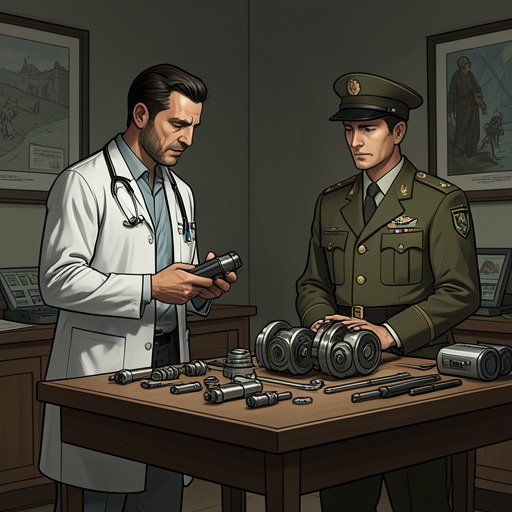
Illyan’s eidetic memory chip
MemoryIllyan’s eidetic memory chip was an experimental implant intended to turn Illyan into a living recording device for Emperor Ezar. It gave him near-instant access to decades of remembered experience, but also became a source of danger and, eventually, catastrophic failure. The chip’s history reveals the gap between its political purpose, its public aura of infallibility, and the ordinary human memory it was supposed to augment.
Origin and Design
When Illyan was in his late twenties and serving as an ImpSec lieutenant, Emperor Ezar sent him to distant Illyrica to have the experimental chip installed. Ezar wanted a recording device answerable to him alone. The decision placed a young officer at substantial medical risk: the technology did not become a commercial development because 90 percent of its wearers subsequently developed iatrogenic schizophrenia. Ezar accepted that risk in pursuit of the possible benefit, treating Illyan as expendable in the same way that he had spent thousands of soldiers in pursuit of his policies.
The chip did not replace Illyan’s original cerebral memory. Its neurological input was split from the sensory nerves rather than diverted away from the brain, leaving subjects with two memories of their experiences. The medical team identifies this duplication as a major contributor to the high rate of schizophrenia among chip wearers, though the account locates the design flaw in the interaction between the device and the human brain, not simply in the chip itself. The implant’s remarkable recall therefore came with a fundamental cost: it added a parallel record instead of substituting a clean technological archive for ordinary memory.
The device was a complex sandwich of organic and inorganic molecular layers, approximately five by seven centimeters across and half a centimeter thick, positioned vertically between the two lobes of Illyan’s brain. Its numerous neural connections made a jump-pilot’s control headset seem simple by comparison. The information-retrieval network was more complex than the protein-based data storage; both systems were highly elaborate and largely unmapped. Rather than following a fully predetermined structure, the autolearning system had assembled itself in a nonlinear fashion after installation.
Its construction also made ordinary data extraction impossible. The chip had no single data port: thousands of neural leads ran across its surface. Miles Vorkosigan connects that feature to the implant’s original purpose as Emperor Ezar’s secure personal data dump. Its resistance to downloading was not a convenience but part of a system built to preserve information under strict control.
Recall and Reputation
For Illyan, the implant meant that decades-old experiences could be recalled with the sharpness of recent ones. Miles imagines the burden of having thirty-five years of memories available without the softening effect of forgetfulness: Illyan could retrieve past mistakes in exact detail, including other people’s words and gestures. That capacity made people careful around him. His memory could turn a casual remark into a record that might later be reproduced precisely.
The implant also helped produce Illyan’s reputation for omniscience. Miles argues that the aura was useful to ImpSec, but not a measure of genius: the chip made Illyan’s recall extraordinary, while Illyan himself remained responsible for interpreting and using what it supplied. Miles had already warned Elli Quinn not to be overawed by the ImpSec insignia or by the legend that the organization always knew what it was doing. His view of the chip is consistent: it could make Illyan seem infallible without making either the man or the institution so.
When Illyan challenged Miles over a falsified report, he made the trust at stake explicit. He told Miles that he would have mistrusted the memory chip before he mistrusted him. The chip was therefore more than an information store in their relationship: its long, accurate record had become a point of comparison for personal trust. The breach mattered because Miles had contradicted a record Illyan trusted, and because Illyan had trusted Miles even more.
Breakdown and Removal
After Illyan’s biocybernetic breakdown, Dr. Ruibal found no evidence of organic neurological damage and judged the dangerously high physiological and psychological stress to be an effect rather than the cause of the breakdown. Admiral Avakli offered two leading explanations for the chip’s failure: senescence, or old age, triggering self-destruction, and some form of chemical or biological attack. He could not establish the second possibility without taking the chip apart. The available evidence therefore leaves the precise cause unresolved.
Repairing and reinstalling the device was not considered a realistic option. During the medical review, Miles also questioned whether preserving the chip was necessary for the Imperium. He separated its contents into obsolete material, current information already backed up elsewhere, personal data, and a small number of potentially sensitive secrets. Much of the record consisted of ordinary daily life, including meals, changing clothes, and paperwork, along with novels and holovid dramas. The potentially valuable secrets were only a tiny fraction of the whole. His point was not that every recorded item was worthless, but that the chip’s immense archive should not be mistaken for the operating foundation of ImpSec.
The removal took place at ImpSec headquarters, with Miles present as Gregor’s appointed observer. The surgeon disconnected the chip’s blood supply and neural connectors, then lifted it from its position and placed it in a dish of solution for Avakli to take to the laboratory. Miles remained behind rather than following the device. When Illyan regained awareness, Miles explained that the eidetic memory chip had broken down irreparably and had been removed.
Life Without the Chip
Following the operation, Illyan was physically well but fatigued, and his motor reflexes were normal. His short-term memory, however, was severely below his former extraordinary level. Ruibal could not yet say whether Illyan’s brain would retrain itself, whether the impairment would be permanent, or whether medical intervention would be needed. He recommended a few weeks of rest, varied activity, and continued observation rather than claiming a quick remedy.
Miles tested Illyan’s functioning through a game of Star-tarot One-up, which required players to track cards already played, cards held by opponents, and likely future plays. After six rounds, Miles and Alys had split the points between them, and Illyan pleaded fatigue. His apparent ability to follow casual conversation did not carry over to the game: his short-term memory and eye for detail were greatly reduced. The contrast made the loss legible through an everyday activity rather than through a technical description alone.
Later, Alys gave Illyan a holocube map covering the continents, populated islands, cities, streets, and mountain ranges at one-meter scale. After walking around town by himself, he showed Miles the map and explained that it could help him find his way back if he became lost. Alys also gave him a business audionote filer that automatically cross-referenced information by keyword. Illyan valued it as a crude but adequate kind of prosthetic memory, and considered attaching it to his belt or wearing it around his neck so he would not misplace it.
These hand-held aids do not reproduce the implant’s vast archive or instantaneous recall. They offer something more ordinary and manageable: external information that Illyan can consult and organize for himself. The chip’s removal thus shifts memory from a hidden, integrated device toward tools that can be carried, checked, and used in daily life. Its central significance lies in that reversal: the implant once made memory seem like an infallible machine, while its failure revealed both the human cost of that ideal and the practical value of supports that do not promise to remember everything.