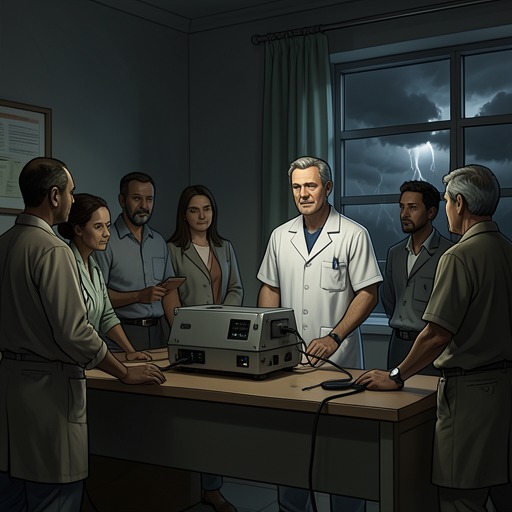
Miles's Seizure-Control Device
MemoryMiles's Seizure-Control Device is an experimental treatment built around a striking paradox: it deliberately triggers a seizure in order to make seizures safer and more manageable. Developed for Miles Vorkosigan after his uncontrolled episodes, it combines a small internal component with an external activator. Its successful test reduces the duration of convulsive symptoms and suppresses bodily movement, while leaving Miles responsible for regular monitoring and carefully timed use.
Design and Medical Purpose
Dr. Chenko, working through the veterans clinic at the Imperial Military Hospital, tells Miles that the microengineering challenges have taken longer to solve than expected. The proposed device is small enough to be inserted beneath Miles's skull and is intended, Chenko hopes, to trigger seizures safely. If it works, the team can complete its final calibrations and schedule surgery. The device is therefore not presented as a cure that eliminates seizure activity. Its purpose is to make an induced episode controlled enough to serve as a treatment for the more dangerous, uncontrolled episodes Miles has experienced.
That distinction shapes the device's use and its risks. It intervenes directly in the same neurological process that has already made Miles's health unpredictable, while offering a way to provoke that process under medical supervision. The system also has separable internal and external elements: Chenko later installs the internal portion, then gives Miles an activation unit to use during the test. The device is consequently both an implanted medical technology and a procedure Miles must learn to operate.
Delay and Distrust
The experimental device becomes available while Miles is occupied with the investigation into the sabotage of Simon Illyan's memory chip. He expects Lucas Haroche to receive a systems team's report at any time, after which events may accelerate. He also suspects that an ImpSec-trained man in Vorbarr Sultana has deliberately targeted him. In that context, Miles hesitates to agree to surgery on the proposed timetable.
His concern is specifically tied to uncertainty about the device and the investigation: he wonders whether the experimental apparatus uses protein circuits and what became of the missing capsule. He is chilled by the prospect of people he does not know well installing something he does not understand into his brain. When Dr. Chenko asks whether he can come in the next day, Miles puts off scheduling rather than accepting immediately. The delay does not establish that the device is unsafe; it shows how the surrounding security crisis makes unfamiliar medical intervention harder for him to trust.
The same investigation reaches into Miles's medical privacy. Lucas Haroche has requisitioned a copy of his neurologist's reports on the seizure disorder and says the treatment plan sounds promising. Miles recognizes the intrusion as part of a broader pattern of ImpSec access to his private information. The episode links the proposed device not only to his physical condition but also to the struggle over who can obtain and use knowledge about that condition.
Implantation and Test
By the afternoon of the operation, Miles tells a companion that Dr. Chenko is ready to install the controlled-seizure chip and that he has been told not to eat beforehand. The surgery to install the internal portion proves shorter and less frightening than he expected. Chenko, now accustomed to Miles's somewhat paranoid view of the world, lets him remain awake and watch the procedure on a monitor positioned above his head-clamp. He is allowed to go home the following morning.
Two afternoons later, Miles returns to Dr. Chenko's neurology laboratory at the Imperial Military Hospital for a smoke-test. Chenko advises against using the device alone as a routine practice and recommends that someone be present to watch him, particularly at first. Miles nevertheless chooses to perform the test himself. Chenko hands him a new mouth guard and the activation unit, which fits neatly in the palm of his hand. Miles lies back on the examination table, checks the settings one last time, presses the activator to his right temple, and turns it on. The narration registers the immediate sequence as colored confetti, then darkness: a brief sensory account rather than a technical description of the seizure itself.
The results give the experimental device a concrete measure of success. Chenko reports that the convulsive symptoms on this run lasted barely half as long as Miles's uncontrolled seizures, and that his body movements were suppressed. The hangoverlike effects Miles reports are also expected to be reduced, although Chenko asks him to observe them over the next day-cycle and report his subjective experience. The test thus yields both clinical observations and a continuing need to assess how the intervention feels to Miles outside the laboratory.
Routine, Limits, and Significance
Chenko's instructions make clear that successful implantation does not end medical supervision. He tells Miles to make use of the device part of his daily routine, like brushing his teeth. At the same time each evening, before bed, Miles is to check his neurotransmitter levels on the activation unit's monitor-readout panel. If the reading exceeds one-half, he should discharge it, but he must do so before it exceeds three-quarters. The procedure depends on repeated measurement and a narrow operating threshold, rather than on a single surgical correction.
The device also has limits. Miles asks whether damage to the internal unit would itself be dangerous. Chenko replies that trauma severe enough to damage it would leave Miles with more pressing concerns, underscoring that the implant is not invulnerable but putting its vulnerability in the context of a much greater injury. After the smoke-test, Chenko says Miles can fly the next day, not immediately. Even with a promising result, physical activity and the return to ordinary life remain subject to medical judgment.
As a plot object, the device concentrates the tension between control and bodily uncertainty. Its promise is practical rather than absolute: the test shortens convulsions and suppresses movement, but it does not remove the need to monitor Miles's condition, have a spotter nearby at first, or reckon with the effects of treatment. The small activator in his hand makes him an active participant in managing his seizures, while the implanted component and precise thresholds keep that agency bounded by a medical system he must learn to trust.