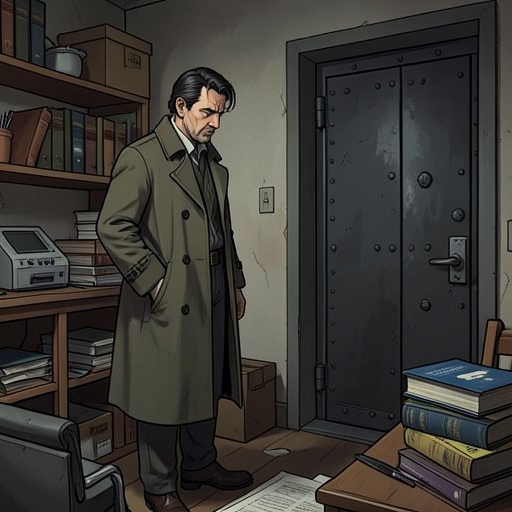
Lydgate’s public disgrace and ostracism
MiddlemarchLydgate’s public disgrace and ostracism begin when Middlemarch reads his £1,000 loan from Bulstrode as a bribe connected to Raffles’s death. The suspicion fuses two uncertain matters—the circumstances of a patient’s treatment and the motive for a loan—into a settled public judgment about Lydgate’s character. His reputation suffers not because the evidence establishes that he committed a crime, but because the town treats his association with Bulstrode as proof enough to exclude him.
Background: Medical ambition and financial dependence
Lydgate arrives in Middlemarch with a reforming purpose. He hopes that the nearly completed fever hospital, alongside the old infirmary, might become the nucleus of a medical school in the provinces. His ambition is scientific as well as institutional: he wants to enlarge the rational basis of medical practice, at a time when the study of bodily tissues had opened new questions about disease and treatment.
He also attempts to put professional reform into practice. Rather than dispense medicines or take a percentage from druggists, he resolves to prescribe without dispensing, a choice likely to offend fellow practitioners in a country town. He sees removing systematic temptations as a way to protect his own honesty. Yet the money pressure that later leads him to borrow from Bulstrode leaves his independence vulnerable precisely where his professional principles matter most.
That vulnerability is set against his difficult position in Middlemarch’s medical community. His treatment of Fred Vincy presents him with a serious case of typhoid and prompts him to insist on bed rest, a regular nurse, and precautions, despite the awkwardness of intervening after Mr. Wrench’s attendance. In another case, he corrects Dr. Minchin’s diagnosis of Nancy Nash: what Minchin called a tumor, Lydgate identifies as cramp, treats, and continues to attend at her home until she recovers. The case brings Lydgate praise, but the story it generates exaggerates the supposed tumor and the doctor’s miraculous cure. Minchin and Wrench, meanwhile, regard Lydgate’s handling of the diagnosis as a breach of professional etiquette. His practice is therefore already caught between clinical judgment, medical custom, and the town’s appetite for simplified accounts.
The loan and the public suspicion
After the meeting at which Bulstrode is told to leave, Lydgate helps him rise and leads him out when the trembling banker appears unable to walk without support. Lydgate’s action is an immediate response to another person’s need, but it also makes his association with Bulstrode visible at the very moment that association has become compromising. Lydgate now understands that the town believes the thousand-pound loan was a bribe and supposes that Bulstrode’s treatment of Raffles was somehow tampered with from an evil motive.
The connection between loan and alleged wrongdoing is persuasive to the public even though Lydgate does not know what happened to his orders. He later learns that the housekeeper at Stone Court said she had given Raffles the opium in the phial Lydgate left, along with brandy. That account does not establish that Bulstrode committed a crime or that Lydgate colluded in one. Lydgate cannot explain how his instructions came to be disobeyed, and allows that Bulstrode might have been innocent of criminal intent and uninvolved in the disobedience. But the town knows that Lydgate accepted money from a man believed to have had a strong motive for Raffles’s death. In public opinion, the loan supplies the missing link.
Lydgate can see how Bulstrode’s conduct has shaped the scandal. He suspects that Bulstrode, afraid of revelations from Raffles, abruptly became generous in order to bind him through obligation; he also fears Bulstrode may have interfered with the patient’s treatment. These remain suspicions, not established facts. Lydgate recognizes that a merely possible alternative may be true: Bulstrode may have kept his hands clean in his last dealings with Raffles. The uncertainty does not protect either man from the public story, which turns motive and association into an undefined accusation of crime.
Ostracism and the limits of self-vindication
The disgrace reaches Lydgate through ordinary signs before he can fully understand them. While paying off his debts and beginning to recover financially, he notices townsmen avoiding him or looking at him strangely. Two patients call in another practitioner. What had puzzled him becomes legible as a general campaign of social rejection: the town is already treating him as tainted.
He sees why a public defense may fail. To tell everything he knows would require explaining that he had first approached Bulstrode for money without knowing of Raffles, and that he accepted the loan innocently. Yet that account would also draw attention to Bulstrode and might deepen suspicion rather than clear Lydgate. His own denial would be set against circumstances that people already interpret as incriminating. Even valid evidence, he fears, would make little difference once the town had decided that his reputation was damaged.
The public judgment also presses on his professional conscience. Lydgate had believed that a doctor’s duty was to do what he thought best for the life entrusted to him, and that scientific practice must remain alert to error. But he recognizes that his medical judgment has become entangled with money, obligation, and personal interest. The loan may not prove that he violated a recognized duty, yet it has compromised the independence from which he once condemned the confusion of medical uncertainty with moral doubt. His disgrace is therefore not only an injustice imposed from outside; it also forces him to confront a vulnerability in his own conduct.
Resistance, compassion, and narrative significance
Despite the social pressure, Lydgate resolves not to leave Middlemarch as though he were retreating before a just condemnation. He would rather remain and face the hostility than appear to accept calumny. He also refuses to abandon Bulstrode merely to improve his own chances of acquittal. He would have returned the money, even at the cost of beggary, had it remained in his hands, but he will not turn away from a fellow mortal whose aid he used or try to clear himself by publicly denouncing him. His conduct preserves a distinction between accepting an obligation and endorsing every suspicion attached to the person who created it.
That resolve does not spare him the strain of anticipating Rosamond’s response. The trouble will soon affect their shared life, but Lydgate would rather wait for events to disclose it than tell her at once. His determination to endure public suspicion therefore coexists with reluctance to face its domestic consequences.
When he later tells Dorothea the whole story, he describes both the limits of what he knows and the troubling possibility that accepting Bulstrode’s money affected his private inclination and professional behavior, even if it did not alter a publicly recognized obligation. Dorothea understands why self-vindication is difficult and remembers his earlier hope of finding better ways through the hospital. Her sympathy gives him room to articulate the grief of an ambition defeated by obstacles that others cannot see. The episode places Lydgate between a genuine scientific vocation, an unresolved question about professional independence, and a community that prefers an intelligible scandal to an uncertain account. His ostracism shows how reputational judgment can convert financial dependence into presumed guilt, while leaving the underlying facts morally and practically unsettled.