Whalebone whales
Moby-DickWhalebone whales are whales possessing baleen rather than relying on teeth, but their apparently convenient definition does not produce a stable natural category. The narrative uses them to show both the practical value and the intellectual inadequacy of whale classification: baleen identifies a visible feature, yet it cannot by itself reveal the whole animal, its relationships, or its place within the immense and irregular diversity of the Leviathan.
Definition and Visible Features
Whalebone whales are described as whales with baleen, and the Finback whale is sometimes included among them because it possesses that material in its mouth. The category also gathers together a loose assortment of fishermen’s names, including broad-nosed whales, beaked whales, pike-headed whales, bunched whales, under-jawed whales, and rostrated whales. This vocabulary records attempts to make the ocean’s creatures legible, but it also preserves how provisional that knowledge remains.
The feeding mechanism associated with Whalebone whales is illustrated by the Right whale. In the waters near the Crozetts, the Pequod encounters immense meadows of brit, a minute yellow substance on which the Right whale largely feeds. The whales move through this floating nourishment with their mouths open; the brit adheres to the fringing baleen inside the mouth while the water escapes at the lips. Baleen therefore functions as a filtering apparatus, separating food from seawater, and makes the whale part of a larger ecological chain rather than merely a target of pursuit.
The Failure of Feature-Based Classification
The central problem with Whalebone whales is that baleen, like a hump, back-fin, or teeth, is only a detached bodily distinction. Such features appear in irregular combinations across different kinds of whales. The Sperm whale and the Humpback whale both have a hump, but the resemblance ends there; the Humpback whale and the Greenland whale both have baleen, yet that shared feature likewise fails to establish a complete likeness. The same instability recurs with fins, teeth, and other conspicuous parts.
The failure is not repaired by turning inward to anatomy. Internal structures offer even fewer dependable distinctions than the external features that initially seem most promising. The proposed solution is therefore a bibliographical system: instead of pretending that one isolated trait can organize the entire Leviathan, the classification takes whales bodily, in their entire volume, and sorts them through accumulated descriptions and records. Whalebone whales thus stand at the point where natural history becomes an inquiry into the conditions of knowledge. The category is useful for reference, but it cannot claim to disclose an essential order in nature.
Ecology, Association, and Human Predation
The narrative places Whalebone whales within a sea of relations. Their baleen links them to brit and to the filtering practices of the Right whale, while the wider marine environment is represented as beautiful, dangerous, and governed by universal predation. The sea’s creatures glide beneath attractive surfaces, prey upon one another, and participate in an apparently endless war. Whalebone whales are consequently not isolated specimens but participants in a living system whose processes exceed human control.
Their social and reproductive lives also resist reduction to human categories. Elsewhere, whales at the center of a great Sperm whale herd are shown engaging peacefully in courtship and other private concerns even while boats attack the outer circles. The scene contrasts human violence with animal continuity: amid the surrounding fear, the whales retain forms of association, desire, and calm that do not depend on the hunters’ purposes. Although the passage concerns Sperm whales rather than defining Whalebone whales specifically, it broadens the narrative’s insistence that whales possess activities and relations irreducible to their commercial value.
Distribution, Hunting, and Polar Refuge
Whalebone whales are presented as animals pressured by extensive pursuit but not necessarily confined to the grounds where humans expect to find them. When they disappear from familiar coasts, the explanation offered is often displacement rather than extinction: hunted from one promontory or cape, they may have startled some remoter shore with their unfamiliar spouts. Their absence from a former feeding ground therefore cannot automatically serve as proof that the species is declining.
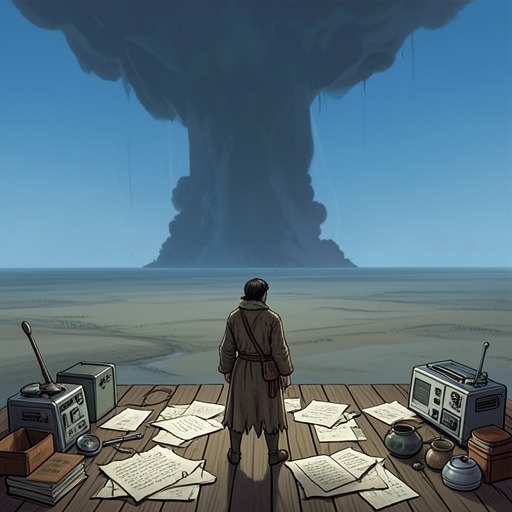
Their strongest protection lies in two remote fortresses: the polar regions. Like the frosty Swiss retreating into mountains, Whalebone whales driven from the middle seas can withdraw beneath the ultimate barriers of ice, rising among fields and floes. In that everlasting winter they form a zone where human pursuit is, at least for the present, defeated. The image acknowledges both the whale’s capacity to evade the hunter and the scale of the oceanic spaces that remain beyond ordinary access.
Yet this refuge does not erase the violence of industrial hunting. The narrative notes that roughly fifty Whalebone whales may be harpooned for every one cachalot, and that Americans alone have killed not fewer than 13,000 of these whales annually on the northwest coast. These figures place the animals within a system of organized extraction whose reach extends across oceans. At the same time, the text argues that the whale’s enormous habitat and the population density of other heavily hunted large animals complicate simple conclusions about imminent disappearance. The tension is crucial: confidence in the whale’s expansiveness coexists with unmistakable evidence of sustained slaughter.
Global Commerce and Narrative Significance
Whalebone whales belong to the same global maritime economy that makes whaling a major commercial and geopolitical force. The whale fishery is credited with powering lamps and candles around the world, while whaling fleets are described as a vast American enterprise involving more than seven hundred vessels, eighteen thousand men, millions of dollars in annual consumption, and millions more in imported value. The whale’s body becomes fuel, commodity, navigation knowledge, and imperial infrastructure.
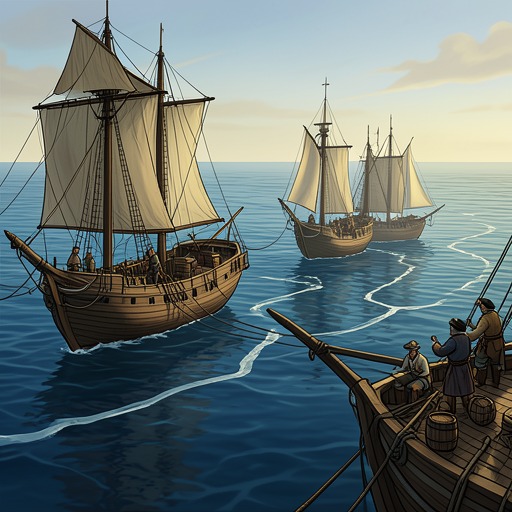
That infrastructure reaches beyond the immediate trade in whale products. Whaling vessels are credited with exploring uncharted seas, opening routes into harbors previously treated as inaccessible, assisting commerce and missionary work among the islands of Polynesia, and helping establish contact with Australia and the Pacific coast of South America. The same maritime activity that is praised as heroic and civilizing depends on the capture and dismemberment of living animals. Whalebone whales therefore occupy an uneasy position in the book’s world system: they are agents within oceanic ecology, objects of scientific classification, and material foundations for human expansion.
Their importance is finally methodological as much as biological. The category shows how quickly a visible trait becomes a supposed species boundary, how fishermen’s practical language competes with learned systems, and how incomplete knowledge can be mistaken for mastery. Whalebone whales remain legible enough to support commerce and description, yet too various to submit to a simple universal scheme. Their baleen filters food from water; the narrative’s classification filters experience into names, but never succeeds in exhausting the animals those names attempt to contain.