Momo and the City's Children
MomoMomo and the city’s children share a bond sustained less by physical proximity than by play, stories, and a mutual sense of belonging. When Momo disappears, the children continue to meet at the Ancient Amphitheater and to treat her as the absent center of their circle. The Child Depots later break up that community and diminish the children’s capacity for imaginative play, but their reunion with Momo at the story’s end shows that the connection has endured.
A Community Kept Alive in Momo’s Absence
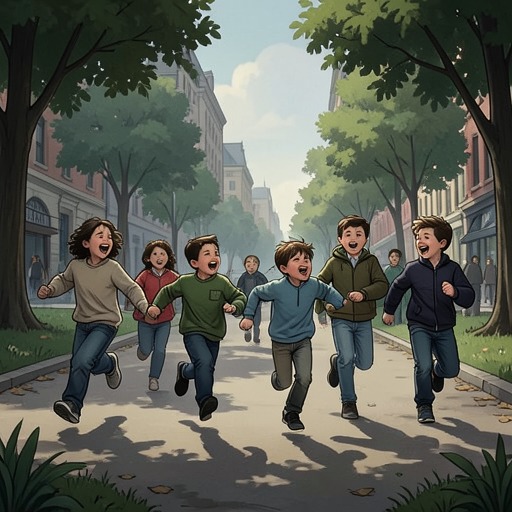
Even after Momo vanishes, her friends meet at the Ancient Amphitheater whenever they can. Their games make a few old crates and boxes into castles, palaces, and galleons sailing on fabulous voyages; they also continue to tell one another stories. These are not merely activities that happen to continue after Momo leaves. The children behave as if she were still among them, and their shared play nearly makes that imagined presence real. Their attachment is expressed through what they keep doing together.
The children do not discuss whether Momo will return, yet they never doubt that she will. That certainty requires no formal promise or repeated reassurance: it is an unspoken understanding among them. Momo remains the focus of their activities whether she is physically present or not. Her place in the group is therefore both personal and communal: she is a particular friend they miss, and also the point around which their friendships, games, and stories cohere.
Separation by the Child Depots
The gray men cannot detach the children from Momo by taking direct control of them, so they use the adults and authorities of the city to bring about their separation. The resulting Child Depots require children whose parents are too busy to care for them to be deposited in large buildings and collected when convenient. Playing in streets, parks, or other public places is forbidden; children found doing so are taken to a depot, and their parents are fined. The rules reach all of Momo’s friends, who are divided according to their districts and sent to different depots.
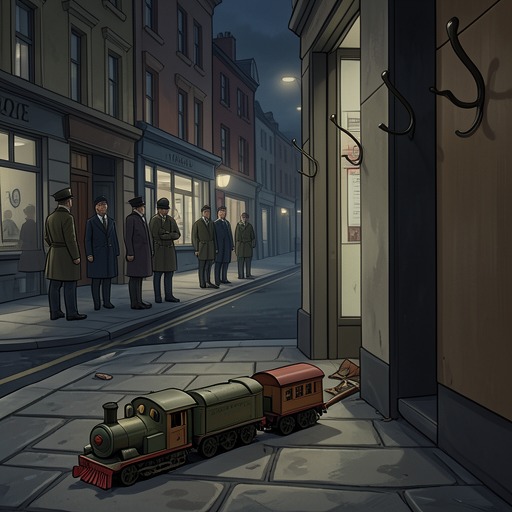
Inside, supervisors choose the games and insist that they serve a useful, educational purpose. The change reaches beyond where the children spend their time: they learn the approved games while losing the capacity to find happiness in small things, take pleasure in play, and dream. After weeks under the new arrangement, they appear like miniature timesavers, sullen and resentful, and can no longer occupy themselves even when left alone. Their noise remains, but it is angry rather than the joyful uproar of their earlier gatherings. The silent, deserted Ancient Amphitheater makes the loss visible: the place where the children had kept Momo present has been emptied along with their freedom to invent and play.
Momo’s Encounter with Her Former Friends
While wandering through the city, Momo encounters Paolo, Franco, and Maria, who used to carry her little sister Rosa. Their gray uniforms and stiff, lifeless expressions make them so changed that Momo can hardly recognize them. She greets them delightedly and asks them to return to the Ancient Amphitheater to play. They refuse, explaining that they are no longer allowed to fritter their time away. Momo answers that they never had; Maria concedes that the old games were nice, but says that this is no longer the point. Their exchange exposes the distance between Momo’s understanding of play as valuable in itself and the depot’s demand that children justify their time through usefulness.
Franco recalls that they enjoyed making up games, while their supervisors said those games taught nothing useful. He says he tried to run away at the beginning, but was always caught again. Maria counters that at least the children are taken care of now, a defense that sits uneasily beside the trio’s gloomy silence. Momo asks whether they could take her in because she is lonely. Before they can answer, the children are swept through the building’s gate and it clangs shut behind them. Momo starts toward the gate, hoping to join them in whatever game they are playing, but stops in terror when a man in gray appears between her and the entrance. The interrupted meeting makes the coercion concrete: her longing for the children cannot overcome the barrier enclosing them.
Reunion and the Return of the Circle
After time resumes, Momo and Beppo Roadsweeper reach the Ancient Amphitheater, where her friends are waiting. The children gathered there include Guido, Paolo, Massimo, Franco, Maria, and Rosa, along with Claudio and many others. Nino, Liliana, their baby, Salvatore, and Momo’s former regular visitors are also present. The children who once met there in her absence now greet her in person, as part of a wider reunion of the community that the Child Depots had scattered.
The celebration continues until the stars appear, with cheers, embraces, handshakes, and excited conversation. When everyone settles on the grass-grown steps, Momo enters the middle of the arena and sings, remembering the music of the stars and the hour-lilies. Her return does not simply restore an individual friendship: it brings the children back into a shared gathering in the place where their imaginative life had first persisted without her. The contrast between the once-silent Ancient Amphitheater and the final celebration gives their bond its shape—from presence sustained in absence, through enforced separation, to a reunion made visible in collective play and welcome.