long before Momo's arrival
The Ancient Amphitheater
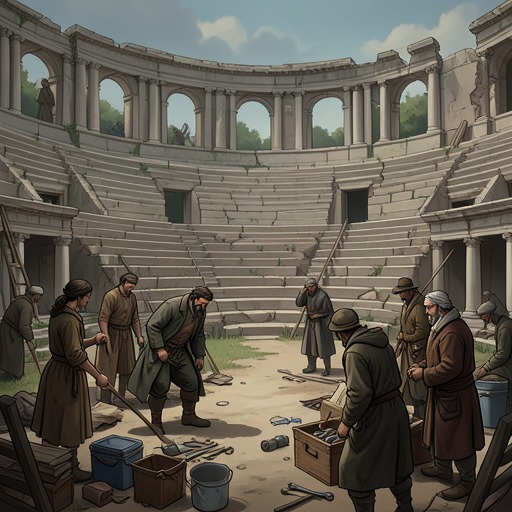
The story opens among the ancient cities of the world, where amphitheaters once gathered people to watch invented events made vivid onstage. Centuries pass; the cities crumble, and crickets take up residence in their ruins.
On the outskirts of [The Unnamed City](entity:location-recall-location-26ad35f24128), one small amphitheater survives amid modern streets and shabby houses. It is nearly forgotten, used by neighbourhood children and sweethearts, until a homeless girl settles there.
before the neighbourhood befriends her
Momo Makes a Home
[Momo](entity:character-recall-character-momo-d421f1d5958c) is a tiny, barefoot girl with unruly black hair, a patchwork dress, and an oversized jacket. She has no clear account of her age, family, or origins, but insists that the ruined amphitheater is her home.
When local residents question her, they discover she has run away from a cruel children's home. Rather than force her back or take her in separately, they decide to care for her together and make her a modest room beneath the arena.
soon after Momo settles in
The Neighbours' Gift
A bricklayer repairs [Momo](entity:character-recall-character-momo-d421f1d5958c)'s underground room, a carpenter makes a table and chairs, and neighbours provide a bed, blankets, and a small stove. Their children bring whatever food their families can spare.
The practical help turns into a cheerful housewarming party. Momo gains a home, and the people who have welcomed her begin to discover that her presence gives something back to the whole neighbourhood.
early in Momo's life at the amphitheater
Momo's Gift of Listening
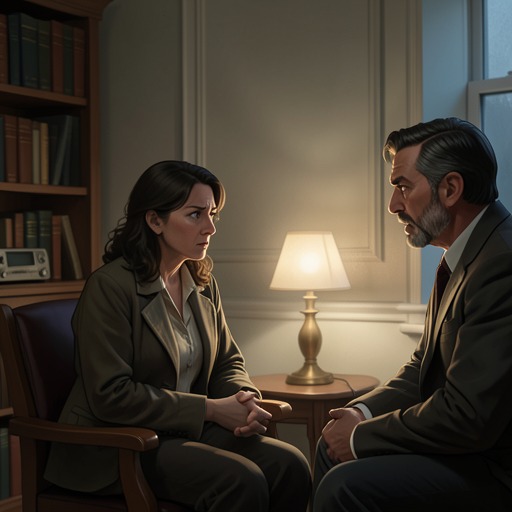
Visitors soon find that [Momo](entity:character-recall-character-momo-d421f1d5958c) is unusually good at listening. She offers neither brilliant advice nor showy entertainment; instead, she gives people her full attention until they begin to hear their own thoughts more clearly.
The worried grow surer, the lonely feel that they matter, and the discouraged recover hope. “Why not go and see Momo?” becomes a familiar recommendation among neighbourhood residents, marking her as the quiet centre of their community.
during Momo's early days in the neighbourhood
Salvatore and Nino Make Peace
Two neighbours arrive at the amphitheater furious with each other: [Salvatore](entity:character-recall-character-salvatore-ca9069804419), the bricklayer, and [Nino](entity:character-recall-character-nino-6aa3d722e1c2), the innkeeper. Their quarrel has grown out of jokes, a disputed deal over a picture of Saint Anthony, and their competing claims about who wronged whom first.
[Momo](entity:character-recall-character-momo-d421f1d5958c) listens while the men retrace the chain of grievances. Once they understand the original misunderstanding, anger gives way to laughter, and they embrace. Her attentive silence has helped them find their own way back to friendship.
another time during Momo's early years
The Canary Sings Again
A little boy brings [Momo](entity:character-recall-character-momo-d421f1d5958c) a canary that has stopped singing. She does not try to force the bird to perform or distract it with a trick; she sits and listens to it for a whole week.
At last the canary begins to trill and warble again. The episode extends Momo's gift beyond human conversation: she gives patient attention to animals, the weather, and the world around her.
one stormy afternoon
The Argo Expedition
on a hot day, the children gathered in the circular theater under thunderclouds, but could not start. after momo joined, the ruined arena became the research ship argo, with captain gordon, professor einstein, and a group of imaginative crew members, sailing toward dangerous seas. the
during Momo's early friendship with Beppo
Beppo's Slow Wisdom
[Beppo Roadsweeper](entity:character-recall-character-beppo-roadsweeper-9f80ee3bcba2) is a quiet, bent-backed street cleaner who takes a long time to answer because he wants to say nothing untrue. He believes haste is one source of the world's misfortunes, and [Momo](entity:character-recall-character-momo-d421f1d5958c) is one of the few people patient enough to understand him.
He explains that a long street should be swept one step, breath, and stroke at a time, not all at once. His maxim becomes a plainspoken answer to the panic that the [Men in Gray](entity:character-recall-character-men-in-gray-d820878af7dd) will later cultivate: attention to the present makes a difficult task bearable.
during Beppo's friendship with Momo
Beppo Recognizes the Stones
Beppo tells [Momo](entity:character-recall-character-momo-d421f1d5958c) that, in the heat of the day, the world can seem transparent, with other times visible beneath the present. He remembers a particular arrangement of stones in an old city wall and says he recognizes the people who placed them there.
In Beppo's vision, those people were Momo and himself in another age. Others dismiss his words as eccentric, but Momo treasures them, just as she treasures the patient attention that lets him speak.
during Momo's early years at the amphitheater
Guido's Tall Tales
[Guido Guide](entity:character-recall-character-guido-guide-54b0a22ddb7d), a quick-witted young man who invents stories for tourists, dreams of wealth and fame but dislikes steady work. [Momo](entity:character-recall-character-momo-d421f1d5958c)'s presence strengthens his imagination: when she listens, fresh stories seem to pour out of him, and audiences gather to hear them.
He spins extravagant histories about emperors, whales, and an imagined world built over the old one. The stories are deliberate inventions, but with Momo he also creates gentler fairy tales meant only for the two of them.
a warm evening before the gray men begin their campaign
The Magic Mirror
At [Momo](entity:character-recall-character-momo-d421f1d5958c)'s request, [Guido](entity:character-recall-character-guido-de4cf8e3f447) tells a fairy tale about Princess Momo, a magic mirror, and Prince Girolamo of [Futuria](entity:location-recall-location-4c51db713955). The princess leaves her palace to find him, while a wicked fairy's spell makes the prince forget who he is and sends him to [Presentia](entity:location-recall-location-1ebc8fa88cce) as a poor wanderer.
The tale ends with the two companions recognizing one another and finding their way back to the prince's kingdom. Beneath the invention lies a tender portrait of Momo and Guido's friendship, and of the dreams they share beneath the moon.
before the city's time-saving campaign begins
The Men in Gray Appear
While [Momo](entity:character-recall-character-momo-d421f1d5958c)'s friends go about their lives, the [Men in Gray](entity:character-recall-character-men-in-gray-d820878af7dd) begin to spread through the city. Their suits, cigars, briefcases, and limousines are visible, but they are so easy to overlook that people forget having seen them.
Momo catches sight of several gray figures observing the amphitheater. Their presence chills her, but the next day she has forgotten them too. Their invisibility to ordinary attention allows their quiet invasion to proceed.
as the time-saving campaign takes hold
Figaro's Recruitment
[Mr Figaro](entity:character-recall-character-mr-figaro-4afef1339665), a barber who enjoys his work and his conversations, falls into a gloomy mood and wonders whether his life is passing him by. A gray agent arrives at his shop and presents time as a bankable fortune, using elaborate arithmetic to label nearly everything he values as waste.
The agent urges him to save time by working faster, abandoning personal ties, and cutting out pleasures. He promises the [Timesaving Bank](entity:organization-recall-organization-timesaving-bank-7b2dcb7299db) will store the savings and multiply them, although no contract is signed and Figaro is never told where the time goes.
after the gray agent leaves Mr Figaro's shop
Figaro Becomes a Time-Saver
[Mr Figaro](entity:character-recall-character-mr-figaro-4afef1339665) forgets the gray agent but keeps the conviction that he must save time. He speeds through customers, hires assistants to increase output, and posts a slogan promising that saved time will double.
He sends his mother to an inexpensive old people's home, sells his budgerigar, and stops visiting Miss Daria. Though he follows the agent's advice, his days seem to disappear faster, and his supposed savings never leave him with time to spare.
as the gray men's campaign spreads
The City Turns to Time-Saving
More and more residents begin saving time. Advertisements urge them on, and neighbours follow suit because they feel they cannot afford to fall behind. Work becomes a contest in speed and output; conversation, daydreaming, and taking pleasure in life at an unhurried pace are all treated as waste.
The city changes along with its residents. Old buildings are replaced by uniform apartment blocks, and standardized streets stretch into the distance. People earn more and dress better, but grow impatient, lose their joy, and find it increasingly difficult to share time with one another.
after time-saving becomes widespread
Children Lose Their Elders
As adults become preoccupied with efficiency, children are left increasingly alone. Some receive expensive toys that offer little room for imagination; others are sent to the cinema or given recordings in place of companionship.
When children gather at the amphitheater, they describe parents who are absent, exhausted, or fighting at home. The newcomers' boredom and occasional disruptions make sense once [Momo](entity:character-recall-character-momo-d421f1d5958c) and her friends hear how neglected they feel.
after the time-saving campaign has taken hold
Momo Notices Her Friends' Absence
[Momo](entity:character-recall-character-momo-d421f1d5958c), [Guido Guide](entity:character-recall-character-guido-guide-54b0a22ddb7d), and [Beppo Roadsweeper](entity:character-recall-character-beppo-roadsweeper-9f80ee3bcba2) notice that their old neighbours visit less often. More children arrive at the amphitheater, but some bring radios or toys that leave little space for shared invention.
When [Guido](entity:character-recall-character-guido-de4cf8e3f447) asks the children about their homes, they reveal that their parents have little time for them. The children have also been told that Momo's circle wastes time and takes it from other people, a charge that turns the gray ideology into a threat against the community.
during the children's conversation at the amphitheater
The Friends Reject the Accusation
The children wonder whether [Momo](entity:character-recall-character-momo-d421f1d5958c), Beppo, and [Guido](entity:character-recall-character-guido-de4cf8e3f447) are really time-thieves. Beppo solemnly denies ever stealing even a second from anyone, and Momo and Guido join him in the promise.
Guido observes that people once came to Momo to understand themselves and listened to his stories for comfort, but no longer make time for either. He worries that the change is spreading, while Momo recognizes that their old friends need help.
in the days after the children describe their troubles
Momo Visits Salvatore
[Momo](entity:character-recall-character-momo-d421f1d5958c) goes to [Salvatore](entity:character-recall-character-salvatore-ca9069804419)'s lodging but finds that he is working long shifts on a new housing development. When he returns drunk in the small hours, he explains that the buildings are being erected too quickly and badly, leaving him ashamed of his work.
Salvatore promises to visit Momo and speak with her again, but he never comes. His weary confession shows how the drive to save time has stripped meaning from work he once took pride in.
during Momo's rounds of her old friends
Nino Changes Course
[Momo](entity:character-recall-character-momo-d421f1d5958c) finds [Nino](entity:character-recall-character-nino-6aa3d722e1c2) and [Liliana](entity:character-recall-character-liliana-d96e62d1baf8) arguing in their kitchen. Nino has driven away the old men who used to spend evenings at his inn because he hopes to attract more profitable customers, while Liliana protests that he has discarded kind and loyal patrons.
Nino admits that the inn feels cold without them. Momo listens, and he decides to apologize and invite the old men back. When he and Liliana later visit Momo, the inn feels welcoming to them again, despite Nino's fear that the business will never make him rich.
one hot afternoon after Momo revisits her neighbours
The Living Doll's Offer
[Momo](entity:character-recall-character-momo-d421f1d5958c) finds an elaborate doll that calls itself [Lola, the Living Doll](entity:object-recall-object-lola-the-living-doll-b4831e1f087d). Its mechanical phrases repeat that it belongs to Momo and wants new things, but it cannot respond to her attempts to play or converse.
A gray agent appears with clothes, accessories, and more dolls, promising an endless supply of possessions. Momo realizes that the abundance would not create a friend: she says she does not think anyone could love the doll and insists that she loves her real friends.
during Momo's encounter with the gray agent
The Agent Reveals the Bank's Secret
The agent tries to persuade [Momo](entity:character-recall-character-momo-d421f1d5958c) that she harms her friends by distracting them from success. Momo struggles to understand him but asks whether anyone loves him, and the question breaks through his guarded manner.
Against his will, he reveals that the [Timesaving Bank](entity:organization-recall-organization-timesaving-bank-7b2dcb7299db)'s agents remain unnoticed and drain away the time people save. They hoard it and need ever more of it. Realizing that Momo has heard the truth, he panics, retrieves the doll and its belongings, and flees.
the day Momo tells Beppo and Guido about the agent
A Plan to Tell the City
[Guido](entity:character-recall-character-guido-de4cf8e3f447) hears [Momo](entity:character-recall-character-momo-d421f1d5958c)'s account and immediately imagines a campaign to expose the time-thieves. Beppo believes her too, but warns that provoking the [Men in Gray](entity:character-recall-character-men-in-gray-d820878af7dd) could put Momo and the children in danger.
The friends summon children to a council at the amphitheater. Despite Beppo's concern, the children agree to take part, and Guido proposes a public demonstration to tell the whole city about the bank's theft of time.
the Sunday after the children's war council
The Children's Demonstration
Children make banners, posters, and a long warning song, then march through the streets with [Momo](entity:character-recall-character-momo-d421f1d5958c), Beppo, and [Guido](entity:character-recall-character-guido-de4cf8e3f447). More youngsters join as the procession passes, and the children urge adults to attend a meeting at the amphitheater.
The police sometimes break up the march for obstructing traffic, but the children regroup and continue. They do not see the [Men in Gray](entity:character-recall-character-men-in-gray-d820878af7dd), and the adults they hope to reach remain caught in their routines.
the following Sunday evening
The Empty Meeting
Hundreds of children wait at the amphitheater for the city's adults, but no one arrives. As darkness falls, the children leave, disappointed that their warning has gone unheard.
Beppo must report for an unexpected night shift at the municipal garbage dump, and [Guido](entity:character-recall-character-guido-de4cf8e3f447) has to begin work as a night watchman. [Momo](entity:character-recall-character-momo-d421f1d5958c) stays behind, feeling the failure of their plan as something far more serious than a game.
that night after the failed meeting
The Trial at the Garbage Dump
At the [Municipal Garbage Dump](entity:location-recall-location-2e3771e14583), Beppo dozes after exhausting work and wakes to find a tribunal of gray agents judging Agent No. BLW/553/c. The agent admits he spoke to [Momo](entity:character-recall-character-momo-d421f1d5958c) and disclosed the bank's secrets, claiming her listening drew the truth from him.
The judges condemn him for treason and deprive him of all time. Without his cigar, he becomes transparent and disappears into ash. Beppo now knows that the [Men in Gray](entity:character-recall-character-men-in-gray-d820878af7dd) are real and that their threat to Momo is immediate.
the same night as the trial
Cassiopeia Leads Momo Away
While [Momo](entity:character-recall-character-momo-d421f1d5958c) waits alone at the amphitheater, a tortoise approaches and displays the words “FOLLOW ME” on its shell. The girl follows it into the night without knowing where it is taking her.
The tortoise guides her through a city that is still crowded and brightly lit long after dark. Its uncanny timing lets them move among cars and pedestrians without being struck or delayed.
that night and into the early morning
The Search for Momo
Beppo reaches the amphitheater after hearing the tribunal's threat but finds [Momo](entity:character-recall-character-momo-d421f1d5958c) gone and her room ransacked. He finds [Guido](entity:character-recall-character-guido-de4cf8e3f447) at the junkyard and tells him what he witnessed; Guido, shaken for the first time, cannot dismiss the gray agents as part of a story.
The [Timesaving Bank](entity:organization-recall-organization-timesaving-bank-7b2dcb7299db) orders a citywide manhunt, and agents scour streets, sewers, stations, and rooftops. Meanwhile, [Cassiopeia](entity:character-recall-character-cassiopeia-25fac90123fe) steers Momo through the city and warns her to stay quiet when pursuers pass nearby.
before dawn during Momo's escape
The District of White Houses
[Cassiopeia](entity:character-recall-character-cassiopeia-25fac90123fe) leads [Momo](entity:character-recall-character-momo-d421f1d5958c) into an eerie district of white buildings, black windows, and a strange light that casts shadows in every direction. At its centre, Momo finds [Never Lane](entity:location-recall-location-never-lane-2e785e4c3bed) and the ornate entrance to [Nowhere House](entity:location-recall-location-nowhere-house-e6abedb75fae).
The lane's current drives her backward when she tries to move forward. Following Cassiopeia's instruction, she walks backward instead and reaches the house, passing through its bronze door before it closes behind her.
at the end of the night journey
Momo Meets Professor Hora
Inside [Nowhere House](entity:location-recall-location-nowhere-house-e6abedb75fae), [Momo](entity:character-recall-character-momo-d421f1d5958c) enters an immense hall filled with clocks, where [Professor Secundus Minutus Hora](entity:character-recall-character-professor-secundus-d69631b04d7e) greets her and identifies [Cassiopeia](entity:character-recall-character-cassiopeia-25fac90123fe) as the guide who brought her. He explains that he expected Momo and serves as custodian of human time.
The professor says he sent Cassiopeia to protect Momo from the [Men in Gray](entity:character-recall-character-men-in-gray-d820878af7dd). With his [Omnivision Glasses](entity:object-recall-object-07bad595cdef), he can watch the city without leaving the house, and he explains that the gray agents exist by feeding on time people surrender.
during Momo's first visit to Nowhere House
The Riddle of Three Brothers
[Professor Hora](entity:character-recall-character-professor-hora-8ad119a92121) challenges [Momo](entity:character-recall-character-momo-d421f1d5958c) with a riddle about three brothers who resemble one another, live together, and rule an infinite kingdom. Momo reasons that they are the future, the past, and the present, which together make time.
She concludes that the brothers' home is the world. The riddle makes her think about time as more than a measurement on clocks: it is a whole in which past, present, and future depend on one another.
later during Momo's first visit to Nowhere House
The Music of the Stars
[Momo](entity:character-recall-character-momo-d421f1d5958c) asks what time itself is, and [Professor Hora](entity:character-recall-character-professor-hora-8ad119a92121) invites her to witness its source on the condition that she remain silent. He carries her beneath a golden dome to a dark lake where a pendulum's passage summons brilliant hour-lilies that bloom and fade.
The flowers are accompanied by the [Music of the Stars](entity:expression-recall-expression-music-of-the-stars-f15f9681c97a), whose voices name the sun, moon, planets, and stars. Momo senses that the spectacle is taking place in the depths of her own heart and understands that each person's time is singular and beautiful.
the dawn after her night with Professor Hora
Momo's Year of Waiting Begins
[Momo](entity:character-recall-character-momo-d421f1d5958c) wakes on the amphitheater steps with vivid memories of the clocks, the professor, and the hour-lilies. She discovers that the tortoise is [Cassiopeia](entity:character-recall-character-cassiopeia-25fac90123fe), who confirms through messages on her shell that they returned by choice.
The songs and words of the stars continue to rise within Momo, but she does not know that the experience has taken a year and a day. She waits happily for her friends, expecting them to appear at any moment.
during the year Momo is away
Guido's Fame and Decline
While [Momo](entity:character-recall-character-momo-d421f1d5958c) is gone, publicity turns [Guido Guide](entity:character-recall-character-guido-guide-54b0a22ddb7d) into a tourist attraction and then a radio and television celebrity. He moves to [Green Hill](entity:location-recall-location-green-hill-70e9d609a110), calls himself Girolamo, and earns enough money to realize his old ambitions.
Without Momo's listening, however, his imagination falters. Under pressure to produce more stories, he repeats and repackages his old material until he feels like a fraud, rich and famous but cut off from the person and way of life that once made his stories alive.
late in Momo's year away
The Gray Men Silence Guido
When [Guido](entity:character-recall-character-guido-de4cf8e3f447) resolves to expose the [Men in Gray](entity:character-recall-character-men-in-gray-d820878af7dd) and search publicly for [Momo](entity:character-recall-character-momo-d421f1d5958c), a gray voice phones to warn him off. It tells him that his fame is their doing and threatens to withdraw the support that sustains his career.
Guido abandons his plan and continues performing, ashamed of the stories he tells. His success has become another means of keeping him occupied and compliant, while the people who might have helped Momo are left in ignorance.
after Momo disappears
Beppo's Ransom Bargain
Unable to accept that [Momo](entity:character-recall-character-momo-d421f1d5958c) may be lost, Beppo searches for her and tells the police about the [Men in Gray](entity:character-recall-character-men-in-gray-d820878af7dd). The authorities do not believe him; after repeated attempts to report the matter, he is sent to a hospital for nervous disorders.
A gray agent visits Beppo there and claims that Momo is a prisoner. He offers to return her if Beppo saves a hundred thousand hours and keeps silent. Beppo agrees, then leaves the hospital and begins sweeping day and night to earn the ransom.
during Momo's year away
The Children Are Sent Away
The [Men in Gray](entity:character-recall-character-men-in-gray-d820878af7dd) encourage adults to treat unsupervised children as a public problem. Authorities establish [Child Depots](entity:organization-recall-organization-child-depots-43161d7525fa), where children are sent if their parents cannot look after them and where independent play is forbidden.
[Momo](entity:character-recall-character-momo-d421f1d5958c)'s young friends are separated by district and given approved, supposedly useful activities instead of games of their own invention. They become sullen and lose the habit of dreaming, leaving the amphitheater silent and making Momo's eventual return more painful.
one year and one day after leaving with Cassiopeia
Momo Returns to the Amphitheater
[Momo](entity:character-recall-character-momo-d421f1d5958c) waits all day for her friends, then asks [Cassiopeia](entity:character-recall-character-cassiopeia-25fac90123fe) why no one has come. The tortoise tells her that everyone is gone and that a year and a day has passed; Momo must face the fact that her friends' absence belongs to the past.
In her dusty room she finds a letter from [Guido](entity:character-recall-character-guido-de4cf8e3f447), written before he gave up searching. He says he misses her and leaves instructions for her to eat at [Nino](entity:character-recall-character-nino-6aa3d722e1c2)'s. The letter offers comfort, though Momo does not know how long it has been waiting.
the day after Momo returns
Nino's Fast-Food Restaurant
[Momo](entity:character-recall-character-momo-d421f1d5958c) goes looking for [Nino](entity:character-recall-character-nino-6aa3d722e1c2) and finds his old tavern replaced by [Nino's Inn](entity:location-recall-location-nino-s-inn-8f7434b29ce2)'s fast-food restaurant, crowded with hurried customers and no chairs. Nino is pleased to see her but can barely speak over the demands of the queue.
As Momo returns to the line, she learns that [Guido](entity:character-recall-character-guido-de4cf8e3f447) has become famous, Beppo was taken to a hospital, and children without care are placed in [Child Depots](entity:organization-recall-organization-child-depots-43161d7525fa). She eats three hurried meals while trying to get answers, yet leaves feeling emptier than when she arrived.
the next morning
Momo Reunites with Guido
[Momo](entity:character-recall-character-momo-d421f1d5958c) walks to [Green Hill](entity:location-recall-location-green-hill-70e9d609a110) and waits outside [Guido](entity:character-recall-character-guido-de4cf8e3f447)'s secluded house. When his car bursts through the gate, he recognizes her and embraces her, asking at once where she has been and what happened.
His secretaries interrupt with publicity and career plans, and the reunion becomes another hurried appointment. Guido admits that he is exhausted and unhappy, then asks Momo to travel with him and listen so that he might recover his old gift for stories. Momo refuses because she knows she cannot help by giving up her own life.
immediately after the airport reunion
Momo Loses Cassiopeia
After [Guido](entity:character-recall-character-guido-de4cf8e3f447) is hurried onto his flight, [Momo](entity:character-recall-character-momo-d421f1d5958c) realizes that [Cassiopeia](entity:character-recall-character-cassiopeia-25fac90123fe) is missing. She searches outside Guido's house and along the road, but the tortoise is nowhere to be found.
Momo returns alone to the amphitheater. For the first time, she has no friend beside her and no way to know whether waiting or continuing the search is more likely to bring Beppo back to her.
in the months after her return
Momo's Lonely Search
[Momo](entity:character-recall-character-momo-d421f1d5958c) searches the city for Beppo and the children, often waiting at places where she thinks she might cross their paths. She sometimes sees a distant sweeper who resembles Beppo but never catches up with him, and she writes “I'M BACK” on her room's wall in case he comes by.
The memories of the hour-lilies and their music remain vivid, but Momo has no one with whom to share them. Her solitude becomes so heavy that even the treasures within her seem capable of crushing her.
months after the return
Momo Finds Her Old Friends
[Momo](entity:character-recall-character-momo-d421f1d5958c) encounters Paolo, Franco, and Maria in gray uniforms, their expressions stiff and their old playfulness subdued. They explain that they are going to a play class at a Child Depot, where they learn organized games designed to be useful.
They remember that playing with Momo was more enjoyable, but say they are not allowed to waste time. Before Momo can persuade them to return, the children are swept inside the depot and its gates close, exposing the loneliness the new system has imposed on them.
outside the Child Depot
The Gray Agent's Bargain
As [Momo](entity:character-recall-character-momo-d421f1d5958c) approaches the depot, a gray agent appears and tells her that she cannot join the children. He says the [Men in Gray](entity:character-recall-character-men-in-gray-d820878af7dd) have other plans for her and promises to discuss a favour at midnight.
Momo agrees because she is frightened and desperate to help her friends, but the agent gives no meeting place. His offer leaves her alone with the knowledge that the Men in Gray have taken control of the people she loves.
that night at midnight
The Midnight Square
Afraid to wait for the agent at the amphitheater, [Momo](entity:character-recall-character-momo-d421f1d5958c) spends the evening walking crowded streets, hoping that other people will protect her. Exhausted, she falls asleep on a delivery truck and wakes as it carries her to a deserted part of the city.
Remembering her dreams of Beppo, [Guido](entity:character-recall-character-guido-de4cf8e3f447), and the children in distress, she decides to stop running from danger. She calls into the darkness, and headlights begin converging from every street toward the square where she stands.
the midnight meeting in the square
Momo Rejects the Gray Men's Deal
The [Men in Gray](entity:character-recall-character-men-in-gray-d820878af7dd) surround [Momo](entity:character-recall-character-momo-d421f1d5958c) with their cars and tell her that her friends are isolated and that she herself is alone. They offer to return everyone to her if she will lead them to [Professor Hora](entity:character-recall-character-professor-hora-8ad119a92121).
Momo asks why they want the professor and learns that they intend to seize all the time he distributes. She refuses the bargain, explaining that she cannot find the way without [Cassiopeia](entity:character-recall-character-cassiopeia-25fac90123fe), whom she believes she has lost. The gray agents leave to search for the tortoise.
shortly after the meeting in the square
Cassiopeia Returns
After the [Men in Gray](entity:character-recall-character-men-in-gray-d820878af7dd) disappear, [Momo](entity:character-recall-character-momo-d421f1d5958c) stands in the cold, believing there is no hope for her friends. [Cassiopeia](entity:character-recall-character-cassiopeia-25fac90123fe) nudges her foot and spells out that she has come back.
Momo hides the tortoise under her jacket and tells her what happened. Cassiopeia directs her to go to [Professor Hora](entity:character-recall-character-professor-hora-8ad119a92121), assuring her that they will not meet anyone on the way. Despite her exhaustion and the danger, Momo follows the tortoise toward [Never Lane](entity:location-recall-location-never-lane-2e785e4c3bed).
during the journey back to Nowhere House
The Gray Men Follow
The [Men in Gray](entity:character-recall-character-men-in-gray-d820878af7dd) secretly follow [Momo](entity:character-recall-character-momo-d421f1d5958c) and [Cassiopeia](entity:character-recall-character-cassiopeia-25fac90123fe), deciding not to seize the tortoise because it is leading them to [Professor Hora](entity:character-recall-character-professor-hora-8ad119a92121). The pursuers use their knowledge of the district to move more slowly than the pair and gradually close the distance.
Momo reaches [Never Lane](entity:location-recall-location-never-lane-2e785e4c3bed) first and walks backward as she did before, but the gray agents fill the street behind her. They vanish as they try to enter the lane, while the others stop at its threshold. Momo escapes into [Nowhere House](entity:location-recall-location-nowhere-house-e6abedb75fae), unaware how close the danger has come.
after Momo reaches Nowhere House
The House Comes Under Siege
[Professor Hora](entity:character-recall-character-professor-hora-8ad119a92121) tells [Momo](entity:character-recall-character-momo-d421f1d5958c) that the [Men in Gray](entity:character-recall-character-men-in-gray-d820878af7dd) have surrounded the district but cannot enter [Never Lane](entity:location-recall-location-never-lane-2e785e4c3bed). He explains that time flows backward there, and because the agents consist only of stolen time, the reverse current makes them disappear.
Through the [Omnivision Glasses](entity:object-recall-object-07bad595cdef), Momo sees gray cigar smoke gathering into a fog around the house. Professor Hora warns that the agents can poison the time he sends to people, bringing on a fatal condition called deadly tedium.
during the siege
The Gray Men Depend on Dead Time
[Professor Hora](entity:character-recall-character-professor-hora-8ad119a92121) explains that the [Men in Gray](entity:character-recall-character-men-in-gray-d820878af7dd) preserve stolen hour-lilies in a vast underground cold store. They dry the flowers' petals and roll them into cigars, then smoke the dead time to sustain their own existence.
Their cigar smoke, he says, can contaminate the living time he distributes and make people cold and indifferent. Unless the siege is broken, the whole world may fall to deadly tedium, and the Men in Gray will eventually demand every hour in Hora's care.
near the end of the siege
Hora Entrusts Momo with a Plan
[Professor Hora](entity:character-recall-character-professor-hora-8ad119a92121) asks [Momo](entity:character-recall-character-momo-d421f1d5958c) to help him stop the threat. He can halt time, but if he does, he will fall asleep and cannot wake until the stolen time is returned. Momo will have one hour-lily, giving her an hour to act while the rest of the world stands still.
She must follow the [Men in Gray](entity:character-recall-character-men-in-gray-d820878af7dd) to their store, prevent them from replenishing their cigars, and release the stolen time before her flower fades. Momo is frightened by the responsibility, but agrees; [Cassiopeia](entity:character-recall-character-cassiopeia-25fac90123fe) volunteers to go with her.
immediately after Hora leaves
Time Stops
After [Professor Hora](entity:character-recall-character-professor-hora-8ad119a92121) departs to sleep, [Momo](entity:character-recall-character-momo-d421f1d5958c) opens the small door bearing his name and the bronze door to [Never Lane](entity:location-recall-location-never-lane-2e785e4c3bed), as instructed. A strange timequake passes through the house, and every clock stops; the world falls silent and motionless.
An hour-lily appears in Momo's hand, while she and [Cassiopeia](entity:character-recall-character-cassiopeia-25fac90123fe) remain able to move. The [Men in Gray](entity:character-recall-character-men-in-gray-d820878af7dd), who had been kept out by Never Lane's reverse flow, now stream into the house and realize that their supply of time has stopped.
within minutes of time stopping
The Gray Men Flee the House
Inside the great clock hall, the [Men in Gray](entity:character-recall-character-men-in-gray-d820878af7dd) discover that the clocks, even the sand in an hourglass, have stopped. They learn that the whole world is motionless and their supply of time has been cut off.
Panic breaks out as the agents argue over their dwindling cigars. Some lose their cigars in the crush and vanish, while the survivors rush out toward their secret store. [Momo](entity:character-recall-character-momo-d421f1d5958c) follows with [Cassiopeia](entity:character-recall-character-cassiopeia-25fac90123fe) and her hour-lily, trying to keep the fugitives in sight.
during the stopped hour
The Chase Through the Frozen City
[Momo](entity:character-recall-character-momo-d421f1d5958c) pursues the [Men in Gray](entity:character-recall-character-men-in-gray-d820878af7dd) through a city frozen in the instant of time stopping. Cars, pedestrians, pigeons, falling leaves, and even water from fountains hang motionless; only the agents, Momo, and [Cassiopeia](entity:character-recall-character-cassiopeia-25fac90123fe) can move.
As the fugitives run, they fight over cigars and lose more members to exhaustion and desperation. Momo glimpses Beppo standing frozen at work but cannot wake him, and she forces herself onward, knowing that the hour-lily is already flowering and fading.
later in the stopped hour
The Time Warehouse
The pursuit leads [Momo](entity:character-recall-character-momo-d421f1d5958c) to a construction pit and down a pipe into the underground passages beneath the housing development. She reaches a vast chamber where the surviving [Men in Gray](entity:character-recall-character-men-in-gray-d820878af7dd) have gathered beside a huge steel door.
Behind the door lies their cold store, filled with stolen hour-lilies. With their cigars running short, the agents begin eliminating one another by lot, hoping to conserve their reserves. The opened door lets the cold escape, threatening to thaw the flowers and return them to their owners even if the agents survive.
near the end of the stopped hour
Momo Shuts the Cold-Store Door
[Cassiopeia](entity:character-recall-character-cassiopeia-25fac90123fe) tells [Momo](entity:character-recall-character-momo-d421f1d5958c) to use her hour-lily to close the open steel door. Momo slips beneath the conference table, touches the door with the flower, and pushes it shut, sealing the cold store.
The agents realize that Momo can move while time is stopped and pursue her through the tunnels. Cassiopeia repeatedly blocks their path by crawling to places where she knows they will pass, buying Momo time as the hour-lily dwindles to a few petals.
at the end of the stopped hour
The Last Gray Agents Disappear
The final two [Men in Gray](entity:character-recall-character-men-in-gray-d820878af7dd) corner [Momo](entity:character-recall-character-momo-d421f1d5958c) and reach for her flower. Instead of sharing it, they fight over who will possess it; one knocks the other's cigar away, and that agent vanishes.
The last agent begs Momo for the hour-lily, but she refuses. His own cigar goes out, and he disappears too. With the agents gone, Momo touches the steel door with the nearly spent flower and opens the cold store.
at the final moment of Momo's hour
The Stolen Hours Return
Inside the warehouse, the stolen hour-lilies warm and rise from their shelves in a vast swirling cloud. [Momo](entity:character-recall-character-momo-d421f1d5958c)'s own flower loses its last petal as the captured time streams away from the vault and returns to the human hearts to which it belongs.
The wave of flowers carries Momo above the city, and [Cassiopeia](entity:character-recall-character-cassiopeia-25fac90123fe) tells her to fly home. As the stolen time returns, the world begins to move again, and [Professor Hora](entity:character-recall-character-professor-hora-8ad119a92121) wakes from his first sleep.
the moment time resumes
The City Wakes Again
Traffic resumes, pigeons circle, water runs, and the city's people continue their interrupted actions without realizing that an hour has passed. They suddenly have time to spare, though they do not understand that their own stolen time has been restored.
Work becomes more careful and humane, neighbours stop to talk, and children play in the streets while drivers wait or join them. The change is not a new supply of time but a return to the human lives from which it had been taken.
as time resumes
Momo Finds Beppo Again
[Momo](entity:character-recall-character-momo-d421f1d5958c) comes to in the street where she last saw Beppo, who is leaning on his broom without the frantic haste that had consumed him. He wonders whether he has finally saved enough time to ransom her, unaware that the gray agents are gone.
Momo tugs his jacket, and the two friends recognize one another. Their reunion breaks into laughter, tears, and excited conversation, while passers-by pause to share their joy.
later that day
The Friends Return to the Amphitheater
[Momo](entity:character-recall-character-momo-d421f1d5958c) and Beppo walk back to the amphitheater, where [Guido](entity:character-recall-character-guido-de4cf8e3f447), the children, [Nino](entity:character-recall-character-nino-6aa3d722e1c2), [Liliana](entity:character-recall-character-liliana-d96e62d1baf8), [Salvatore](entity:character-recall-character-salvatore-ca9069804419), and the other old neighbours are waiting. Everyone who had been scattered or confined is together again.
The friends celebrate until the stars appear. Their restored gathering shows that the time stolen from their relationships has returned with the hour-lilies, and the old community can begin to live together again.
the evening after time resumes
Momo Sings to Her Friends
When the celebration quiets, [Momo](entity:character-recall-character-momo-d421f1d5958c) steps into the arena and sings the melodies she has carried within her since visiting the golden dome. Her friends listen as the stars emerge overhead.
The song gives the gathered community a glimpse of the music and beauty Momo witnessed in the depths of her heart. It closes the story on an act of shared attention rather than a speech about what has been won.
after the friends' reunion
Cassiopeia and Professor Hora
At [Nowhere House](entity:location-recall-location-nowhere-house-e6abedb75fae), [Professor Hora](entity:character-recall-character-professor-hora-8ad119a92121) watches [Momo](entity:character-recall-character-momo-d421f1d5958c) and her friends through his [Omnivision Glasses](entity:object-recall-object-07bad595cdef), glad that time has returned and the crisis has passed. [Cassiopeia](entity:character-recall-character-cassiopeia-25fac90123fe) appears and tells him she will explain everything later.
The tortoise has caught cold after the chase and goes to find a quiet place to sleep. As she settles down, her shell spells a final message visible only to those who have read the story, leaving the ending gently open.
after the events of Momo's story
The Traveller's Postscript
The narrator says that the story came to him from a remarkable fellow passenger on a long train journey. He never met [Momo](entity:character-recall-character-momo-d421f1d5958c) or her friends and cannot say what became of them or identify their city with certainty.
Before leaving the train, the stranger observed that the events could just as easily be told as future events as past ones. The narrator is left with questions of his own, echoing the book's sense that time does not fit neatly inside a clock or a single telling.