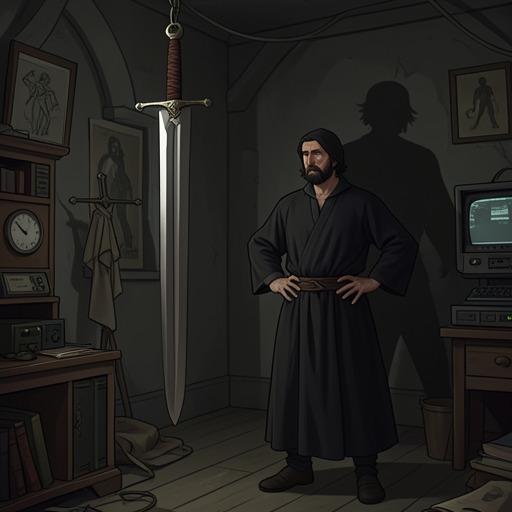
Lu Ting-Pin—Yellow Peony
MulanLu Ting-Pin—Yellow Peony is a relationship shaped first by forbidden love and secrecy, then by separation and consequences borne most heavily by their daughter. Lu’s later account recognizes that his devotion did not excuse his choices: by concealing the marriage and trying to keep Yellow Peony apart from the world, he injured her independence and helped create a family history of shame and rejection.
Love, Marriage, and Secrecy
Lu says that he fell in love with Yellow Peony at a glance. Although they both understood that the relationship was wrong, Lu alone knew that it was forbidden by the moral code of the Eight Immortals. He nevertheless pursued it, breaking that code. His account presents the beginning of their bond as immediate, but the decisive choice to hide it—and the means he used to do so—belonged to him.
They married in secret. Lu used his powers to conceal the relationship, while his explanations for his absences grew increasingly implausible to the seven other Immortals. The lake he created around the home he shared with Yellow Peony ultimately exposed the deception. He had not made it merely as a setting for their life together: he placed it there so that others could not reach the house, imagining that he could keep Yellow Peony secluded and accessible only to himself. The lake thus embodies the contradiction at the center of the relationship. Lu’s effort to protect their secrecy also restricted her connection to the world and made his conduct visible to the Immortals.
Judgment and Separation
When the seven Immortals investigated the unfamiliar lake, they discovered Lu’s lies and learned of the marriage. Their response ended the couple’s private life together. They removed many of Lu’s powers, imposed a penance, and forbade him both to see Yellow Peony and to interfere in her life again. Lu describes the judgment as painful, but his account does not treat his own suffering as the principal measure of the harm. He acknowledges that he had no right to take Yellow Peony out of the world or to treat her as something to be kept for himself.
That recognition marks an important distinction between loving Yellow Peony and respecting her as a person. Lu had acted as though secrecy and seclusion could preserve their relationship; later, he understands that Yellow Peony had thoughts and a destiny of her own. The order barring him from her life was therefore not only a punishment. In his retrospective account, it also enforced a boundary he had violated by making decisions for her and limiting her freedom.
Their Daughter and the Lasting Harm
After the marriage was exposed, Yellow Peony gave birth to their daughter. The relationship brought disgrace in the eyes of those around them, and the Immortals arranged for Yellow Peony to move to another town and adopt a different identity. The marriage was dissolved after the child’s birth. Yellow Peony later remarried and began another family, while Lu remained separated from her under the terms of his penance.
Their daughter’s place in this new life was painful. Lu says that Yellow Peony could not bear to look at her eldest daughter because the child reminded her of the secret marriage, the betrayal, and the dishonor attached to it. The anger and resentment fell on the child, although Lu believes they should have been directed at him. He names this consequence as his gravest transgression: his actions contributed to a mother’s rejection of her innocent daughter. The girl became known as the Unwanted Girl, a name that carries the consequences of the adults’ choices into the next generation.
The account does not make Lu’s penance an answer to that harm. He believes that even its completion could not undo what his daughter endured. His remorse therefore centers not only on losing Yellow Peony, but on recognizing how the relationship’s secrecy and public aftermath shaped the child’s life. Their daughter’s suffering is the lasting consequence that Lu cannot repair simply by accepting punishment.
The Later Confrontation
Later, as Lu faces Daji, Daji takes on Yellow Peony’s appearance and addresses him as the woman he once called his beloved. The scene is an impersonation, not a reunion with Yellow Peony: Daji’s face changes, and the Red Fox watches her. Speaking in Yellow Peony’s likeness, Daji accuses Lu of abandoning her and their child, bringing shame upon her family, and leaving her with resentment that turned against their daughter.
The confrontation gives voice to the costs Lu has already admitted, while sharpening the question of responsibility. Lu’s earlier confession describes his attempt to conceal the marriage, the Immortals’ intervention, and the daughter’s rejection; Daji’s performance recasts those consequences as accusations addressed directly to him. Her words are spoken through a false likeness, so the scene should not be mistaken for evidence that Yellow Peony herself has returned. Its force instead comes from the way the disguise makes Lu face the human consequences of his past choices at the moment he is confronted by Daji.
Significance of the Relationship
The relationship is not presented as a forbidden romance redeemed by the sincerity of Lu’s feelings. His love begins quickly, but it does not prevent him from concealing the marriage or trying to isolate Yellow Peony. His later account instead measures love against the other person’s autonomy: Yellow Peony was not a possession to hide, and their daughter was not responsible for the disgrace attached to her birth.
Their story also links private decisions to consequences that spread beyond the couple. Lu’s breach of the Eight Immortals’ code brings judgment and separation; the shame surrounding the marriage alters Yellow Peony’s life; and the daughter bears the resentment generated by that history. Lu can acknowledge his part and express lasting shame, but the relationship’s defining aftermath remains the pain he recognizes and cannot make right.